Geometry Algebraic Proof Worksheets
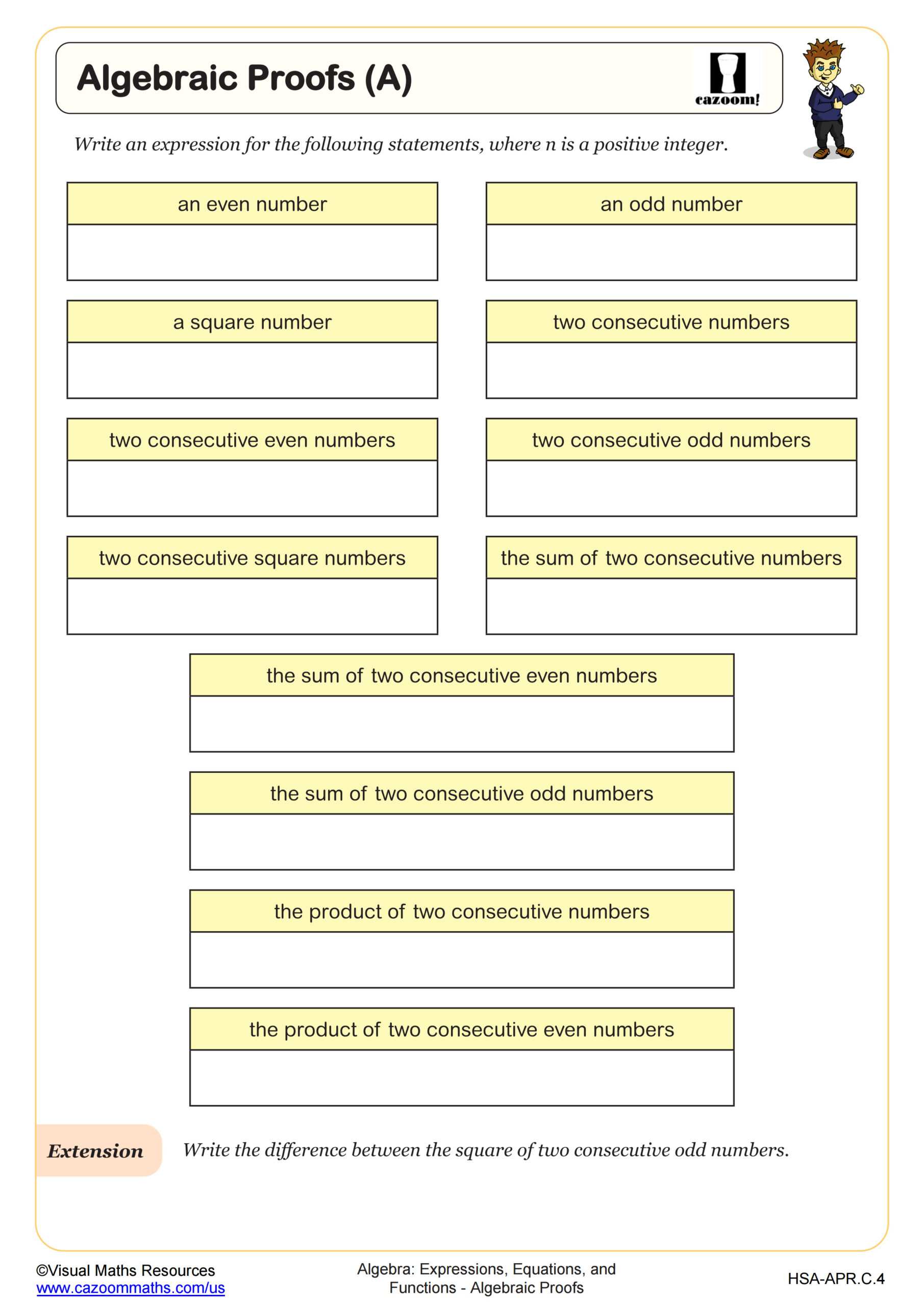
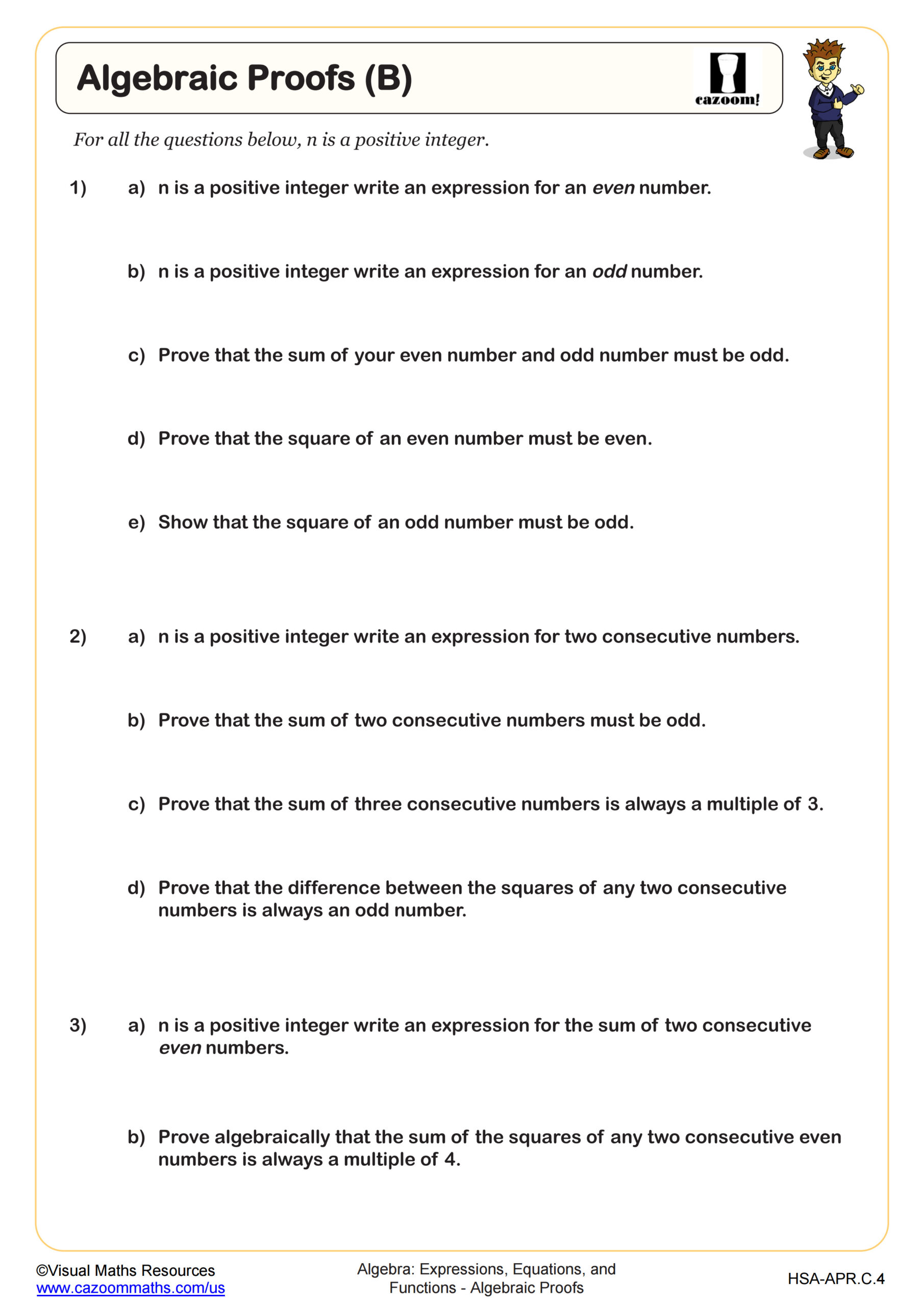
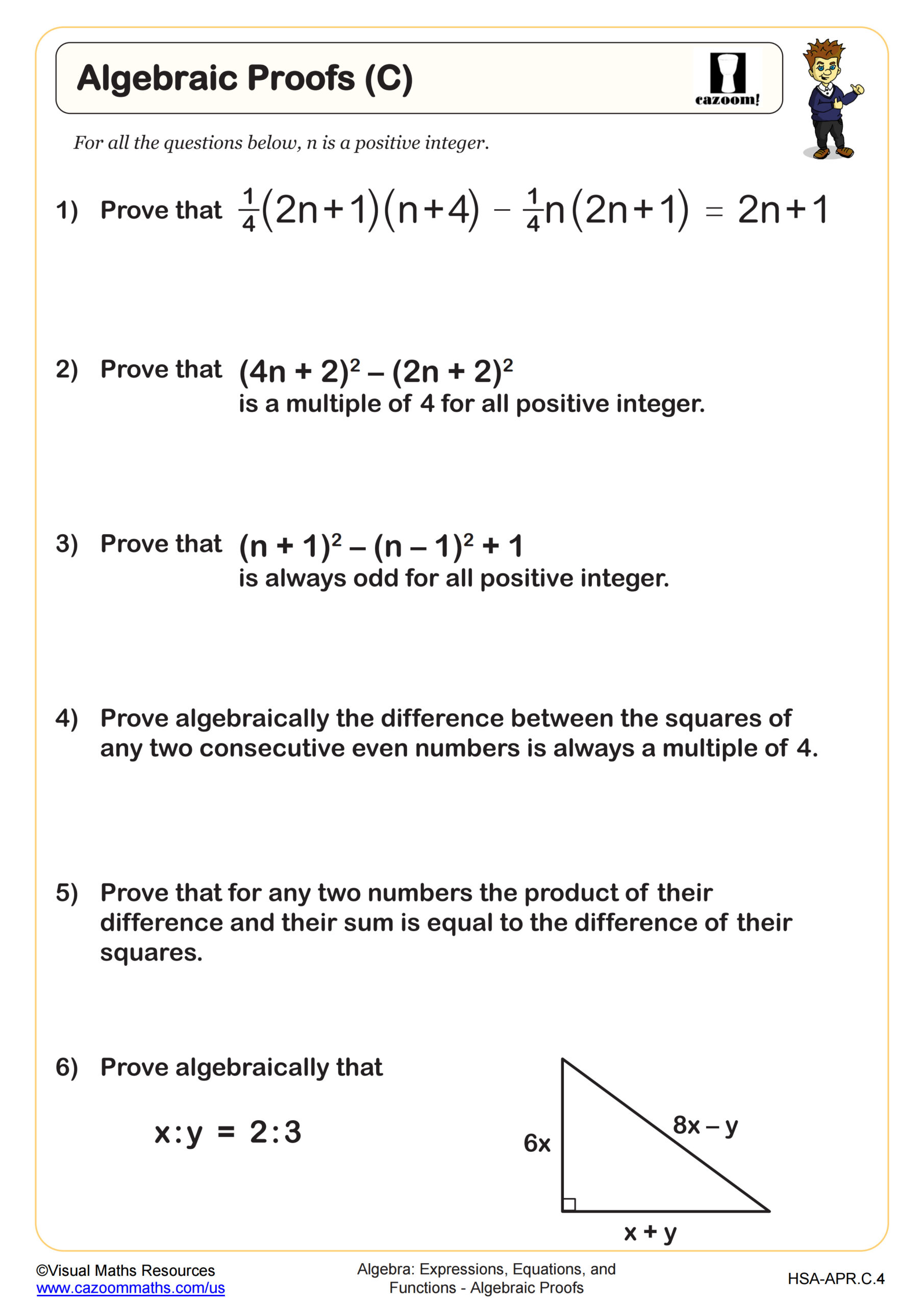
All worksheets are created by the team of experienced teachers at Cazoom Math.
What Are Algebraic Proofs in Geometry?
Algebraic proofs in geometry use properties of equality, operations, and algebraic manipulation to verify mathematical statements and solve for unknown values. Unlike purely geometric proofs that rely on postulates about shapes and angles, algebraic proofs justify each step using familiar properties like the addition property of equality, distributive property, substitution, or transitive property. High school geometry students encounter these proofs when working with segment addition, angle relationships, and equations derived from geometric diagrams.
A common error occurs when students write correct algebraic steps but fail to name the property that justifies each transformation. On standardized tests and classroom assessments, students lose points not for incorrect arithmetic but for incomplete justification. Teachers consistently observe that students need explicit practice identifying whether they applied the reflexive property, symmetric property, or another specific algebraic principle at each stage of their reasoning.
Which Grade Levels Learn Algebraic Proofs?
These algebraic proof worksheets target high school geometry students, typically in grades 9-10, though some advanced 8th graders or students in honors courses may encounter this material earlier. Algebraic proofs appear as a foundational skill in the geometry curriculum, usually introduced in the first semester before students tackle more complex geometric proofs involving triangles, quadrilaterals, and circles. The topic aligns with Common Core State Standards that require students to construct viable arguments and critique the reasoning of others.
Within the geometry course, algebraic proofs serve as scaffolding for increasingly sophisticated reasoning. Students begin with straightforward one-variable equations requiring three or four steps, then progress to multi-step proofs involving substitution across multiple equations. The three-level progression in these worksheets reflects how teachers sequence instruction: basic property identification, then application of multiple properties in sequence, and finally construction of complete proofs with minimal prompting.
How Do Properties of Equality Work in Algebraic Proofs?
Properties of equality form the logical foundation for algebraic proofs by explaining what operations preserve equality between expressions. The addition and subtraction properties of equality state that adding or subtracting the same value from both sides maintains the equation. The multiplication and division properties work similarly for multiplication and division by non-zero values. The reflexive property (a = a), symmetric property (if a = b, then b = a), and transitive property (if a = b and b = c, then a = c) establish fundamental relationships students reference throughout proofs.
Engineers and computer programmers rely on these properties when verifying that algorithms produce correct outputs. When a software engineer debugs code that calculates distances, areas, or structural loads, they trace through each transformation of an equation to verify correctness—essentially constructing an algebraic proof. Understanding why each step in a calculation is mathematically valid prevents errors in fields ranging from aerospace design to financial modeling, where a single unjustified assumption can lead to catastrophic failures or incorrect predictions.
How Can Teachers Use These Algebraic Proof Worksheets?
These worksheets provide graduated practice that moves students from identifying properties to constructing complete proofs independently. Each worksheet presents problems in a consistent two-column format that mirrors what students see on state assessments and standardized tests. The answer keys show both the algebraic steps and the corresponding justifications, giving students clear models of proper proof structure. Teachers value this format because it eliminates ambiguity about expectations and helps students internalize the connection between mathematical operations and logical reasoning.
Many teachers assign these worksheets as guided practice after introducing proof vocabulary, then use them for paired work where students justify each step to a partner before writing it down. The resources work equally well for homework review, as intervention materials for students who rush through proofs without justification, or as bellringers to reinforce previously learned properties. Teachers also report success using individual problems from the worksheets as warm-up exercises, gradually building student confidence before tackling full geometric proofs involving triangles and congruence.