Geometry Bearings Scale and Loci Worksheets
All worksheets are created by the team of experienced teachers at Cazoom Math.
What Do Students Learn in Bearings, Scale, and Loci Worksheets?
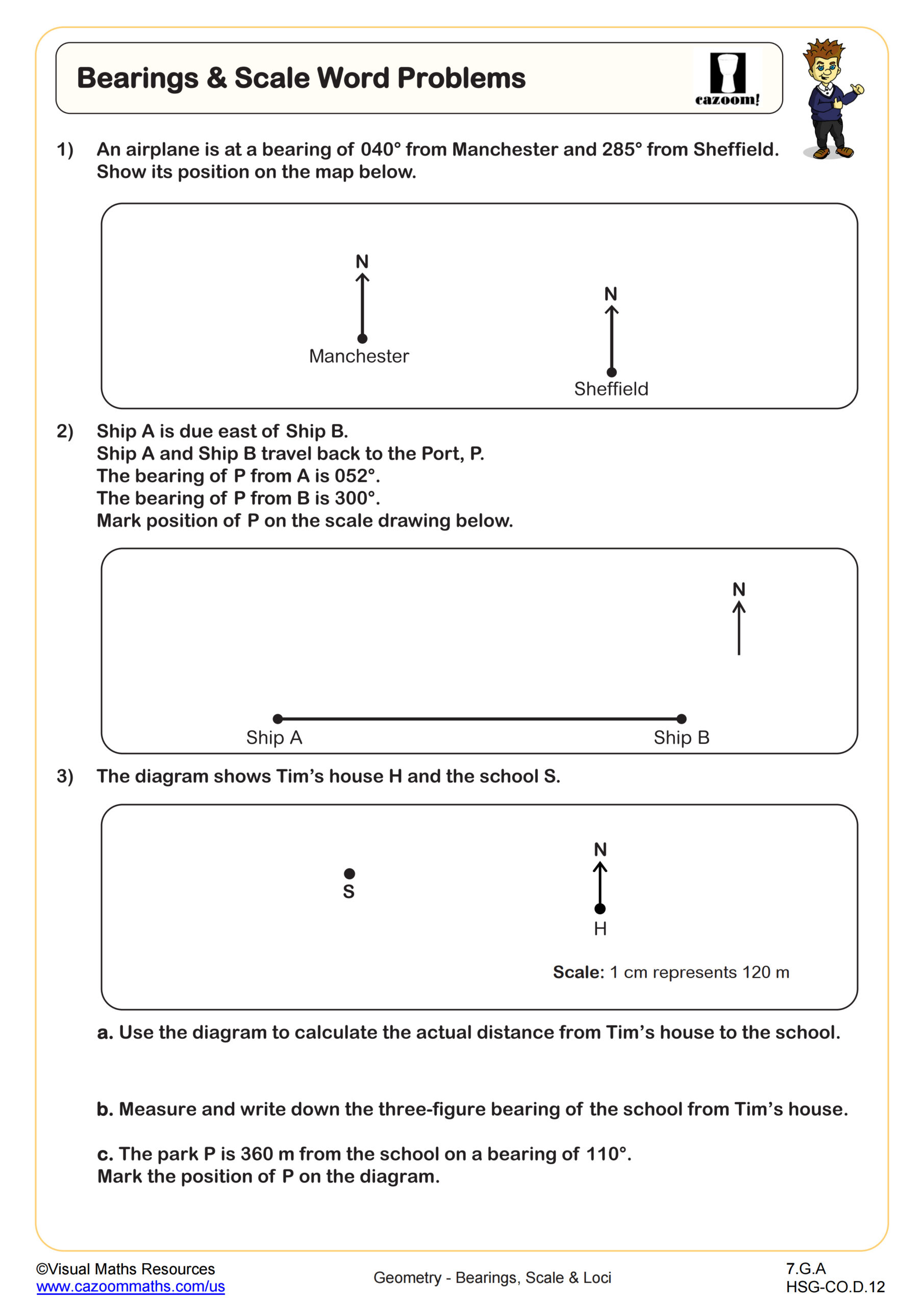
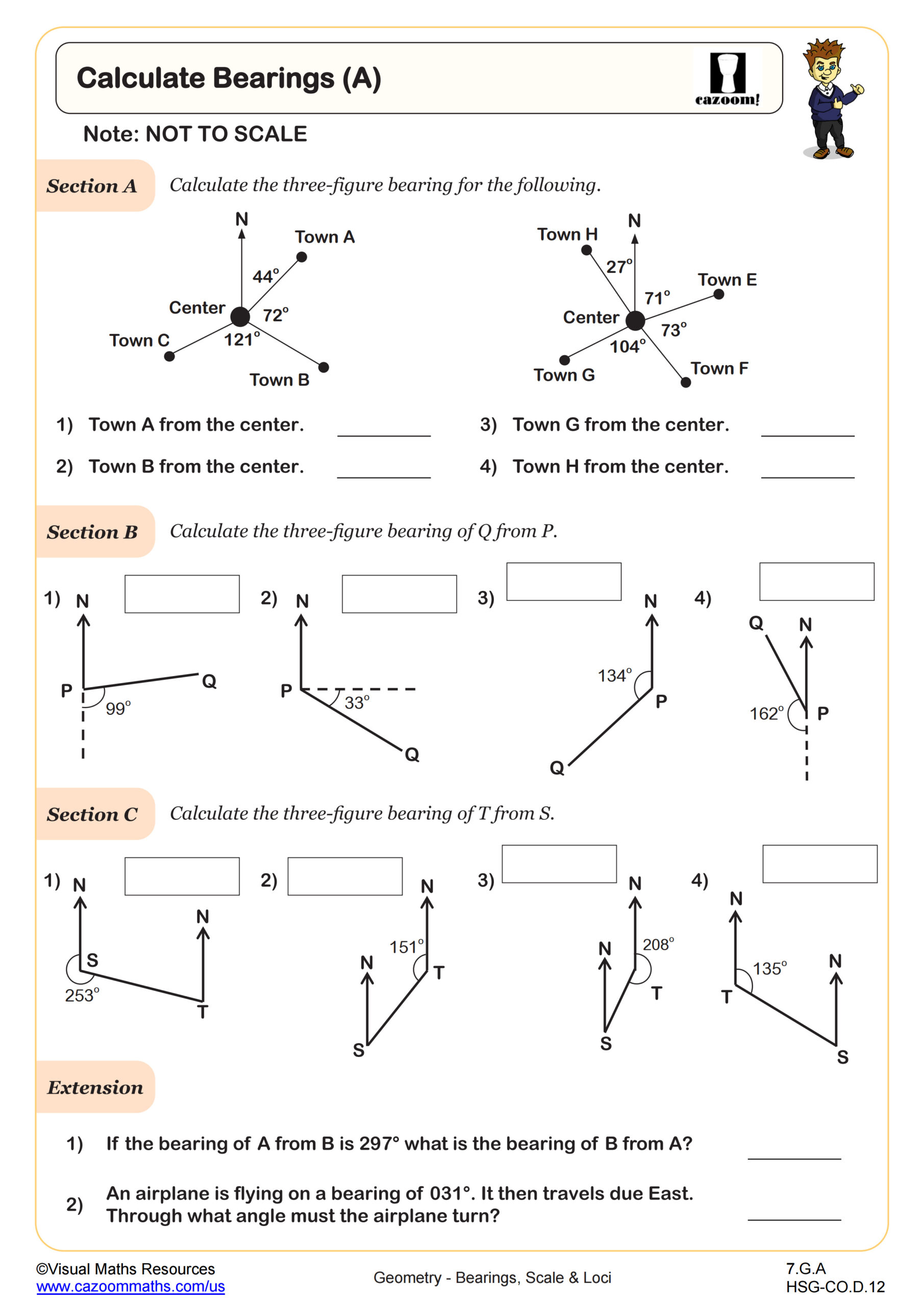
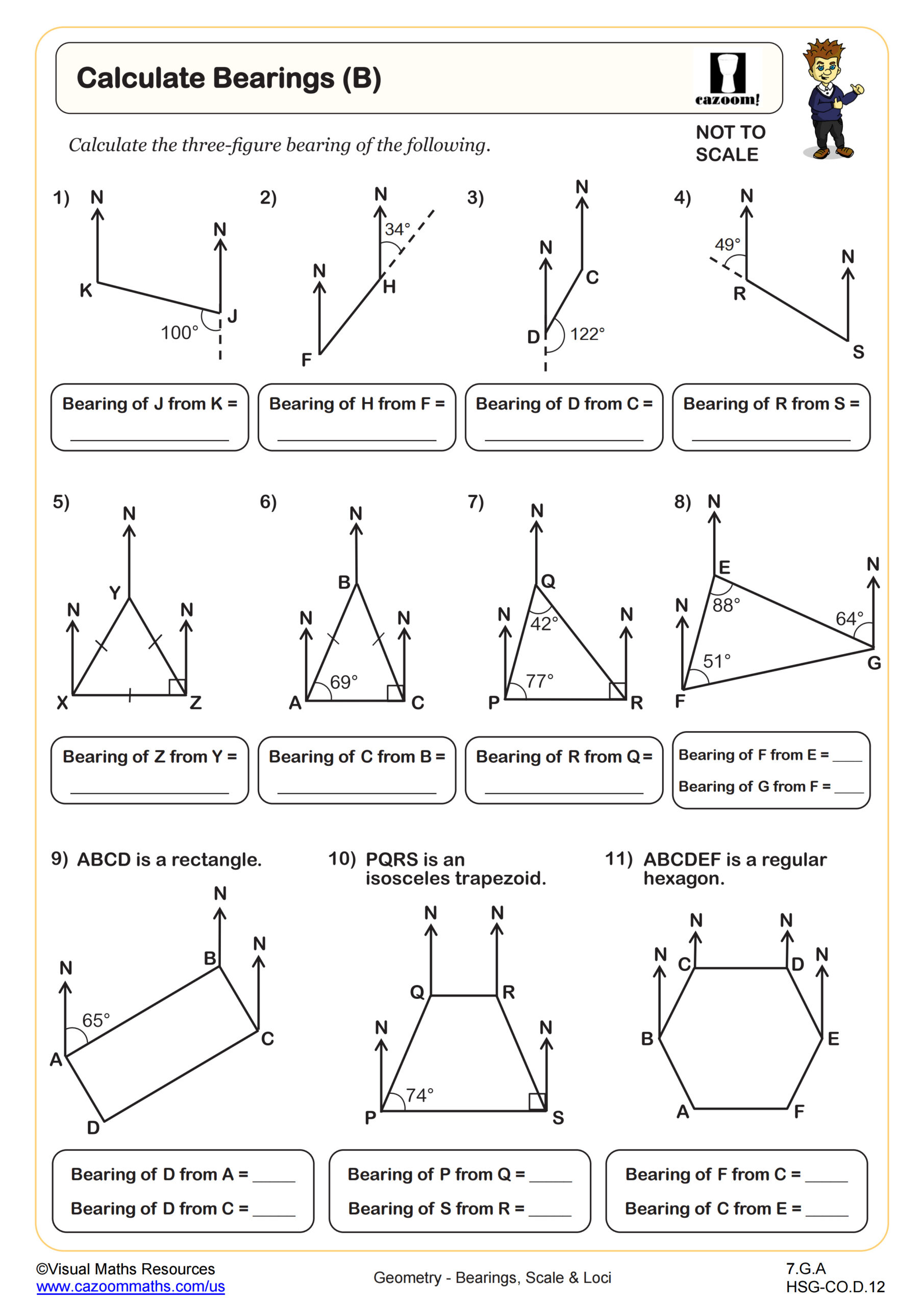
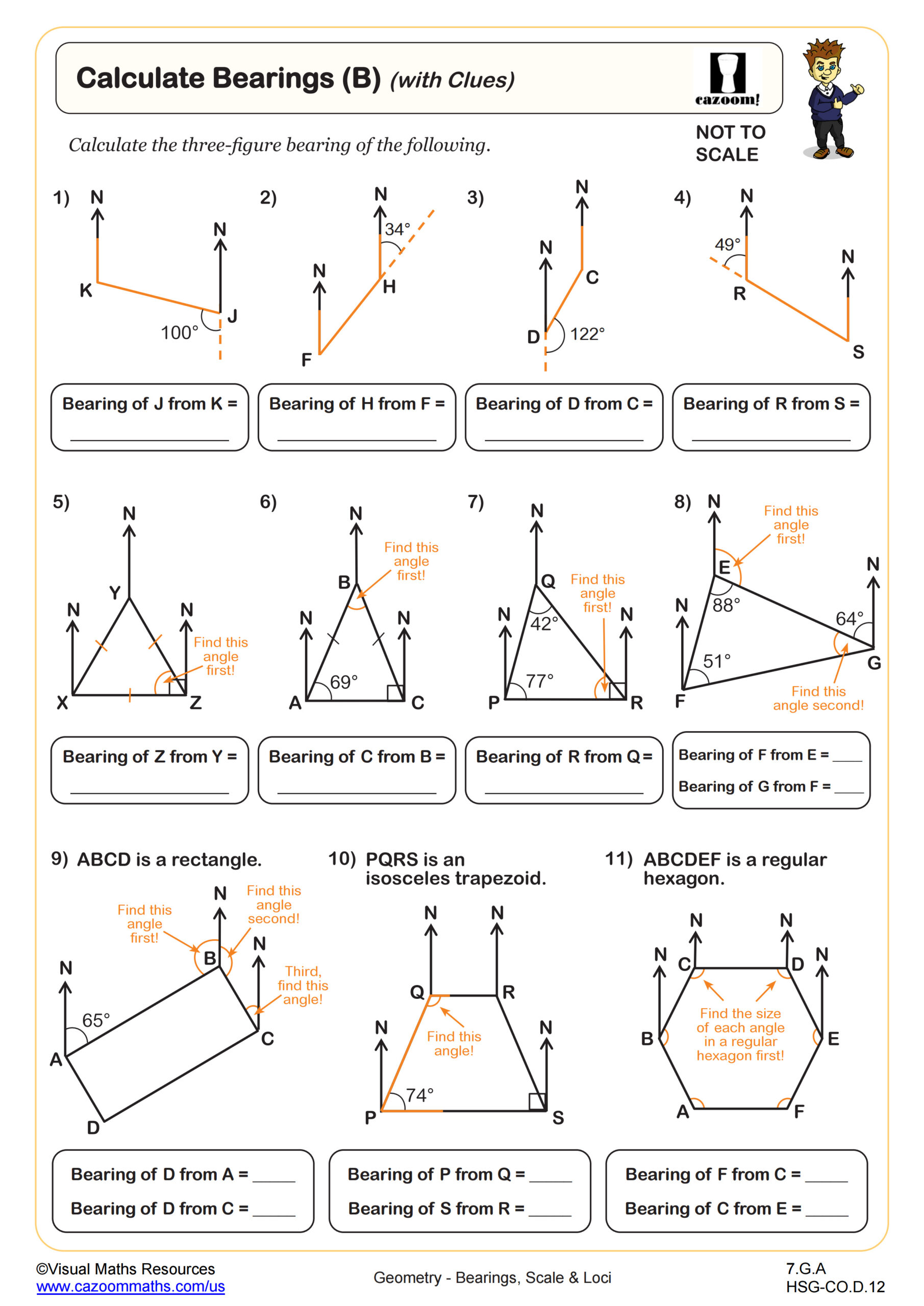
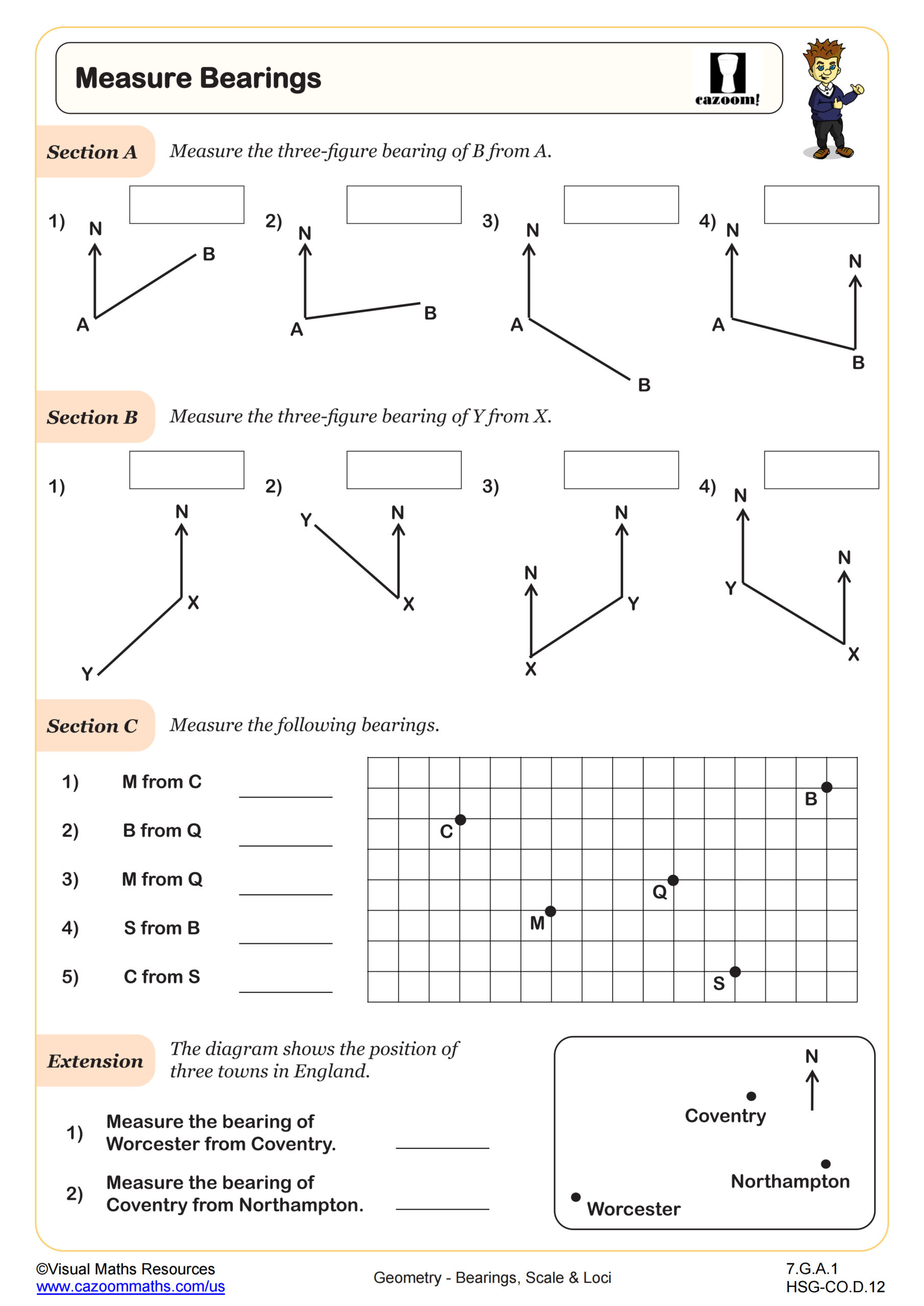
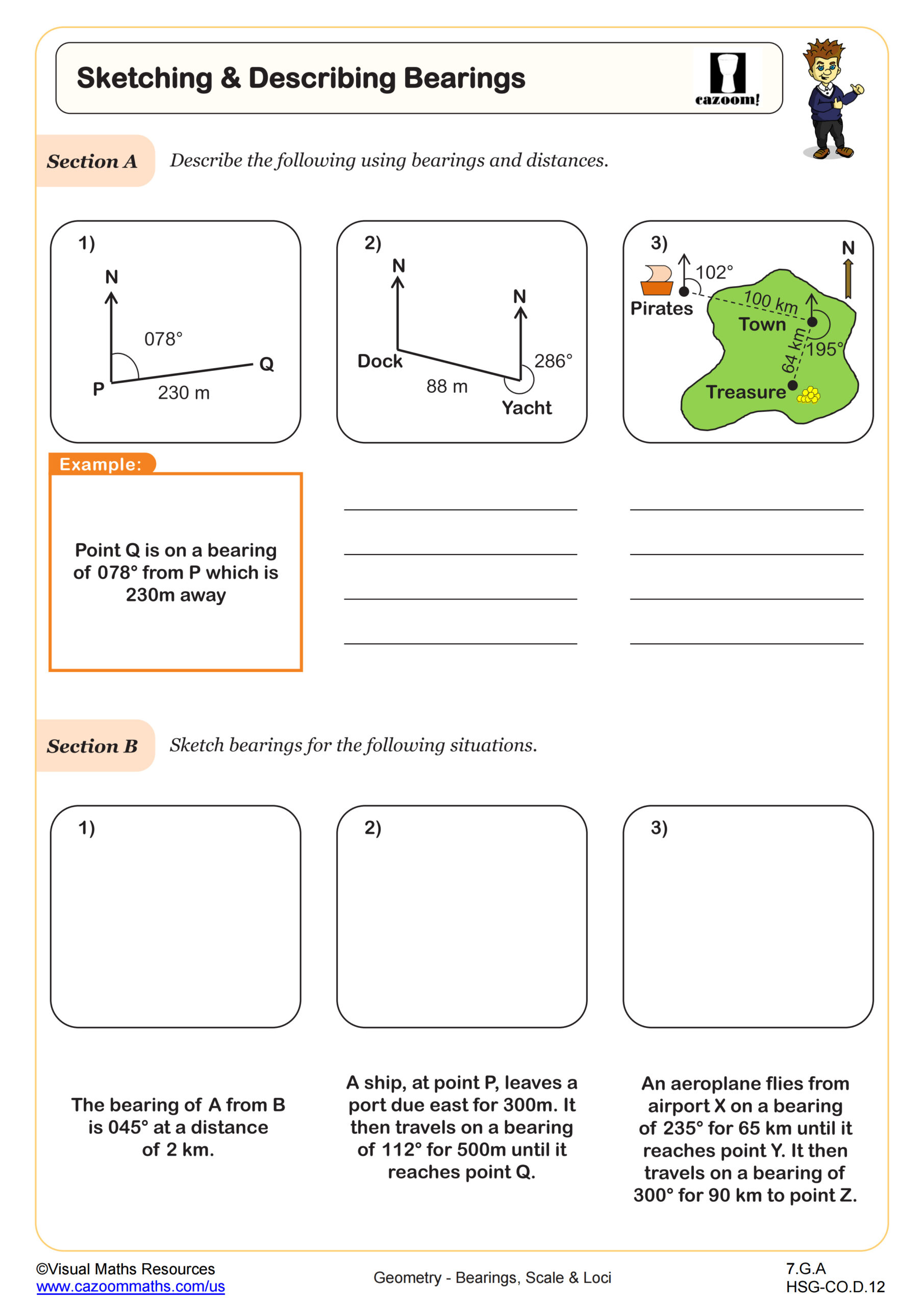
Students learn to work with three-figure bearings measured clockwise from north, apply scale factors to interpret and create accurate diagrams, and construct loci sets of points satisfying specific geometric conditions. The worksheets cover calculating bearings between two points, determining reverse bearings, solving navigation problems with multiple legs, interpreting scale drawings in real-world contexts, and sketching loci such as points equidistant from a line or within a given distance from a point. These skills align with Common Core State Standards for geometric measurement and problem-solving in Geometry courses.
A common error occurs when students measure bearings counterclockwise or from the wrong reference line, particularly when working with south-facing directions. Teachers often address this by having students always draw a north line at each point before measuring, reinforcing that bearings never exceed 360° and always use three digits. The connection between bearings and coordinate geometry becomes clearer when students recognize that navigation problems involve vector components and angle relationships they've studied in trigonometry contexts.
How Do Bearings and Scale Problems Appear on Standardized Tests?
Standardized assessments like the SAT, ACT, and state Geometry tests include bearings and scale problems within geometry and problem-solving sections, typically requiring students to interpret diagrams, calculate distances using scale factors, or determine directions between points. Test questions often embed bearings within real-world scenarios like navigation, surveying, or mapping, expecting students to translate between verbal descriptions and mathematical representations. Students must demonstrate understanding of angle measurement conventions, proportional reasoning with scales, and the ability to work with geometric constraints in loci problems.
Students lose points when they forget to express bearings as three-figure numbers, confuse bearings with standard angle measures from the positive x-axis, or misapply scale factors by adding instead of multiplying. Another frequent error involves calculating back bearings incorrectly, either adding or subtracting 180° when the situation doesn't require it. Questions involving composite loci, where students must identify regions satisfying multiple conditions simultaneously, challenge students who haven't practiced shading or sketching techniques systematically.
What Are Loci and Why Do They Matter in Geometry?
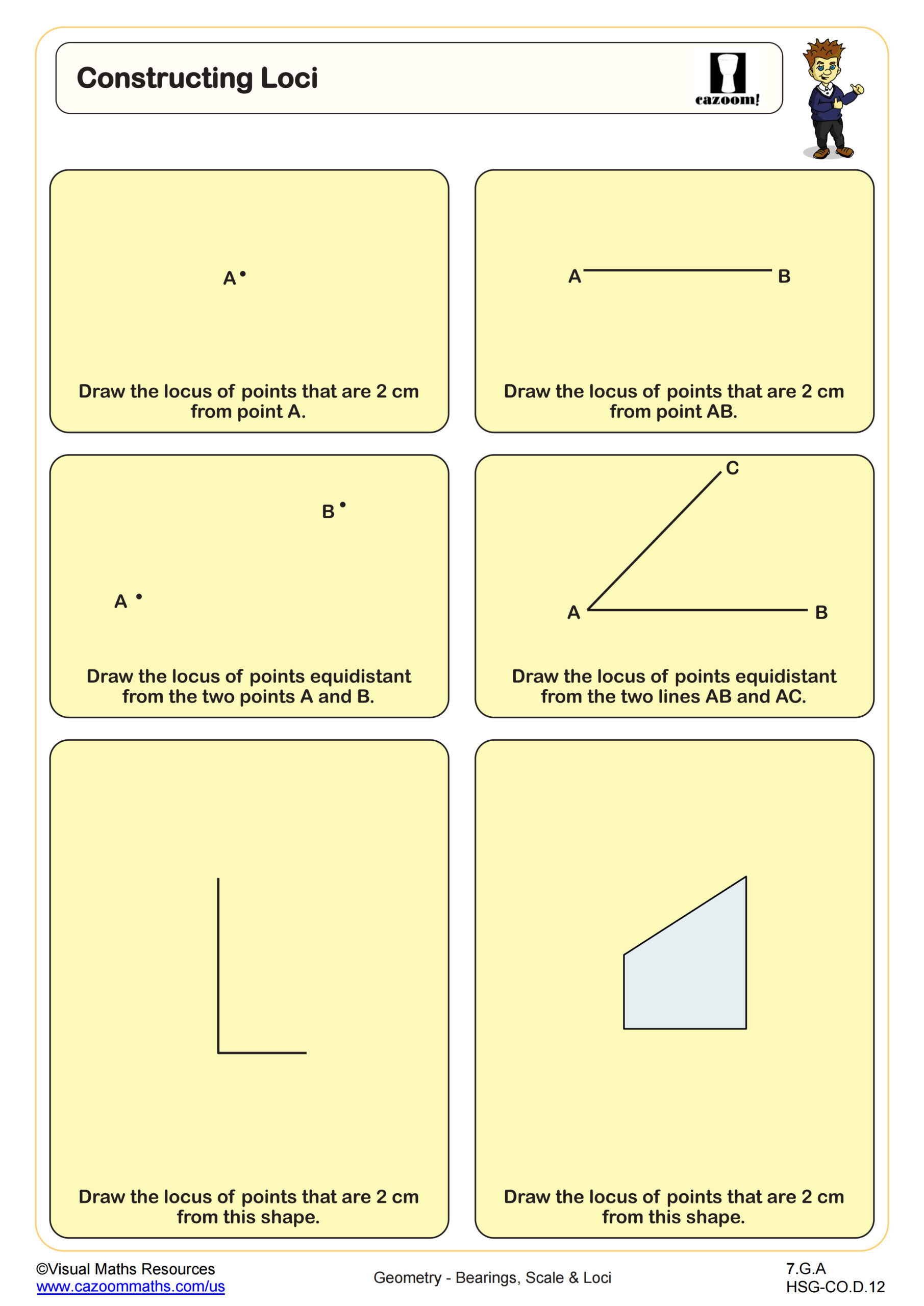
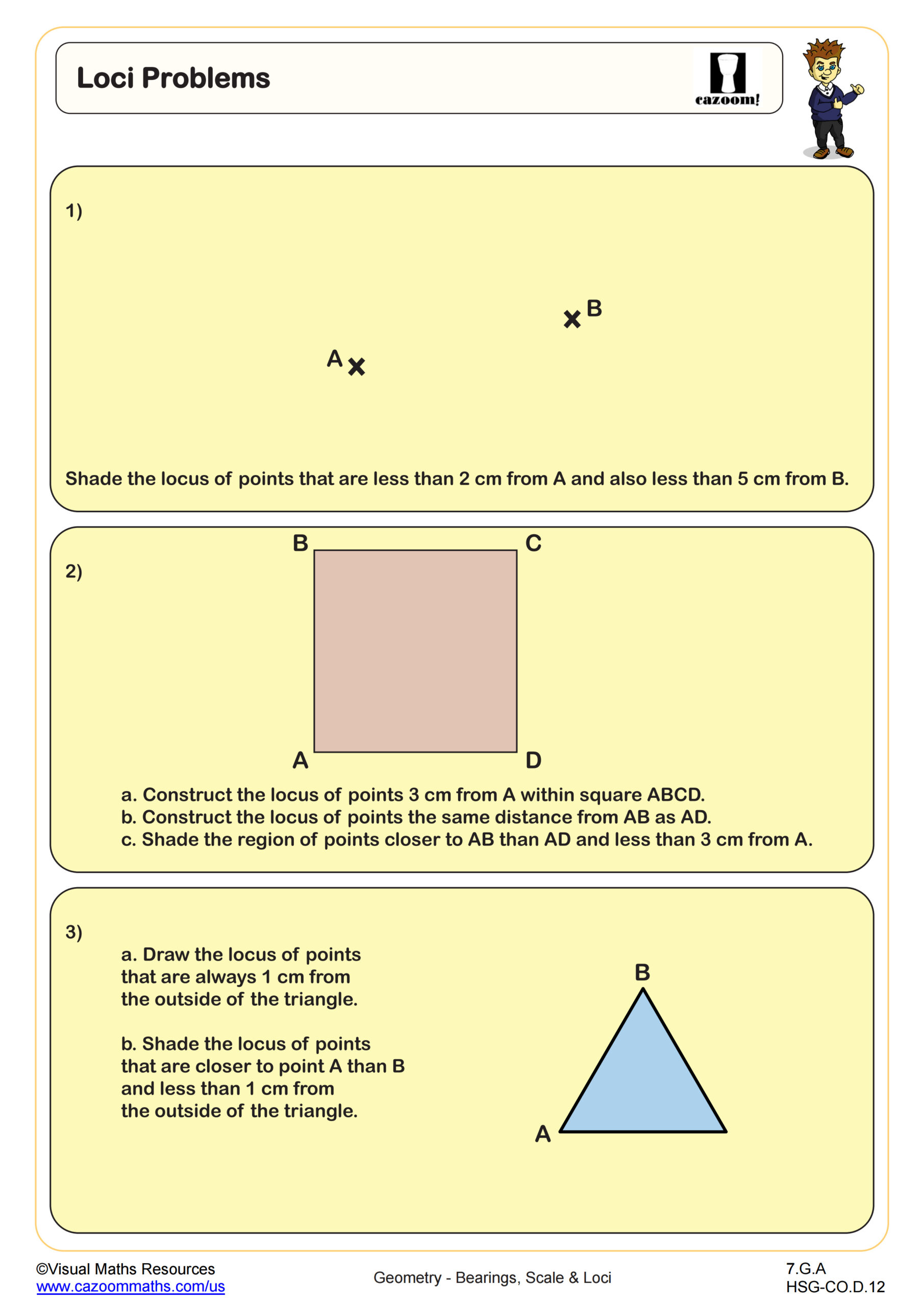
A locus is the set of all points satisfying a particular geometric condition or rule. Common loci include the perpendicular bisector of a line segment (all points equidistant from two fixed points), a circle (all points at a fixed distance from a center), and angle bisectors (all points equidistant from two intersecting lines). Students learn to describe loci verbally, construct them using compass and straightedge, and apply them to constraint-based problems. Understanding loci strengthens spatial visualization and prepares students for more advanced topics like conic sections in Pre-Calculus and coordinate geometry.
Loci concepts appear extensively in STEM fields, particularly engineering design, robotics, and computer graphics. Engineers use loci when determining optimal placement for equipment that must maintain specific distances from multiple locations, such as positioning cell towers to provide coverage areas. In robotics, path planning algorithms calculate loci to identify reachable positions for robotic arms given joint constraints. Students often recognize the practical value of loci when working with problems involving fence placement, signal range, or finding locations meeting multiple distance requirements simultaneously.
How Can Teachers Use These Bearings and Scale Worksheets in Geometry Classes?
The worksheets provide structured practice that builds from basic bearing calculations to multi-step navigation problems, allowing teachers to differentiate instruction based on student readiness. Each worksheet includes worked examples or scaffolded problems that guide students through the problem-solving process, helping them internalize the conventions for measuring and recording bearings. The inclusion of scale drawing problems connects abstract bearing calculations to visual representations, reinforcing the relationship between numerical and graphical information. Answer keys enable students to check their work during independent practice or allow teachers to quickly verify solutions during class review.
Teachers use these worksheets for SAT and ACT preparation since navigation and scale problems appear regularly on standardized tests. The materials work well as warm-up activities to review prior learning, as homework following direct instruction, or as intervention resources for students who need additional practice with spatial reasoning. Paired work proves particularly effective with loci construction problems, where students can discuss strategies and verify each other's compass-and-straightedge techniques. The progression from calculation-focused problems to applied word problems helps students build confidence before encountering similar questions on state assessments.