Geometry Polygons Worksheets
All worksheets are created by the team of experienced teachers at Cazoom Math.
What Do Students Learn About Polygons in High School Geometry?
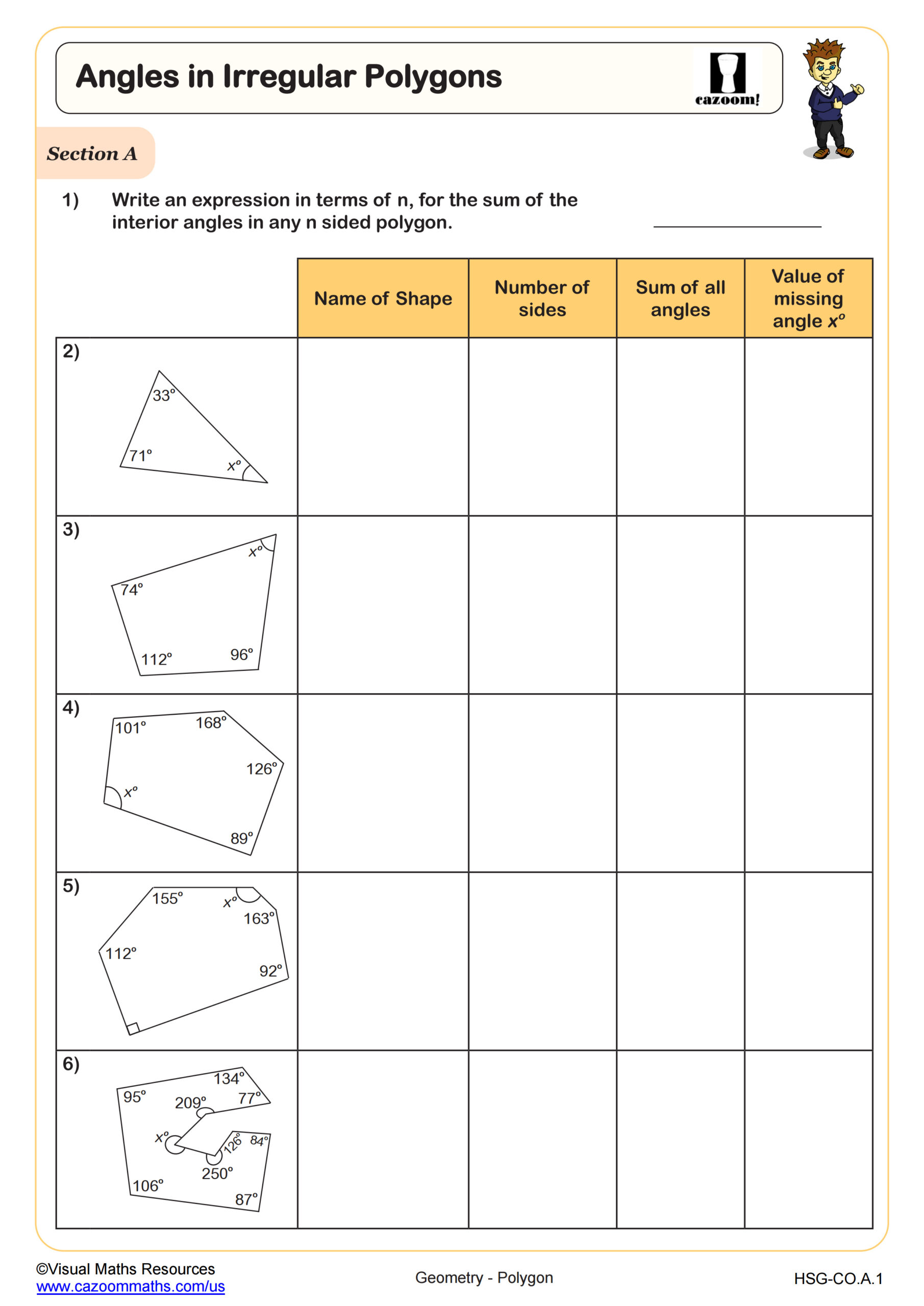
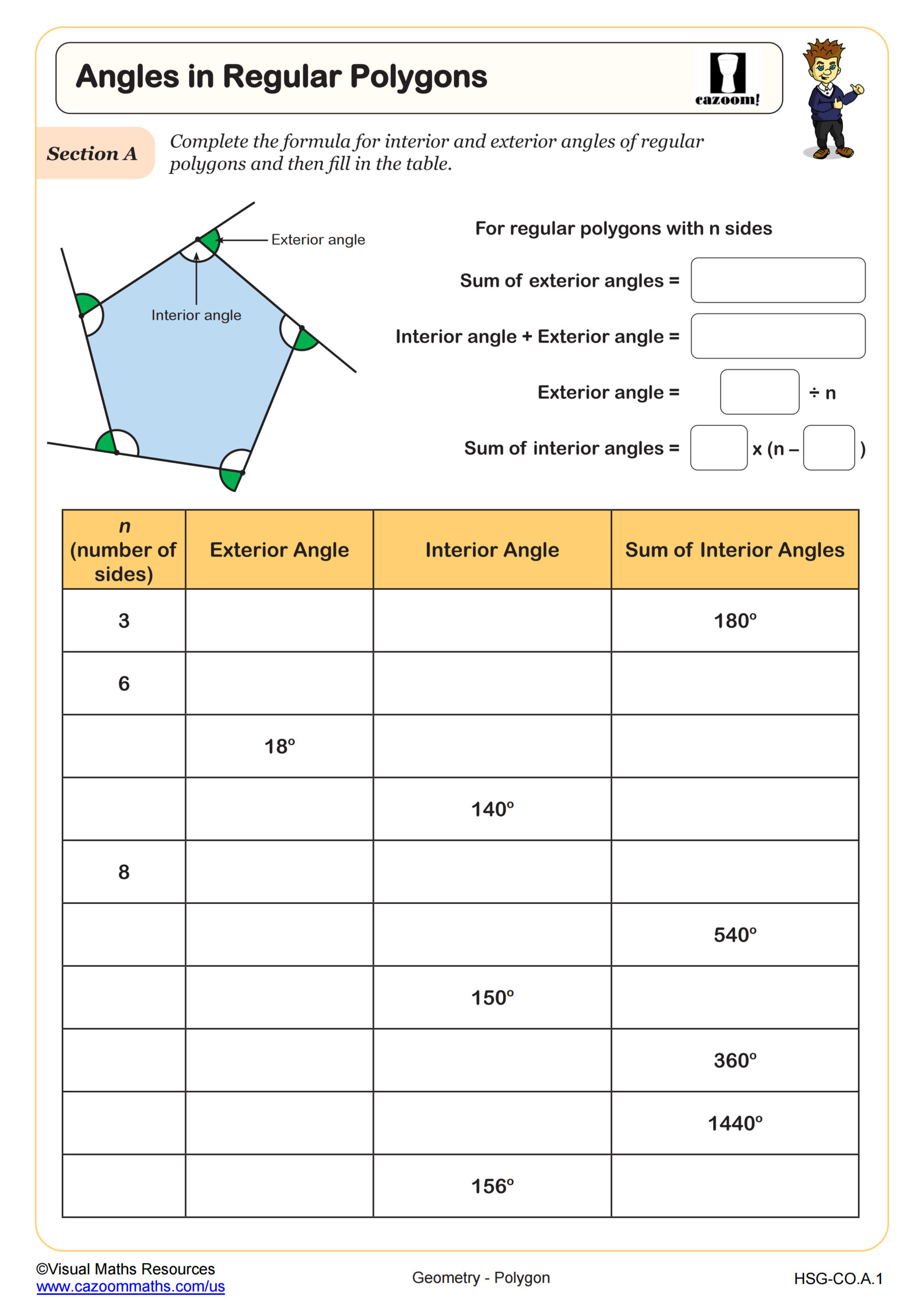
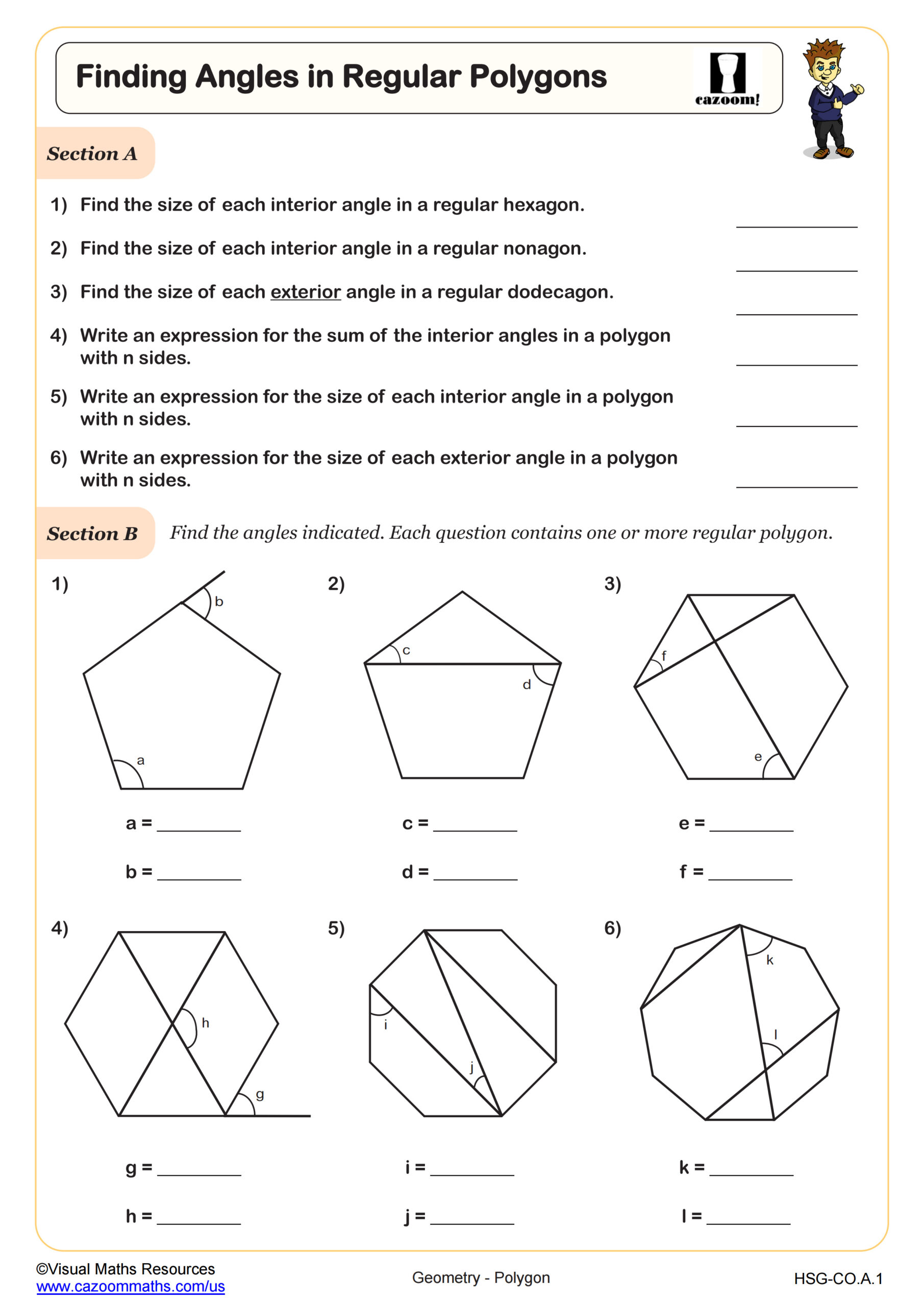
Students master the properties and angle relationships of polygons, focusing on both regular polygons (where all sides and angles are congruent) and irregular polygons. They learn to calculate interior angle sums using the formula (n-2)×180°, find individual interior angles in regular polygons, and understand how exterior angles relate to the number of sides. The curriculum also covers tessellations, where students determine which polygons tile a plane without gaps or overlaps, connecting geometric properties to visual patterns.
A common error occurs when students confuse the interior angle sum formula with the measure of one interior angle in a regular polygon. Teachers often see students correctly calculate 540° for a pentagon's interior angle sum, then mistakenly report that as the measure of one angle instead of dividing by five. This confusion clears up when students practice distinguishing between total sum and individual angle measure across various polygon types.
How Do Polygon Questions Appear on the SAT and ACT?
Standardized tests like the SAT and ACT present polygon problems within coordinate geometry contexts, diagram interpretation, and multi-step reasoning questions. Students must identify missing angles in complex figures, apply the relationship between exterior and interior angles, or determine how many sides a polygon has given one angle measure. Questions often embed polygons within larger geometric figures, requiring students to recognize which angles are interior to the polygon versus supplementary or complementary angles formed by intersecting lines.
Students lose points when they forget that exterior angles of any polygon sum to 360°, regardless of the number of sides. Test questions deliberately include answer choices that result from using 180° or other common misconceptions. Another frequent error involves misreading whether a diagram shows a regular or irregular polygon, leading students to incorrectly assume all angles are equal when the problem specifically states or shows otherwise.
Why Do Regular Polygons Tessellate Differently Than Irregular Ones?
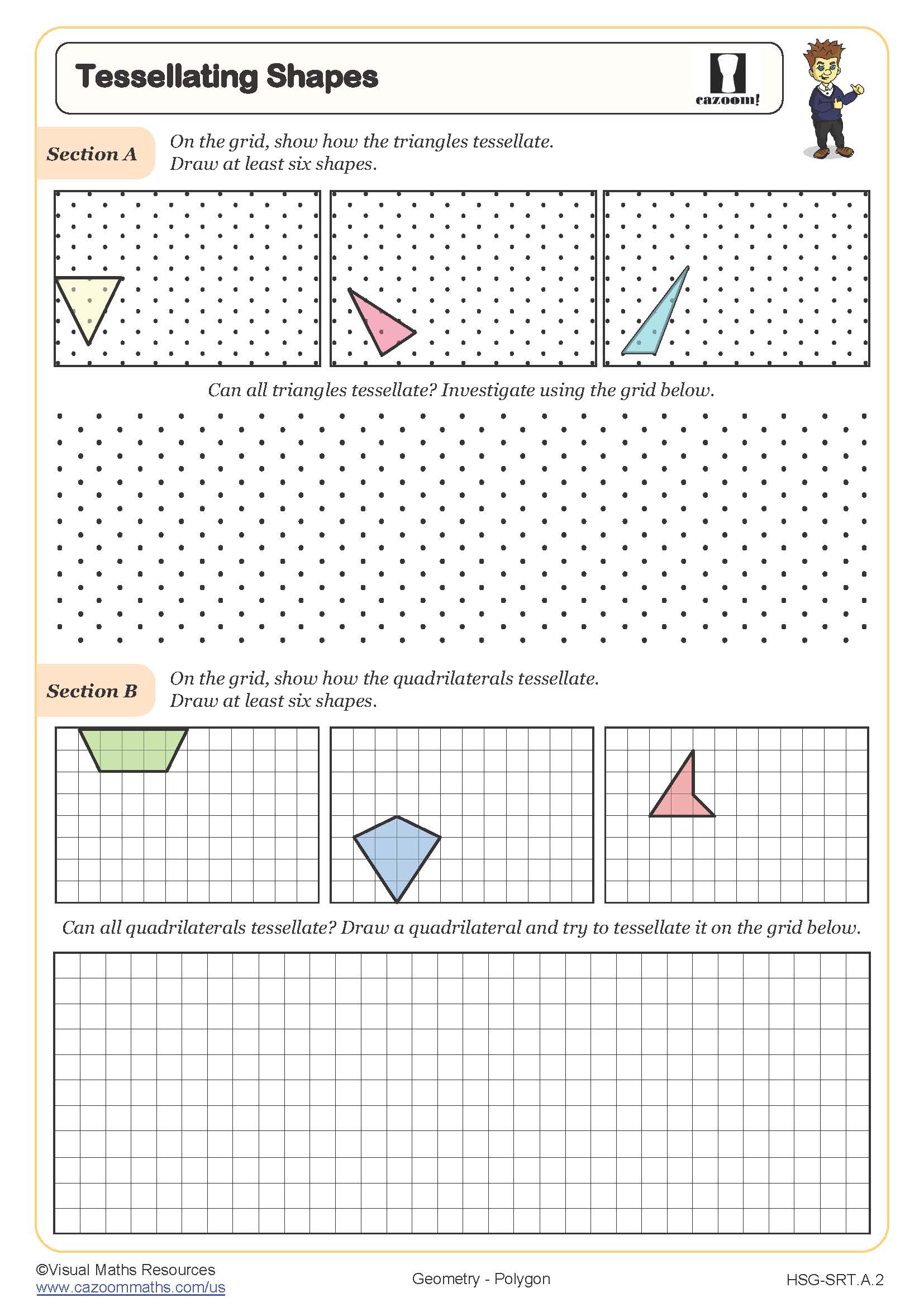
A shape tessellates when copies of it fit together to cover a flat surface without gaps or overlaps. For regular polygons, tessellation depends entirely on whether the interior angle divides evenly into 360°. Equilateral triangles (60° angles), squares (90° angles), and regular hexagons (120° angles) tessellate because their angles meet perfectly at each vertex. Regular pentagons don't tessellate because 108° doesn't divide evenly into 360°, leaving gaps. Irregular polygons follow different rules since their varying angles can sometimes combine to sum to 360° at vertices.
This concept appears throughout architecture, engineering, and design. Hexagonal tessellations show up in honeycomb structures, bathroom tile patterns, and geodesic domes because they efficiently cover surfaces while maintaining strength. Urban planners use tessellation principles when designing street grids and property boundaries. Students preparing for STEM fields benefit from recognizing how mathematical properties directly influence structural design decisions and material efficiency in manufacturing processes.
How Can Teachers Use These Polygon Worksheets in Geometry Classes?
These worksheets provide scaffolded practice that moves from straightforward angle calculations in regular polygons to more complex problem-solving with irregular shapes and tessellation analysis. The progression helps students build confidence with formulas before applying them to unfamiliar contexts. Answer keys allow students to check their work immediately during independent practice, helping them catch calculation errors or formula misapplications before those mistakes become ingrained habits. Teachers appreciate having worked solutions when students ask for help, making it easier to pinpoint exactly where reasoning breaks down.
Many teachers use these worksheets for targeted intervention when formative assessments reveal gaps in understanding polygon properties. The tessellation activities work well as enrichment for students who master angle calculations quickly, giving them visual and creative applications of the same concepts. During test preparation, assigning mixed polygon problems helps students practice identifying which formula or property applies to each situation, building the flexible thinking that standardized tests reward. The worksheets also support paired work, where students compare solutions and discuss different approaches to the same problem.