Geometry Position and Direction Worksheets
All worksheets are created by the team of experienced teachers at Cazoom Math.
What Do Position and Direction Worksheets Cover in High School Geometry?
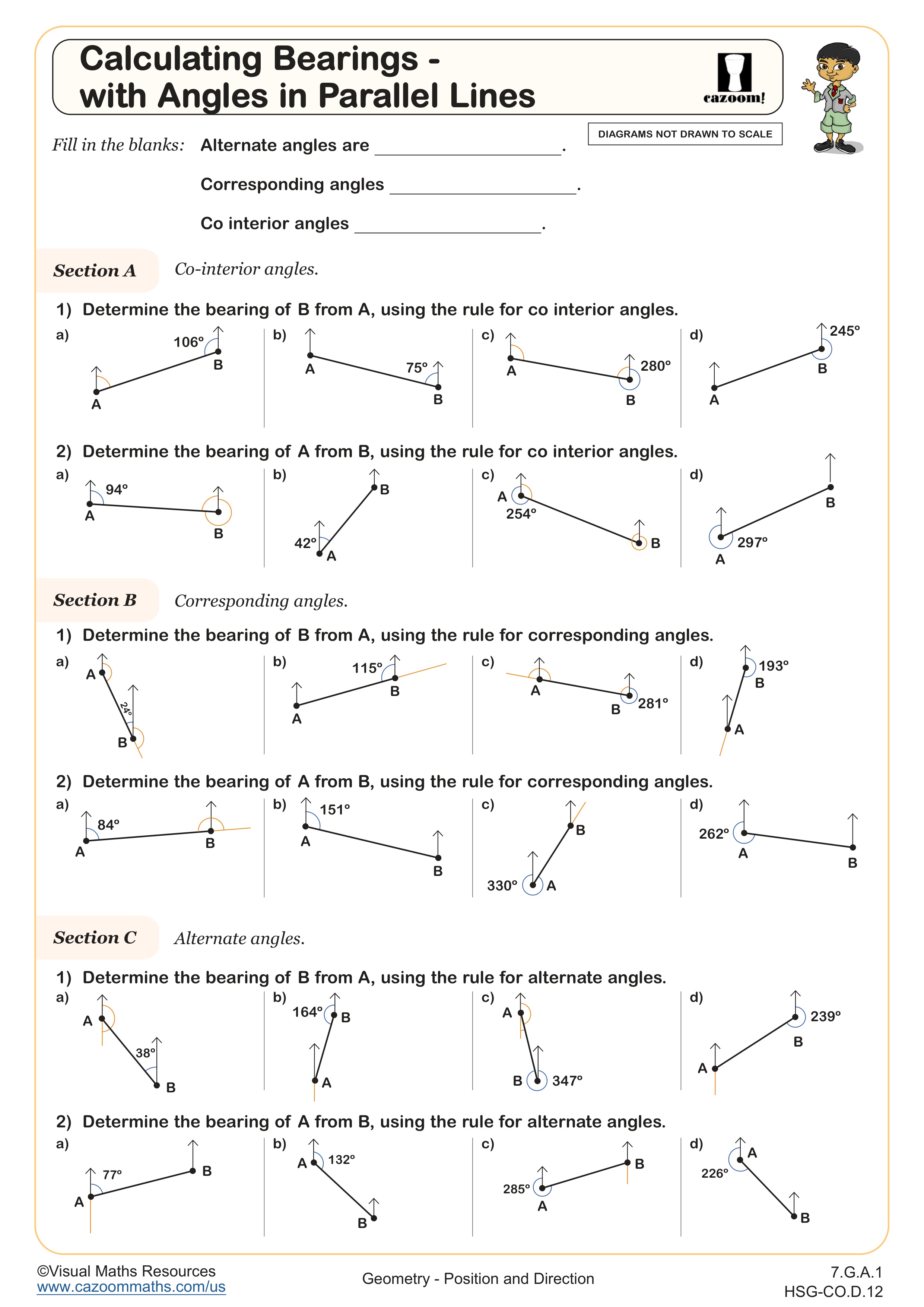
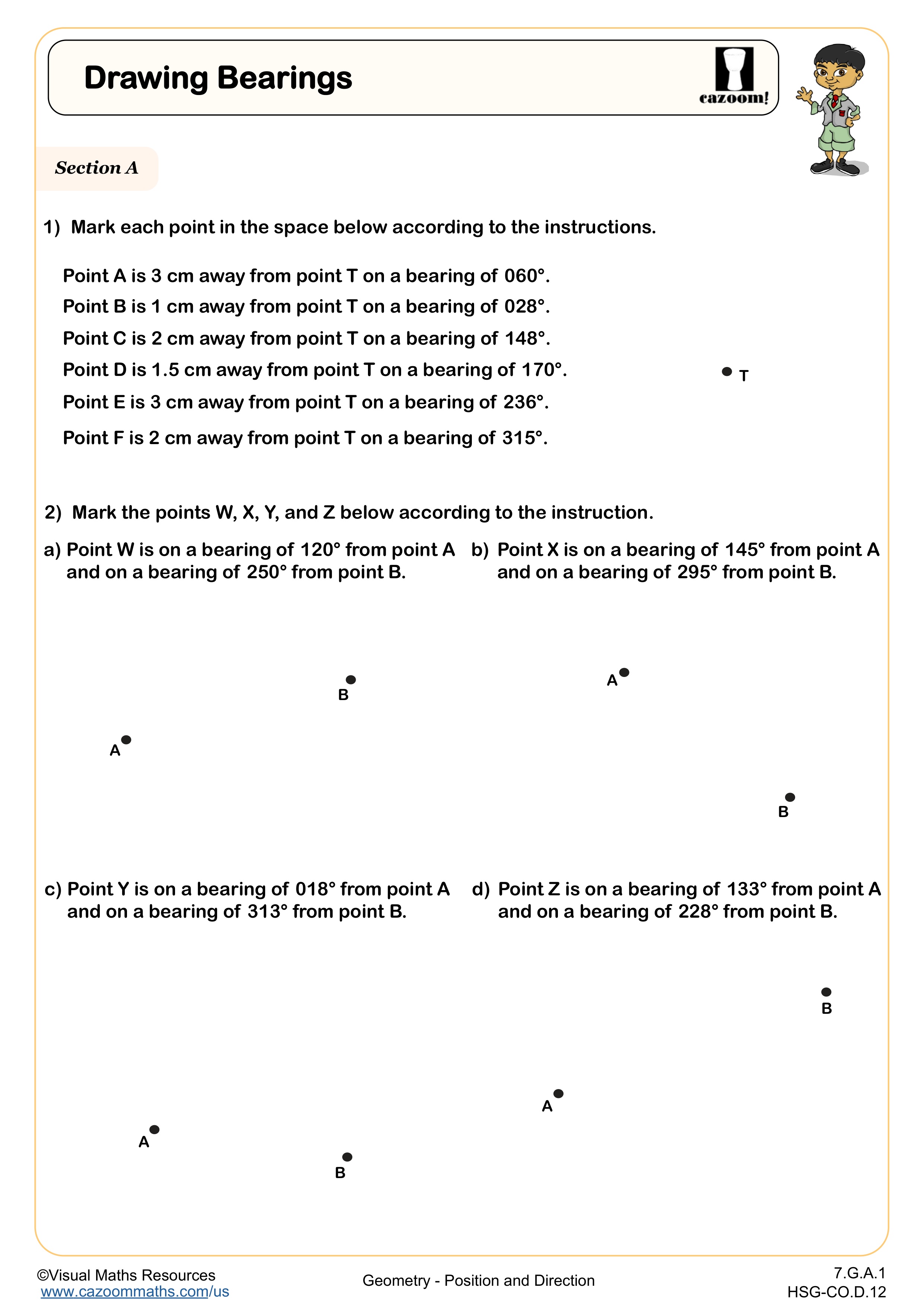
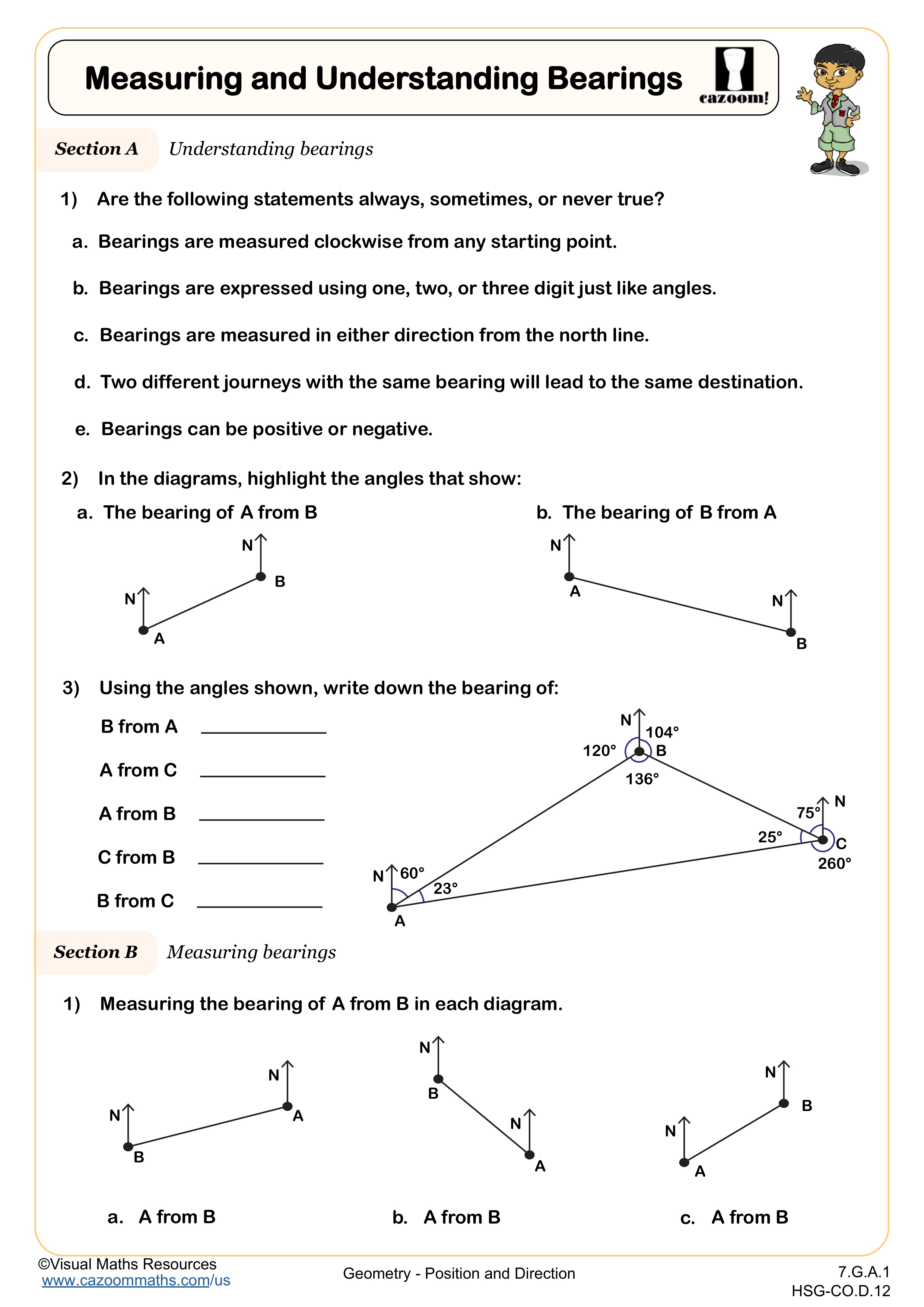
Position and direction worksheets in Geometry focus on bearing notation and calculations, including three-figure bearings measured clockwise from north, back bearings (reverse directions), and problems that incorporate angle relationships with parallel lines. Students work with both drawing bearings accurately using protractors and calculating bearings algebraically when geometric information is provided. The worksheets connect coordinate geometry to navigation concepts, reinforcing how angles function in real-world contexts.
Many students initially struggle with the convention that bearings use three digits (045° rather than 45°) and always reference north as the starting point. Teachers observe that students who master alternate and corresponding angles in parallel line diagrams find bearing problems significantly more manageable, since many bearing calculations involve recognizing these angle relationships when paths cross or run parallel to each other.
How Are Position and Direction Skills Tested on the SAT and ACT?
Standardized tests typically assess position and direction through coordinate geometry problems rather than traditional bearing notation, focusing on distance calculations, midpoint formulas, and understanding directional movement on a coordinate plane. The SAT Math section may present problems involving compass directions in word problems or expect students to interpret diagrams showing paths and angles. Students need to demonstrate spatial reasoning and the ability to translate verbal descriptions of position into mathematical representations.
Students lose points when they misinterpret directional language or fail to visualize the problem accurately before attempting calculations. A common error involves confusing clockwise and counterclockwise rotations or misapplying angle measures when directions change. Teachers notice that students who sketch quick diagrams before solving perform significantly better on these problems, as the visual representation helps prevent sign errors and directional mistakes.
What Are Back Bearings and Why Do They Matter?
A back bearing represents the reverse direction of a given bearing, calculated by adding or subtracting 180° from the original bearing. If a ship travels from point A to point B on a bearing of 065°, the back bearing from B to A is 245° (065° + 180°). When the calculated result exceeds 360°, students subtract 360° to keep the bearing within the standard range. This concept reinforces understanding that bearings represent specific directions in a complete 360° system.
Navigation systems, GPS technology, and aviation rely heavily on bearing calculations and back bearings. Pilots use back bearings to return to their departure point, and search and rescue teams apply these calculations to coordinate grid searches. Surveyors and civil engineers regularly work with bearings when mapping property boundaries and planning infrastructure projects, making this skill directly applicable to several STEM careers beyond pure mathematics.
How Can Teachers Use These Position and Direction Worksheets in Geometry Classes?
The worksheets provide structured progression from measuring and drawing bearings with protractors to calculating bearings using angle relationships in more complex geometric diagrams. This scaffolded approach helps students build confidence with the notation and conventions before tackling multi-step problems involving parallel lines and transversals. The inclusion of angle properties in parallel lines within bearing contexts reinforces two important Geometry topics simultaneously, helping students see connections across the curriculum.
Teachers find these worksheets particularly useful for differentiated instruction, as students who struggle with abstract angle relationships often grasp the concepts more readily when presented through the concrete context of navigation and direction. The materials work well for test preparation, particularly for state assessments that include applied geometry problems, and serve effectively as warm-up activities to refresh spatial reasoning skills. Paired work allows students to check each other's bearing drawings and calculations, promoting mathematical discussion about accuracy and angle measurement conventions.