Geometry Probability Worksheets
.jpg?w=3840)
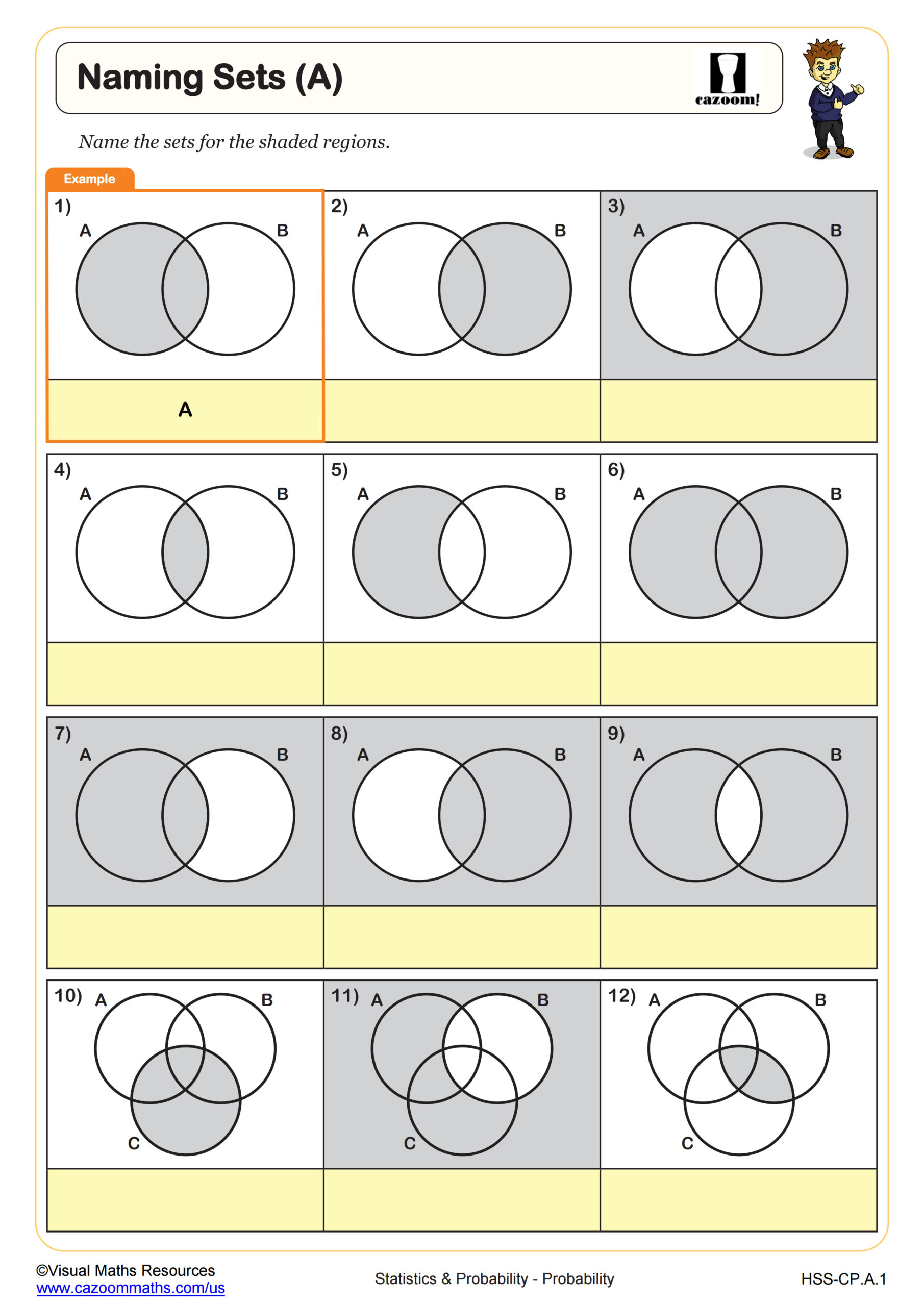
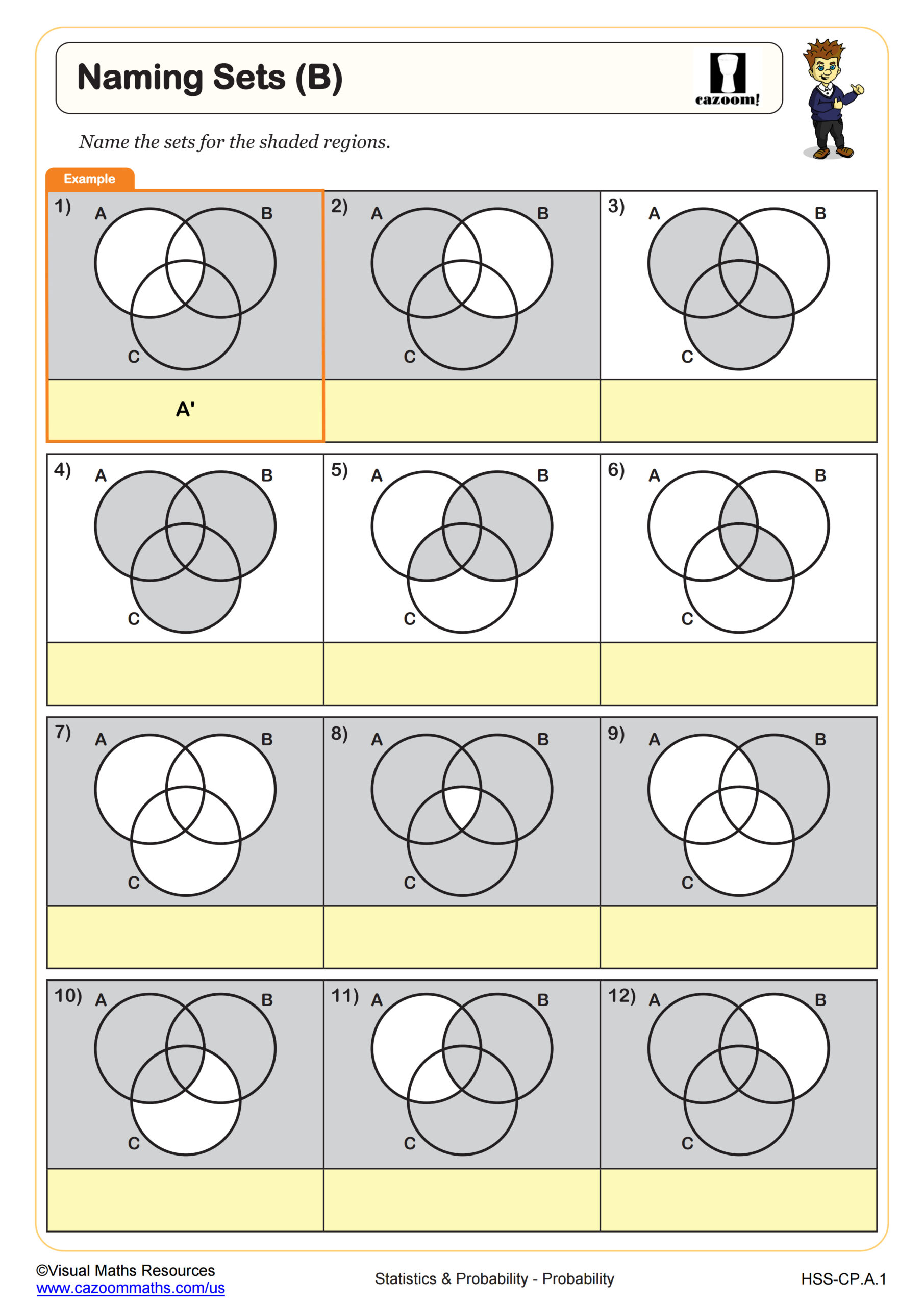
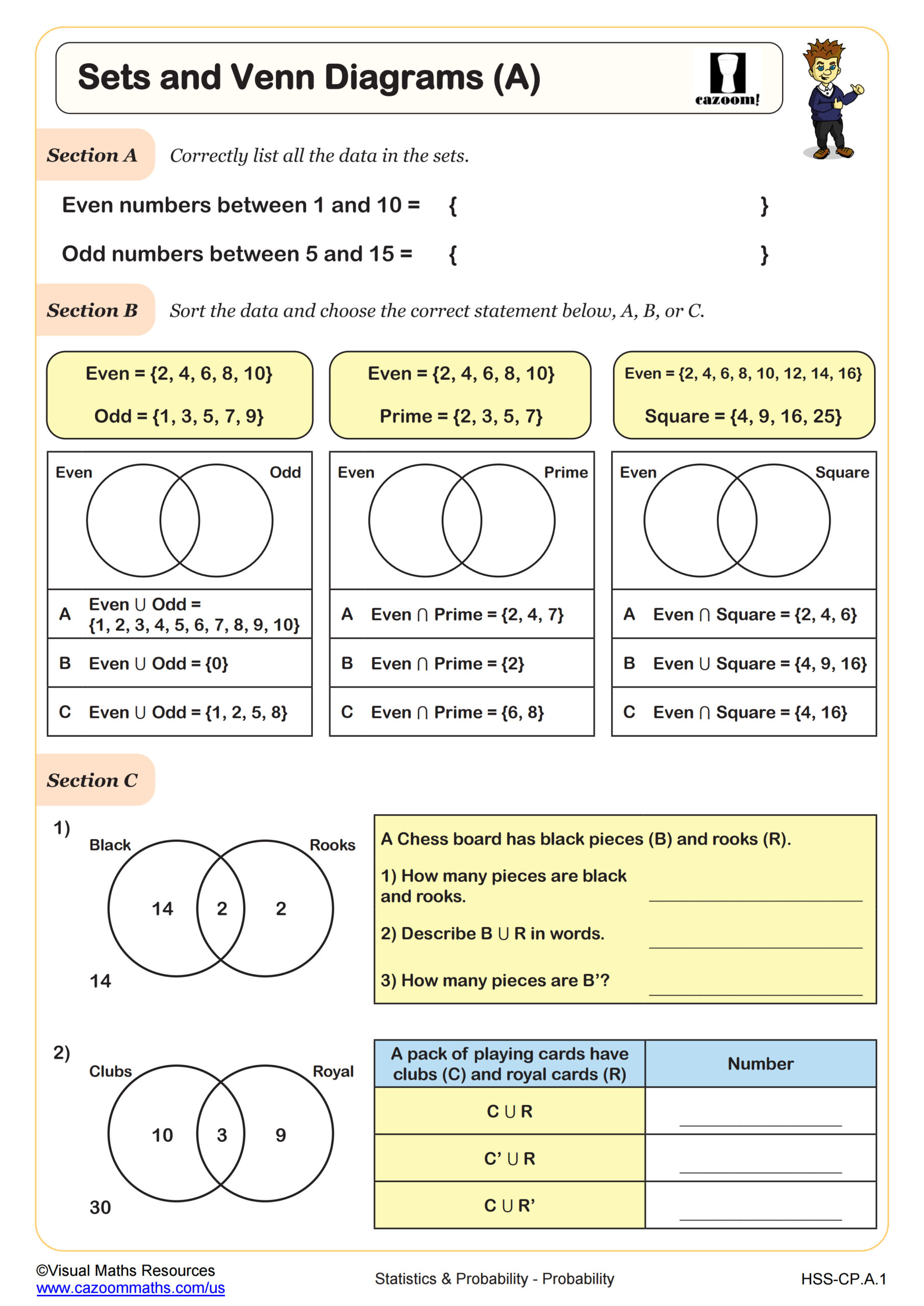
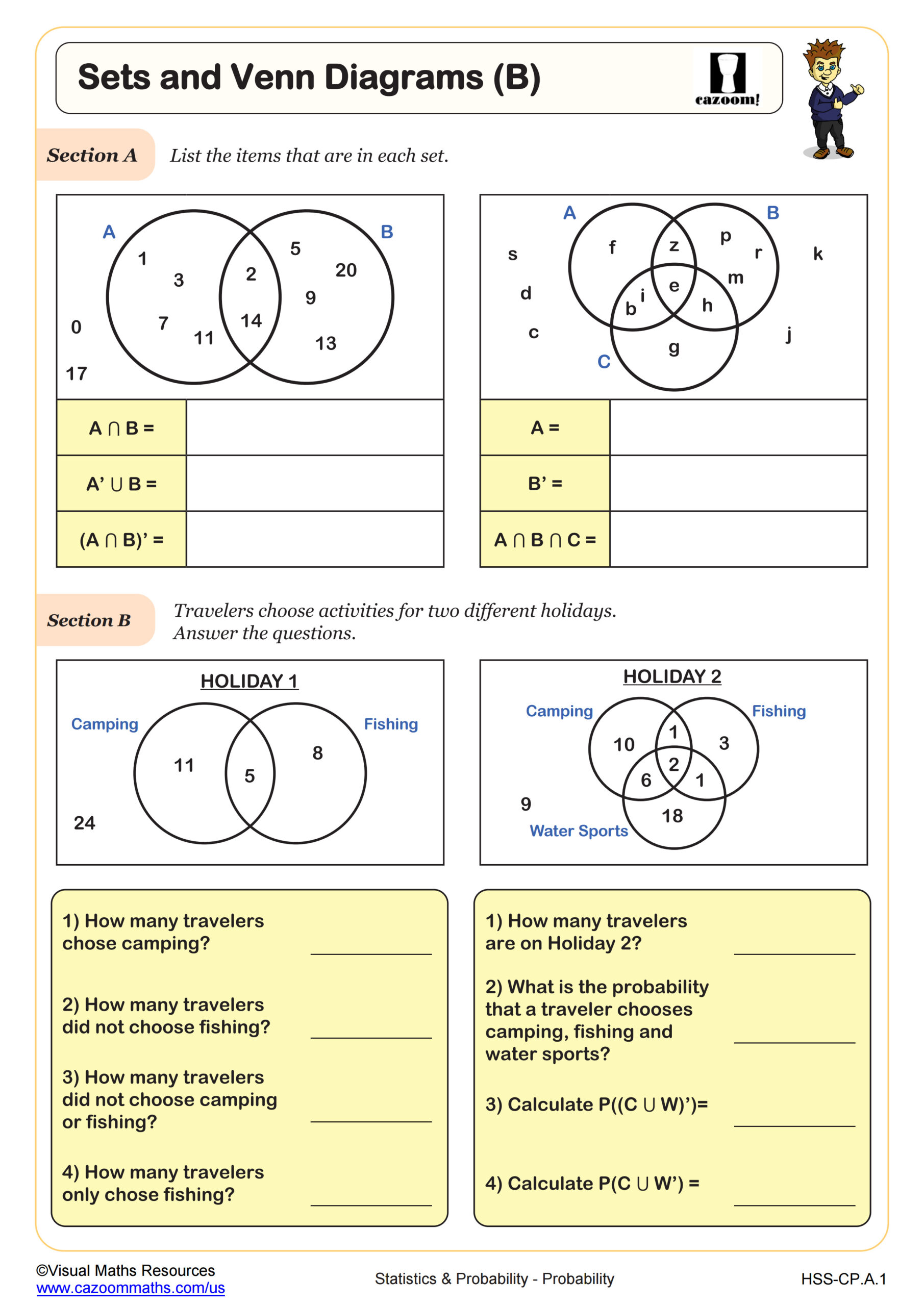
All worksheets are created by the team of experienced teachers at Cazoom Math.
What Probability Topics Are Covered in High School Geometry?
Geometry probability focuses on foundational concepts that prepare students for Statistics and higher math courses. Students learn set notation and terminology, work with Venn diagrams to visualize relationships between events, and explore mutually exclusive events where outcomes cannot occur simultaneously. The curriculum emphasizes understanding sample spaces, using proper notation for unions and intersections, and recognizing when events are independent or dependent.
A common misconception emerges when students confuse the concepts of mutually exclusive events and independent events. Many students initially think these terms are interchangeable, but teachers can clarify this by showing that mutually exclusive events (like rolling a 3 or rolling a 5 on one die) actually cannot be independent since knowing one occurred tells you the other did not. This distinction becomes important for probability calculations in later courses.
How Does Probability Appear on the SAT and ACT?
Standardized tests regularly include probability questions that test understanding of set relationships, Venn diagrams, and mutually exclusive events. The SAT Math section expects students to interpret Venn diagrams with three overlapping sets, calculate probabilities from given information, and apply basic counting principles. ACT Math questions often present real-world scenarios requiring students to determine sample spaces and calculate theoretical probabilities using proper notation.
Students lose points when they misread Venn diagrams by adding all visible numbers without accounting for overlapping regions. Another frequent error occurs when students fail to recognize mutually exclusive events in word problems, leading them to add probabilities incorrectly. Test-takers who systematically label all regions of a Venn diagram before calculating typically avoid these mistakes and score higher on probability items.
Why Are Venn Diagrams Important for Understanding Probability?
Venn diagrams provide visual representations of set relationships that help students organize information and calculate probabilities accurately. Students learn to identify intersections (elements belonging to multiple sets), unions (elements in at least one set), and complements (elements not in a particular set). This visual approach helps students see overlapping events and avoid double-counting when calculating compound probabilities, making abstract notation concrete and manageable.
Venn diagrams appear throughout STEM fields, from analyzing survey data in social sciences to organizing clinical trial results in medical research. Pharmaceutical companies use Venn diagrams to track medication side effects and identify which patients experience multiple symptoms. Computer scientists apply set theory and Venn diagrams when designing database queries and filtering data. College-bound students encounter these concepts again in Statistics, Discrete Mathematics, and even introductory Biology courses when studying genetics and population characteristics.
How Can Teachers Use These Probability Worksheets in Geometry Class?
The worksheets provide structured practice that builds from fundamental set notation through increasingly complex probability applications. Teachers can assign the naming sets worksheets first to establish vocabulary and notation before moving to Venn diagram problems that require visualization skills. The mutually exclusive events worksheet challenges students to distinguish between different types of event relationships, reinforcing conceptual understanding. Complete answer keys allow students to check their work immediately, making these worksheets suitable for independent practice or homework.
Many teachers use these worksheets during unit reviews before chapter tests or as targeted intervention for students who struggle with abstract notation. The Venn diagram worksheets work particularly well for paired activities where students compare solutions and discuss their reasoning. Teachers preparing students for standardized tests often assign these worksheets as timed practice to build speed and accuracy. The graduated difficulty levels allow teachers to differentiate instruction by assigning different versions based on student readiness.