Geometry Pythagorean Theorem Worksheets
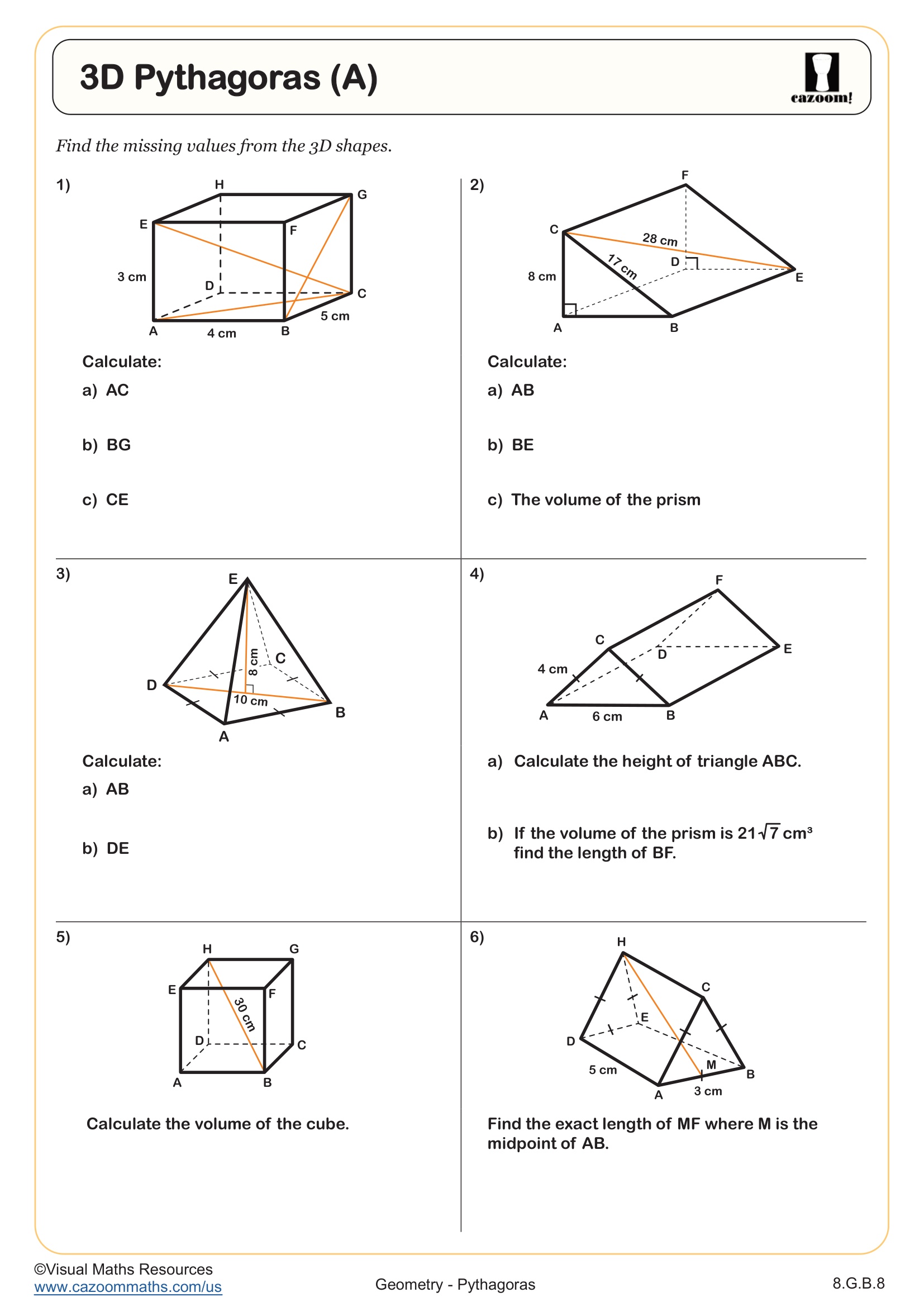
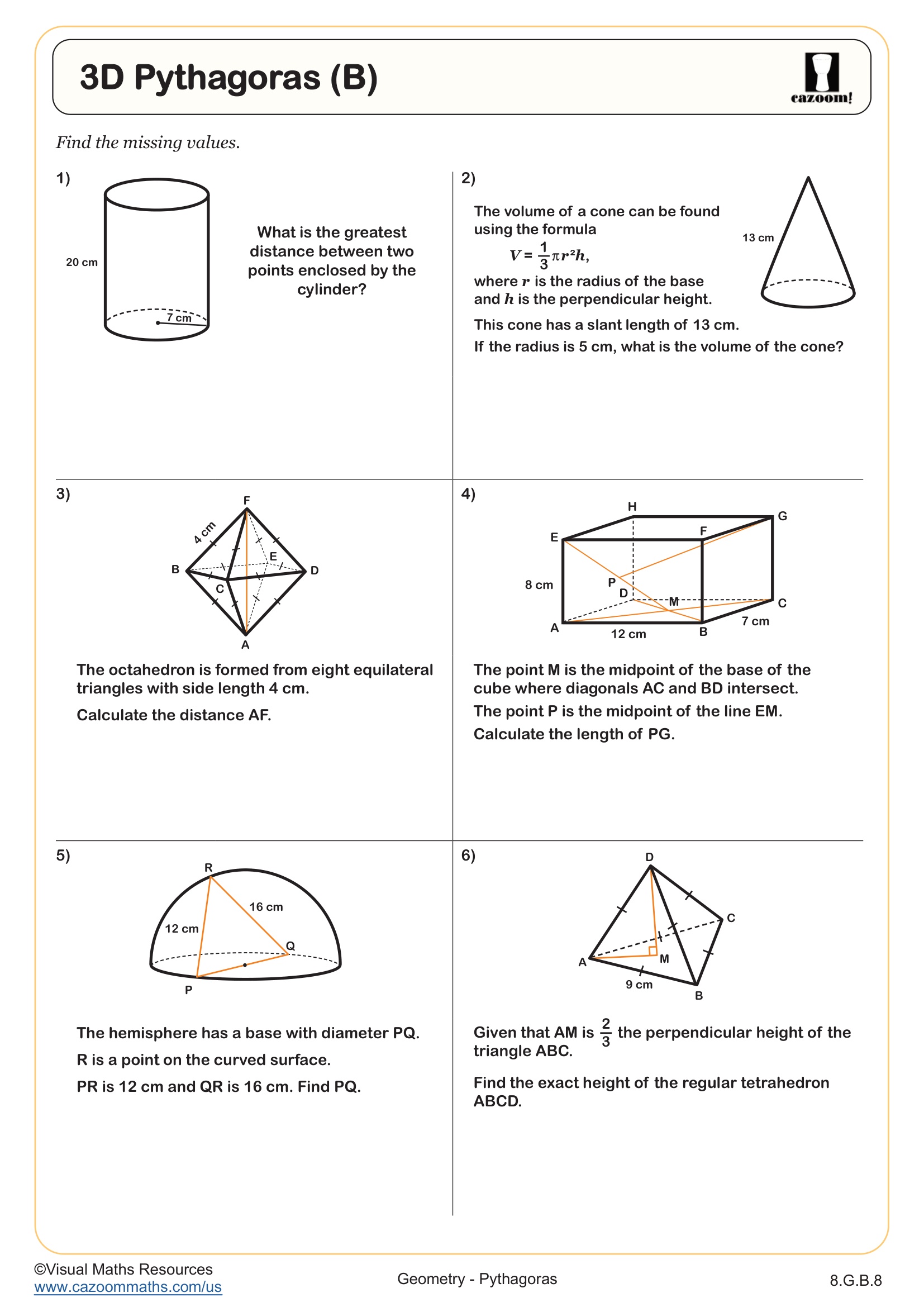
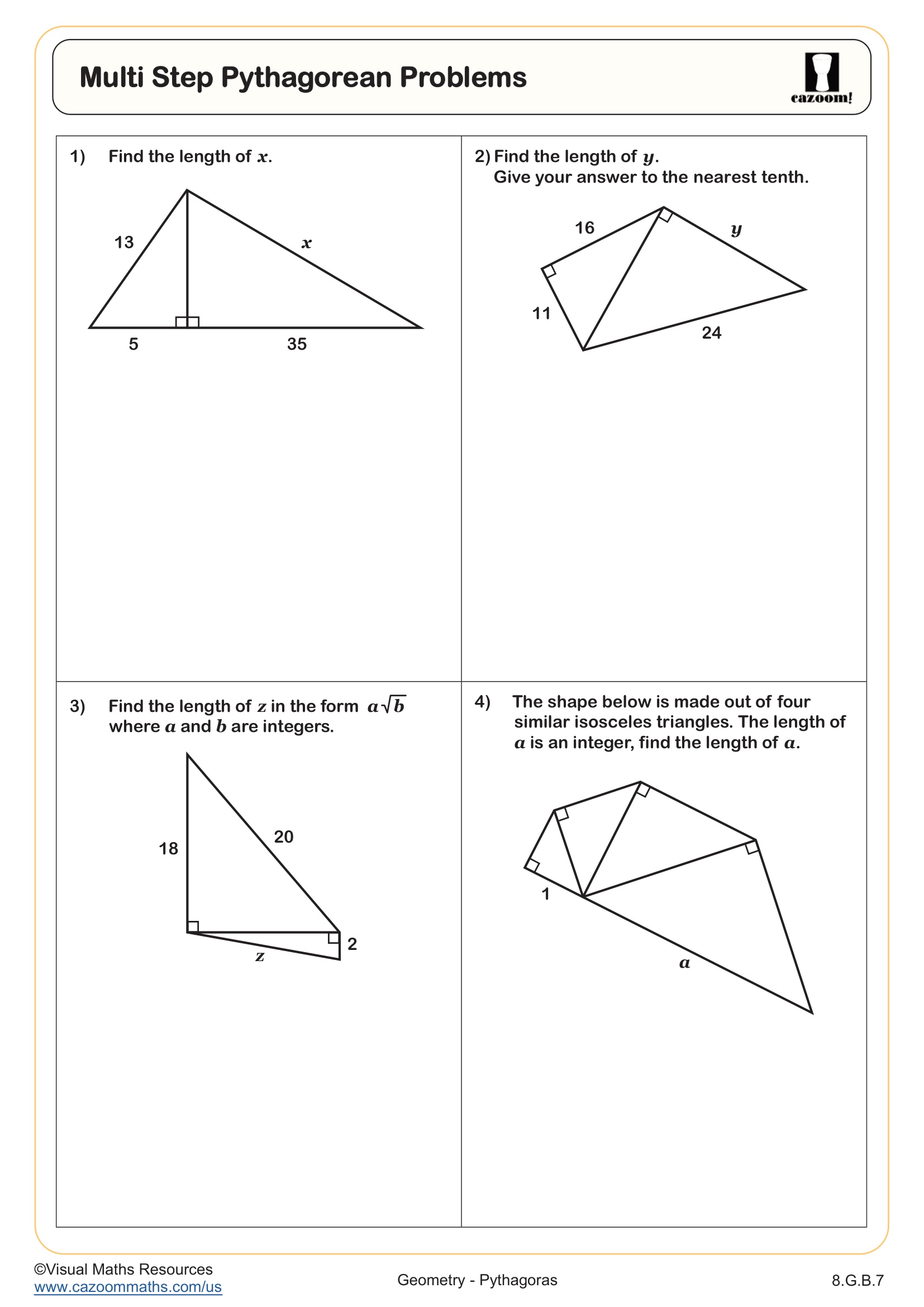
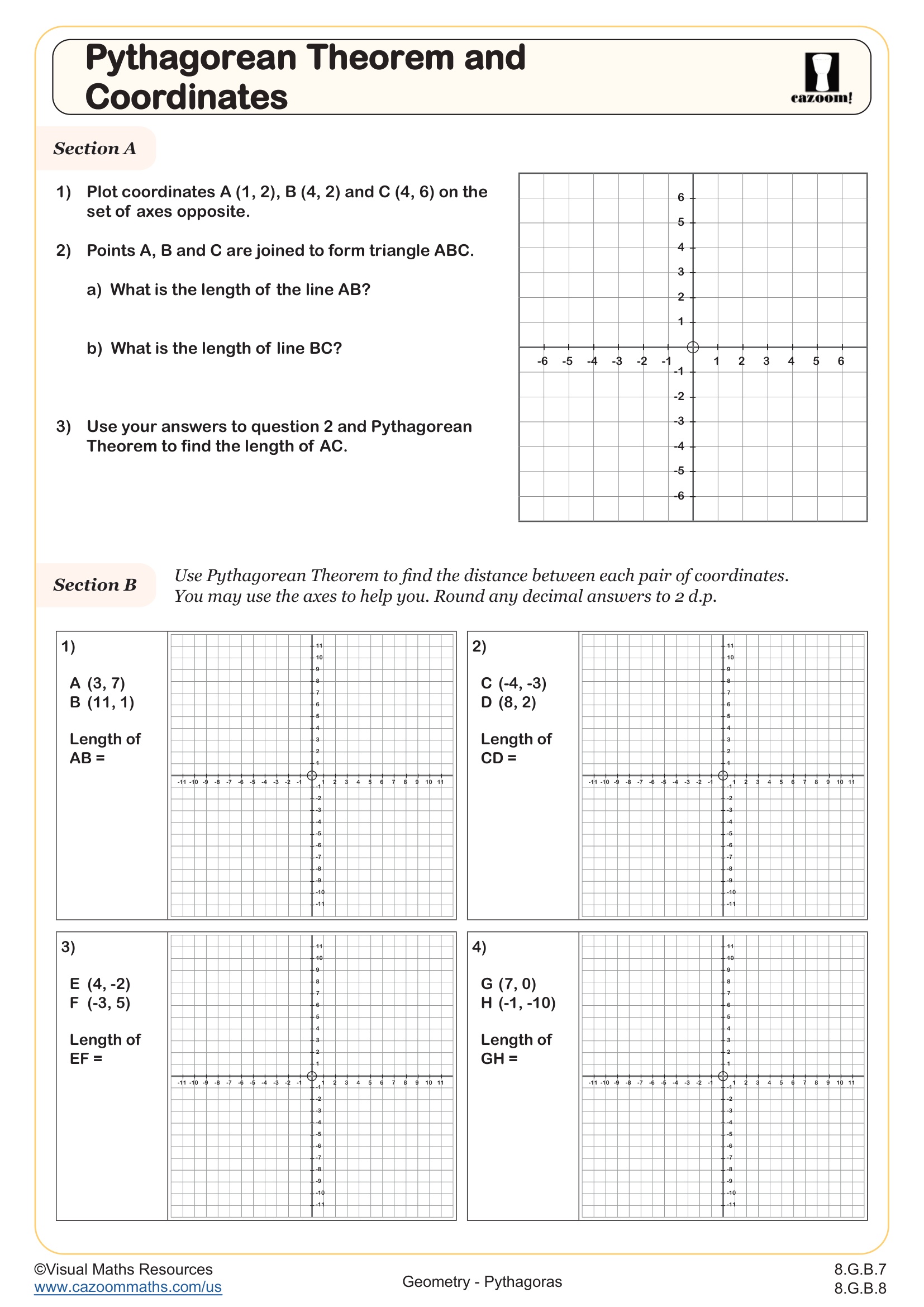
All worksheets are created by the team of experienced teachers at Cazoom Math.
What is the Pythagorean Theorem and why do students learn it?
The Pythagorean Theorem states that in any right triangle, the square of the hypotenuse equals the sum of the squares of the two legs: a² + b² = c². High school geometry students study this theorem as part of Common Core standard HSG-SRT.C.8, which connects geometric relationships to algebraic reasoning. The theorem appears throughout standardized assessments and serves as a bridge between geometry, algebra, and trigonometry.
Students often struggle initially with recognizing that the theorem only applies to right triangles and that c must always represent the hypotenuse, not just any side. A common error pattern appears when students solve for a leg but accidentally take the square root of (c² + b²) instead of (c² - b²). Once students visualize the theorem using area models—seeing the squares literally built on each side—the algebraic relationship becomes more intuitive and errors decrease significantly.
What grade level learns the Pythagorean Theorem?
The Pythagorean Theorem is typically introduced in eighth grade as an initial exposure, then thoroughly developed in high school geometry courses. At the high school level, students move beyond basic calculations to explore proofs, apply the theorem to coordinate geometry, and solve complex multi-step problems that require strategic thinking about which triangle to analyze first.
The progression in high school geometry starts with identifying right triangles and calculating missing sides, then advances to distance formula applications (which derive directly from the theorem), three-dimensional problems, and scenarios requiring auxiliary lines or multiple applications. Teachers notice that students who master the basic theorem in eighth grade approach high school applications with more confidence, while those encountering it for the first time need additional practice with the fundamental a² + b² = c² relationship before tackling coordinate plane problems.
How does the Pythagorean Theorem connect to coordinate geometry?
The distance formula used to find the length between two points on a coordinate plane is actually the Pythagorean Theorem in disguise. When finding the distance between points (x₁, y₁) and (x₂, y₂), the horizontal distance (x₂ - x₁) and vertical distance (y₂ - y₁) form the legs of a right triangle, with the straight-line distance as the hypotenuse. This connection appears explicitly in geometry standards and on state assessments.
This relationship has direct STEM applications in GPS navigation systems, which calculate distances between coordinates to determine routes and travel times. Computer graphics and game design rely on these calculations constantly—whenever a character moves across a screen or a physics engine calculates collision detection, the Pythagorean Theorem determines distances between coordinate points. Architects and engineers use the same principle when working with blueprints and technical drawings, translating two-dimensional plans into three-dimensional construction measurements.
How can teachers use these Pythagorean Theorem worksheets effectively?
These worksheets scaffold learning from foundational concepts through challenging applications, allowing teachers to differentiate instruction based on student readiness. The progression from identifying right triangles to multi-step problems helps students build confidence before tackling complex scenarios. The included answer keys enable self-checking during independent practice, which research shows increases student metacognition and error correction without teacher intervention for every problem.
Many teachers use the basic calculation worksheets for homework after introducing the theorem, then reserve coordinate plane and multi-step problems for guided practice where students can discuss strategies. The worksheets work well for intervention with students who need additional practice beyond the textbook, and for review before unit tests or state assessments. Paired work with these worksheets encourages mathematical discussion—students explain their reasoning about which side is the hypotenuse or why they chose subtraction versus addition when solving for a leg.