Geometry Space Worksheets
All worksheets are created by the team of experienced teachers at Cazoom Math.
How does geometry apply to space exploration?
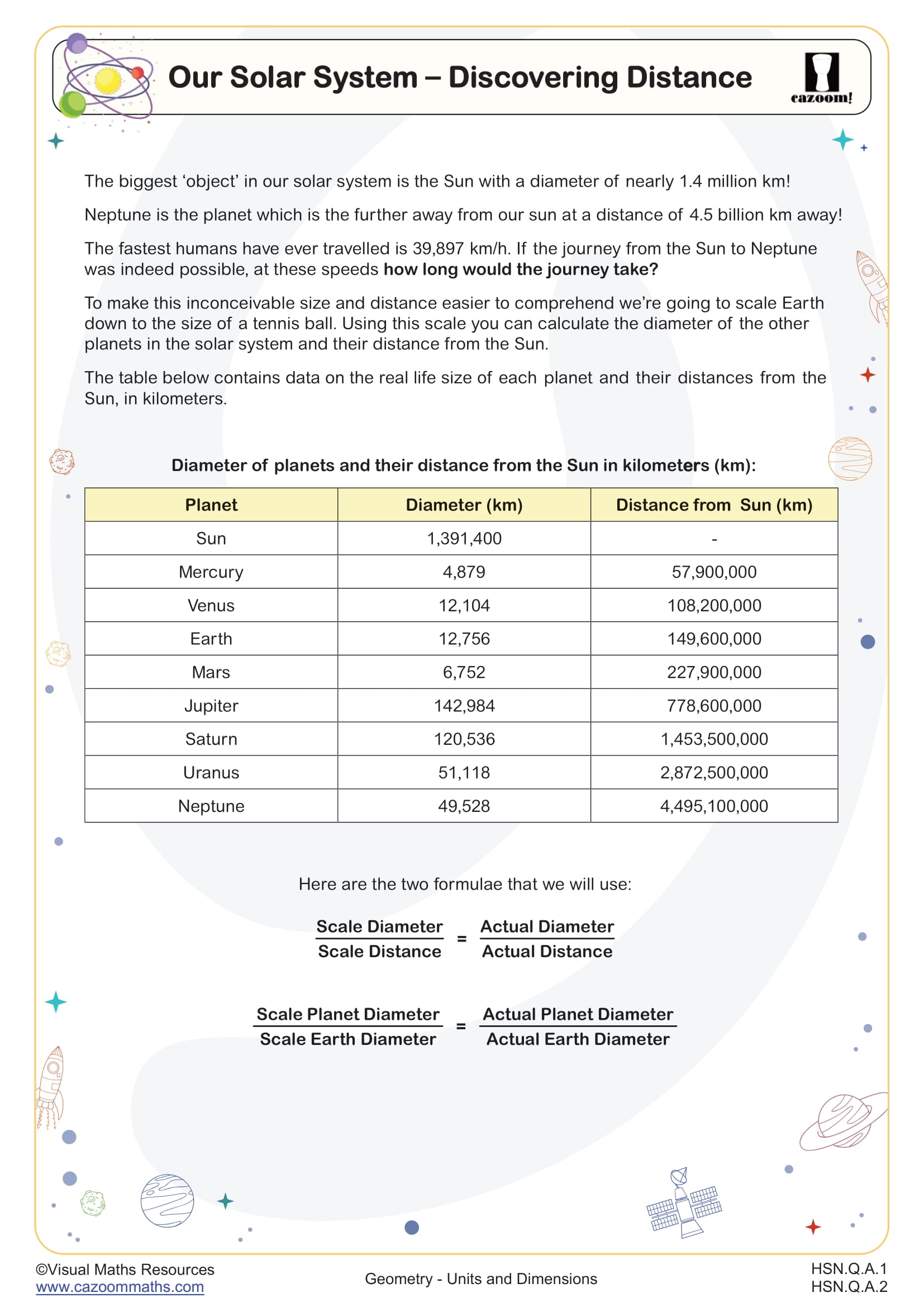
Geometry forms the mathematical foundation for nearly every aspect of space exploration, from calculating orbital trajectories using ellipse equations to designing spacecraft structures with precise measurements and transformations. Students use coordinate geometry to plot positions, apply reflections and rotations to understand spacecraft orientation, and work with scale factors to comprehend astronomical distances that range from thousands to billions of miles.
A common misconception students hold is that space science only requires physics or astronomy knowledge. Teachers frequently observe that students underestimate how geometric principles like symmetry, proportional reasoning, and conic sections directly translate to mission-critical calculations. When students realize that the same transformation matrices they practiced in class help position solar panels on the International Space Station, geometry becomes tangibly relevant rather than theoretical.
What grade level are these space geometry worksheets for?
These worksheets target high school geometry students who have developed foundational skills in coordinate systems, transformations, and proportional reasoning. The problems assume familiarity with graphing on coordinate planes, calculating distances, working with scale factors, and applying reflection properties—all standard expectations in high school geometry coursework aligned with Common Core standards.
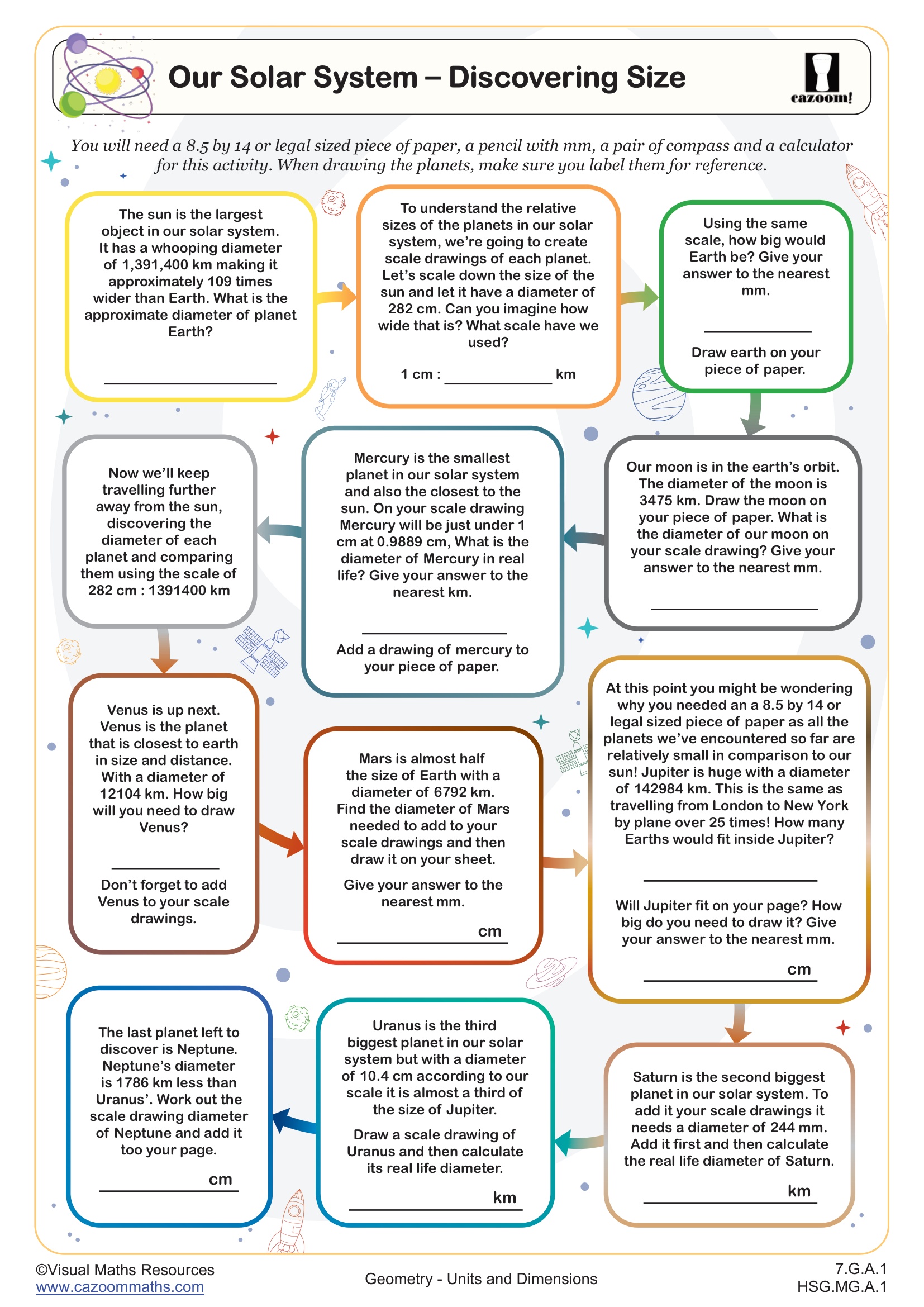
The collection progresses from more accessible scale problems involving solar system sizes to more sophisticated applications like modeling elliptical orbits and applying multiple transformations to spacecraft designs. Students who initially struggle with abstract transformation notation often find breakthrough moments when they see these operations applied to recognizable objects like the SpaceX Dragon capsule or the International Space Station, making the mathematical processes more concrete and purposeful.
Why do orbital paths follow elliptical shapes?
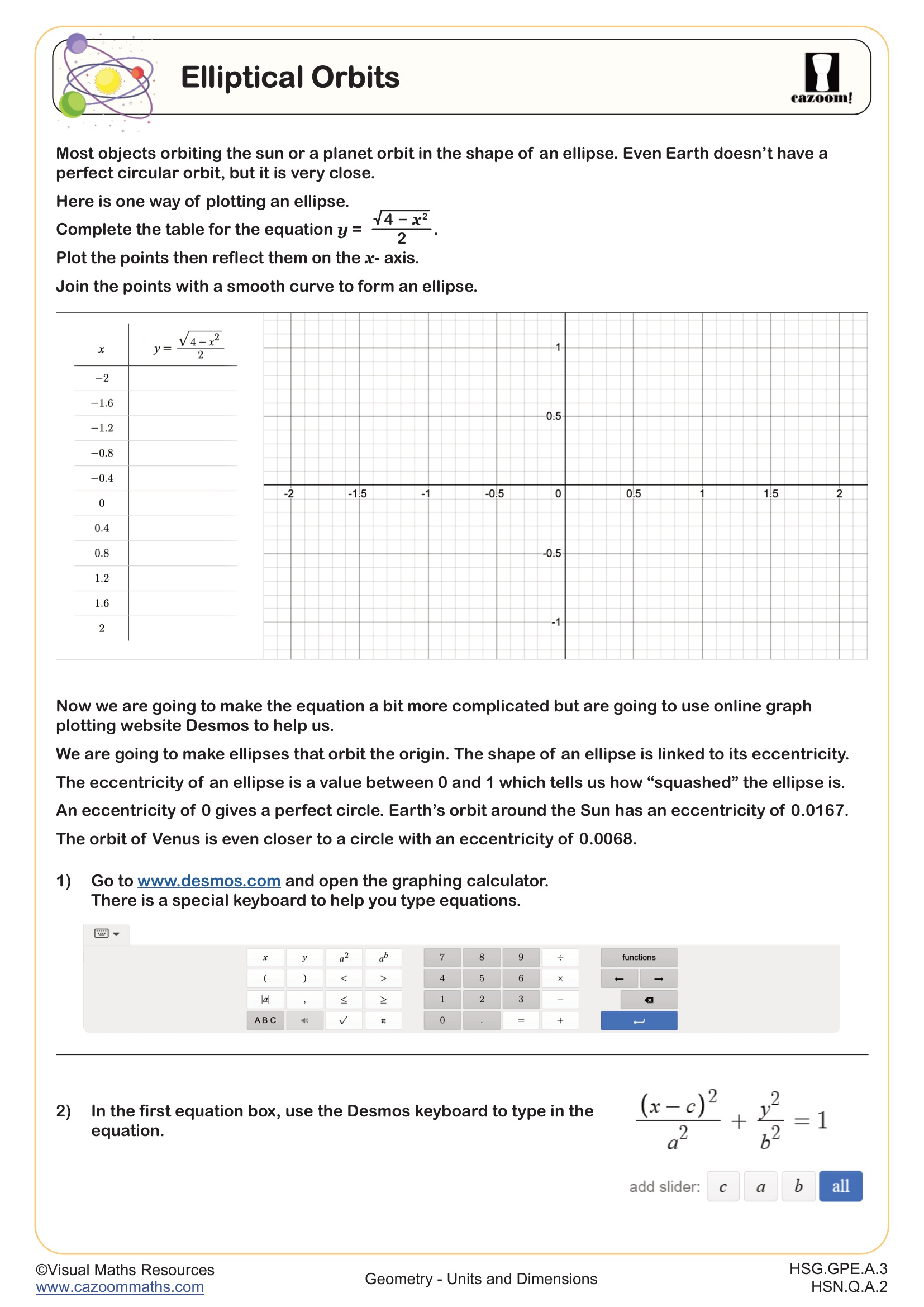
Elliptical orbits result from the gravitational interaction between celestial bodies, described mathematically by Kepler's laws and represented geometrically using conic sections. In geometry class, students study ellipses through their algebraic equations and geometric properties—two foci, major and minor axes, and the constant sum of distances from any point to both foci. These same mathematical relationships govern how planets orbit the Sun and how satellites circle Earth.
This connection appears directly in aerospace engineering when mission planners design satellite trajectories or interplanetary transfers. GPS satellites, for instance, follow elliptical paths that engineers calculate using the exact ellipse properties students practice on these worksheets. Understanding elliptical geometry allows students to comprehend why satellites don't travel in perfect circles and how space agencies predict exactly where a spacecraft will be at any given time—critical for everything from communications timing to rendezvous maneuvers between vehicles in orbit.
How can teachers use these space-themed geometry worksheets effectively?
The worksheets scaffold learning by presenting geometric concepts through progressively challenging space contexts, beginning with scale comparisons that reinforce proportional reasoning before advancing to transformations and conic sections. The complete answer keys show detailed solution steps, allowing students to check their work independently and identify exactly where errors occur in multi-step problems—particularly valuable since these application problems often involve several geometric operations in sequence.
Many teachers use these worksheets as engagement tools when students question the relevance of geometric transformations or coordinate geometry. The space theme works particularly well for differentiated instruction, where advanced students tackle the elliptical orbit or transformation problems while others build confidence with scale and distance calculations. Teachers also report success using these as collaborative problem-solving activities, where pairs work through the spacecraft design problems together, discussing how each geometric step connects to the engineering challenge at hand.