Geometry Transformations Worksheets
All worksheets are created by the team of experienced teachers at Cazoom Math.
What transformations do students learn in high school geometry?
High school geometry students work with four fundamental transformations: translations (slides), reflections (flips), rotations (turns), and dilations (size changes). The Common Core State Standards emphasize rigid motions, transformations that preserve distance and angle measures, as the foundation for understanding congruence. Students learn to describe transformations using coordinate notation, recognize transformation types from before-and-after images, and perform sequences of transformations.
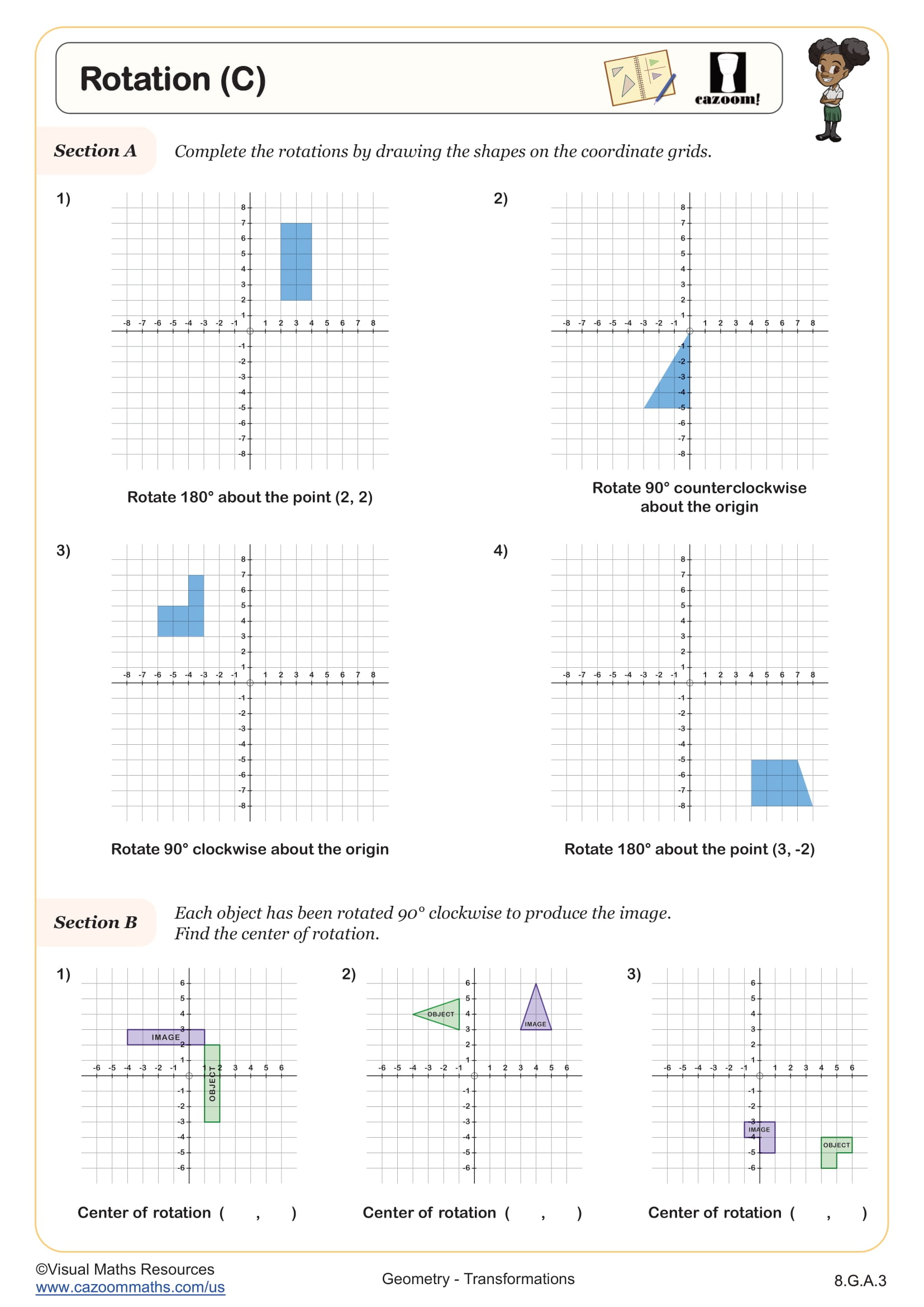
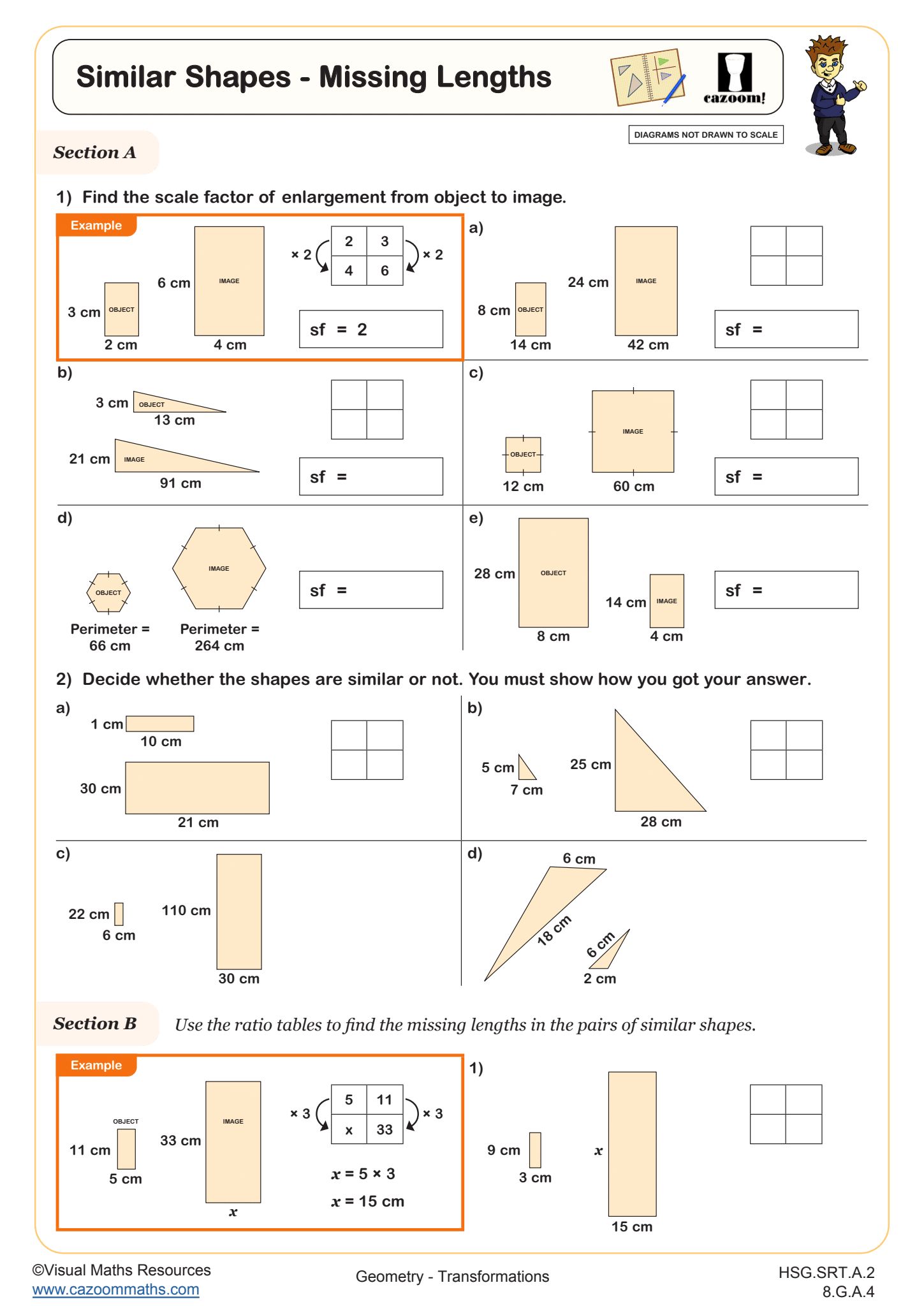
A common error occurs when students attempt rotations around the origin. Many students correctly identify the rotation angle but reverse the direction, rotating clockwise when counterclockwise is required. Standardized assessments frequently test whether students recognize that translations, reflections, and rotations produce congruent figures, while only dilations create similar figures. Students lose points when they claim a dilation preserves congruence or fail to identify the center of rotation in multi-step transformation problems.
What grade level studies transformations?
These transformation worksheets align with high school geometry courses, typically taught in grades 9 or 10 depending on the student's math pathway. The content directly supports geometry curriculum standards where students formalize their understanding of transformations on the coordinate plane and connect these concepts to formal proofs of congruence and similarity.
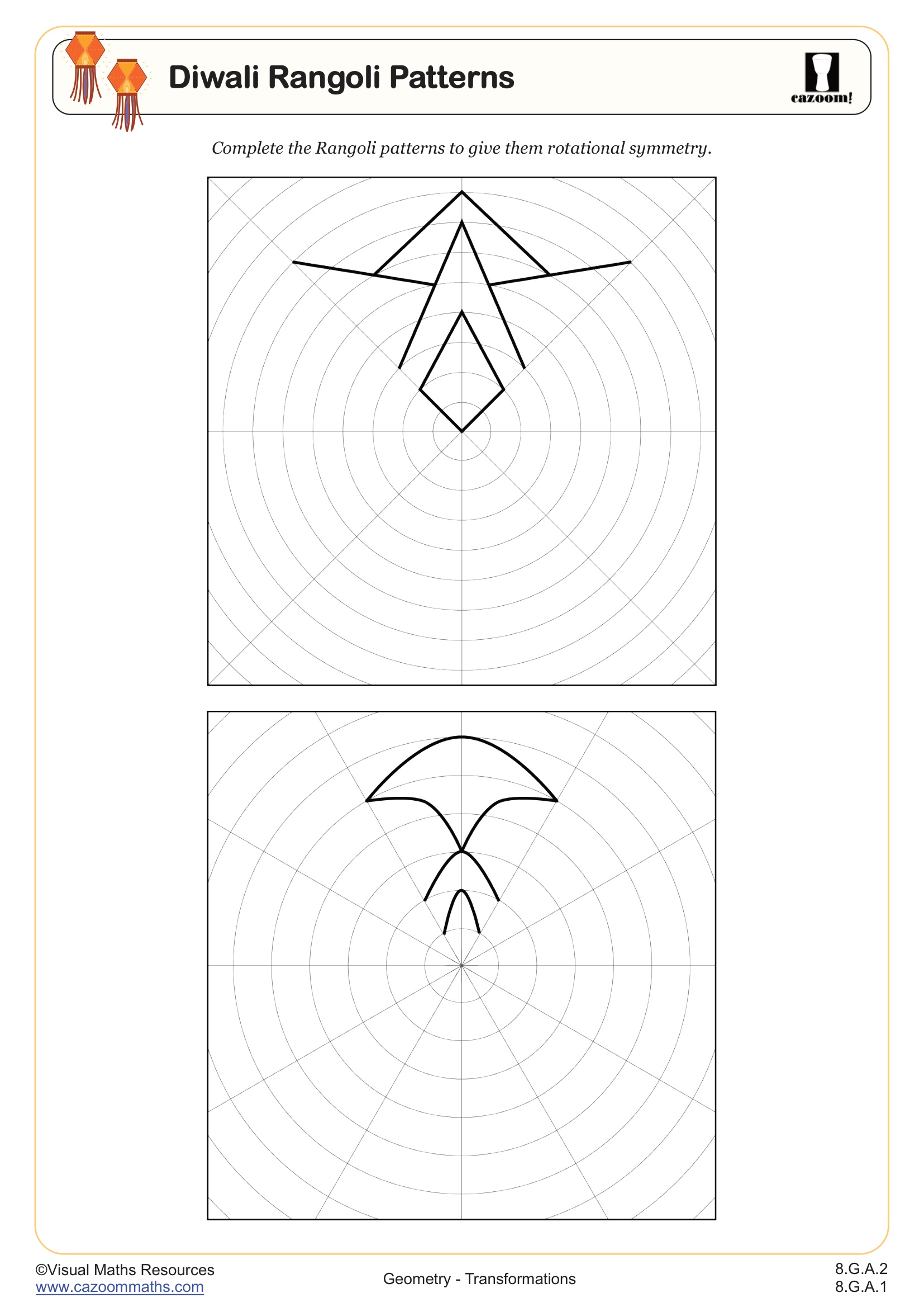
The worksheets progress from recognizing and describing single transformations to applying sequences of transformations and analyzing symmetric patterns. Problems increase in complexity from basic reflections across the x-axis or y-axis to rotations around points other than the origin and compositions involving multiple transformation types. Advanced problems require students to determine what transformation or series of transformations maps one figure onto another, building the analytical skills needed for geometric proofs and construction challenges.
How do rotations work on the coordinate plane?
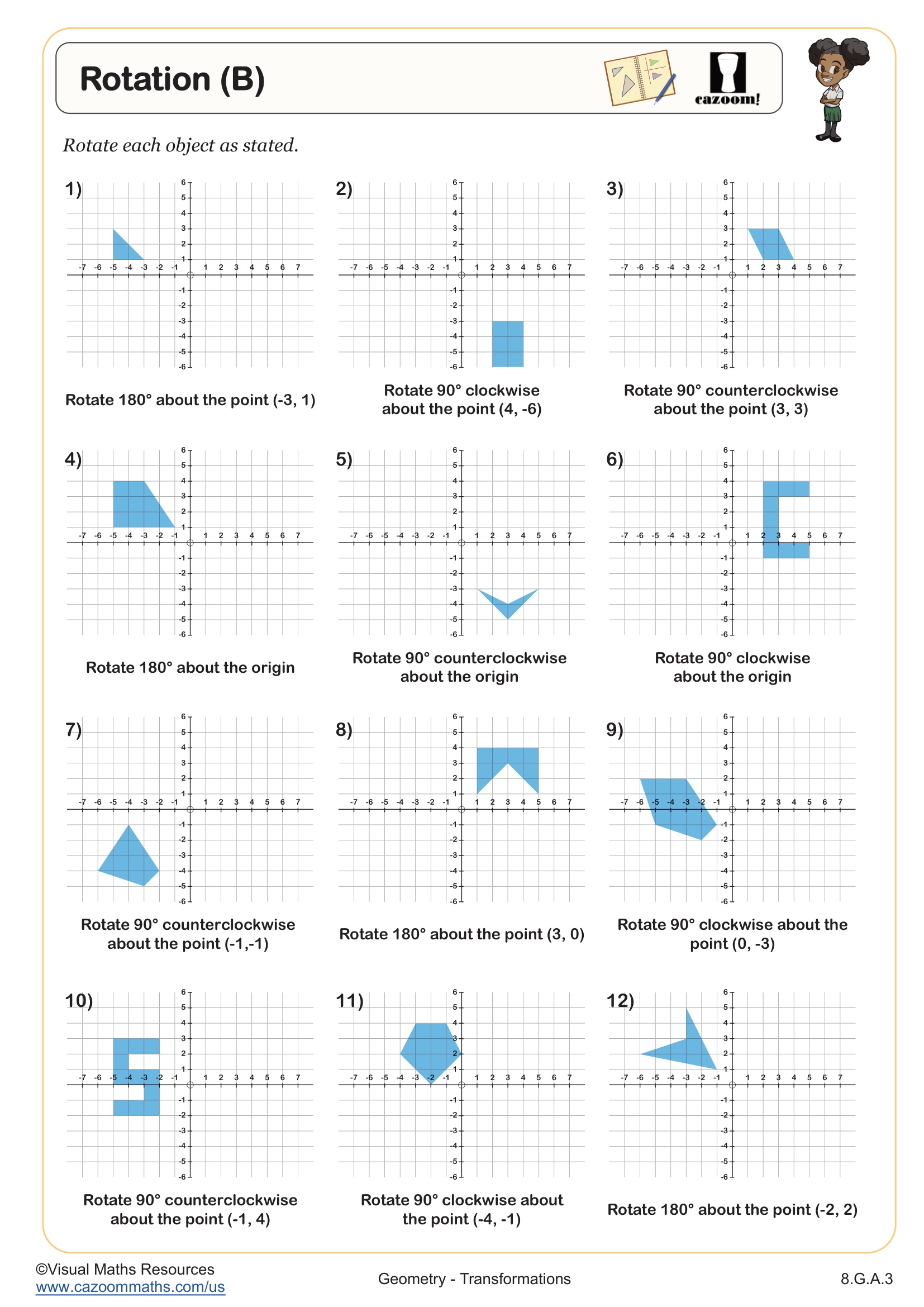
Rotations turn a figure around a fixed point called the center of rotation, typically the origin in coordinate geometry. Students learn standard rotation rules: 90° counterclockwise transforms point (x, y) to (-y, x), 180° changes it to (-x, -y), and 270° counterclockwise produces (y, -x). Teachers observe that students master these rules more quickly when they first practice with graph paper and tracing paper to physically see how coordinates change, then recognize the algebraic patterns.
Computer graphics and animation rely heavily on rotation transformations. Game developers use rotation matrices to spin characters, rotate camera views, and create realistic motion. Robotics engineers program rotational transformations to control robotic arms in manufacturing, where precision rotations around multiple axes allow robots to assemble components, weld joints, or package products. Understanding how coordinates change during rotation provides the mathematical foundation for these real-world applications in computer science and engineering fields.
How can teachers use these transformation worksheets effectively?
The worksheets provide structured practice that builds from identifying transformation types to performing complex compositions. Each problem set includes varied question formats: some provide the transformation rule and ask students to find the image, while others show both pre-image and image and require students to describe the transformation. This variety helps students develop both procedural fluency and conceptual understanding, preparing them for the mixed-format questions common on state assessments and the SAT.
Many teachers use these worksheets for differentiated instruction during geometry units. Struggling students benefit from starting with symmetric pattern recognition before tackling coordinate-based transformations, while advanced students can work through rotation problems at higher difficulty levels. The complete answer keys allow for self-checking during independent practice or homework, and teachers often assign specific subtopics as targeted intervention when assessment data reveals gaps in transformation knowledge. Paired work sessions where students explain their transformation reasoning to partners consistently strengthen both procedural skills and mathematical communication.