High School Algebraic Proof Worksheets
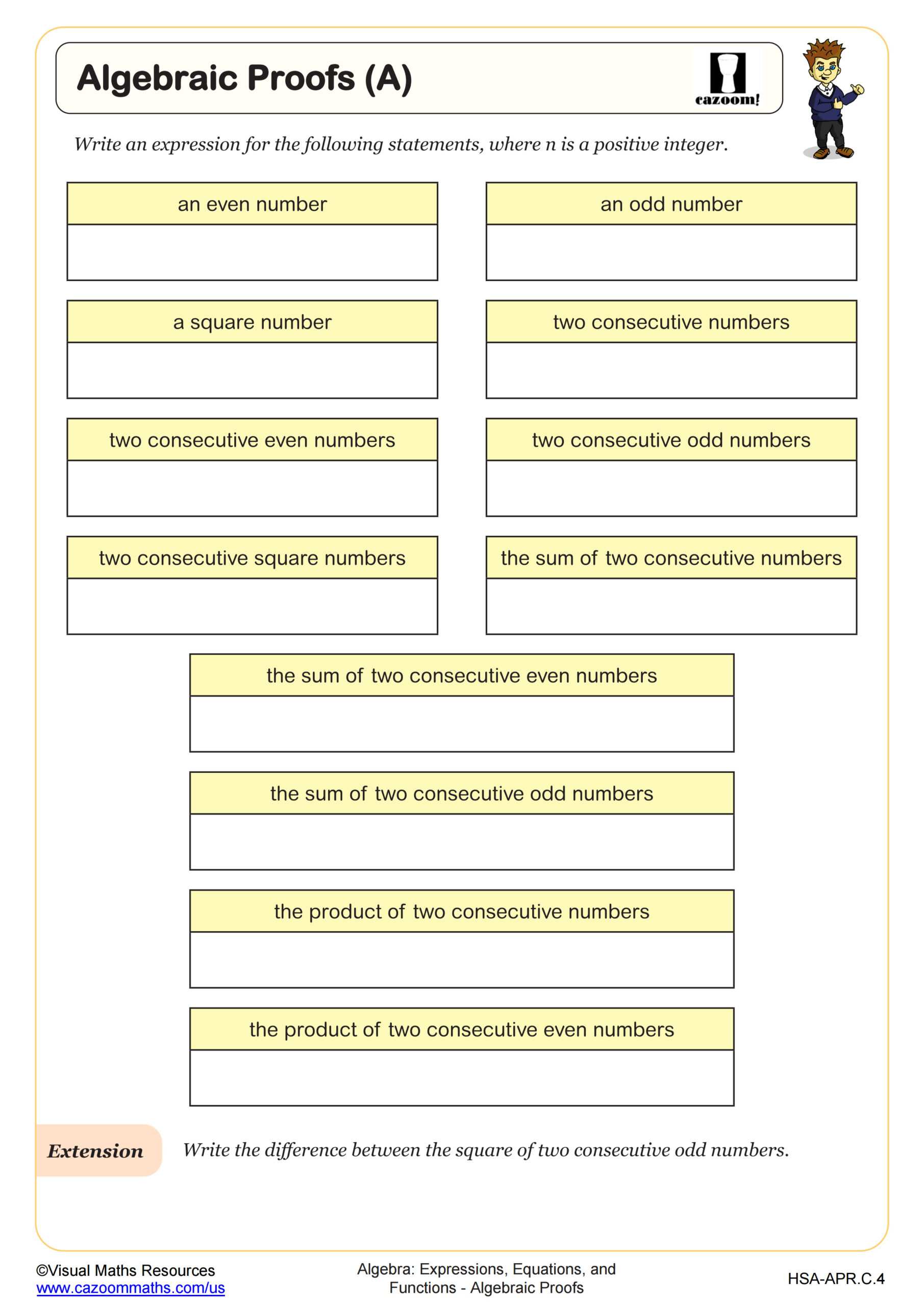
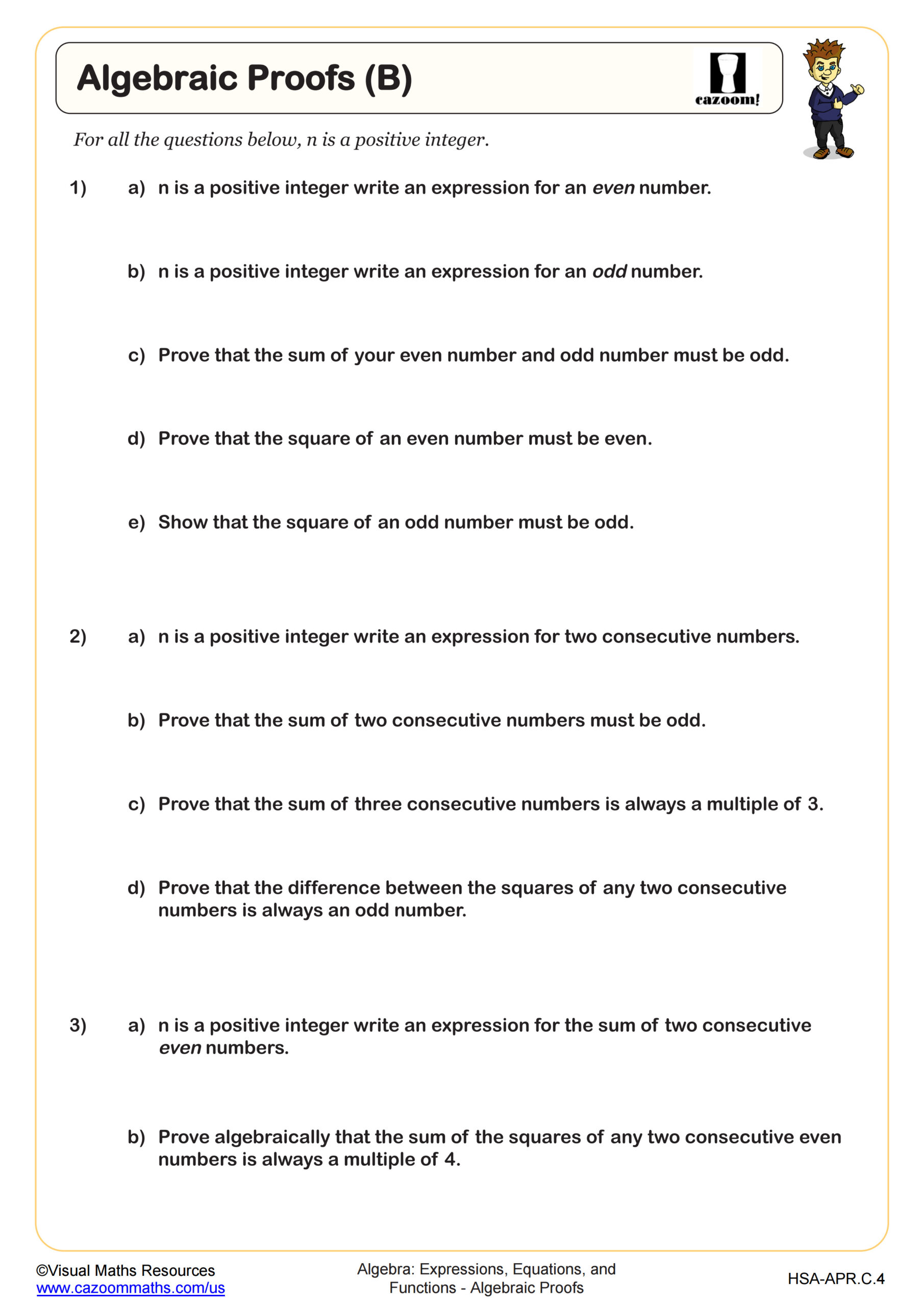
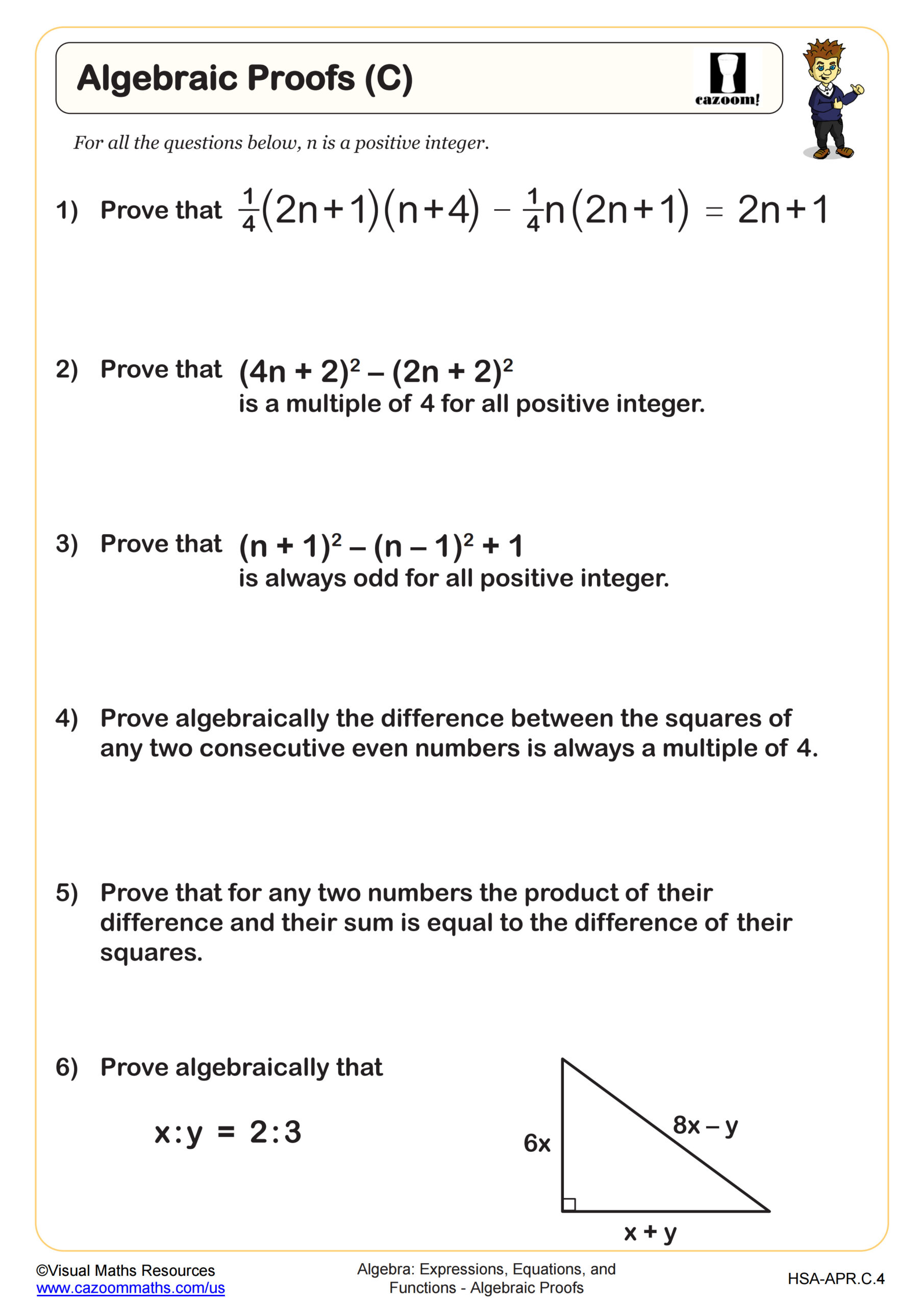
All worksheets are created by the team of experienced teachers at Cazoom Math.
What Are Algebraic Proofs and Why Do Students Learn Them?
Algebraic proofs are formal arguments that justify why algebraic statements are true by citing specific properties of real numbers and equality. Students write two-column or paragraph-style proofs that list each algebraic step alongside the property that allows that step, such as the Commutative Property of Addition, the Multiplication Property of Equality, or the Reflexive Property. This skill appears throughout Common Core State Standards for high school mathematics and connects directly to proof-writing in geometry and advanced courses.
Students often make the mistake of writing "simplify" or "solve" as justifications rather than naming the actual property being used. For example, when combining like terms in 3x + 5x = 8x, students might write "combine" instead of recognizing this uses the Distributive Property (factoring out the common x). Standardized tests and state assessments regularly include questions asking students to identify missing steps or justifications in algebraic arguments, making this a tested skill beyond theoretical importance.
Which Grade Levels Use Algebraic Proof Worksheets?
These algebraic proof worksheets align with Algebra I, Algebra II, Geometry, Precalculus, and Integrated Mathematics courses (IM 1, IM 2, IM 3) throughout high school. The topic typically appears first in Algebra I when students learn properties of equality and real numbers, then resurfaces in Geometry as students apply similar reasoning to angle relationships and geometric statements. The skill continues developing through upper-level courses as proofs become more abstract and involve advanced algebraic structures.
The progression across grade levels moves from proving simple one-step equations using basic properties to multi-step proofs involving distribution, combining like terms, and substitution. Algebra I students might prove why 2(x + 3) = 2x + 6 using the Distributive Property, while Algebra II students prove identities or work with more complex expressions. Geometry students connect algebraic proof techniques to geometric reasoning, recognizing that the logical structure remains consistent across mathematical domains. Integrated Mathematics courses weave these skills throughout the curriculum rather than isolating them in single units.
What Is the Two-Column Proof Format in Algebra?
The two-column proof format organizes algebraic arguments into two parallel columns: the left column shows each algebraic statement or step, while the right column provides the property or reason justifying that step. This structured approach helps students see the logical flow of an argument and ensures they account for every transformation they make. Students begin with a given statement, perform valid operations, and conclude with what they needed to prove, with each line building on previous steps using properties like the Transitive Property, Addition Property of Equality, or Inverse Property.
This logical reasoning skill translates directly to computer programming and algorithm design, where every step in a process must be justified and each operation has defined rules. Software engineers writing code must understand why each line executes as it does, following logical sequences similar to algebraic proofs. In physics and engineering, professionals regularly justify mathematical transformations when deriving formulas or proving equations work under specific conditions. The habit of asking "what property allows this step?" develops critical thinking that extends beyond mathematics into any field requiring systematic problem-solving and verification.
How Can Teachers Use These Algebraic Proof Worksheets Effectively?
These worksheets scaffold learning by presenting proofs of increasing complexity, allowing students to build confidence with simpler arguments before tackling multi-step reasoning. The progression helps students recognize patterns in how properties combine and when specific justifications apply. Answer keys showing complete reasoning for each step serve as models, demonstrating how experienced mathematicians think through formal arguments and which properties apply in different situations.
Teachers often use these worksheets during initial instruction to provide guided practice immediately after introducing proof concepts, helping students internalize the connection between algebraic steps and their justifications. The materials work well for paired work where students check each other's reasoning, catching errors in property identification that individual work might miss. Many teachers assign portions as homework to reinforce classroom learning, then review common misconceptions during the next lesson. The worksheets also serve as targeted intervention for students preparing for state assessments or standardized tests that include proof-related questions, offering concentrated practice on a skill that typically appears in multiple-choice and constructed-response formats.