High School Constructions Worksheets
All worksheets are created by the team of experienced teachers at Cazoom Math.
What Are Geometric Constructions and Why Do They Matter?
Geometric constructions use only a compass and unmarked straightedge to create precise figures, angles, and segments without relying on measurement tools like protractors or rulers. This method, dating back to ancient Greek mathematics, develops spatial reasoning and proves geometric relationships through logical steps rather than numerical calculations. Common Core State Standards require constructions in high school geometry as they bridge intuitive understanding with formal proof.
Many students initially view constructions as outdated until they realize these techniques prove why geometric relationships work rather than just demonstrating that they work. For instance, constructing a perpendicular bisector proves that every point on that line is equidistant from the segment's endpoints, a concept that becomes crucial when studying circle theorems, triangle centers, and coordinate geometry. Students lose points on assessments when their construction arcs are too faint to verify their process or when they erase guidelines that demonstrate their logical steps.
Which Grade Levels Study Construction Techniques?
These construction worksheets serve high school students in Geometry, Algebra I, Algebra II, Precalculus, and Integrated Math 1, 2, and 3 courses. Geometry courses typically introduce constructions as foundational skills during units on segments, angles, and triangles, while Integrated Math courses distribute construction topics across multiple years alongside algebraic and statistical content. State assessments in geometry-focused courses frequently include construction tasks that require students to demonstrate precise technique.
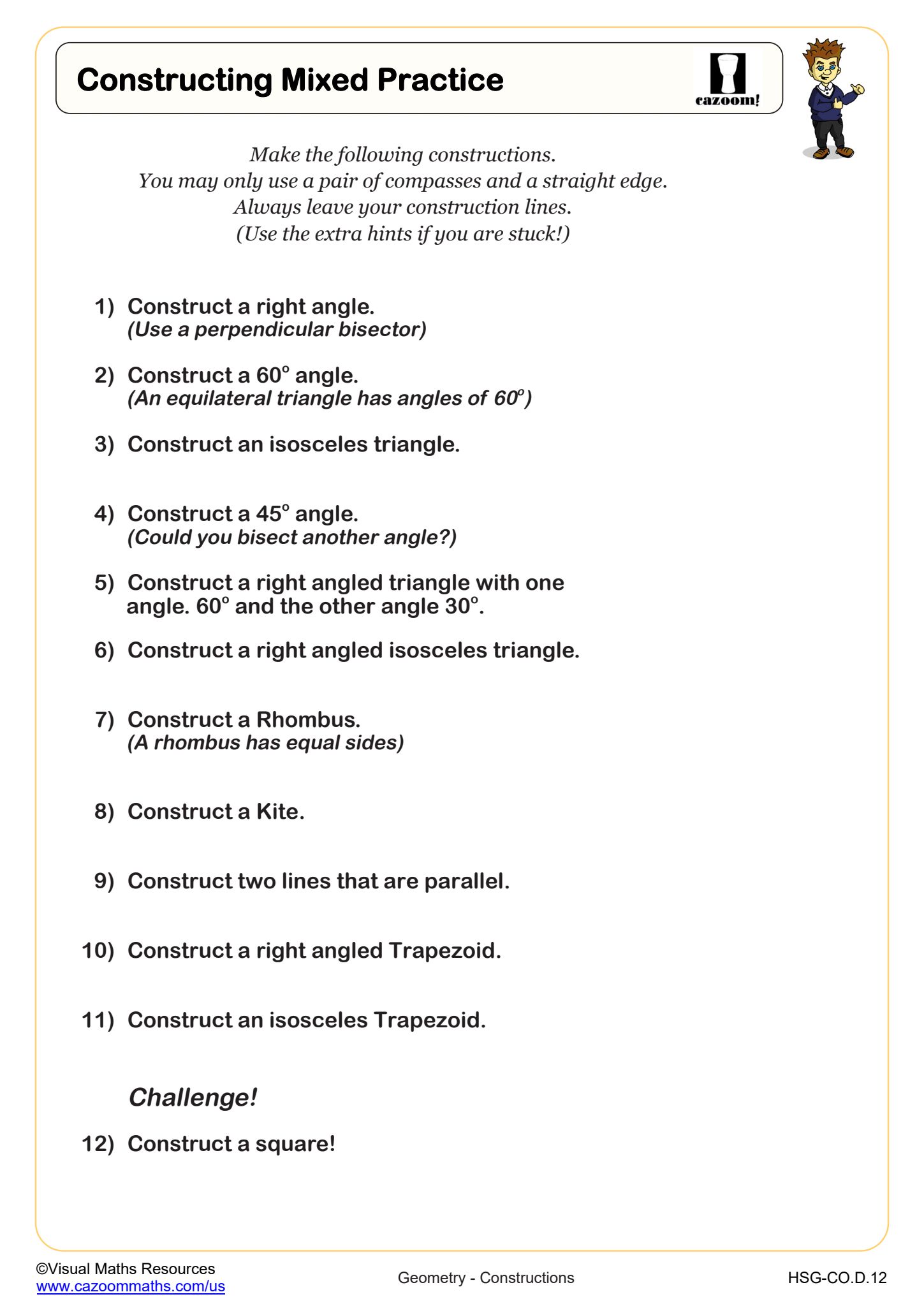
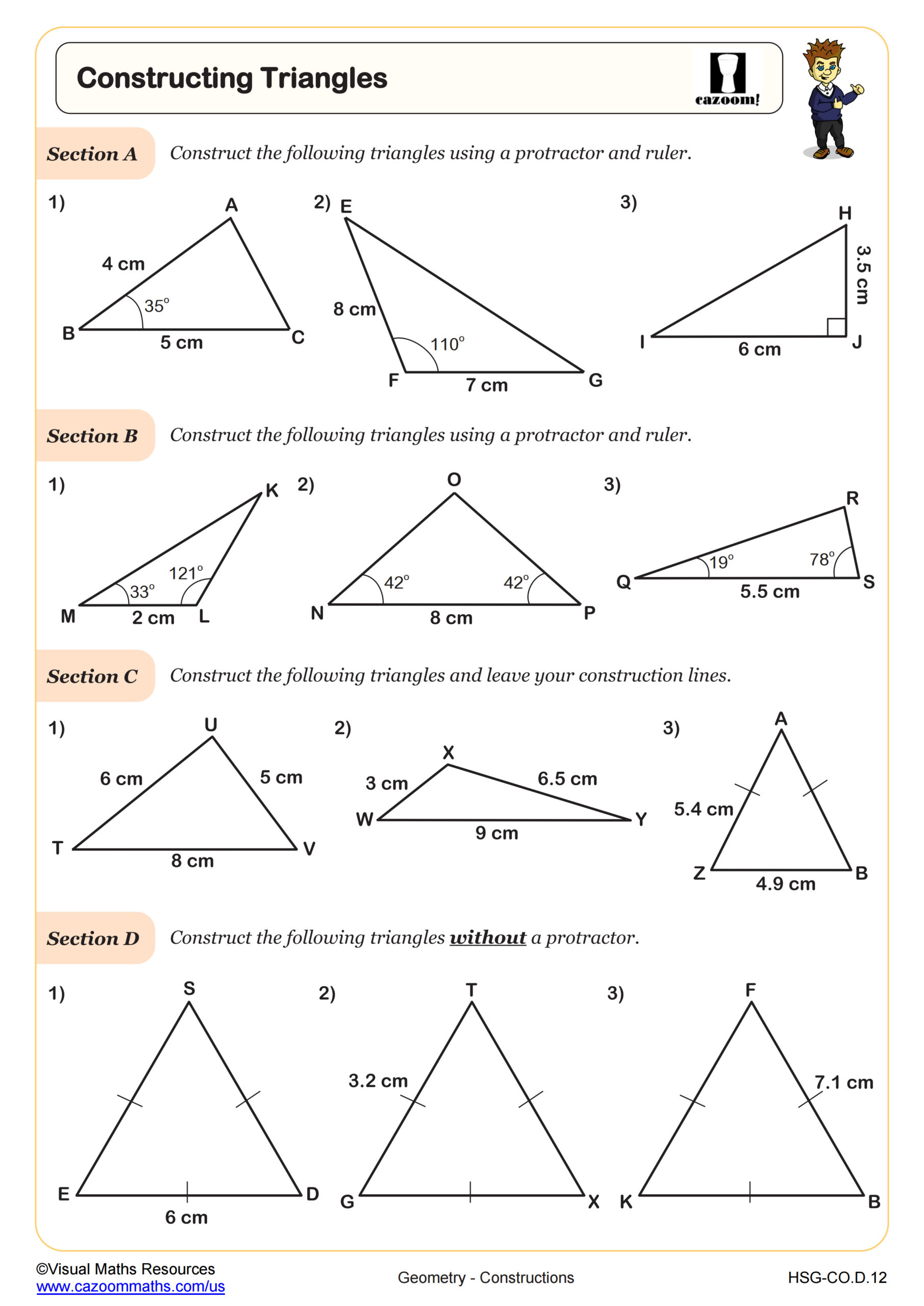
The progression builds systematically from basic perpendicular and angle bisectors toward complex triangle constructions that satisfy multiple constraints. Early worksheets focus on single-step constructions like copying angles or bisecting segments, while advanced problems require students to construct triangles given specific combinations of sides, angles, or special segments. Students working through Integrated Math sequences encounter constructions in context with transformations and coordinate geometry, connecting compass-and-straightedge methods to algebraic representations of the same geometric relationships.
How Do Students Construct Perpendicular Bisectors Accurately?
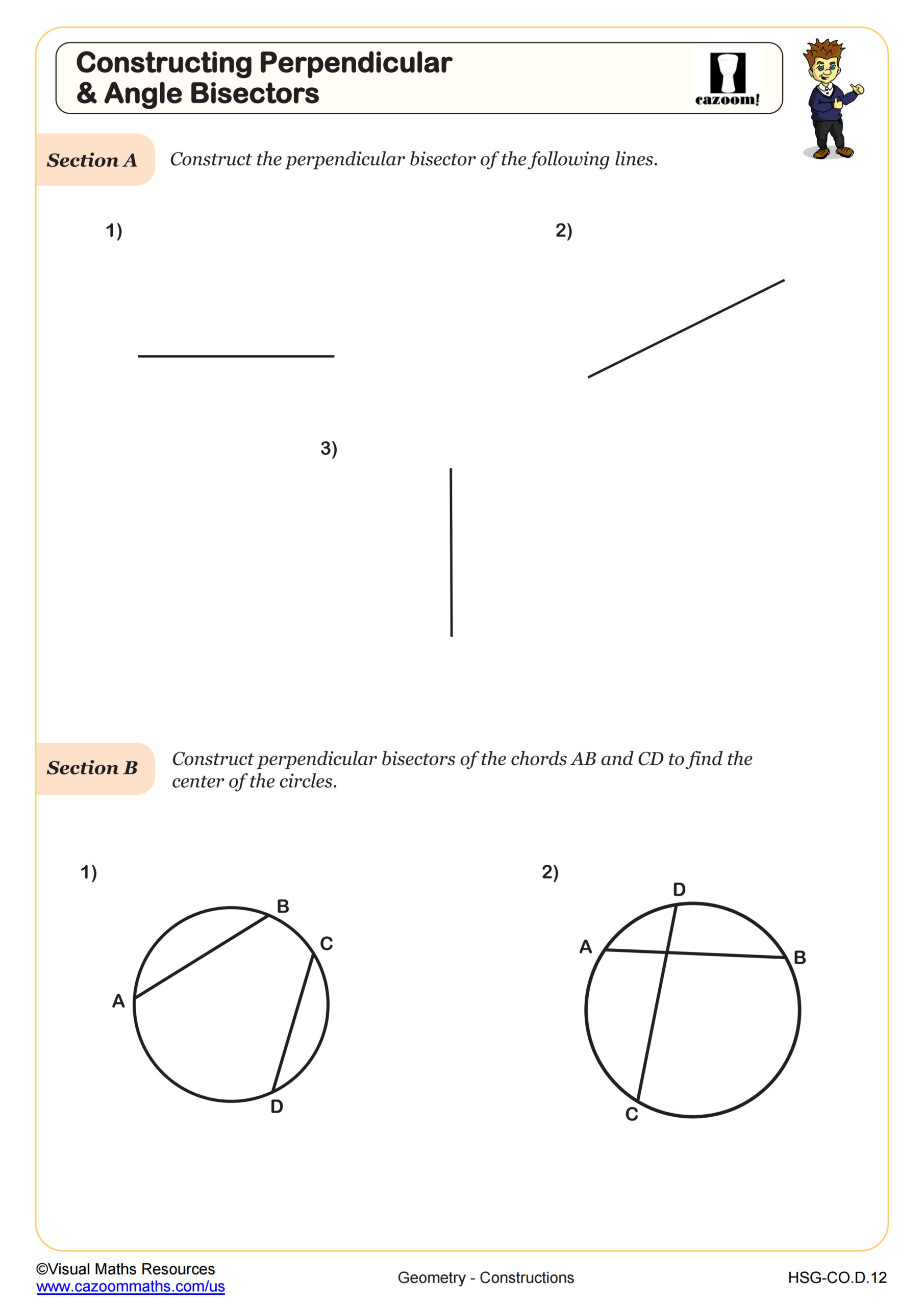
Constructing a perpendicular bisector requires setting the compass width to more than half the segment length, then drawing arcs from each endpoint that intersect above and below the segment. Connecting these intersection points creates a line perpendicular to the original segment that passes through its midpoint. The critical insight students often miss is that the compass width must exceed half the segment length, otherwise the arcs won't intersect and the construction fails before it begins.
This construction technique appears throughout STEM fields, particularly in engineering and computer graphics where perpendicular bisectors locate optimal placement points. Cellular tower placement uses perpendicular bisectors to determine coverage boundaries between towers, ensuring each phone connects to its nearest tower. In robotics, perpendicular bisector constructions help calculate efficient paths and collision-free zones. Students confidently tackle more complex constructions once they recognize that perpendicular bisectors fundamentally create the locus of all points equidistant from two given points, a principle that extends to Voronoi diagrams used in computational geometry and geographic information systems.
How Should Teachers Use These Construction Worksheets?
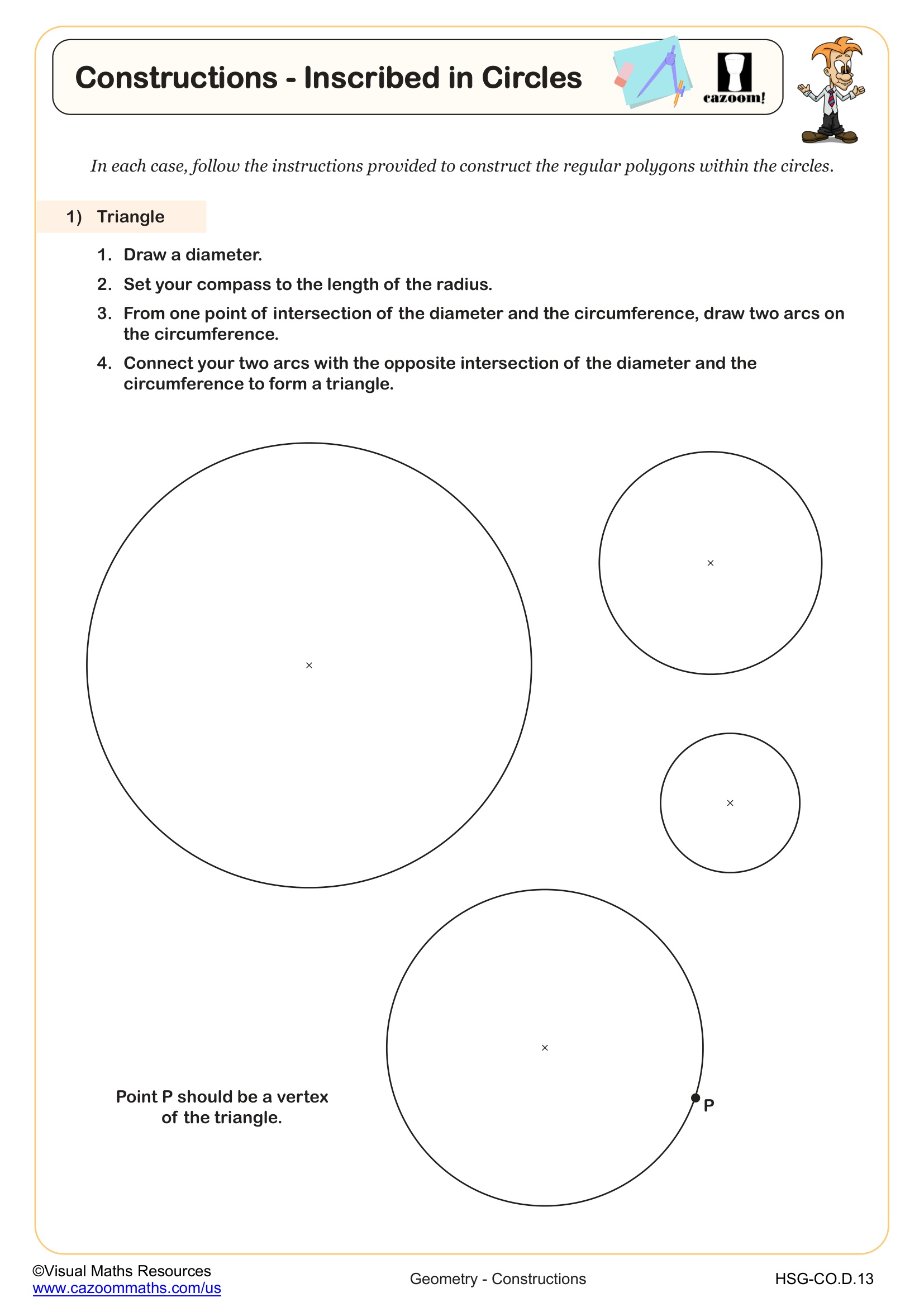
These worksheets provide structured practice that builds from isolated construction skills toward mixed problems requiring students to select and sequence multiple techniques. Each worksheet includes step-by-step construction problems with adequate workspace for compass arcs and straightedge lines, while answer keys display proper construction marks that help teachers verify student technique rather than just final positions. The scaffolding supports students who need repeated practice with fundamental constructions before attempting multi-step challenges.
Teachers use these worksheets for targeted skill development during geometry units, homework assignments that reinforce classroom demonstrations, and review sessions before standardized assessments that test construction knowledge. Paired work proves particularly effective since students can check each other's arc intersections and construction marks in real time, catching errors before they compound. The mixed practice worksheets work well as formative assessments that reveal whether students can distinguish when to construct angle bisectors versus perpendicular bisectors, a decision point where many students falter during tests.