High School Function Machines Worksheets
All worksheets are created by the team of experienced teachers at Cazoom Math.
What Are Function Machines and Why Do They Matter?
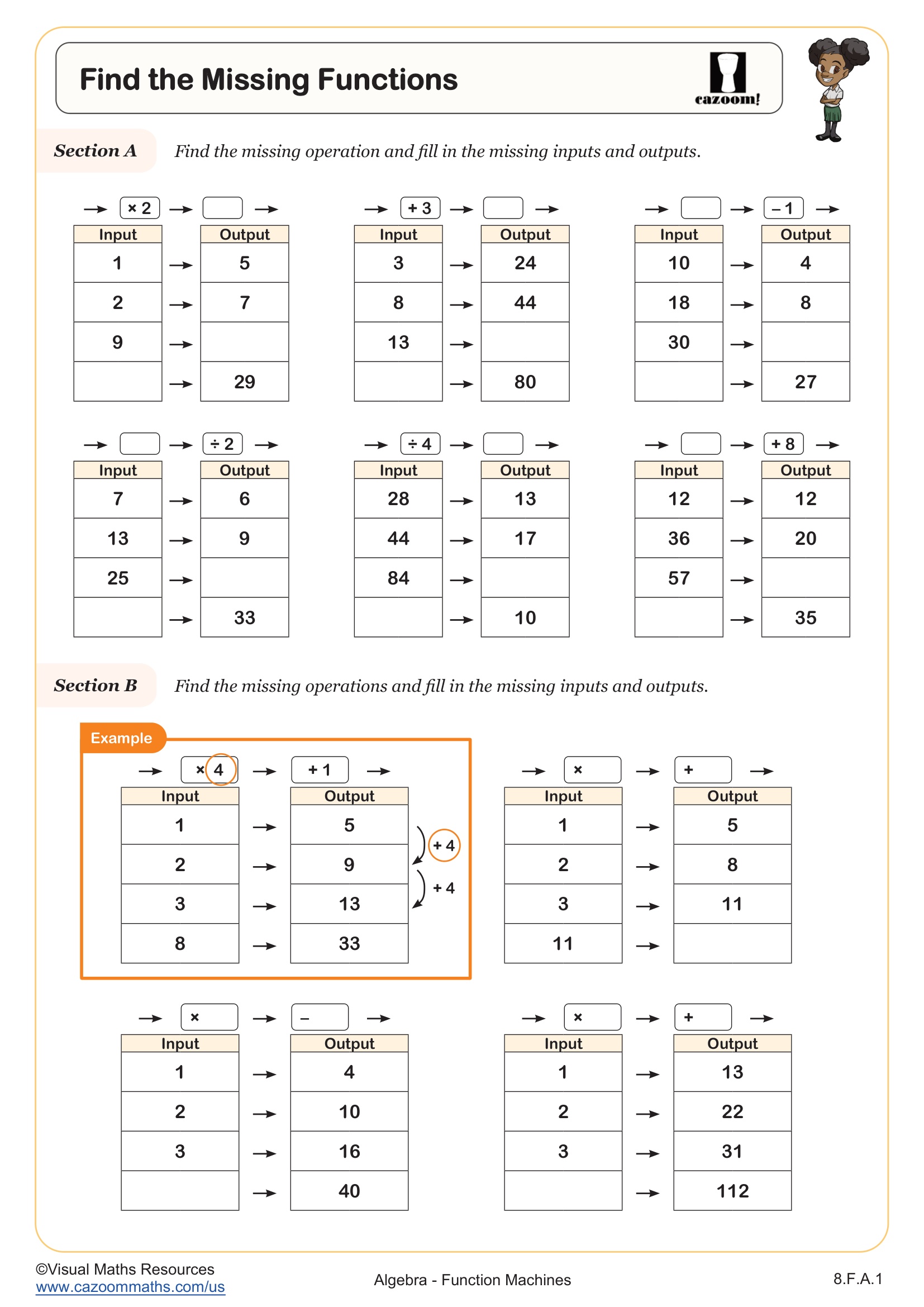
Function machines are visual representations that show how a function takes an input value, applies a rule or operation, and produces an output value. They're particularly valuable for introducing function notation because they make the abstract concept of f(x) concrete and visible. Students see the input go into the machine, the rule applied inside, and the output emerge, which naturally connects to writing expressions like f(x) = 2x + 3.
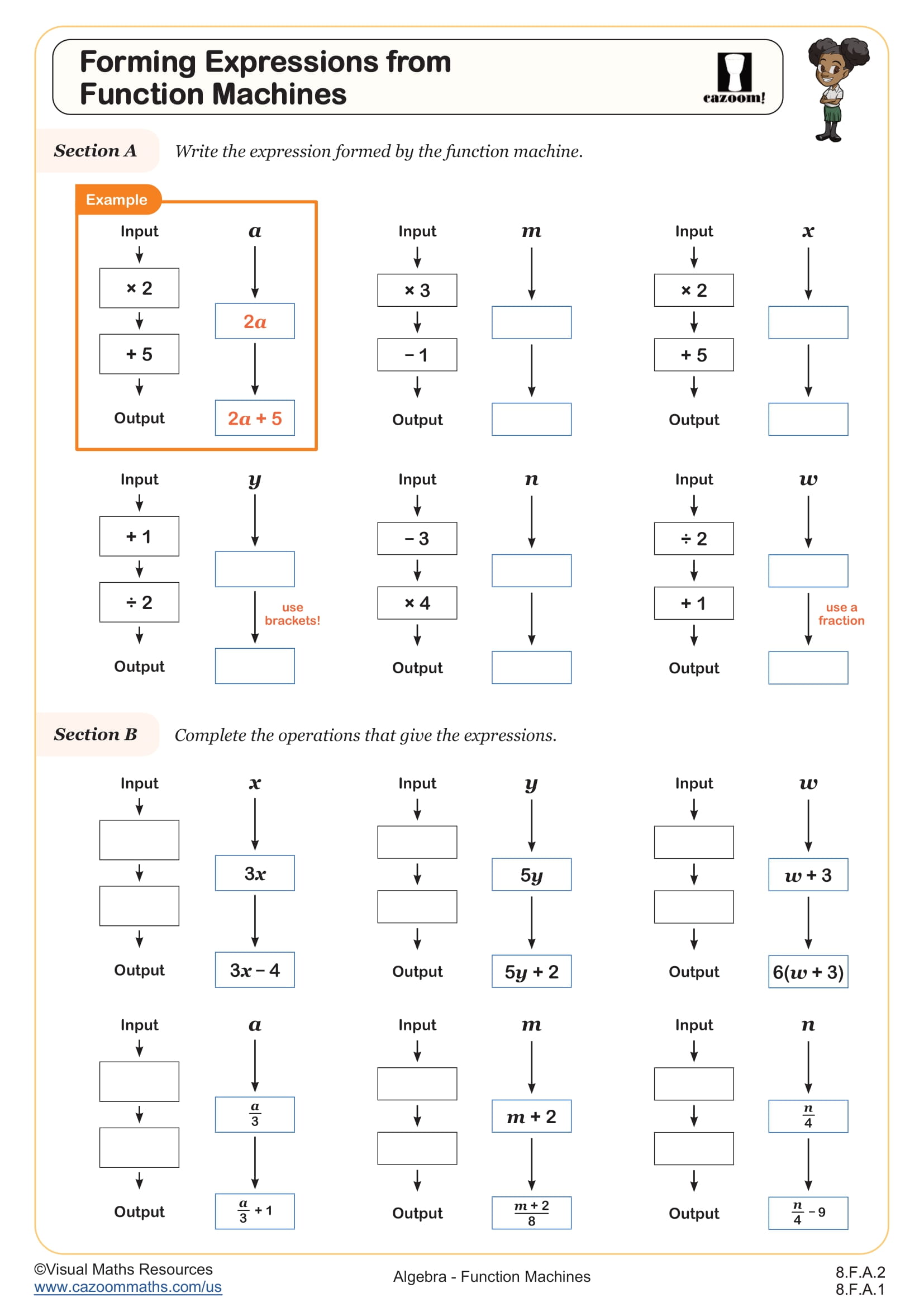
A common misconception occurs when students reverse the order of operations within the function machine. For example, if the machine shows "multiply by 3, then add 5," students sometimes write 5x + 3 instead of 3x + 5. Teachers notice this error decreases significantly when students practice tracing the path of a specific number through each step of the machine before generalizing to a variable expression.
Which Grade Levels Use Function Machines Worksheets?
These function machines worksheets are designed for high school mathematics courses including Algebra I, Algebra II, Geometry, Precalculus, and Integrated Math 1, 2, and 3. The topic appears across multiple courses because function machines reinforce different skills depending on the context, from basic algebraic thinking to complex function composition.
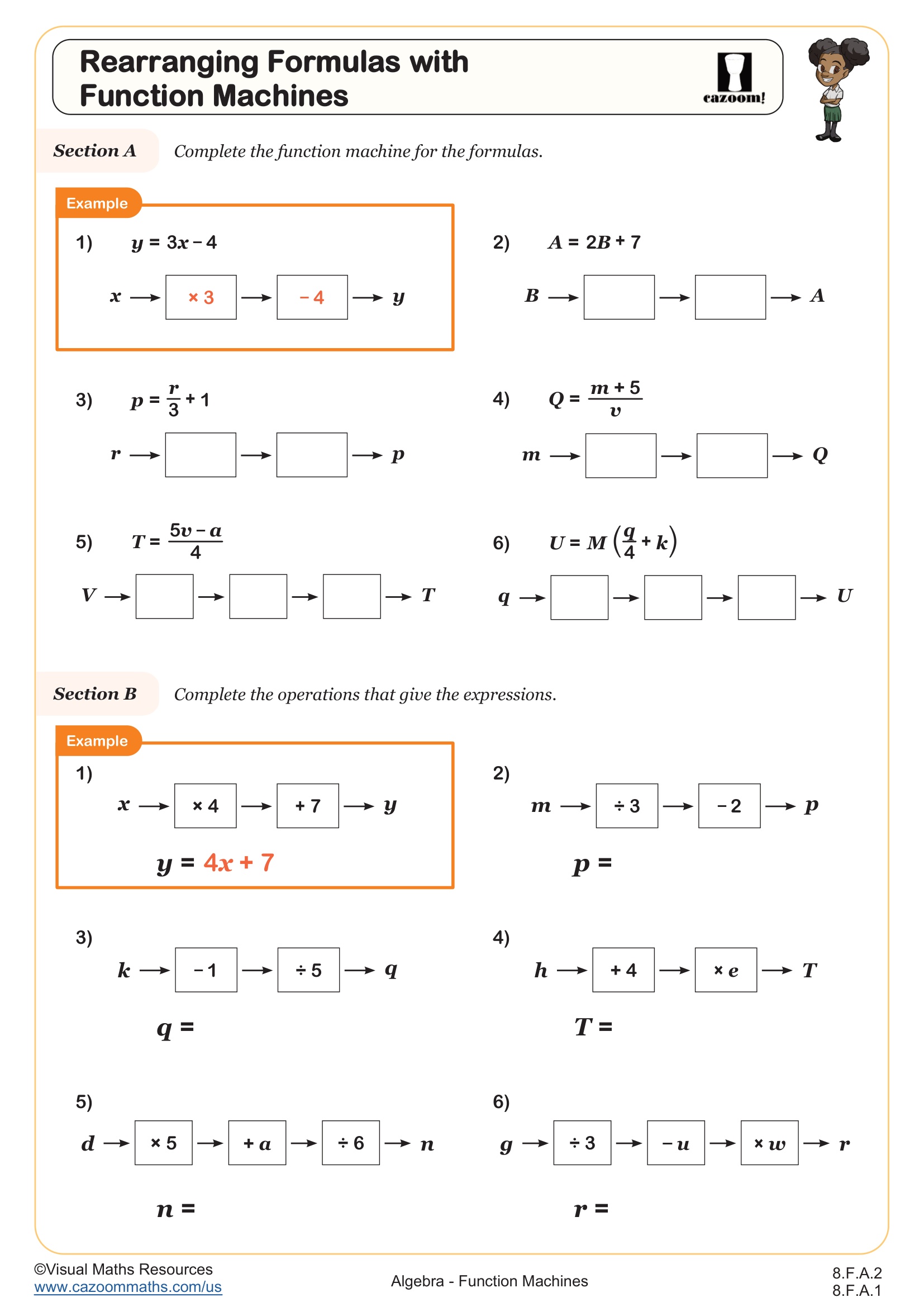
In Algebra I and IM 1, students typically work with linear function machines and simple operations. By Algebra II and IM 2, the complexity increases to include quadratic and exponential functions, while Precalculus and IM 3 students tackle function machines involving composition, inverse functions, and more sophisticated multi-step transformations. This progression allows students to revisit the visual model with increasingly challenging content.
How Do Students Form Expressions from Function Machines?
Forming expressions from function machines requires students to translate a visual sequence of operations into algebraic notation. Students identify each step the machine performs (such as "add 4" or "multiply by 2"), then write these operations in order using a variable to represent the unknown input. This process strengthens the connection between verbal descriptions, visual models, and symbolic algebra.
This skill directly applies to computer programming and data processing, where functions transform data inputs into outputs. Software engineers use function notation to describe algorithms that process user information, calculate costs, or convert units. Students who master function machines find it easier to understand how spreadsheet formulas work, how apps calculate tips or split bills, and how GPS systems convert location inputs into distance and time outputs.
How Can Teachers Use These Function Machines Worksheets Effectively?
These worksheets provide structured practice that moves from concrete examples to abstract thinking. Many sets include worked examples showing how to trace values through the machine step-by-step, which gives struggling students a model to follow. The variety of subtopics allows teachers to select worksheets that target specific skills, whether students need help identifying function rules, finding missing values, or writing algebraic expressions.
Teachers use these worksheets during intervention time to reinforce function notation before moving to more complex topics like composition or inverses. They also work well for paired activities where one student creates inputs and the partner determines outputs, then they check answers together using the answer key. The worksheets are equally effective as homework for reinforcing classroom lessons or as warm-up activities to activate prior knowledge before introducing new function concepts.