High School Polygons Worksheets
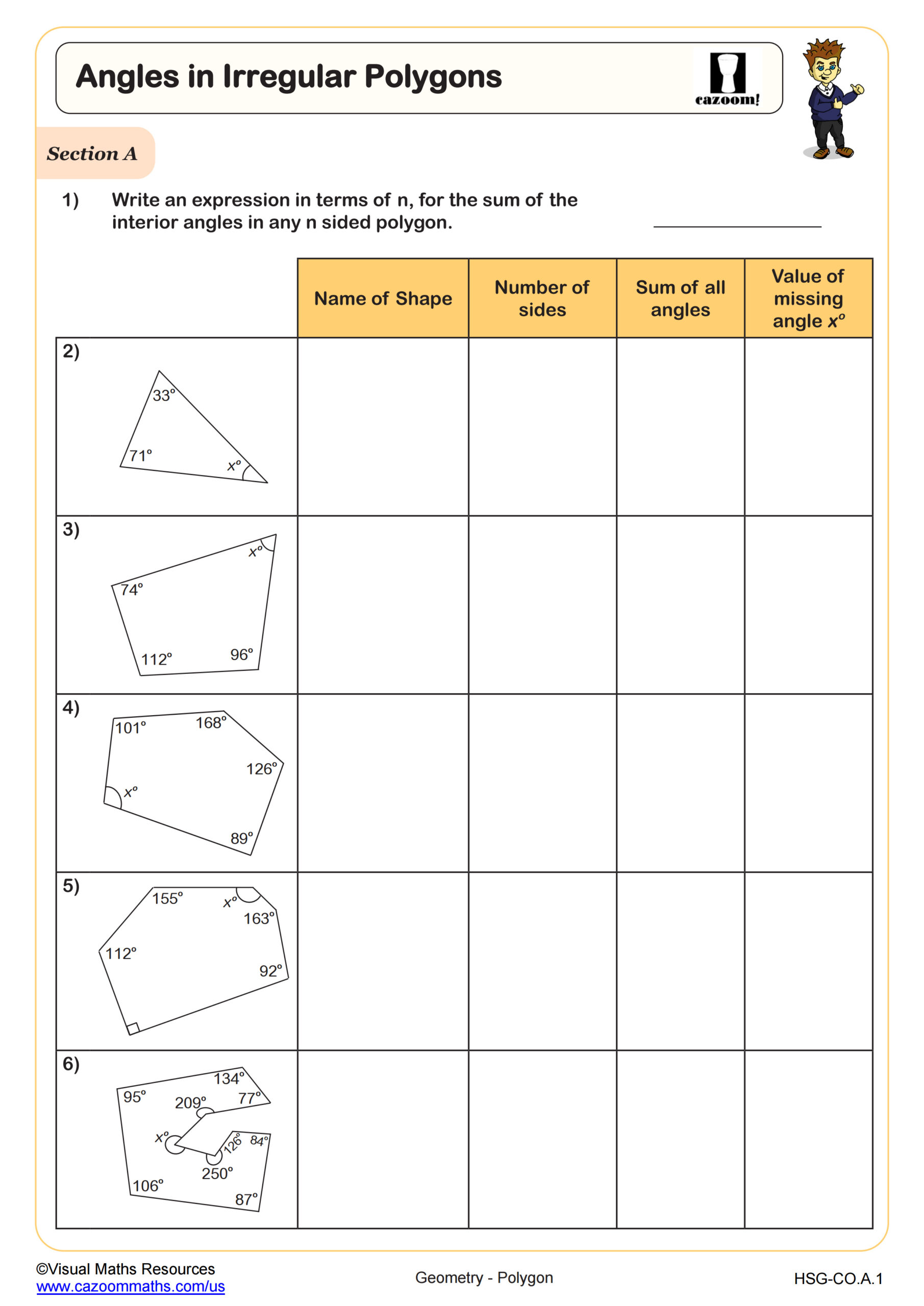
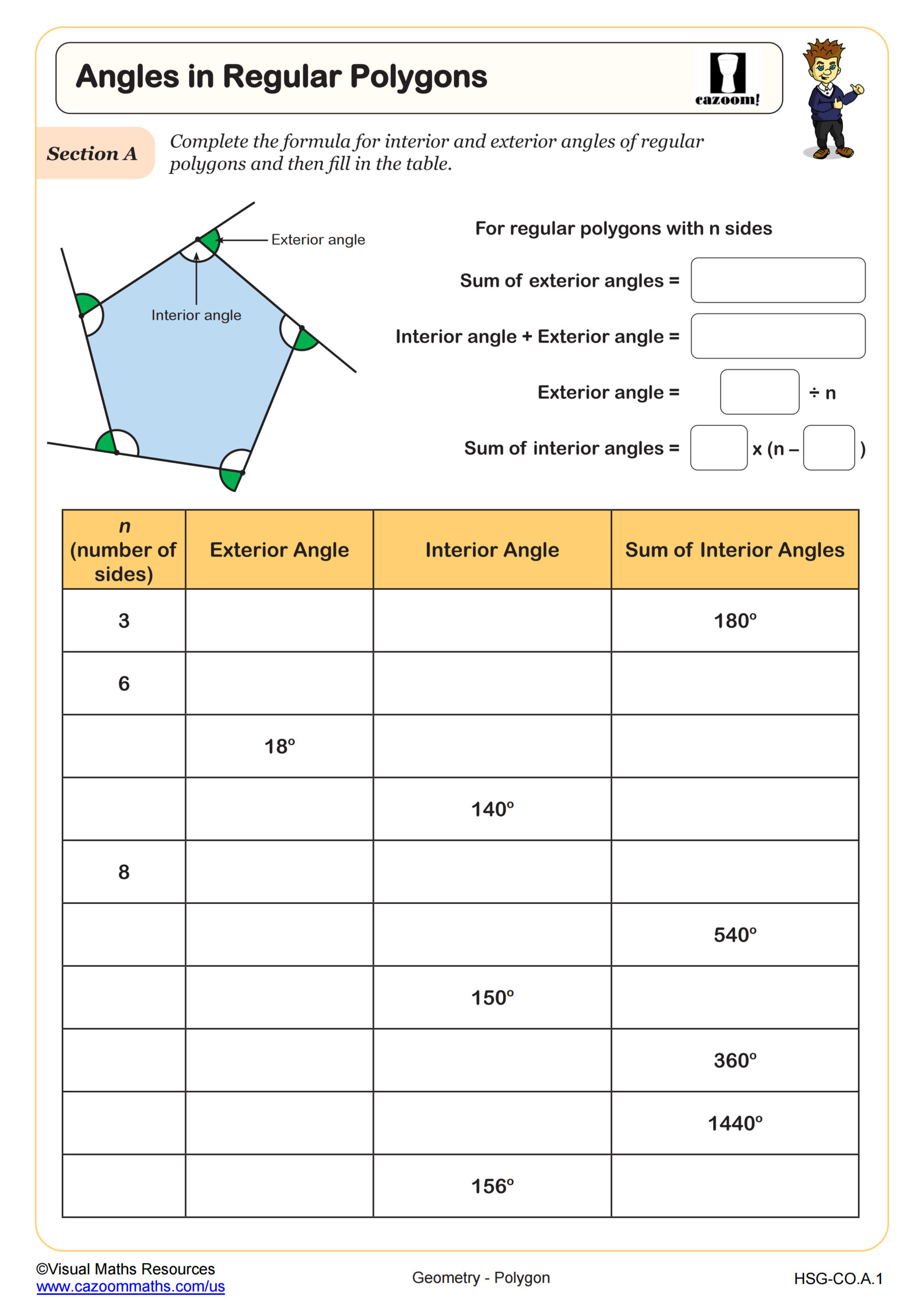
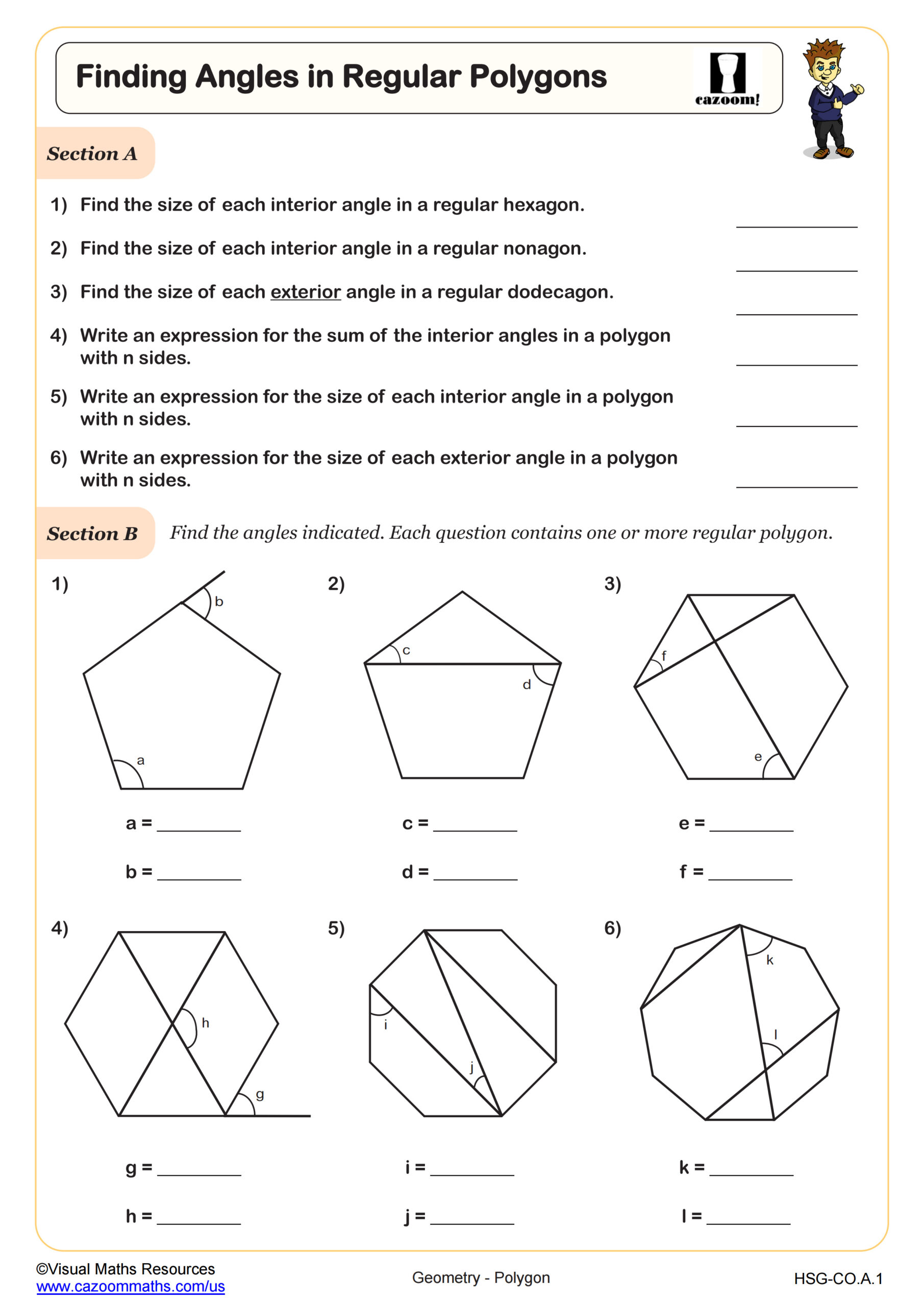
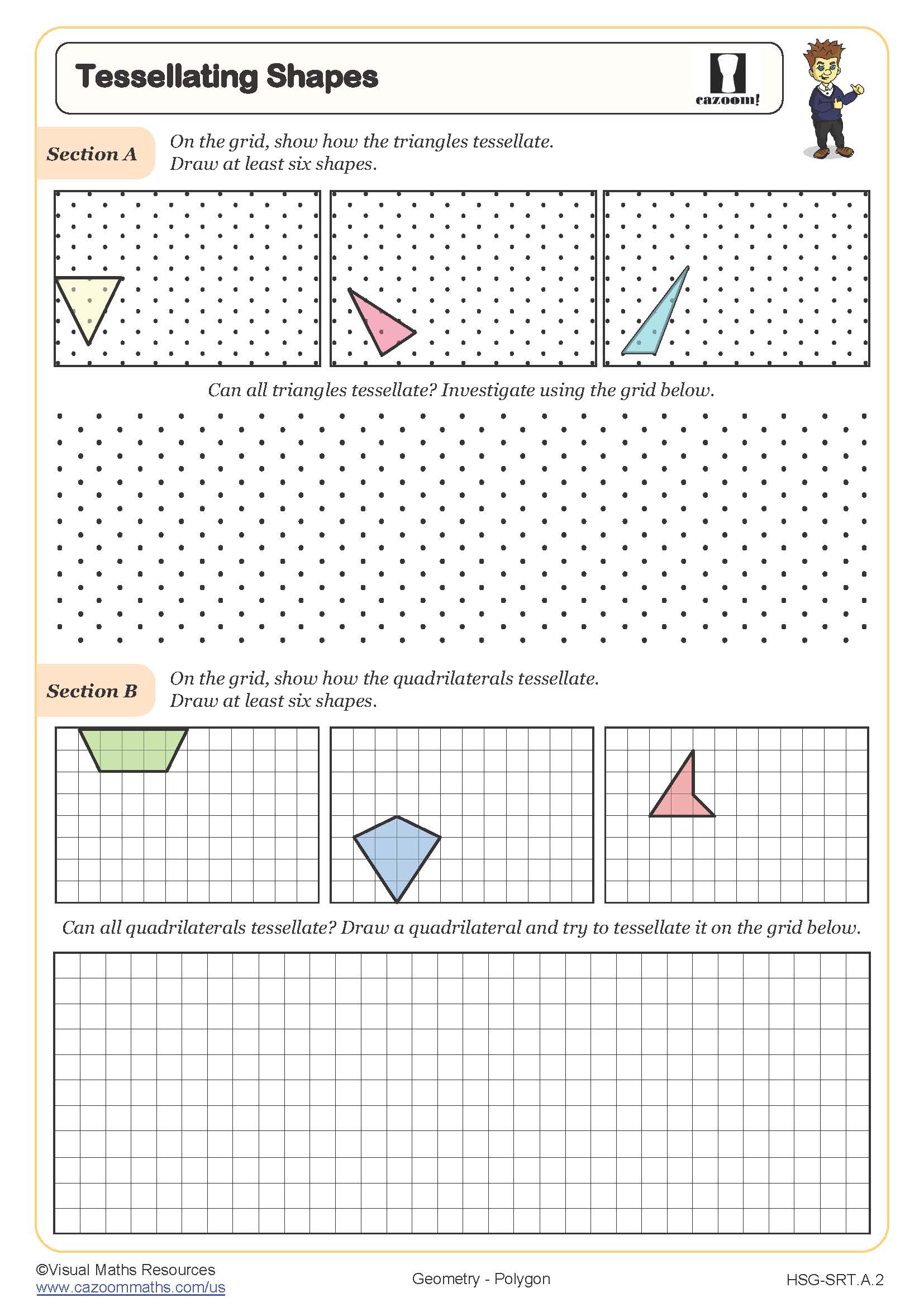
All worksheets are created by the team of experienced teachers at Cazoom Math.
What Are the Key Properties of Polygons That High School Students Need to Know?
High school students must understand that polygons are closed plane figures formed by line segments, with properties that include the number of sides, vertices, interior angles, and exterior angles. The fundamental formulas—interior angle sum equals (n-2)×180° and each exterior angle of a regular polygon equals 360°/n—appear consistently on state assessments and standardized tests.
A common misconception is assuming all polygons with equal side lengths are regular polygons. Students lose points when they forget that regular polygons require both equilateral sides and equiangular vertices. Teachers often use rectangles as counterexamples since they have equal opposite sides but aren't regular unless they're also squares, helping students distinguish between different classification criteria.
Which Grade Levels Study Polygons in High School?
Polygon worksheets span high school mathematics courses including Geometry, Algebra I, Algebra II, Precalculus, and Integrated Math 1, 2, and 3. Geometry typically provides the most concentrated polygon study, while algebra and precalculus courses revisit these concepts when working with coordinate geometry, transformations, and trigonometric applications.
The progression moves from basic polygon classification and naming in Algebra I and IM1 to complex angle calculations in irregular polygons during Geometry, then to coordinate proofs and transformations in Algebra II and IM2. By Precalculus and IM3, students apply polygon properties to polar coordinates, vectors, and modeling real-world situations, building connections between geometric and algebraic representations.
How Do Students Calculate Interior Angles in Regular Versus Irregular Polygons?
For regular polygons, students divide the total interior angle sum by the number of sides to find each individual angle measure. The formula (n-2)×180°/n gives the measure of each interior angle directly. With irregular polygons, students must use the total sum formula (n-2)×180° along with given angle measures or algebraic expressions to solve for unknown angles.
Architects and engineers rely on polygon angle calculations when designing structures like geodesic domes, floor plans, and truss systems. The Pentagon building in Washington, D.C., demonstrates regular polygon principles at massive scale, while irregular polygon calculations help structural engineers determine load distribution in non-uniform frameworks. Understanding these angle relationships allows students to analyze stability, material efficiency, and aesthetic appeal in architectural design.
How Can Teachers Use These Polygon Worksheets Most Effectively?
The worksheets provide scaffolded practice that moves from identifying and naming polygons to applying angle formulas in increasingly complex problems. Answer keys allow students to check their work immediately, reinforcing correct problem-solving approaches and helping them identify errors in their reasoning before concepts become entrenched incorrectly.
Many teachers use these worksheets as differentiated stations during geometry units, assigning regular polygon problems to students who need foundational practice while challenging advanced learners with irregular polygon angle calculations. The PDF format works well for homework assignments that parents can support at home, intervention sessions targeting specific skill gaps, and review before unit assessments or standardized tests. Paired work proves particularly effective for quadrilateral classification activities, where students verbalize their reasoning to identify hierarchical relationships between different polygon types.