High School Pythagorean Theorem Worksheets
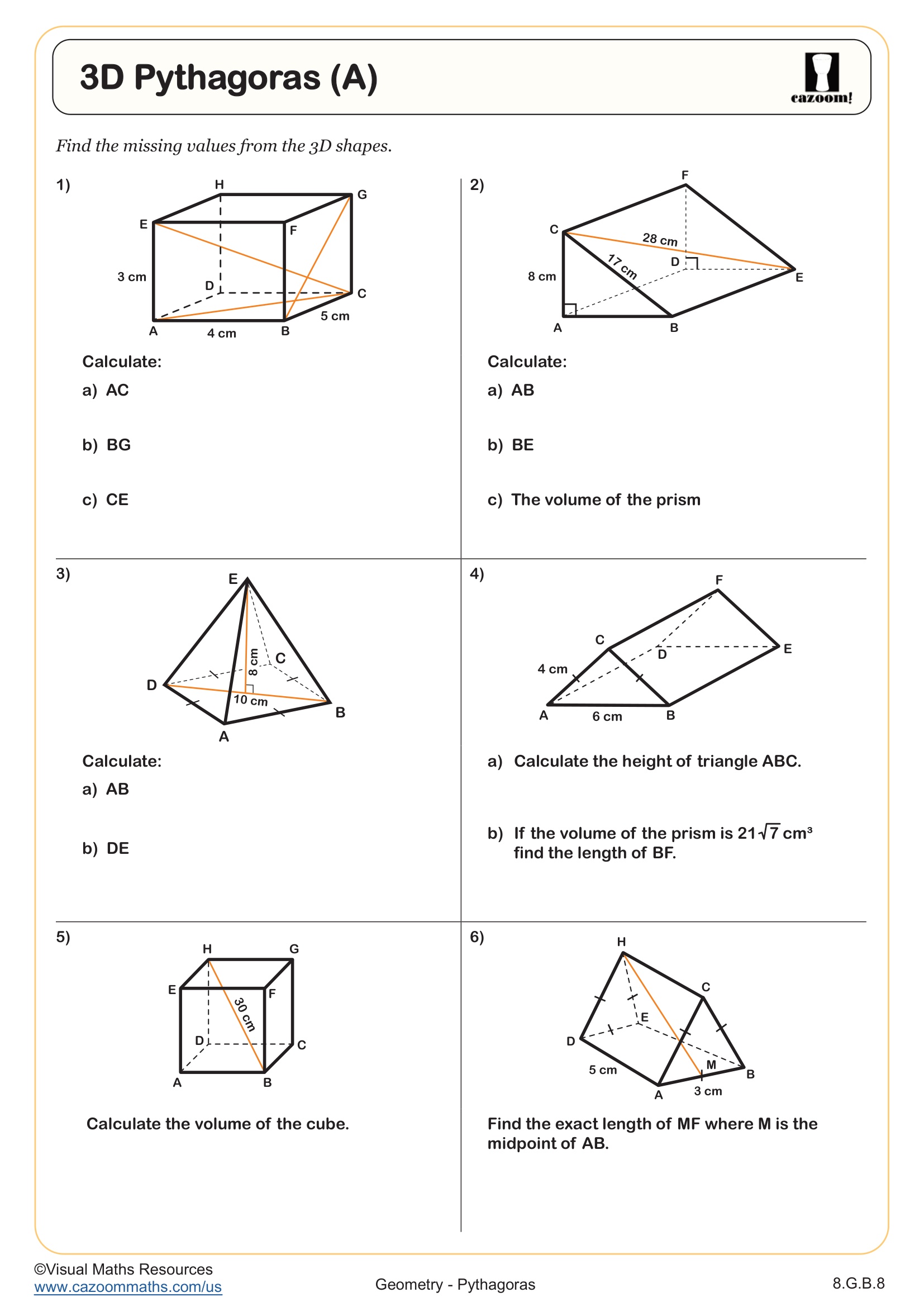
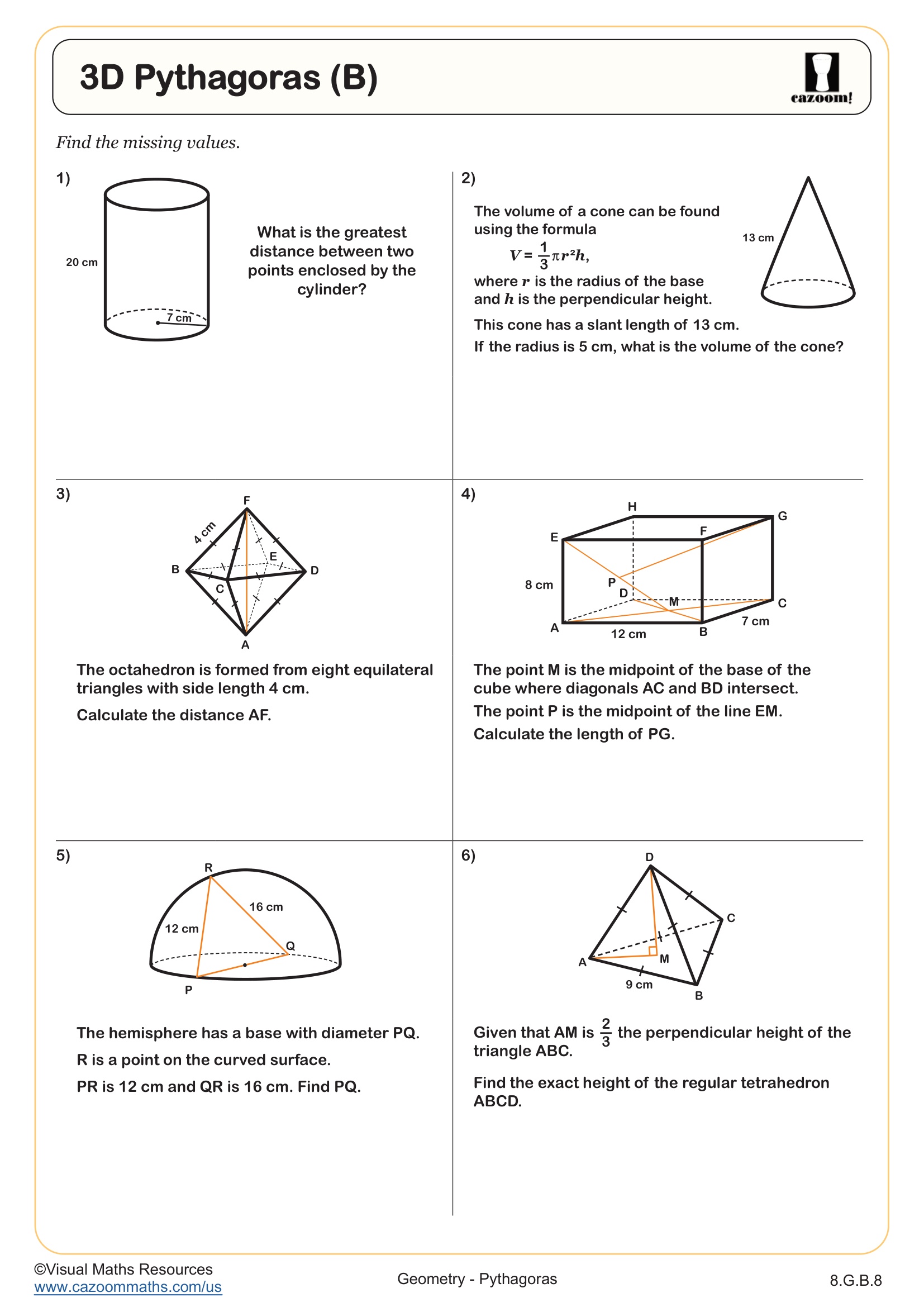
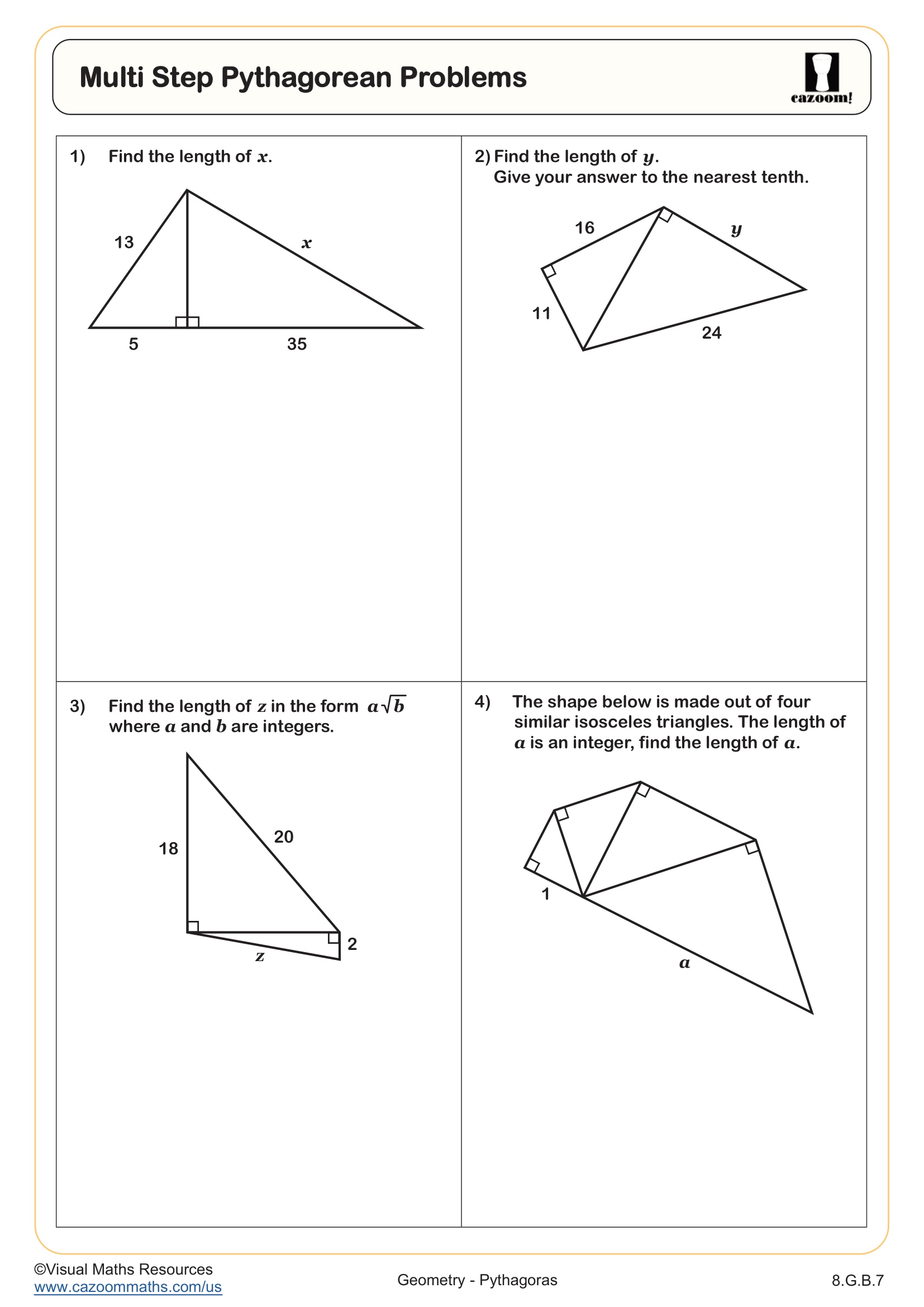
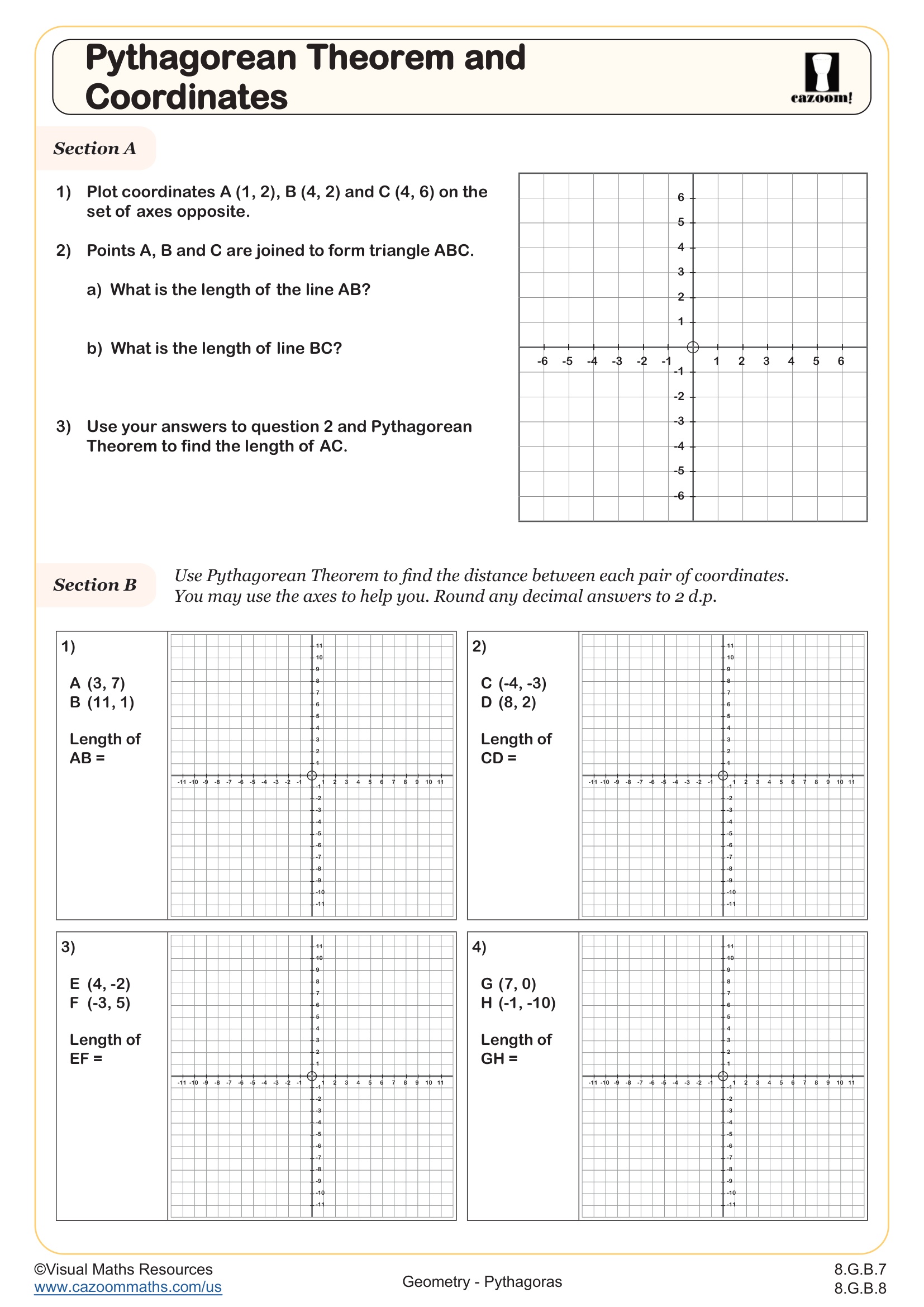
All worksheets are created by the team of experienced teachers at Cazoom Math.
What is the Pythagorean Theorem and why do students learn it?
The Pythagorean Theorem states that in a right triangle, the square of the hypotenuse equals the sum of the squares of the other two sides (a² + b² = c²). High school students encounter this theorem across Algebra I, Geometry, and higher-level courses because it connects algebraic thinking with geometric relationships. The theorem appears frequently on standardized assessments and serves as a foundation for trigonometry, distance formulas, and three-dimensional geometry.
Teachers notice that students grasp the theorem quickly but lose points when they fail to identify which side is the hypotenuse or when they forget to take the square root as their final step. The breakthrough typically happens when students recognize that the hypotenuse is always opposite the right angle and always the longest side, making it easier to set up equations correctly.
Which grade levels use Pythagorean Theorem worksheets?
These high school worksheets align with Algebra I, Algebra II, Geometry, Precalculus, and Integrated Math 1, 2, and 3 curricula. The Pythagorean Theorem first appears in eighth grade under Common Core standards, but high school courses expand its applications significantly. In traditional sequences, Geometry classes spend considerable time on the theorem, while Algebra courses apply it within coordinate geometry and problem-solving contexts.
The progression increases in complexity across grade levels. Algebra I students work with basic right triangle problems and distance on the coordinate plane. Geometry students tackle proofs, converse applications to verify right triangles, and multi-step problems. By Precalculus, students apply the theorem within three-dimensional figures and as a foundation for understanding trigonometric relationships and the unit circle.
How do students use the Pythagorean Theorem with coordinates?
The distance formula for finding the length between two coordinate points is actually the Pythagorean Theorem in disguise. When students plot two points and imagine the horizontal and vertical distances as legs of a right triangle, the straight-line distance becomes the hypotenuse. Many students make the connection between coordinate geometry and the theorem once they visualize this invisible right triangle on the graph, transforming abstract formulas into concrete geometric reasoning.
This coordinate application appears throughout STEM fields. GPS systems calculate distances between locations using latitude and longitude coordinates. Video game programmers use the distance formula to determine collision detection between objects. Architects and engineers apply coordinate-based Pythagorean calculations when designing structures, planning construction sites, or calculating material requirements for diagonal bracing. Students confidently tackle distance problems once they recognize that every coordinate pair creates potential right triangle applications.
How can teachers use these Pythagorean Theorem worksheets effectively?
The worksheets scaffold learning by starting with basic side-length calculations before progressing to identifying right triangles using the converse and solving multi-step applications. This structure helps students build confidence with straightforward problems before tackling scenarios that require strategic thinking about which formula to apply or how to break complex figures into workable right triangles. The answer keys allow students to check their work independently, making these worksheets valuable for self-paced learning and immediate feedback.
Teachers frequently use these worksheets for differentiated instruction, assigning simpler identification problems to students who need foundational practice while challenging advanced learners with multi-step coordinate applications. They work well as warm-up activities to review concepts before assessments, as homework to reinforce classroom lessons, or as intervention materials when students struggle with distance formulas or triangle problems. Paired work encourages students to explain their reasoning, which often reveals whether they truly understand when and how to apply the theorem.