High School Rearranging Equations Worksheets
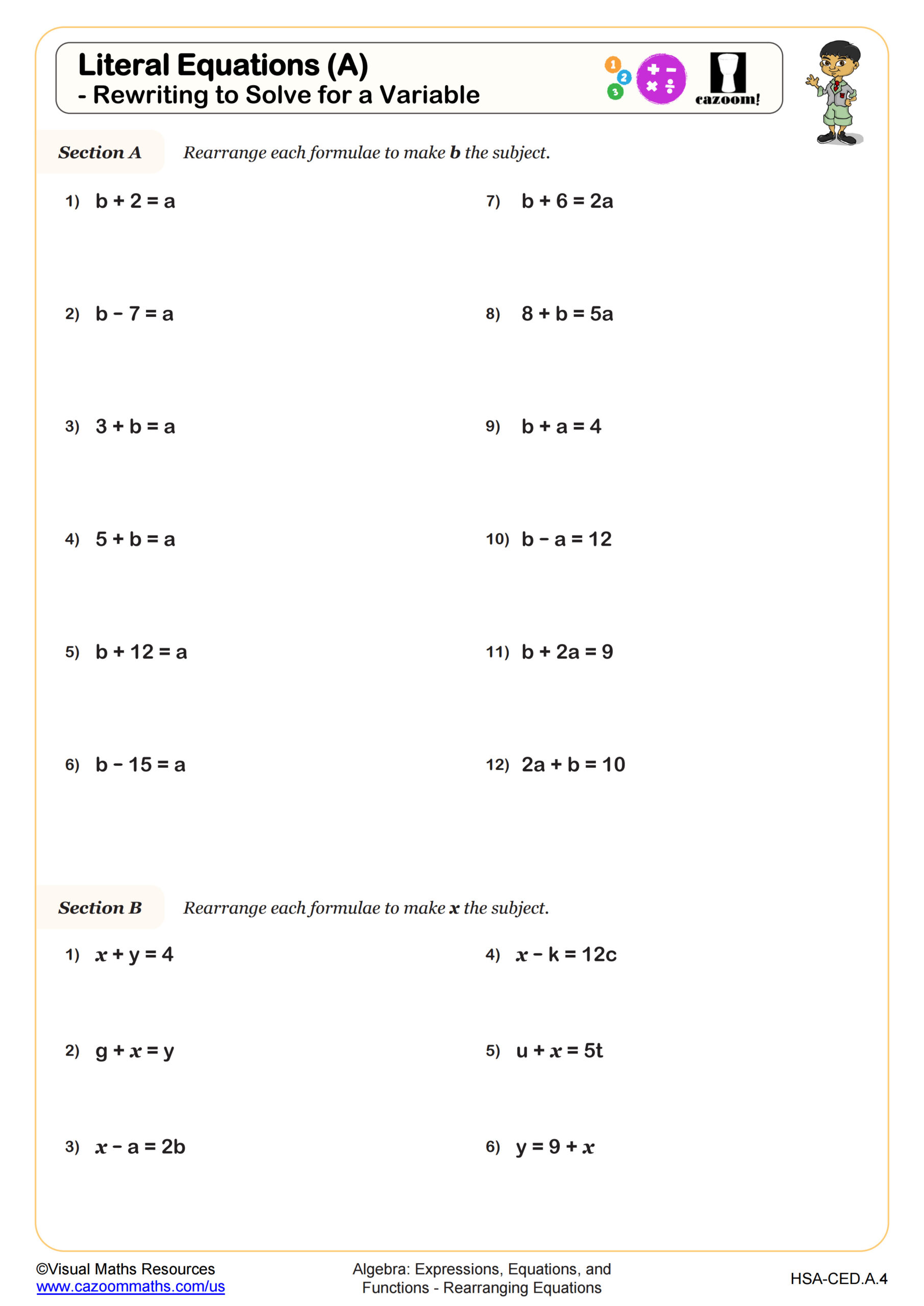
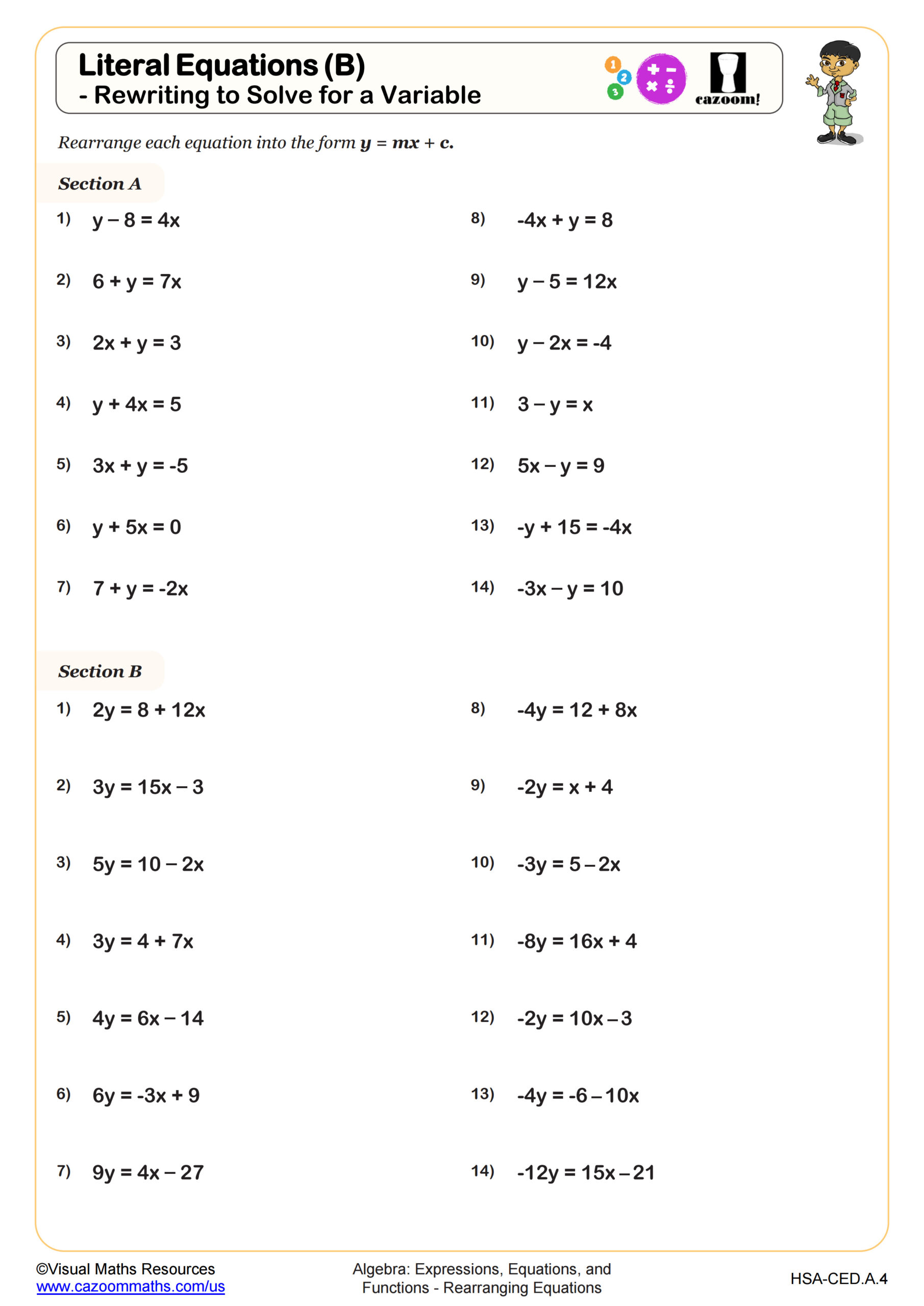
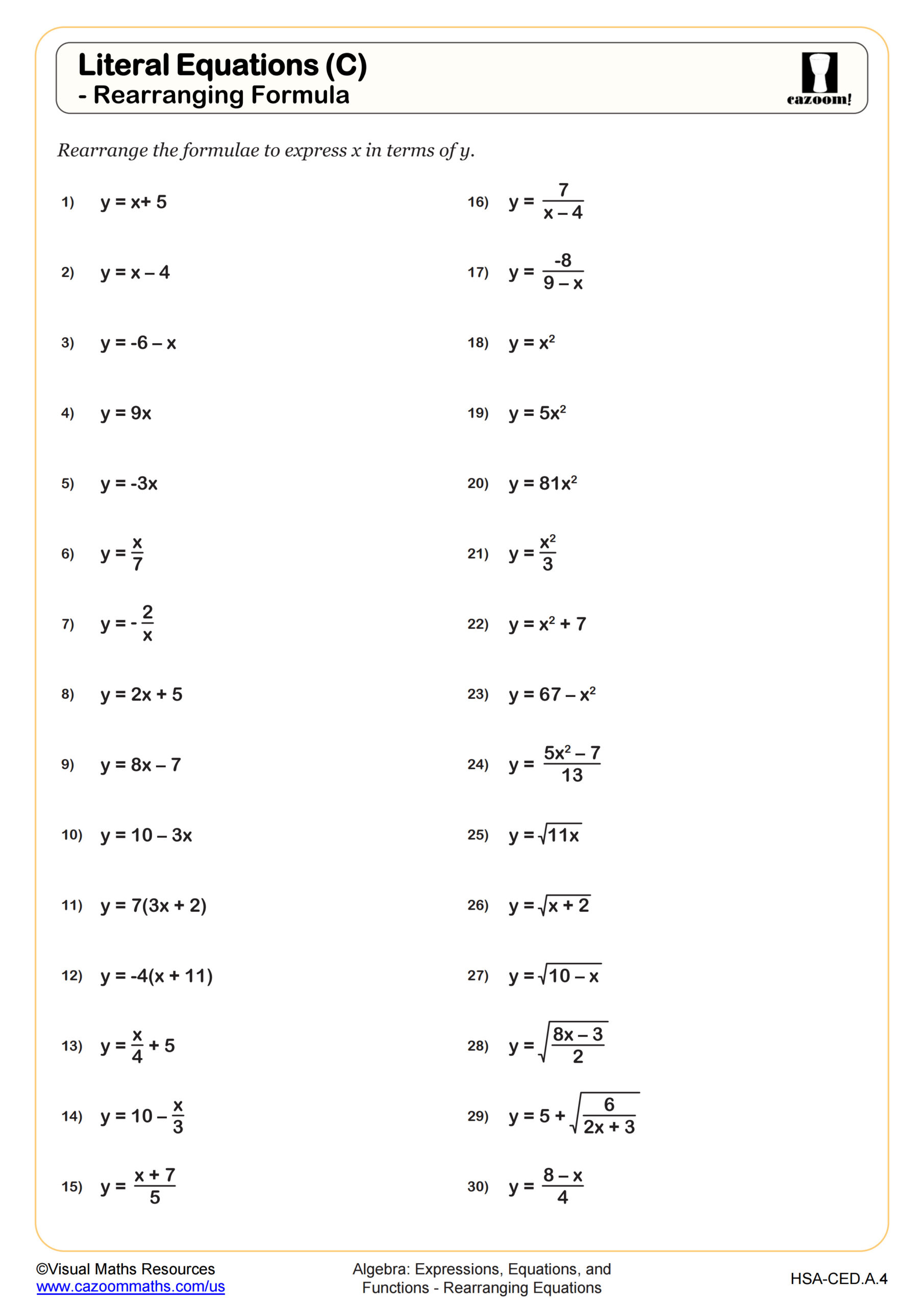
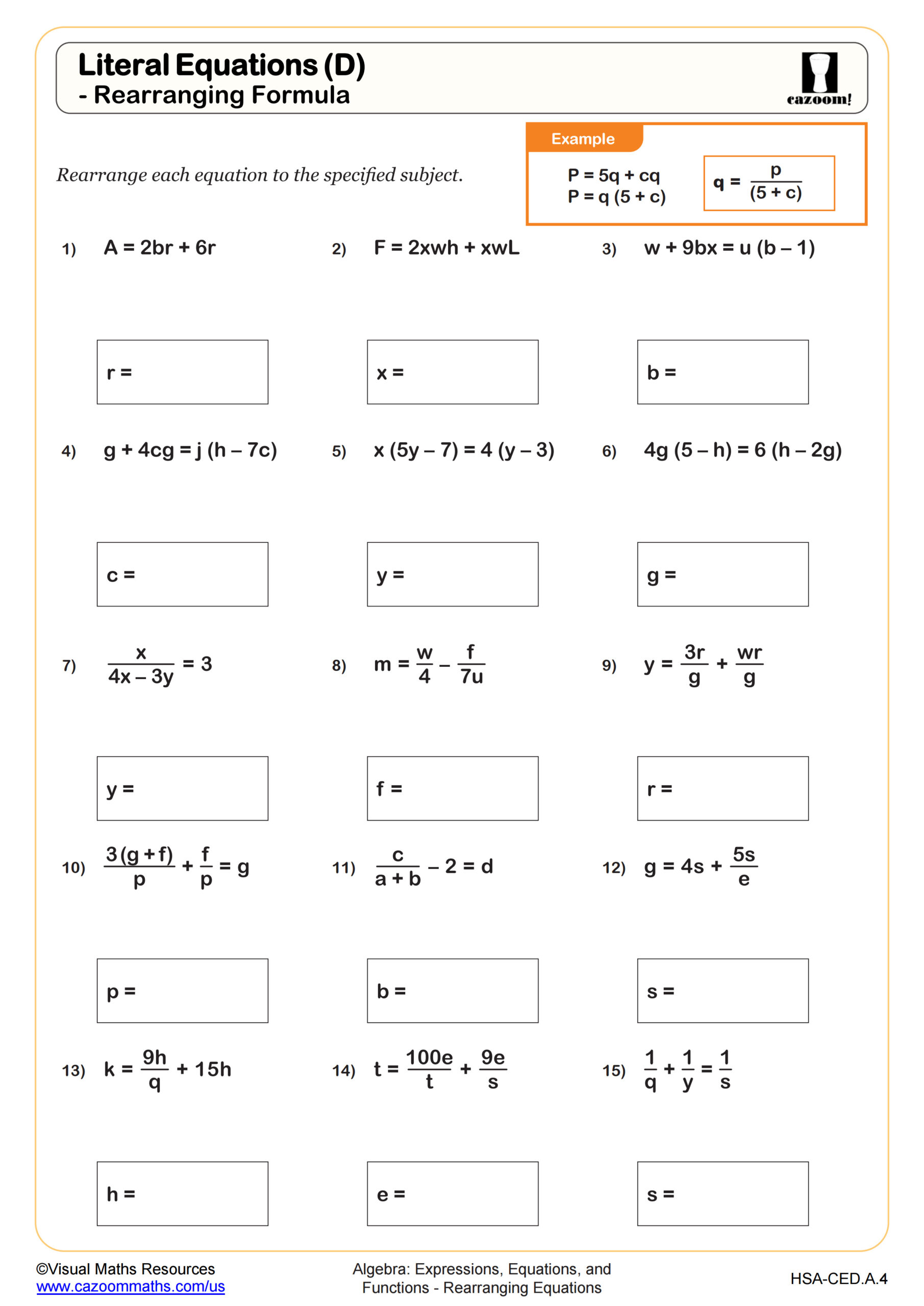
All worksheets are created by the team of experienced teachers at Cazoom Math.
What skills does a rearranging equations worksheet typically cover?
A quality rearranging equations worksheet addresses the fundamental algebraic skills outlined in Common Core High School Algebra standards, including isolating variables in linear equations, manipulating literal equations, and working with formulas from geometry and science. Students practice maintaining equation balance while performing inverse operations in the correct sequence.
Teachers notice that students frequently make errors when dealing with equations containing fractions or when the variable appears on both sides. The most effective worksheets include problems that gradually increase in complexity, starting with simple one-step rearrangements and progressing to multi-variable formulas commonly found in physics and chemistry courses.
Which grade levels benefit most from rearranging equations practice?
High school students in Algebra 1, Algebra 2, and Pre-Calculus courses gain the most from systematic rearranging equations practice, though the skill builds throughout grades 9-12. Algebra 1 students focus on basic variable isolation, while upper-level students work with complex formulas involving multiple variables and advanced operations.
Teachers report that students who master equation rearrangement in early high school perform significantly better in physics and chemistry courses, where formula manipulation is constant. The skill also proves core for calculus preparation, particularly when working with implicit differentiation and related rates problems that require algebraic fluency.
How do manipulating formulas worksheet problems differ from basic equation solving?
Manipulating formulas worksheet problems require students to work with literal equations containing multiple variables, unlike basic equation solving that typically involves finding numerical solutions. Students must isolate a specified variable while treating other letters as constants, which demands stronger conceptual understanding of algebraic operations.
Teachers observe that students often struggle with the abstract nature of literal equations, particularly when asked to solve for a variable that appears in a denominator or under a radical. The most challenging problems involve formulas from real-world contexts like physics equations for motion, electrical circuits, or geometric relationships where students must recognize which variable to isolate based on the given information.
How can teachers maximize student success with rearranging equations worksheets?
Teachers achieve better results by having students work through problems systematically, emphasizing the importance of identifying the target variable first and then planning the sequence of inverse operations needed. Providing guided practice with worked examples helps students internalize the logical reasoning process before attempting independent work.
Classroom observations show that students benefit from connecting worksheet problems to real applications, such as solving physics formulas for different variables or rearranging geometric formulas. Teachers who encourage students to check their work by substituting values report higher accuracy rates and improved conceptual understanding of the underlying algebraic principles.