High School Sequences Worksheets
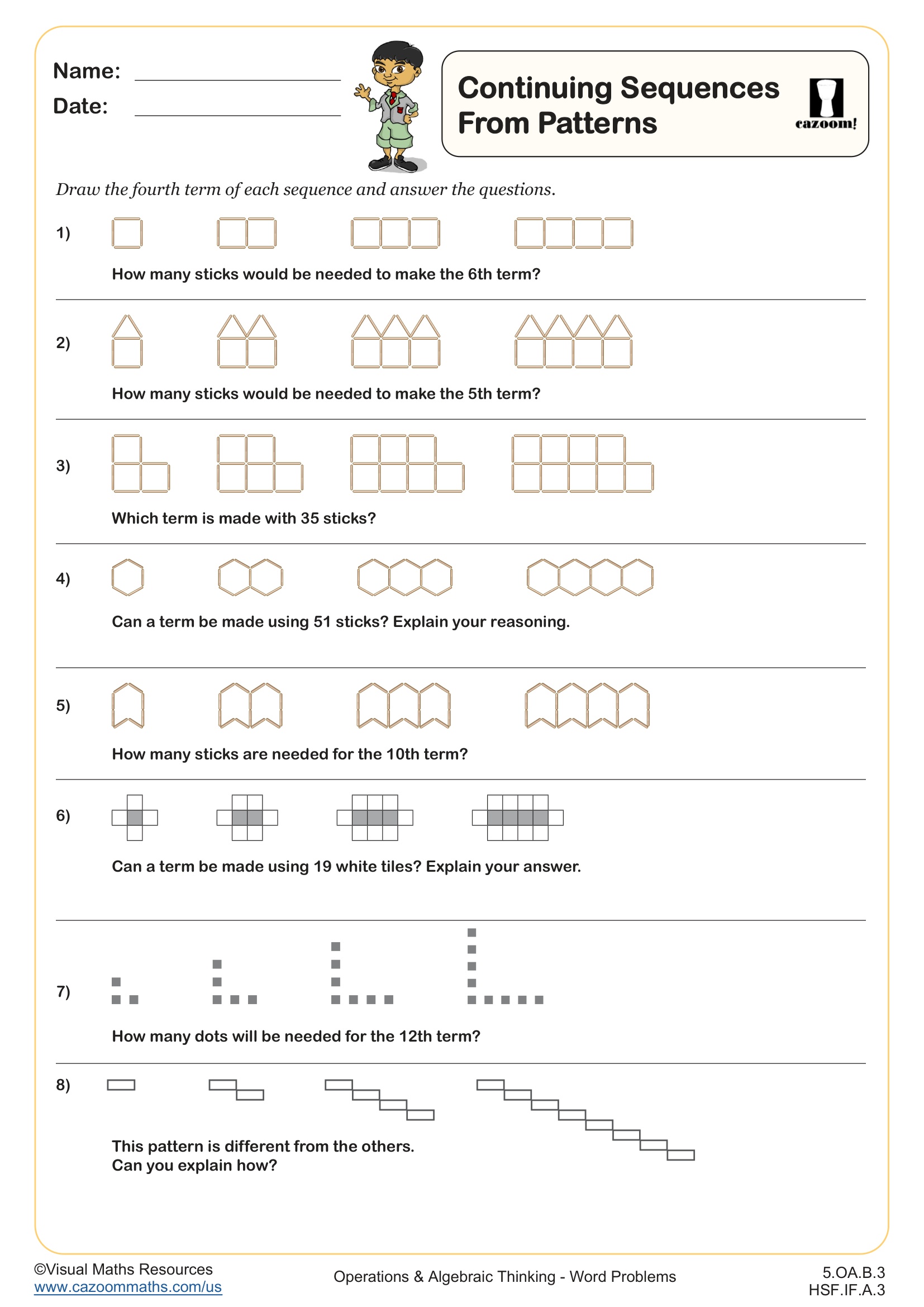
Continuing Sequecnes from Patterns
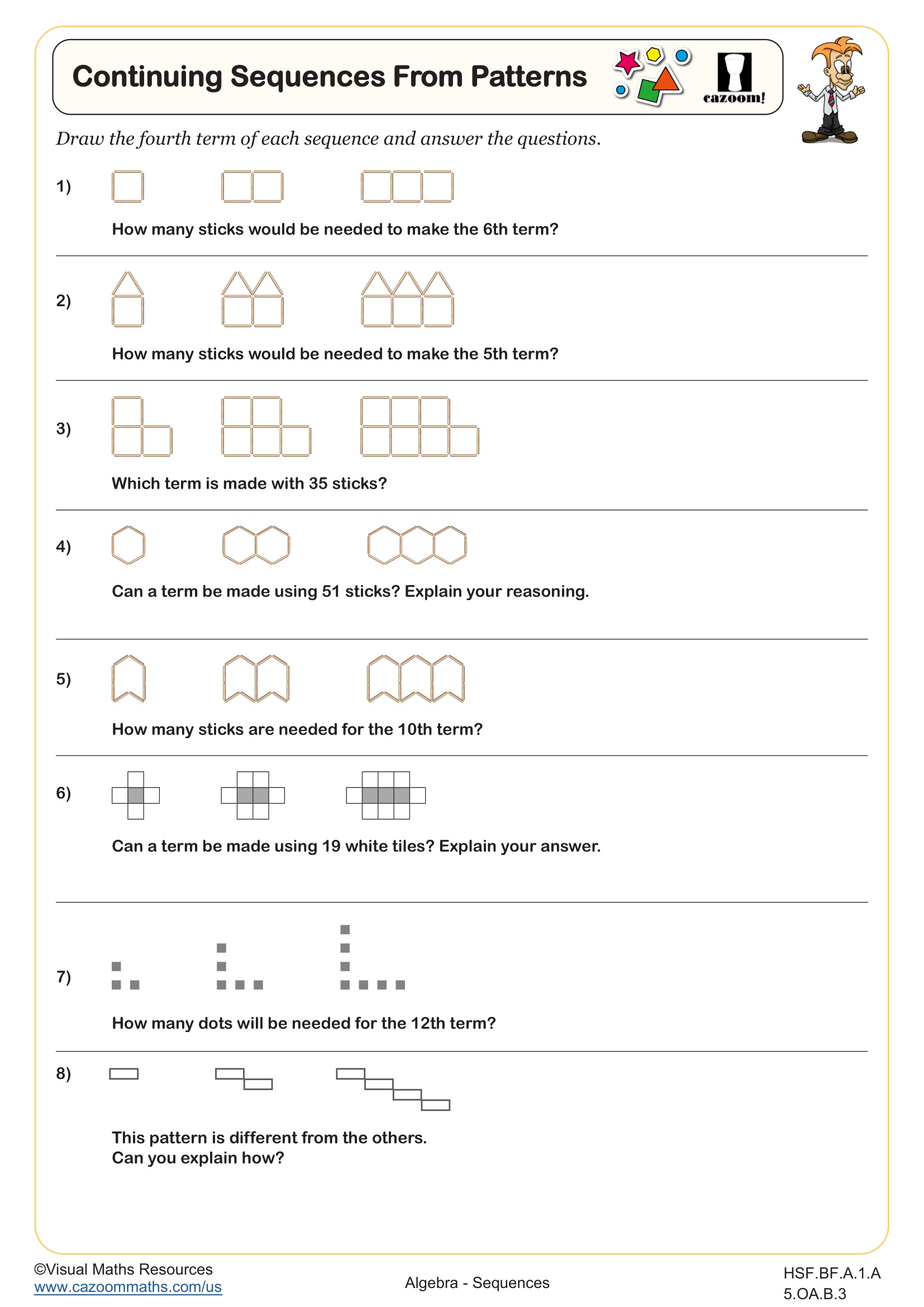
Continuing Sequences from Patterns
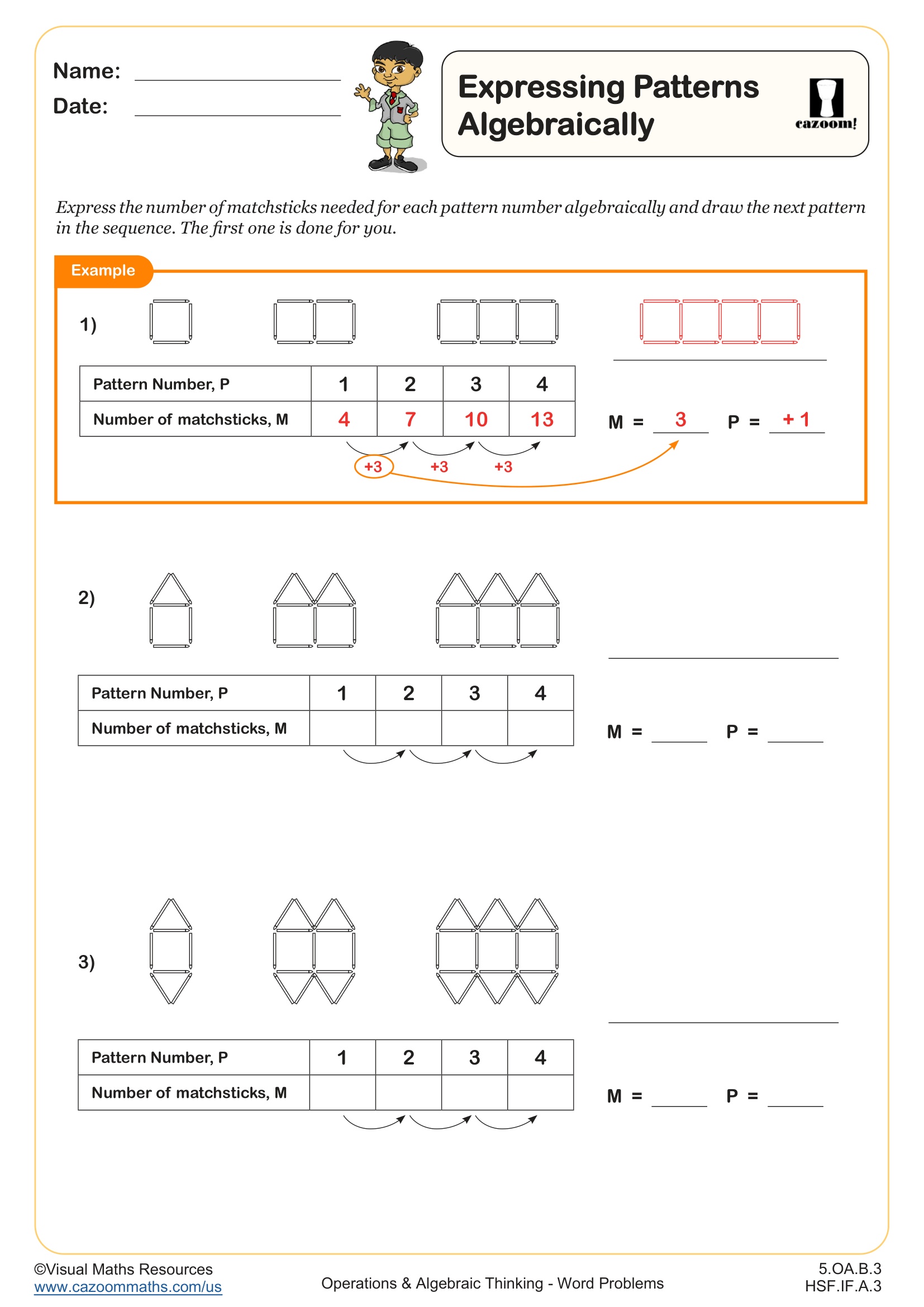
Expressing Patterns Algebraically
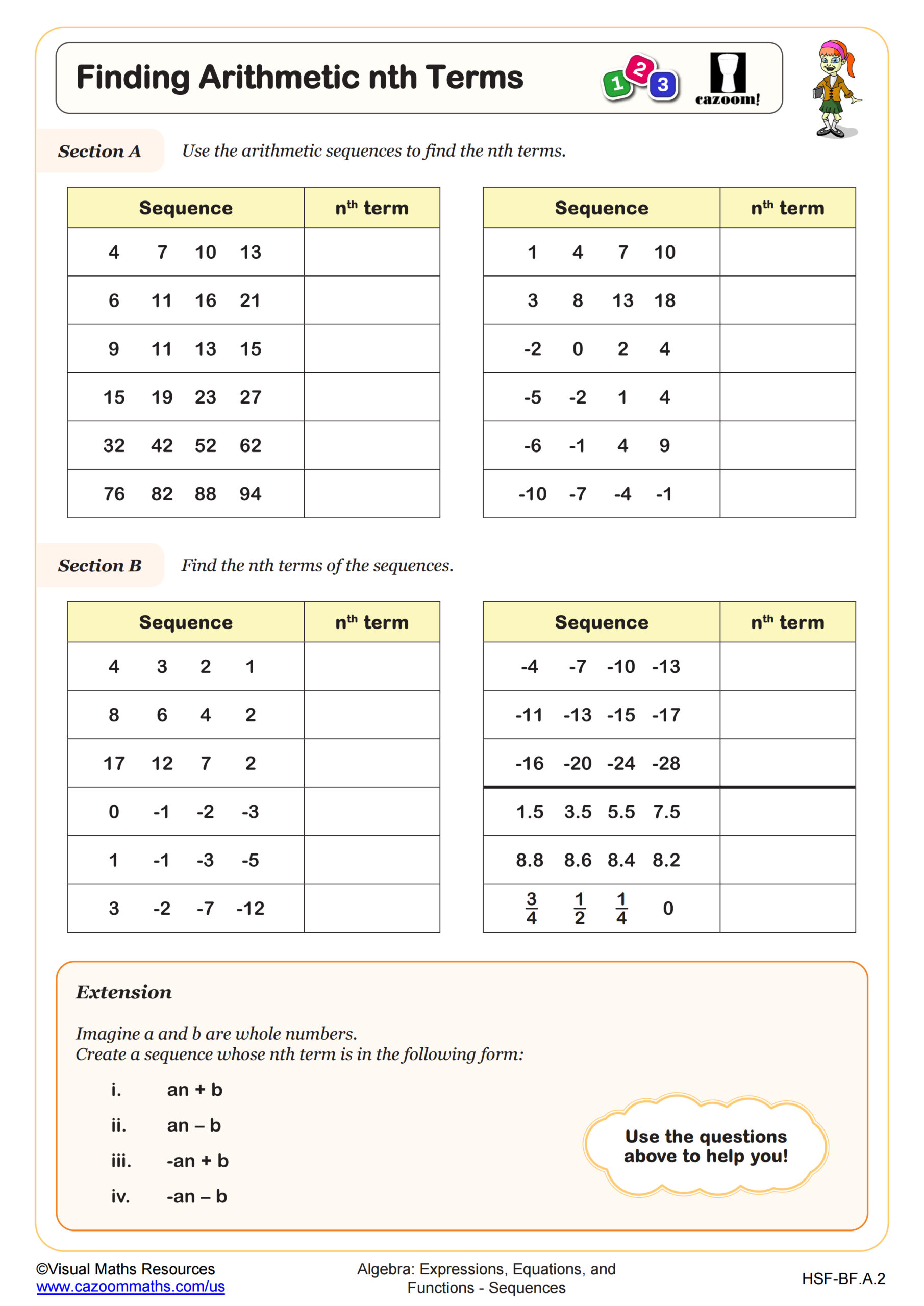
Finding Arithmetic nth Terms
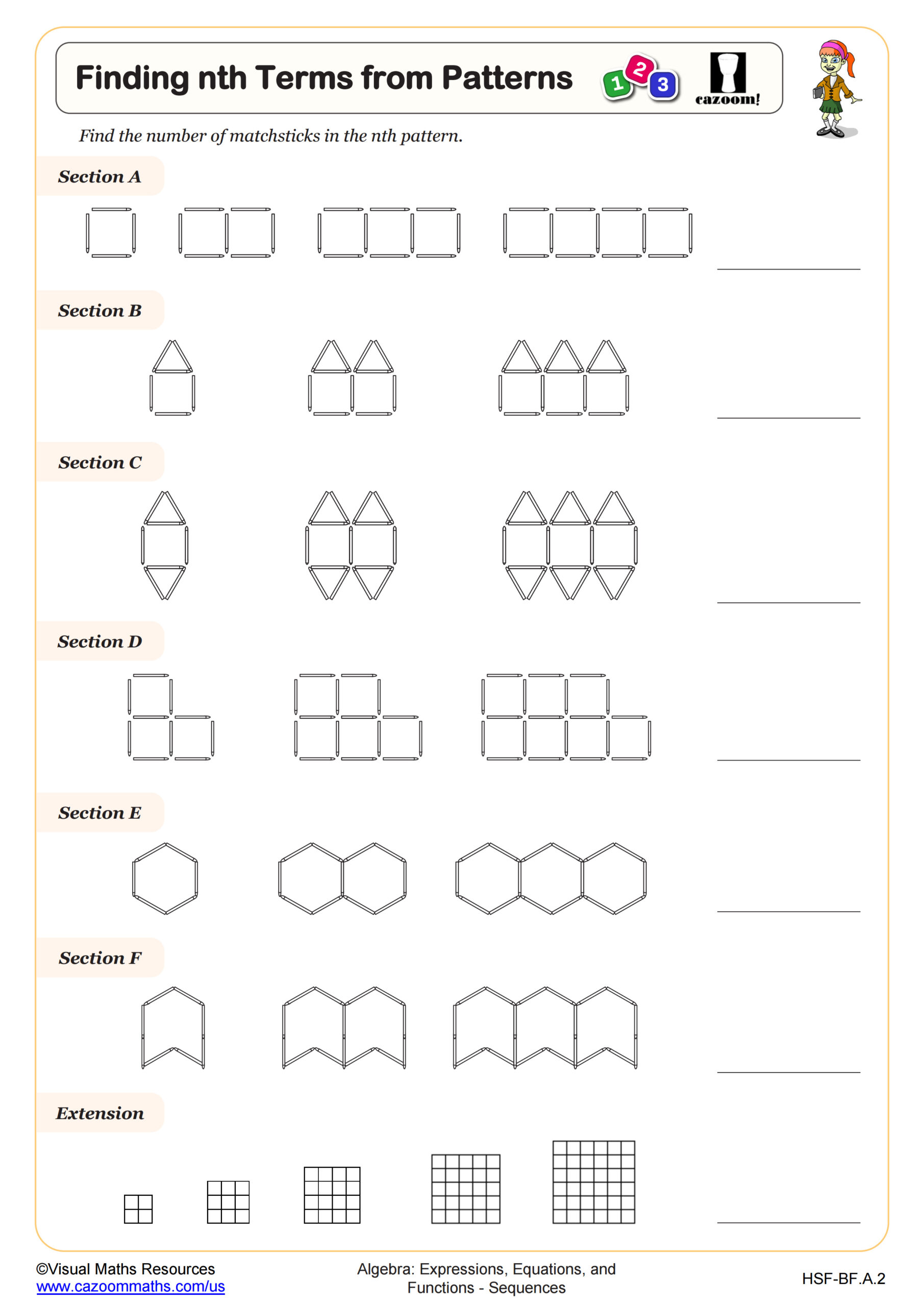
Finding nth Terms from Patterns
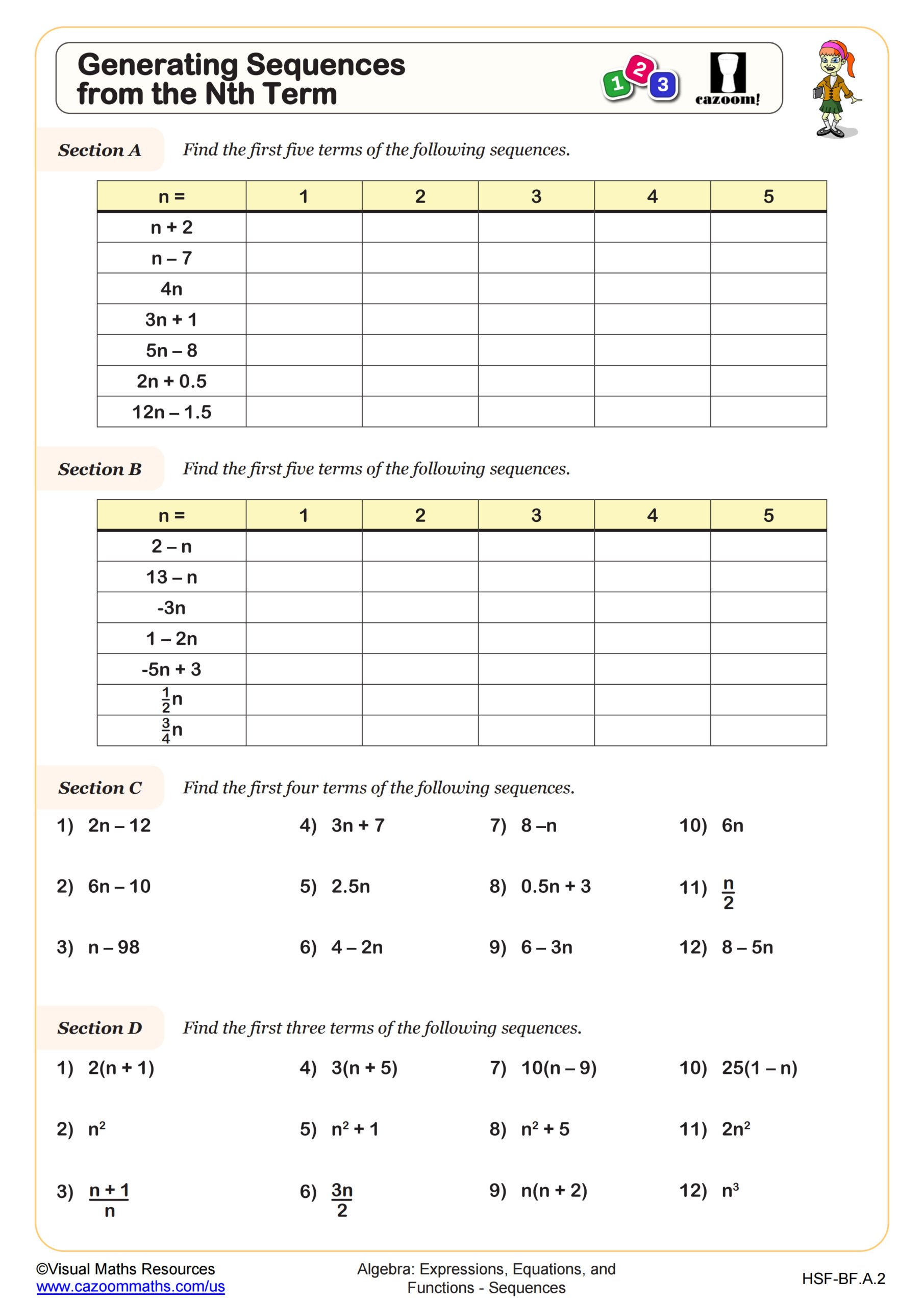
Generating Sequences from the Nth Term
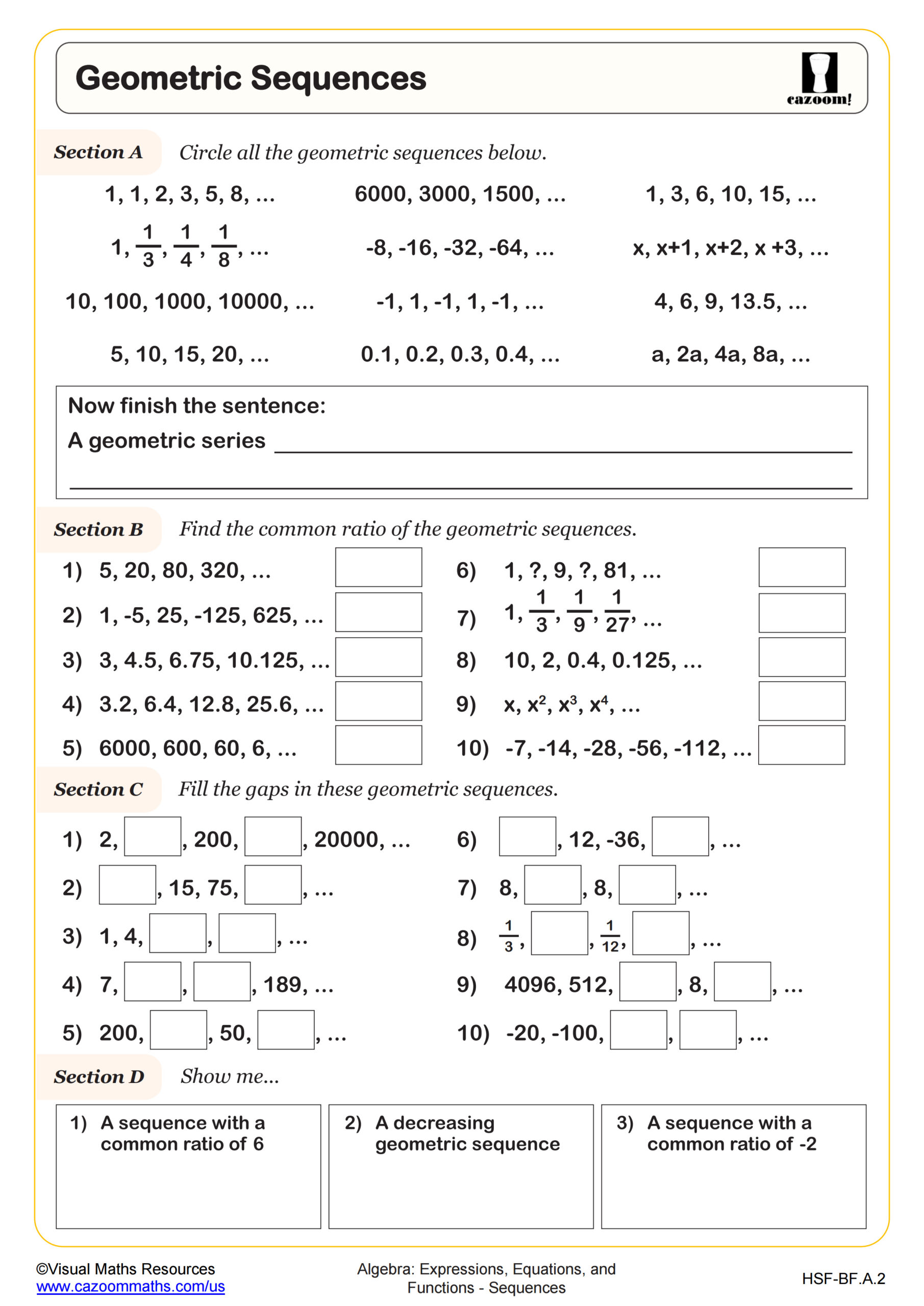
Geometric Sequences
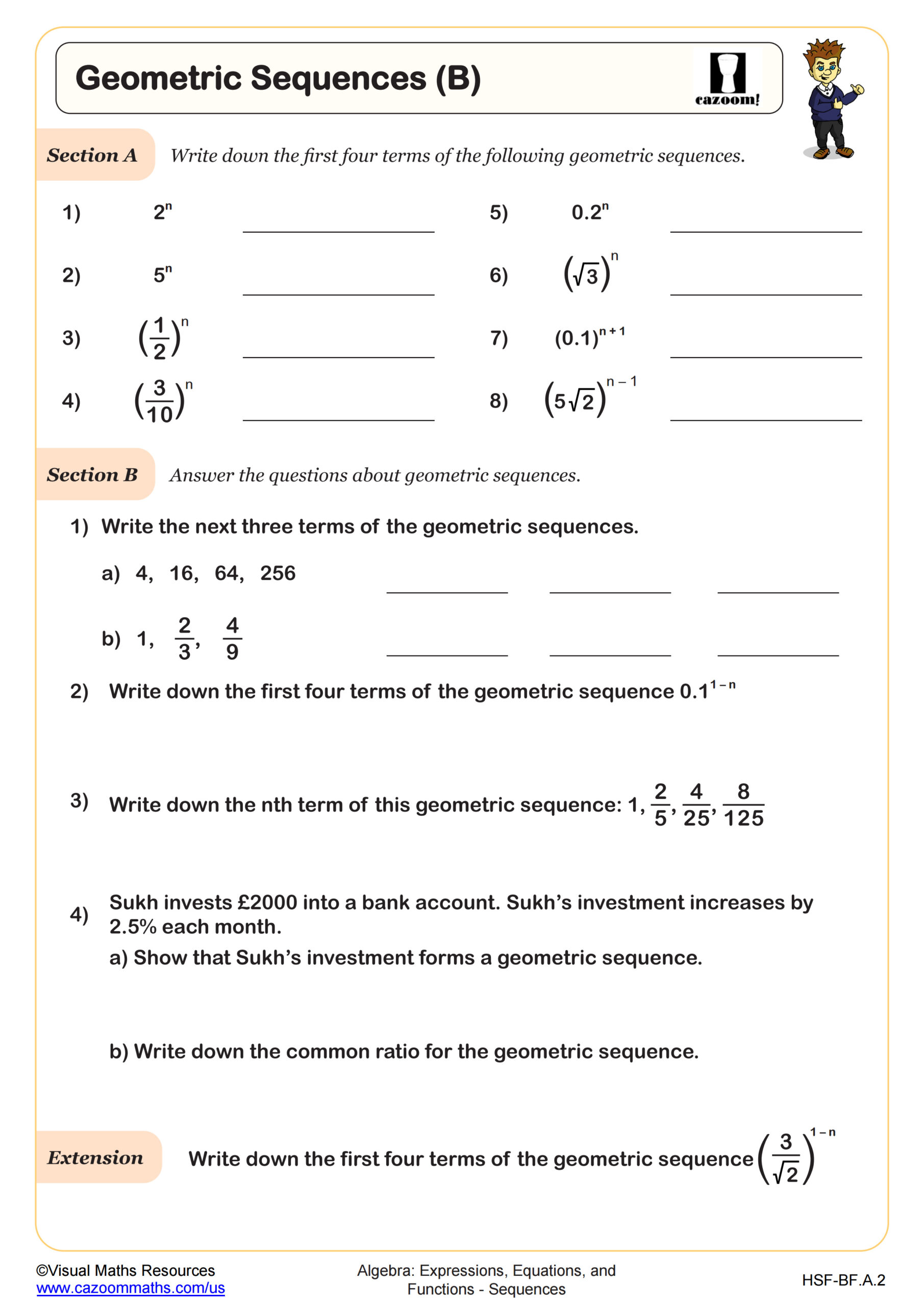
Geometric Sequences (B)
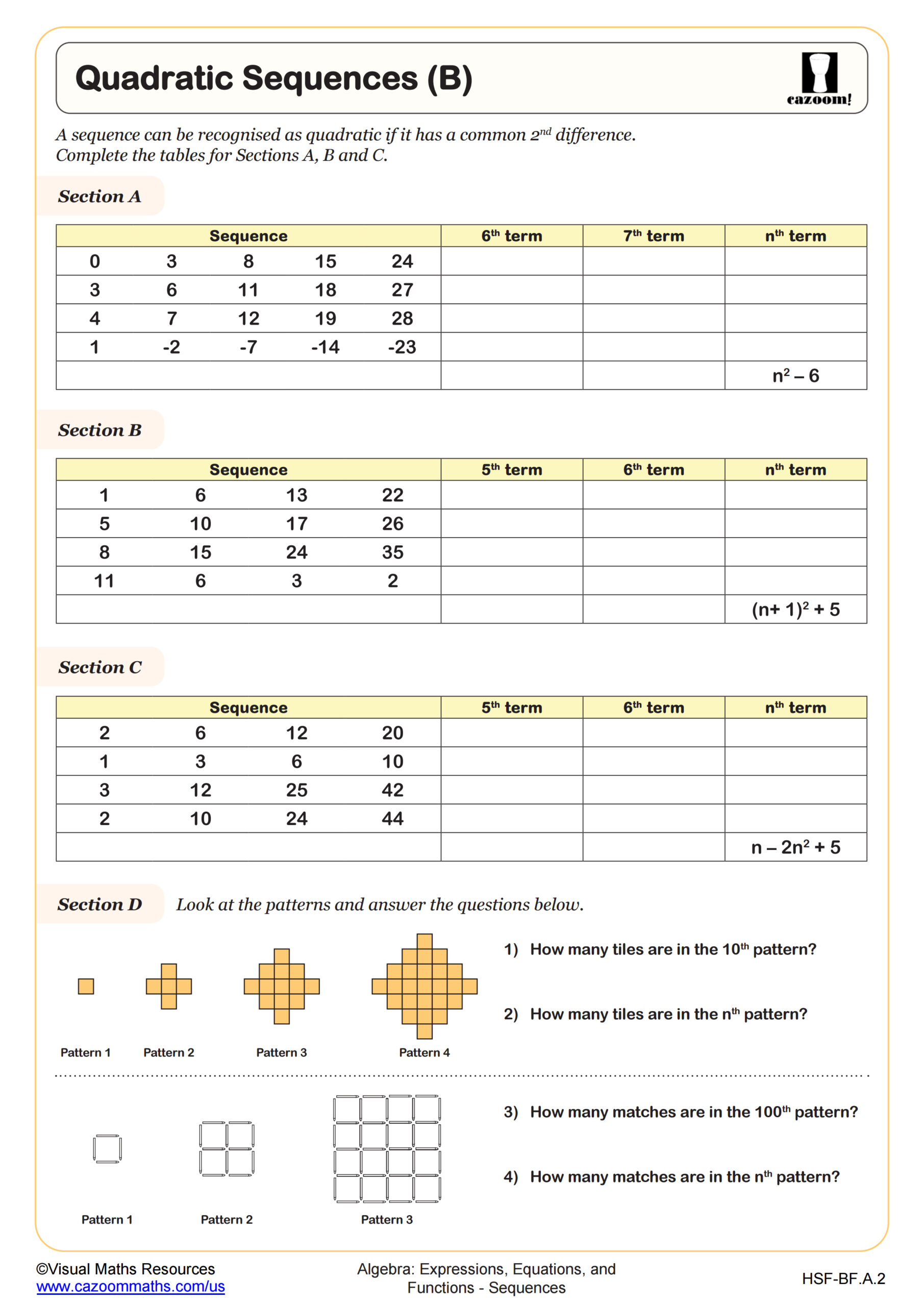
Quadratic Sequences (B)
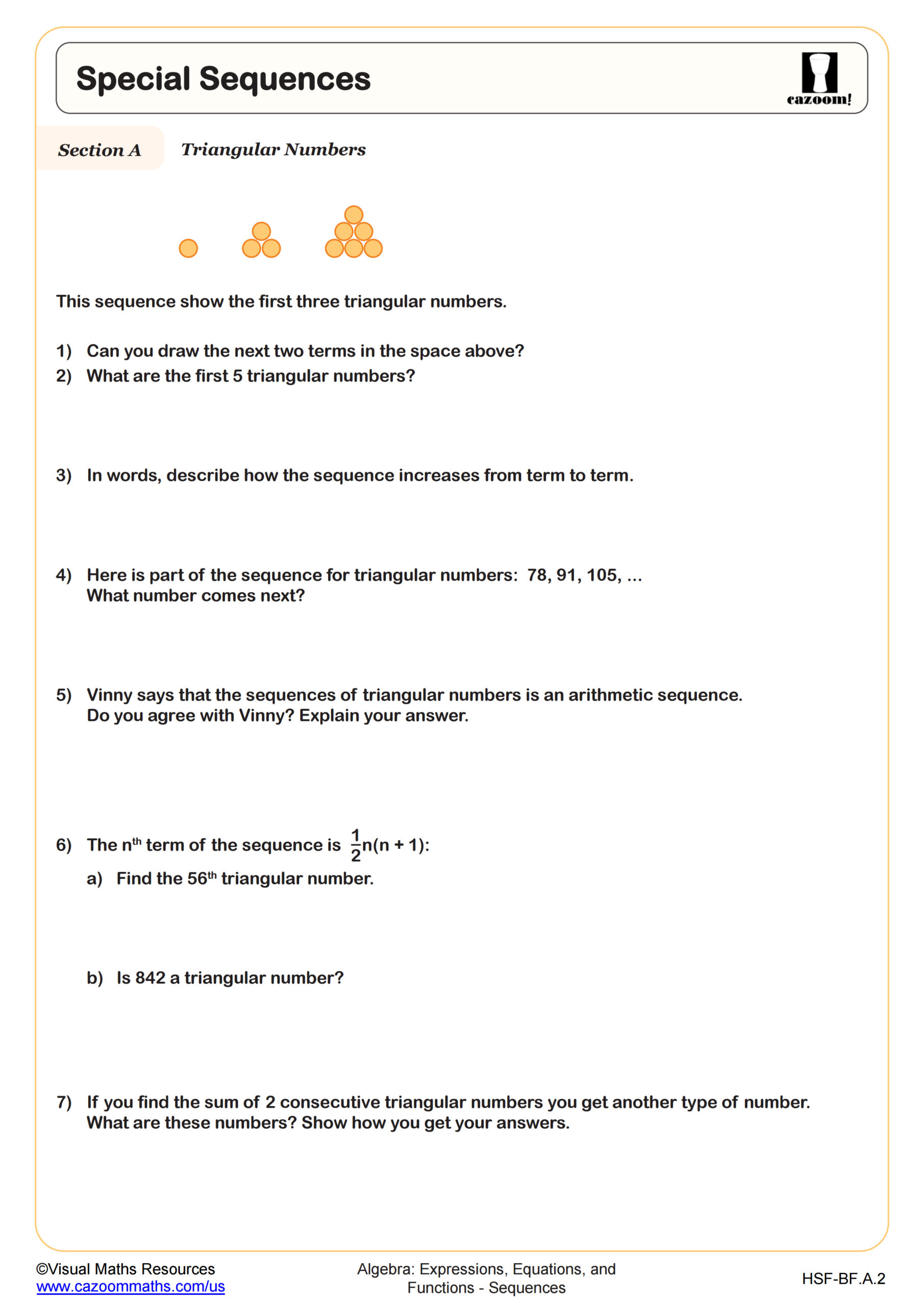
Special Sequences
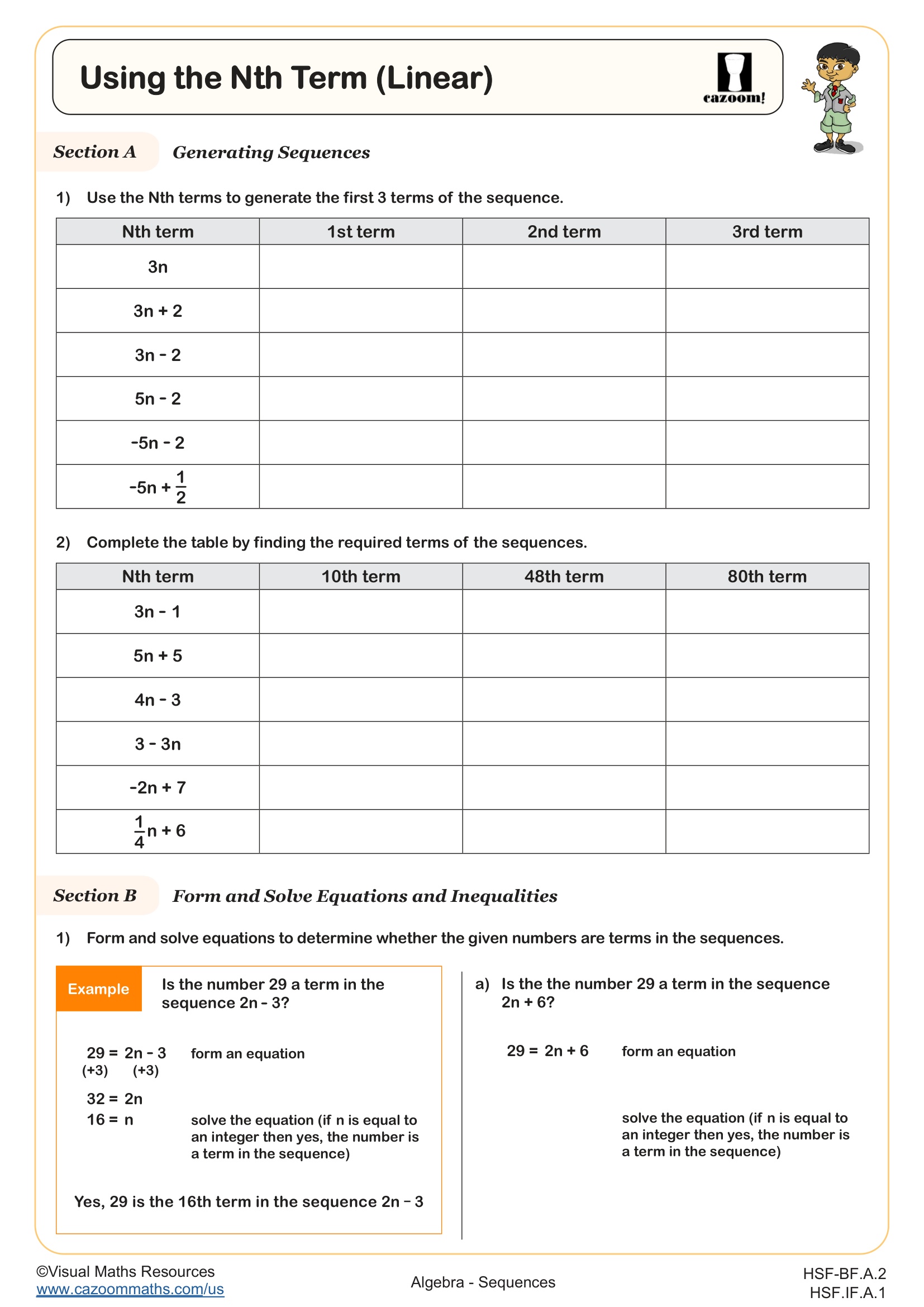
Using the Nth Term (Linear)
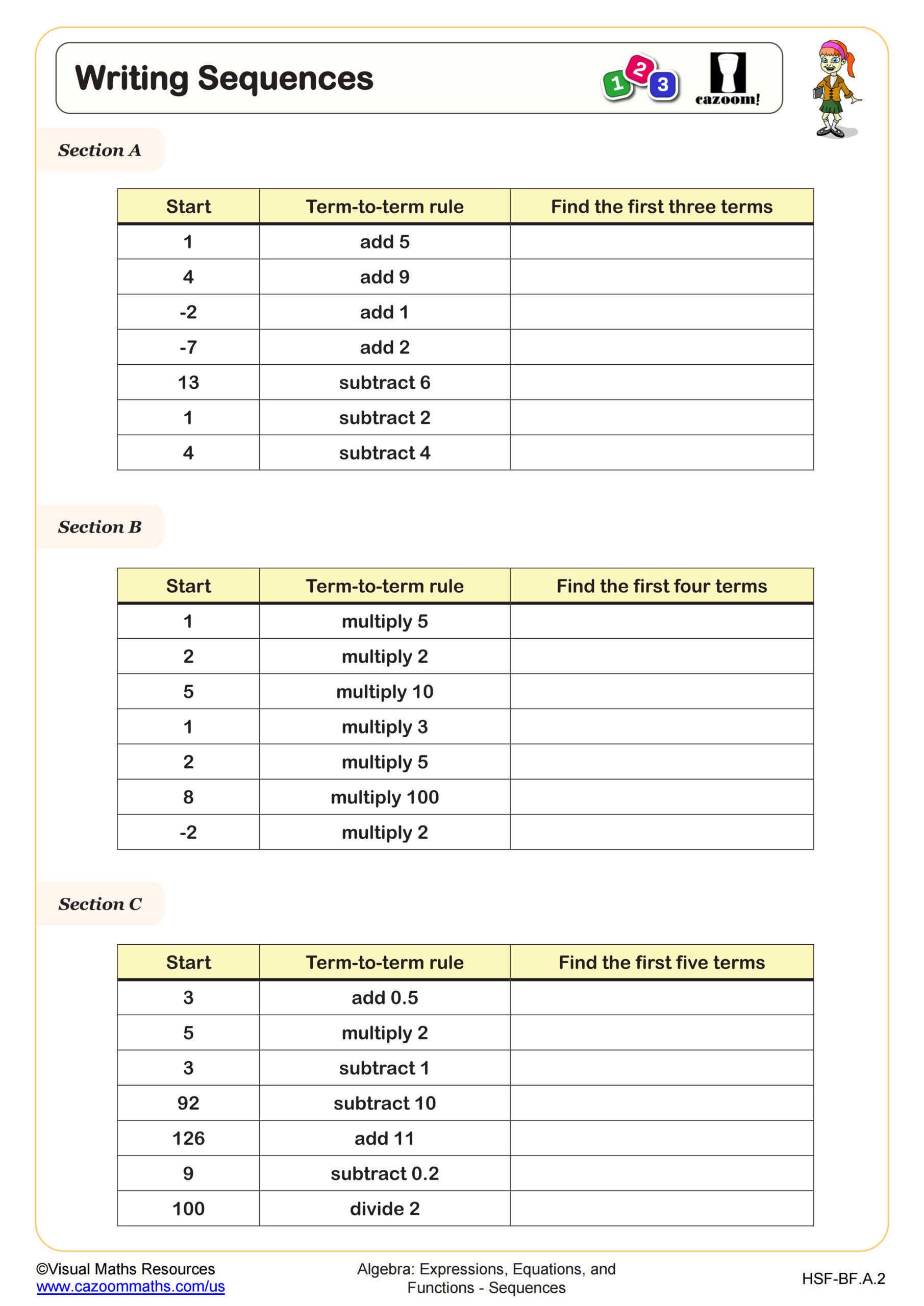
Writing Sequences
All worksheets are created by the team of experienced teachers at Cazoom Math.
What are sequences in high school math?
Sequences are ordered lists of numbers that follow specific patterns or rules. In high school mathematics, students analyze arithmetic sequences (where consecutive terms differ by a constant amount), geometric sequences (where consecutive terms share a constant ratio), and special sequences like Fibonacci numbers. These concepts align with Common Core standards for Algebra I, Algebra II, and Precalculus, as well as Integrated Mathematics pathways. Students learn to write both explicit formulas that calculate any term directly and recursive formulas that define each term based on previous terms.
A common error occurs when students write formulas but forget that 'n' represents position, not value. For example, when asked to find the 50th term of an arithmetic sequence, many students substitute 50 for the common difference instead of the term number. Teachers notice this misconception especially when sequences don't start with n=1, requiring students to adjust their formulas accordingly.
Which grade levels study sequences?
These high school sequences worksheets cover Algebra I, Geometry, Algebra II, Precalculus, and Integrated Mathematics courses (IM 1, IM 2, IM 3). While sequences appear briefly in middle school as patterns, high school courses formalize the notation, terminology, and algebraic representations. Students encounter sequences most intensively in Algebra I and Algebra II, where they connect to linear and exponential functions.
The progression across grade levels builds complexity strategically. Algebra I students typically work with arithmetic sequences and simple geometric patterns, establishing the vocabulary of terms, common differences, and position. Algebra II and Precalculus students tackle geometric sequences with rational and irrational ratios, analyze convergence, work with sigma notation for series, and explore recursive relationships. Integrated Math pathways distribute these concepts across IM 1 through IM 3, connecting sequences to coordinate algebra and modeling contexts.
How does the Fibonacci sequence connect to real-world applications?
The Fibonacci sequence follows the recursive pattern where each term equals the sum of the two preceding terms: 1, 1, 2, 3, 5, 8, 13, and so on. Unlike arithmetic or geometric sequences, Fibonacci numbers require students to track multiple previous terms simultaneously, challenging their understanding of recursive definitions. This sequence introduces students to more complex mathematical thinking beyond simple addition or multiplication patterns, preparing them for advanced topics in discrete mathematics and computer science.
Fibonacci numbers appear throughout nature and engineering applications, making them particularly engaging for STEM learners. The spiral arrangements of sunflower seeds, pinecone scales, and pineapple sections follow Fibonacci patterns to maximize packing efficiency. Architects and artists use the related golden ratio (approximately 1.618) derived from consecutive Fibonacci terms to create aesthetically pleasing proportions in buildings and visual designs. Computer scientists use Fibonacci sequences in algorithm analysis, while financial analysts apply them in market technical analysis, demonstrating how this mathematical pattern bridges biology, design, and technology.
How can teachers use these sequence worksheets effectively?
These worksheets support differentiated instruction through their progression from Equal Steps (D) through Equal Steps (A), indicating increasing difficulty levels. Teachers can assign specific levels based on student readiness, allowing advanced learners to move quickly through foundational concepts while providing struggling students with accessible entry points. The answer keys enable students to check their work independently during practice sessions, building self-assessment skills and mathematical confidence without constant teacher monitoring.
Many teachers use these worksheets for bell ringers to activate prior knowledge about patterns, or as homework to reinforce classroom instruction on explicit versus recursive formulas. The structured format works well for intervention groups where students need repeated practice identifying sequence types before writing formulas. During test preparation, teachers often assign mixed-level worksheets so students encounter the variety of sequence problems typical on standardized assessments. Paired work activities allow students to compare strategies for finding terms, with one student using explicit formulas while another uses recursive patterns to verify answers.