High School Simplification Worksheets
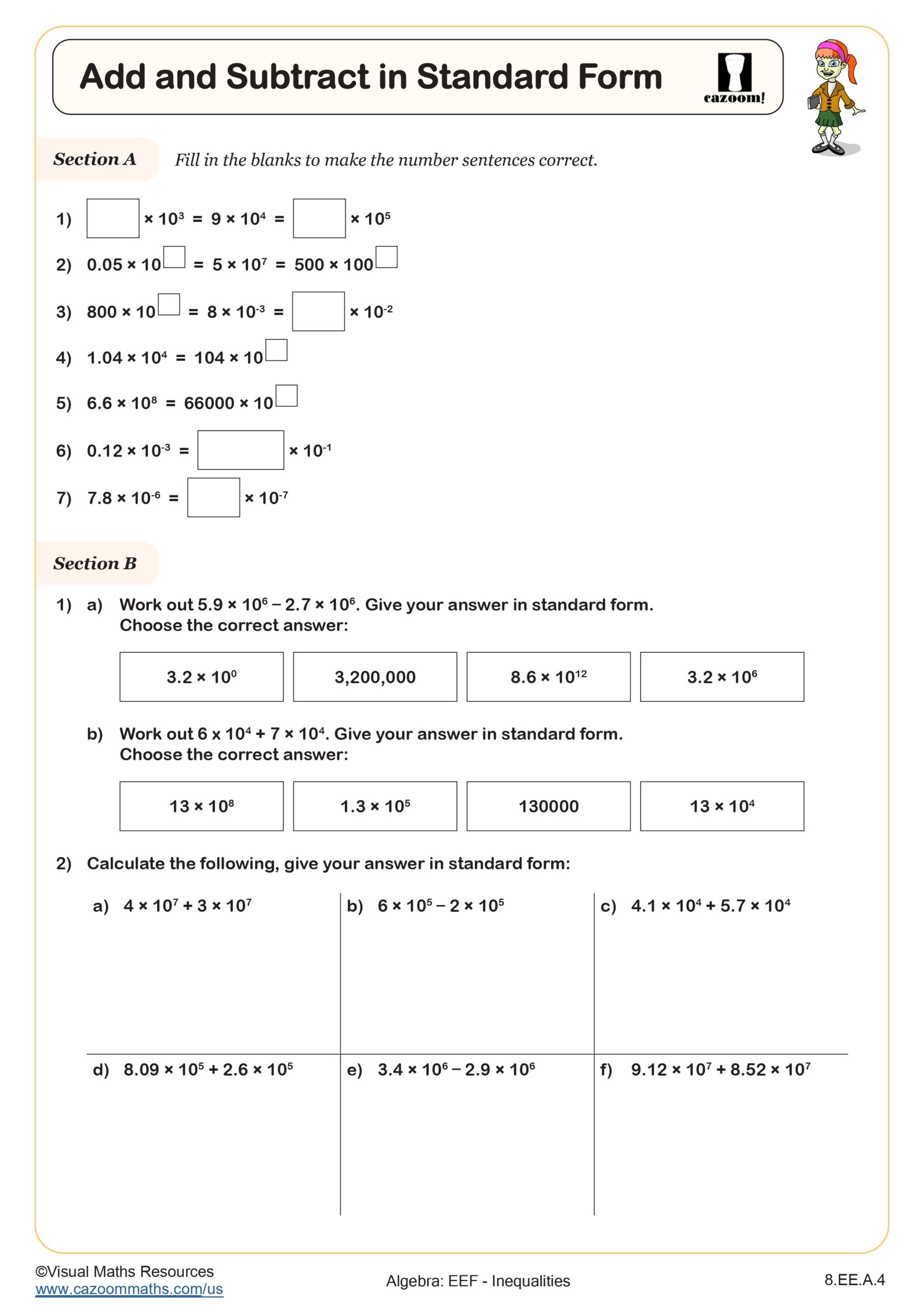
Add and Subtract in Standard Form
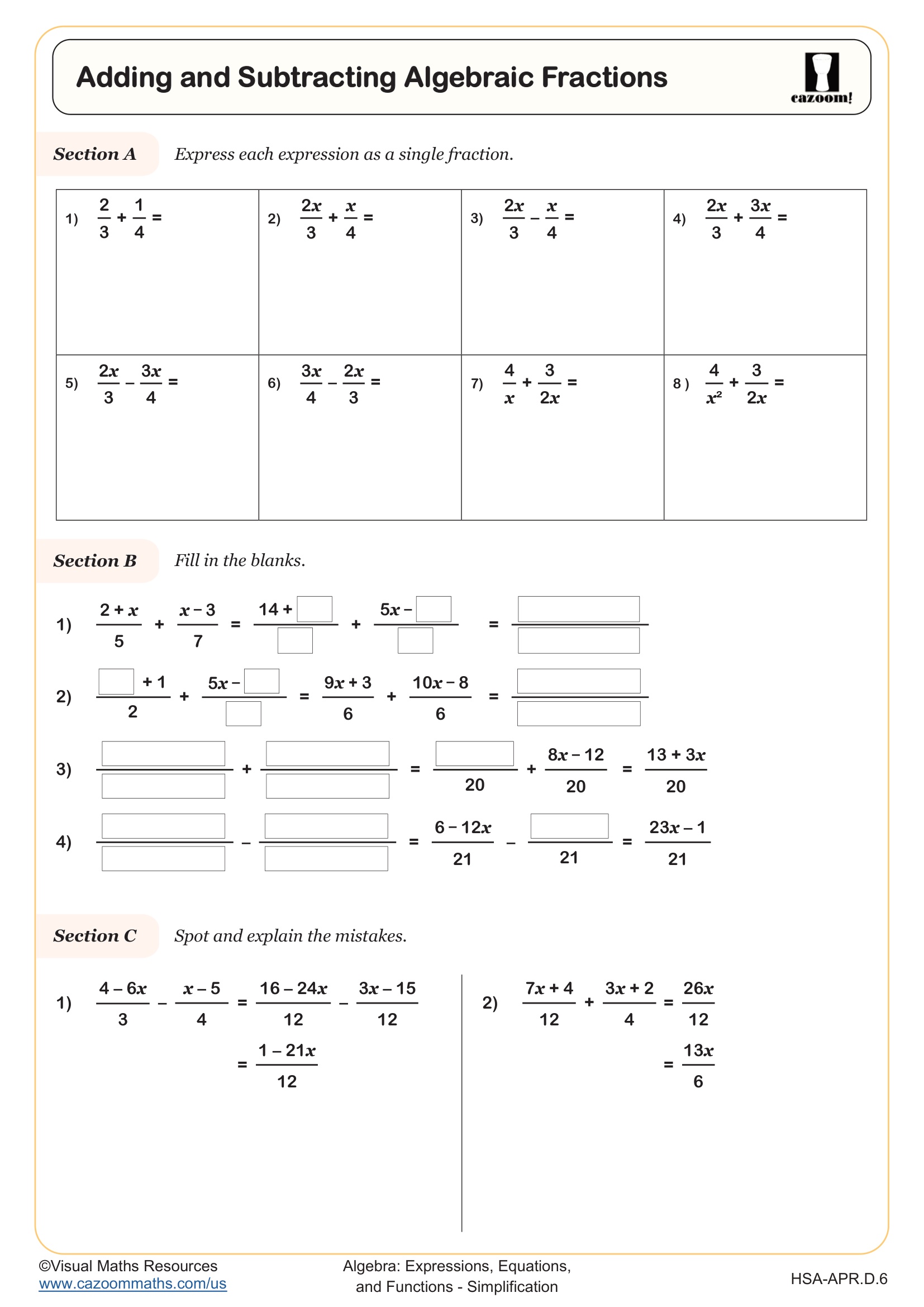
Adding and Subtracting Algebraic Fractions
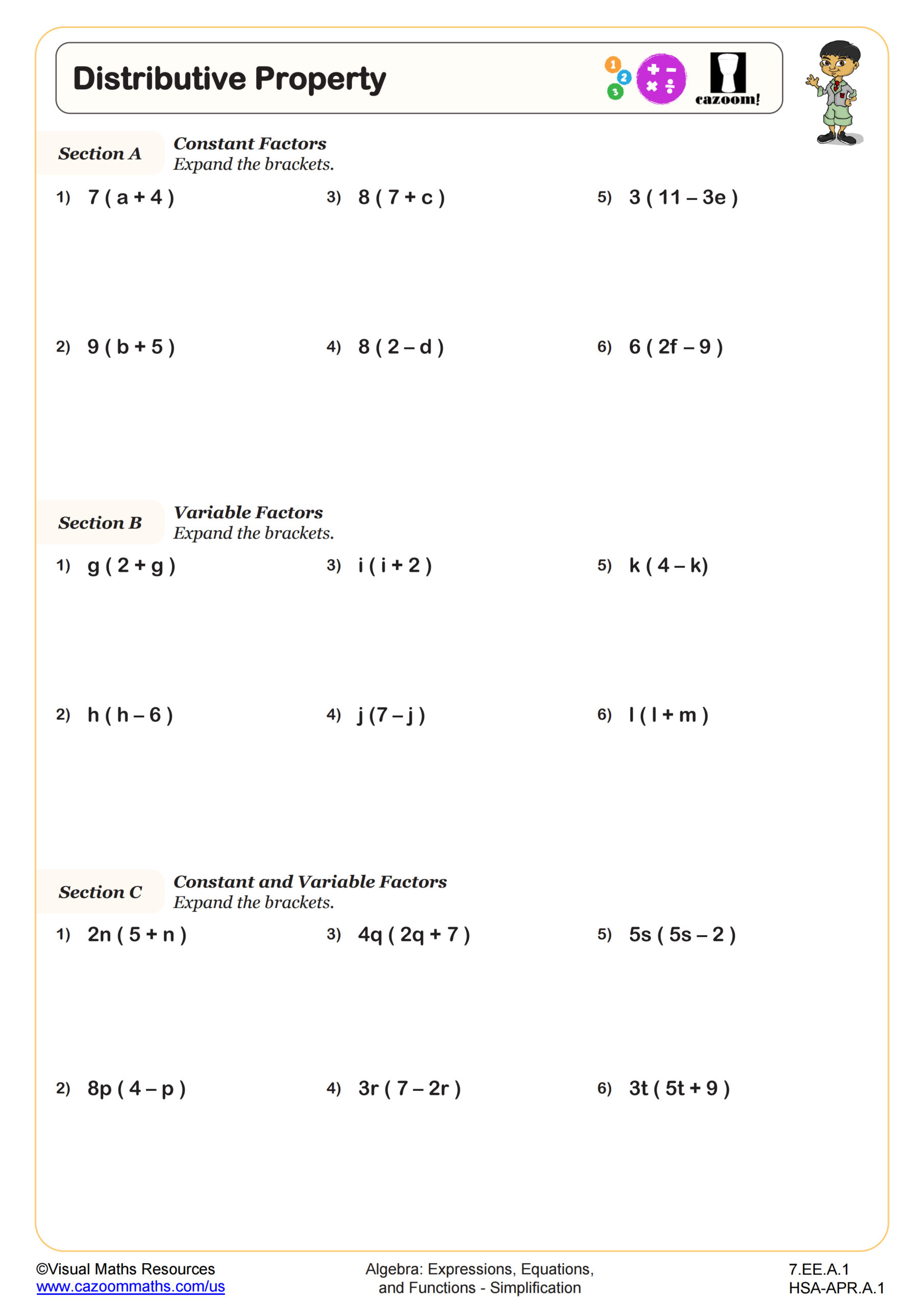
Distributive Property
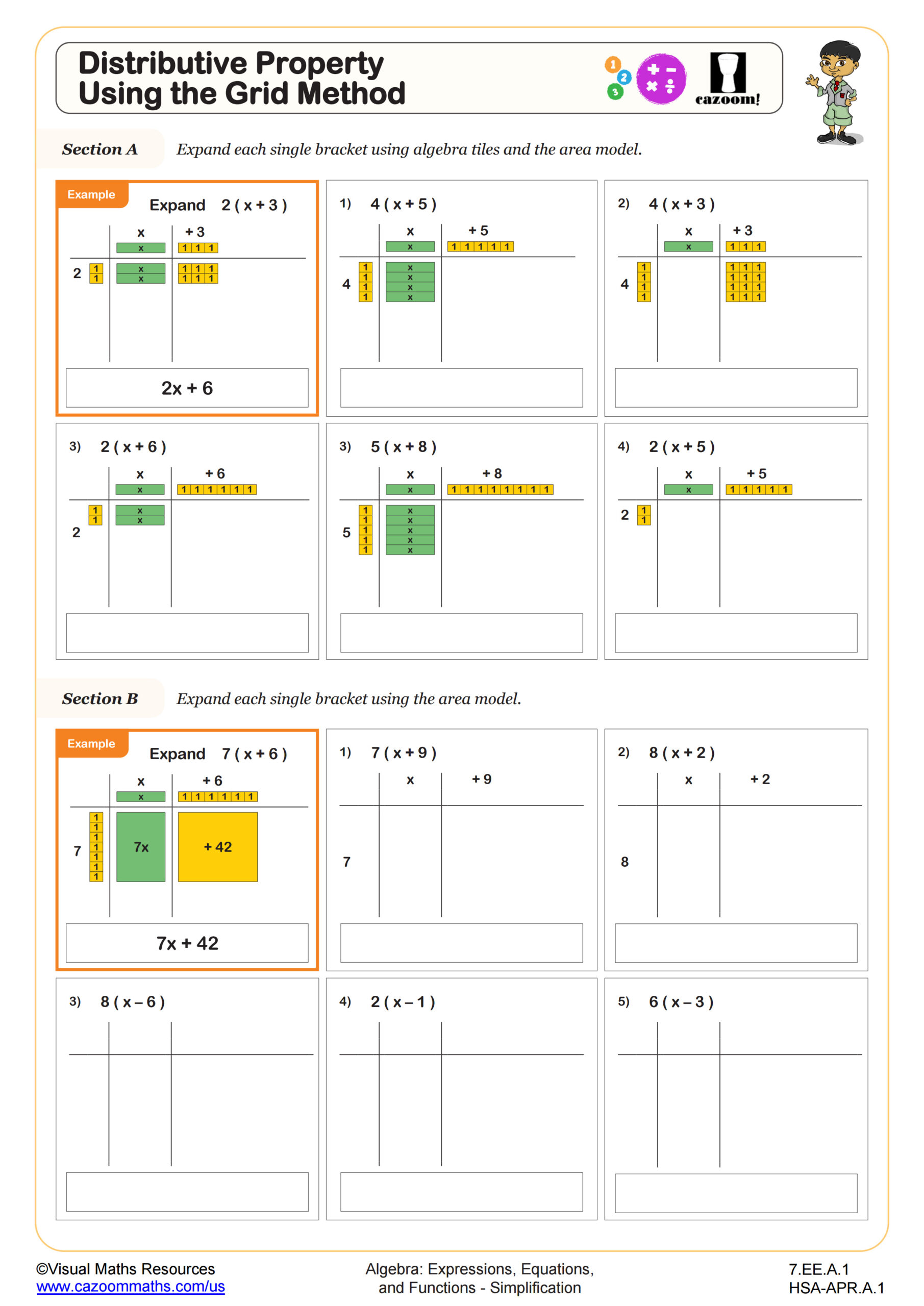
Distributive Property using the Grid Method
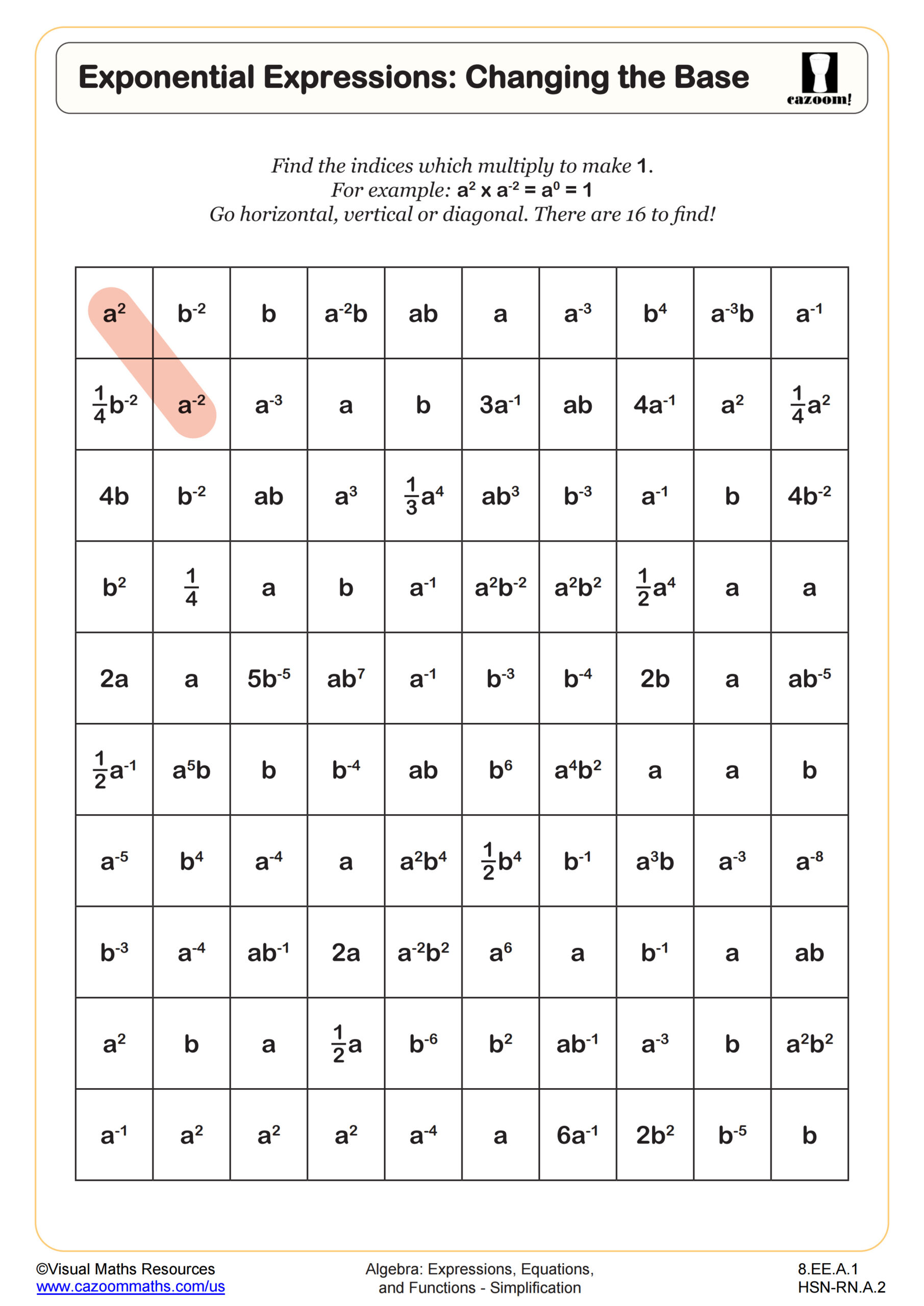
Exponential Expressions: Changing the Base
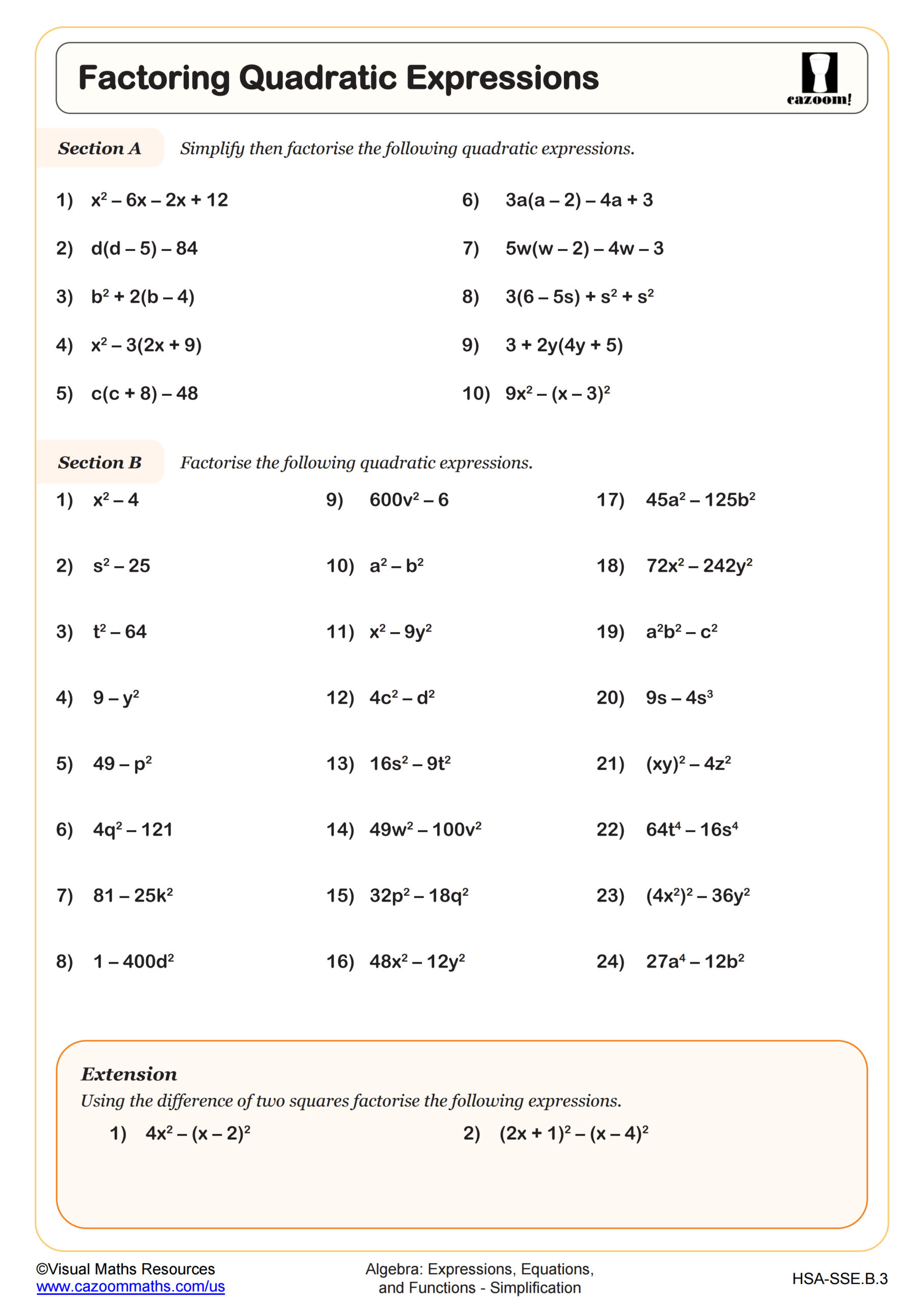
Factoring Quadratic Expressions
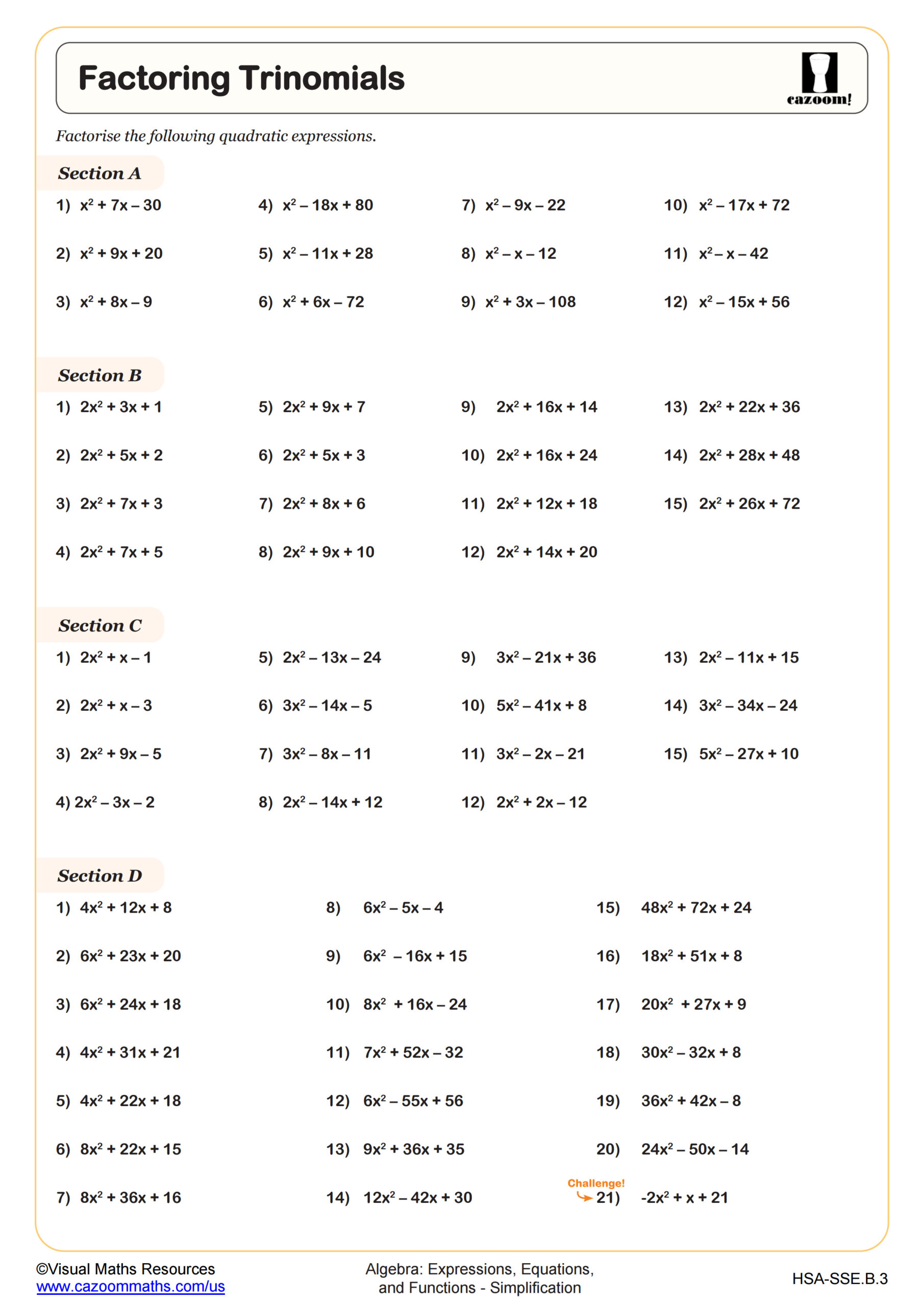
Factoring Trinomials
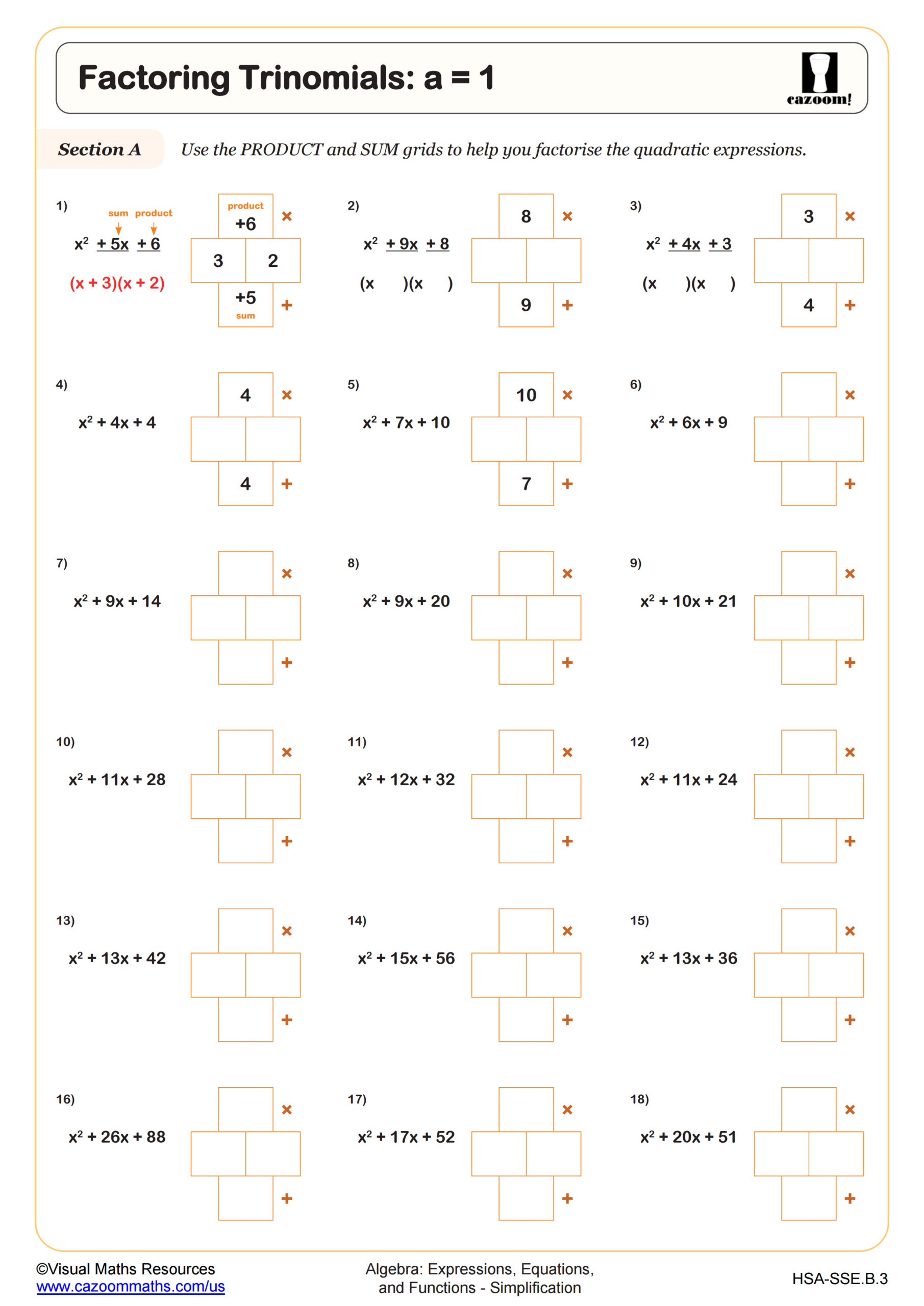
Factoring Trinomials: a = 1
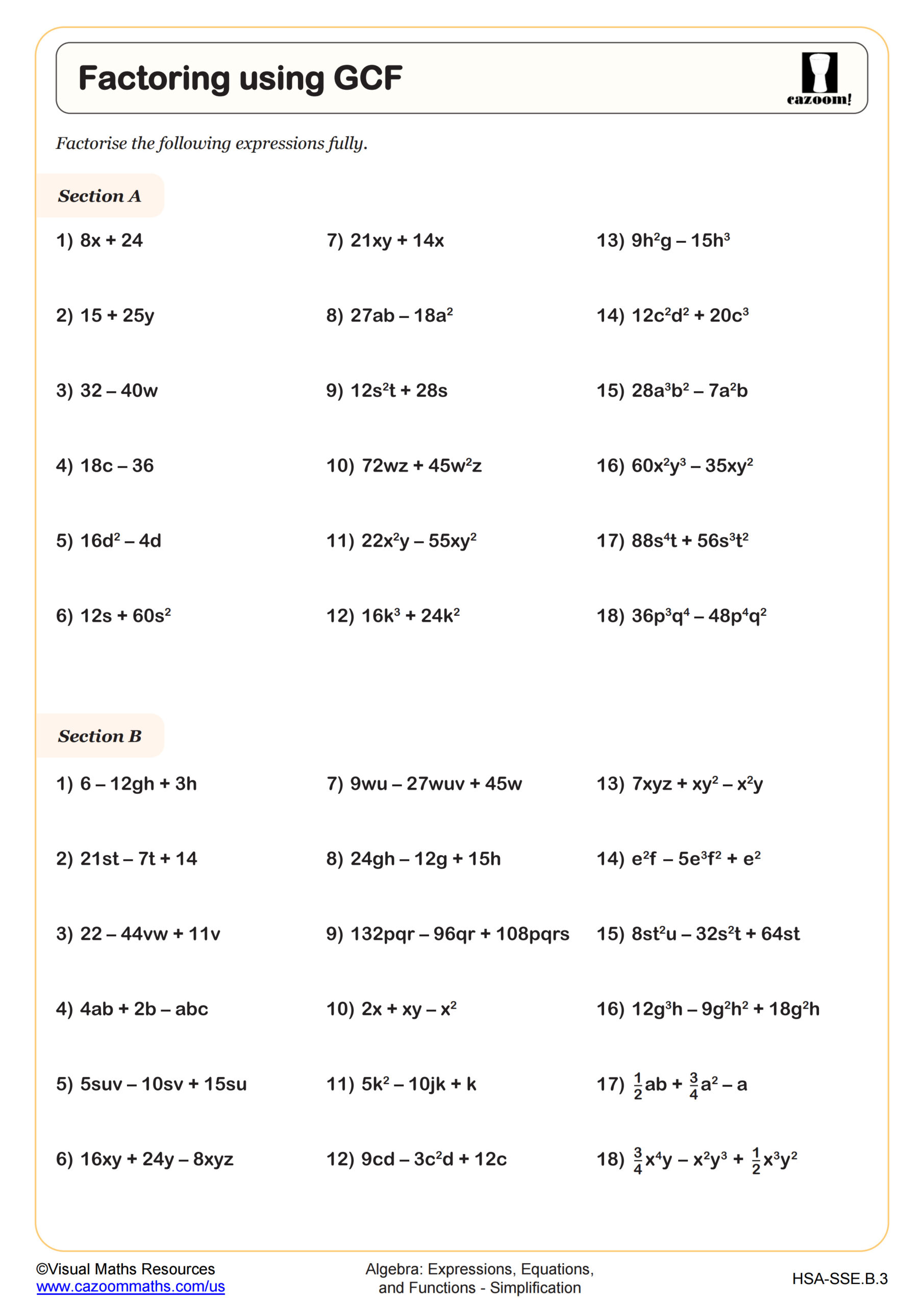
Factoring using GCF
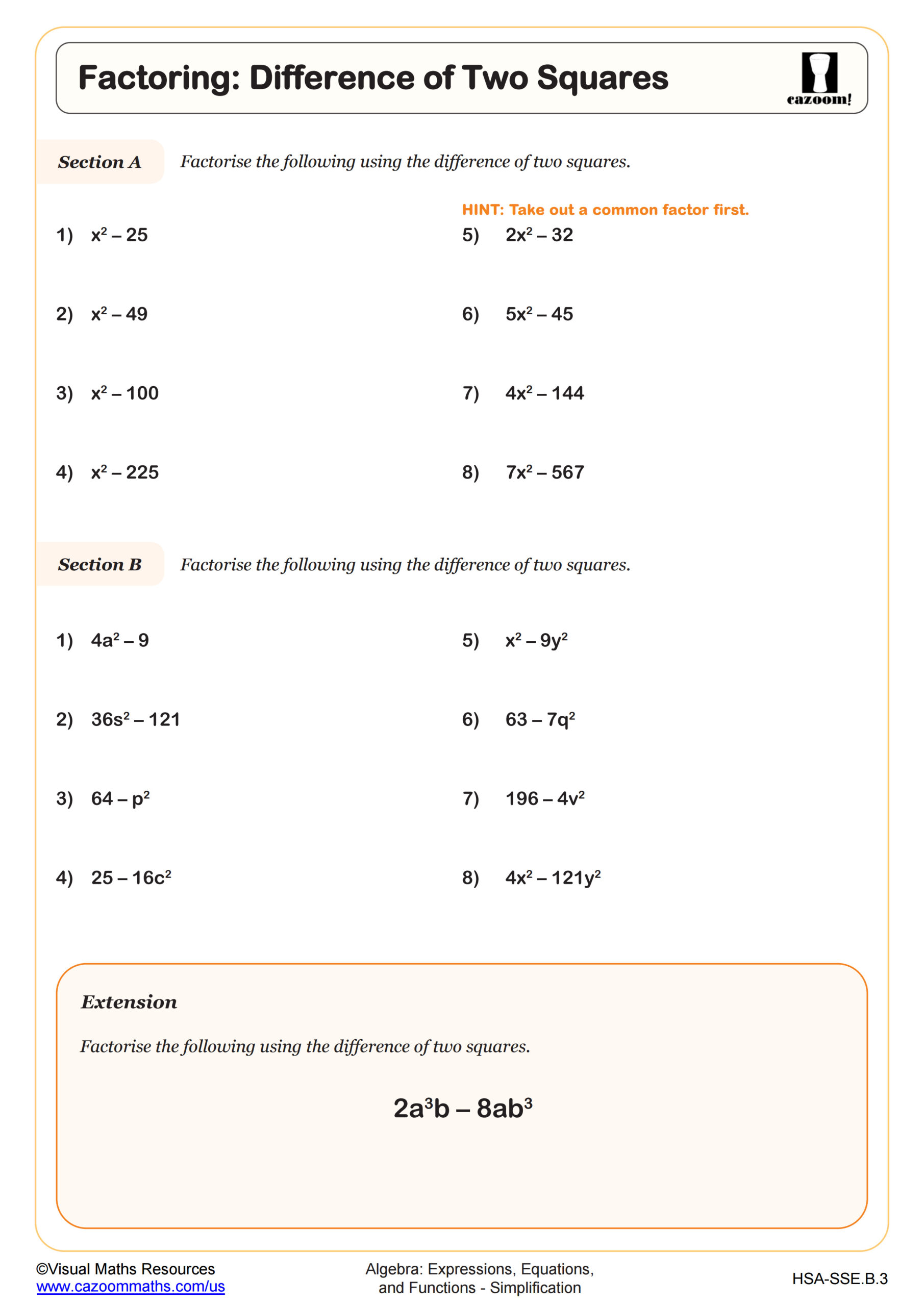
Factoring: Difference of Two Squares
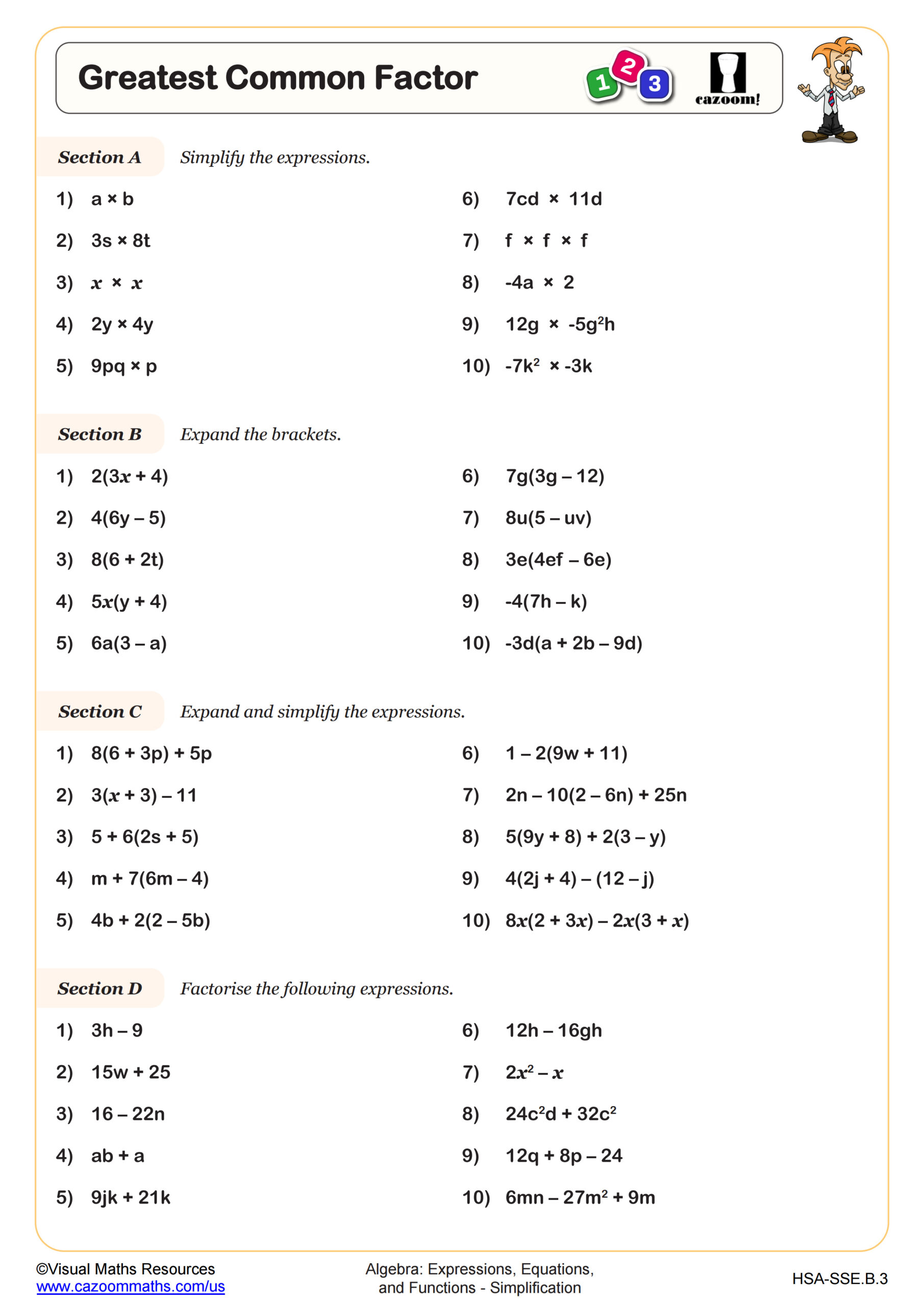
Greatest Common Factor
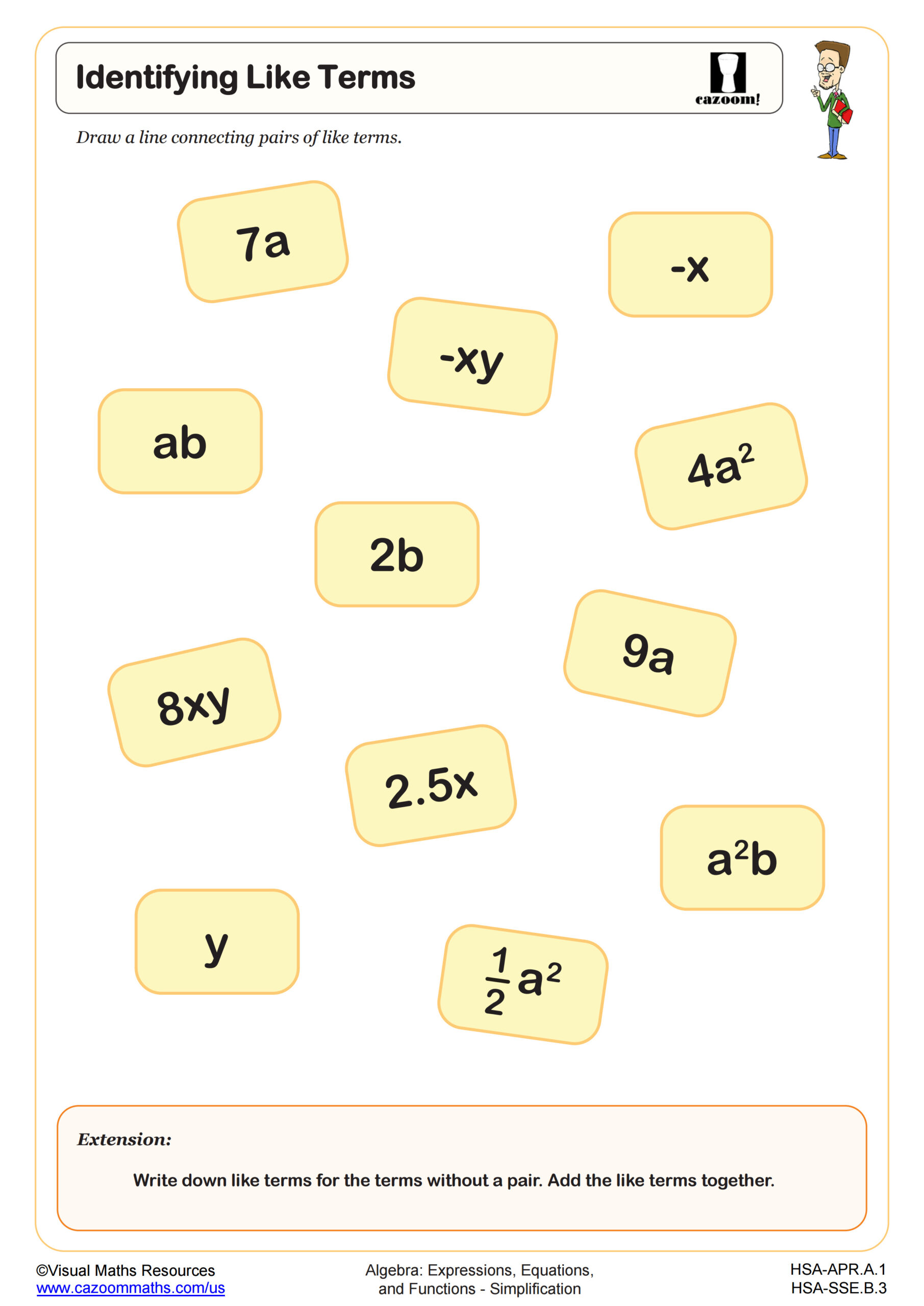
Identifying Like Terms
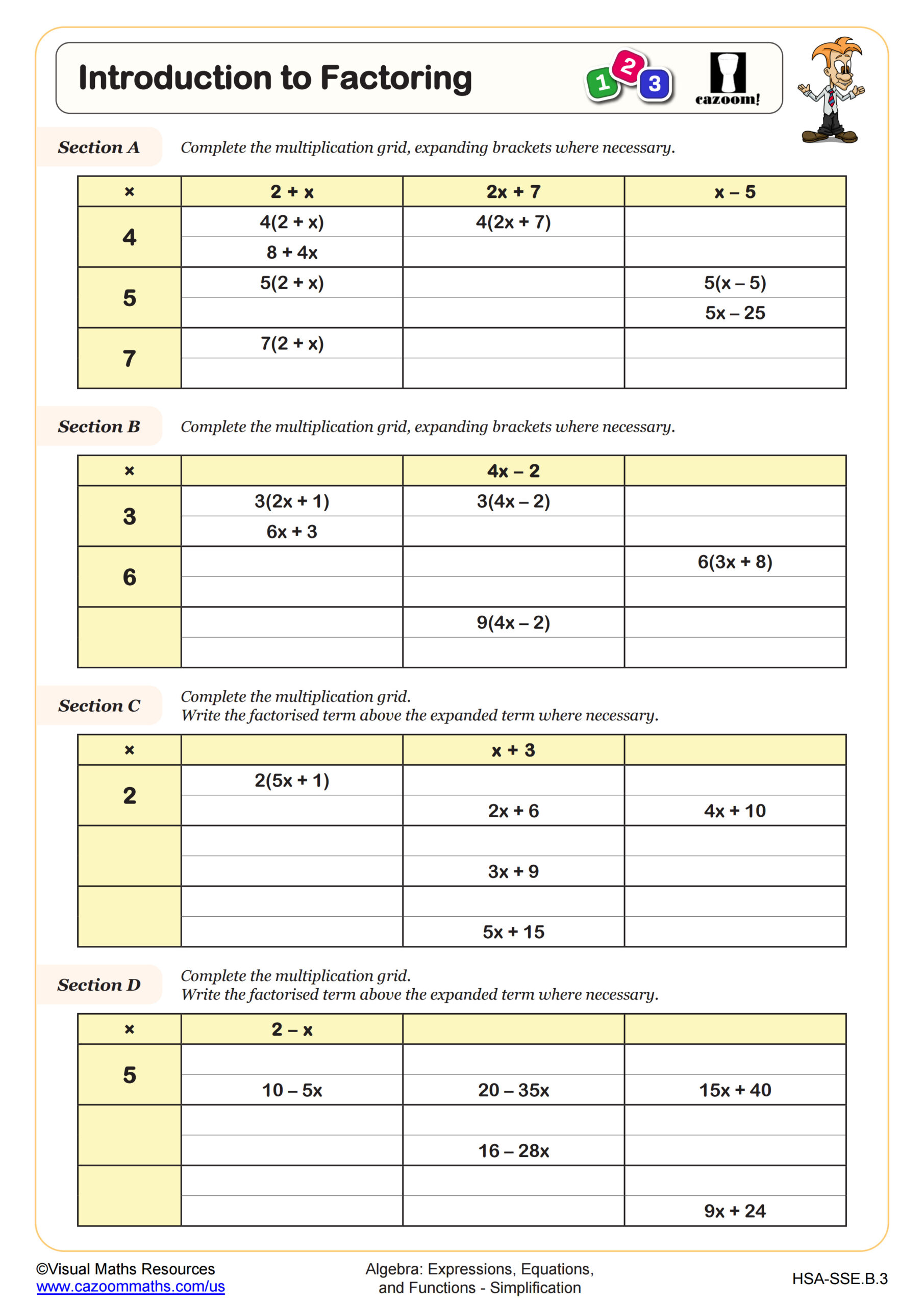
Introduction to Factoring
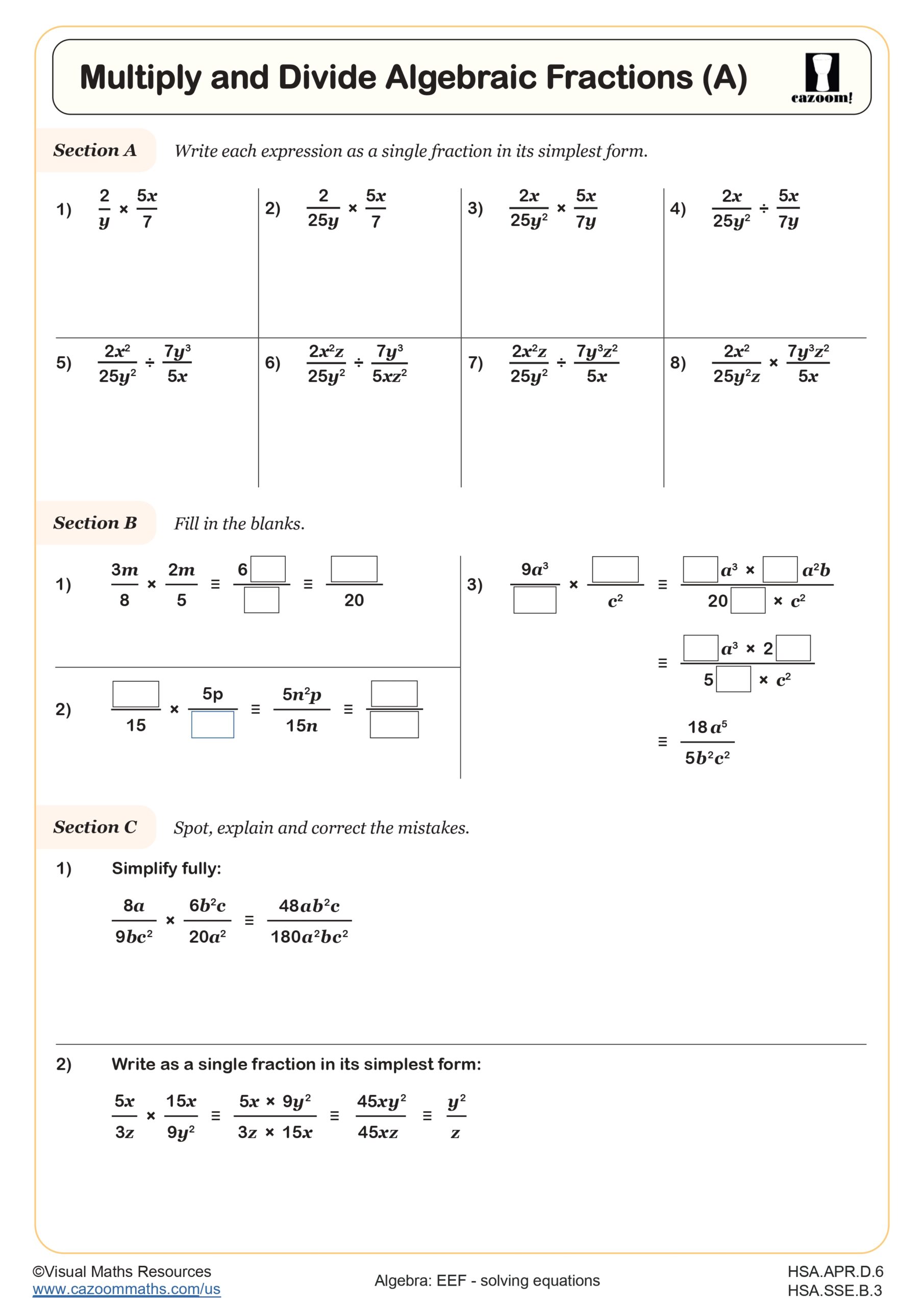
Multiply and Divide Algebraic Fractions (A)
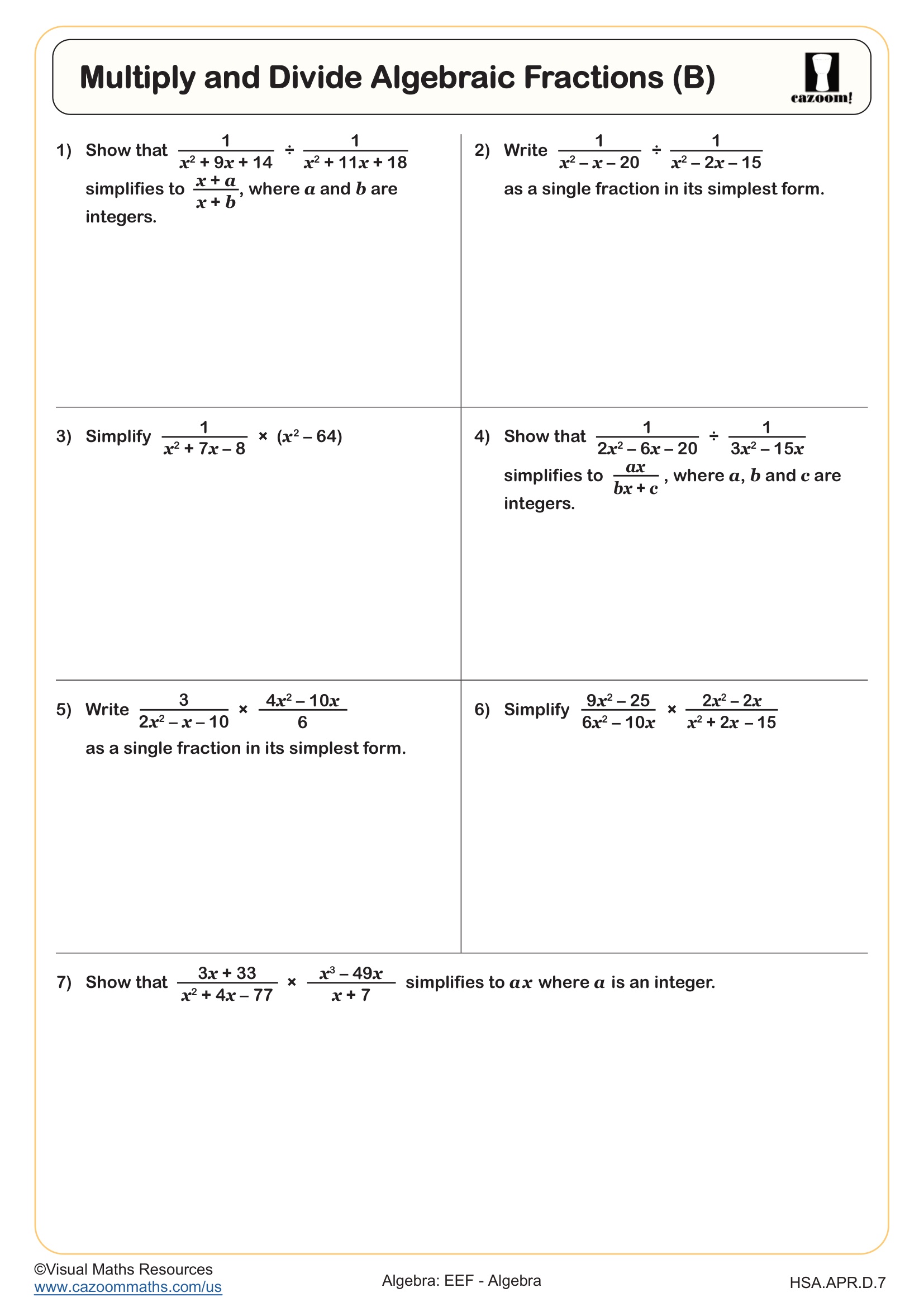
Multiply and Divide Algebraic Fractions (B)
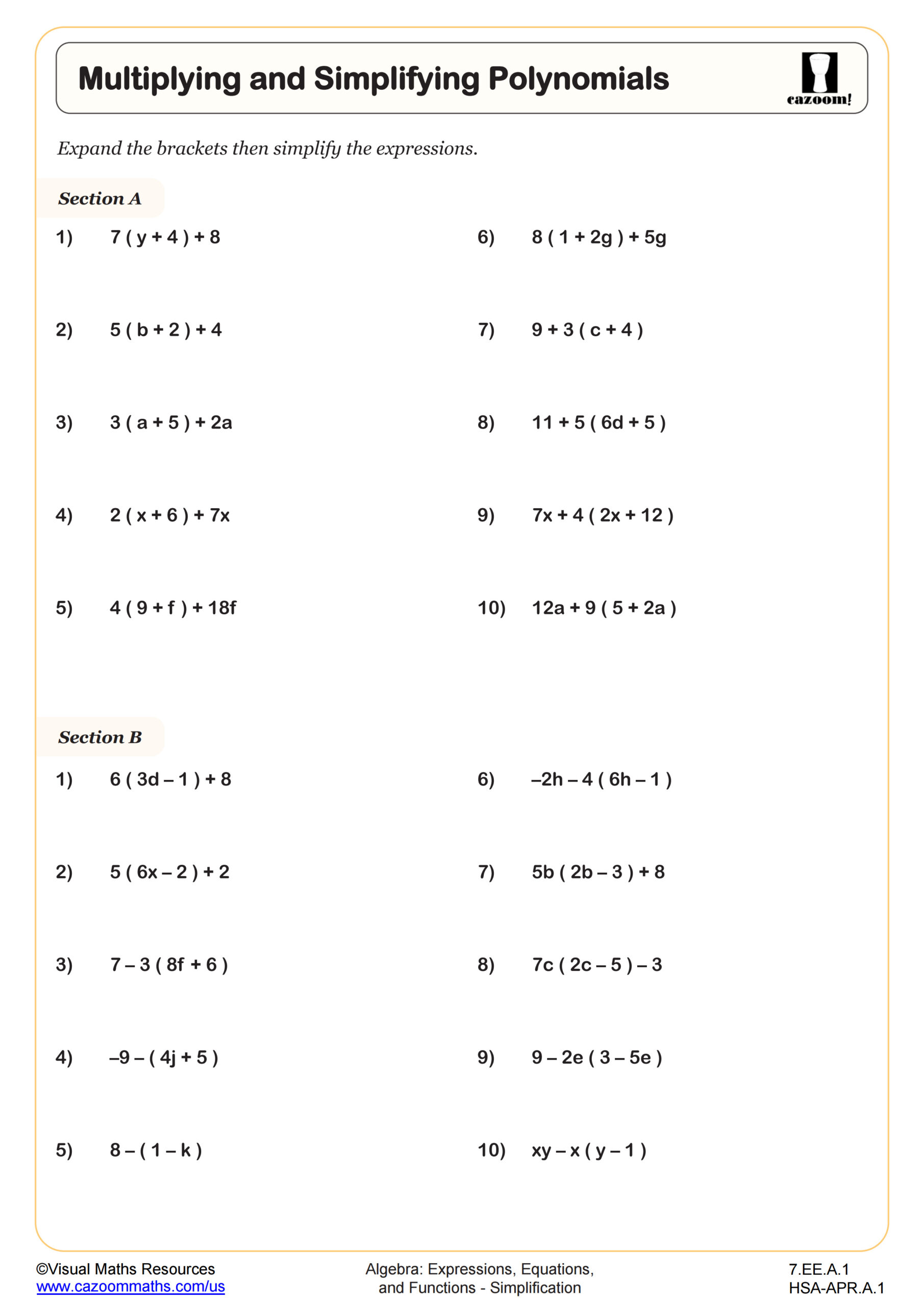
Multiplying and Simplifying Polynomials
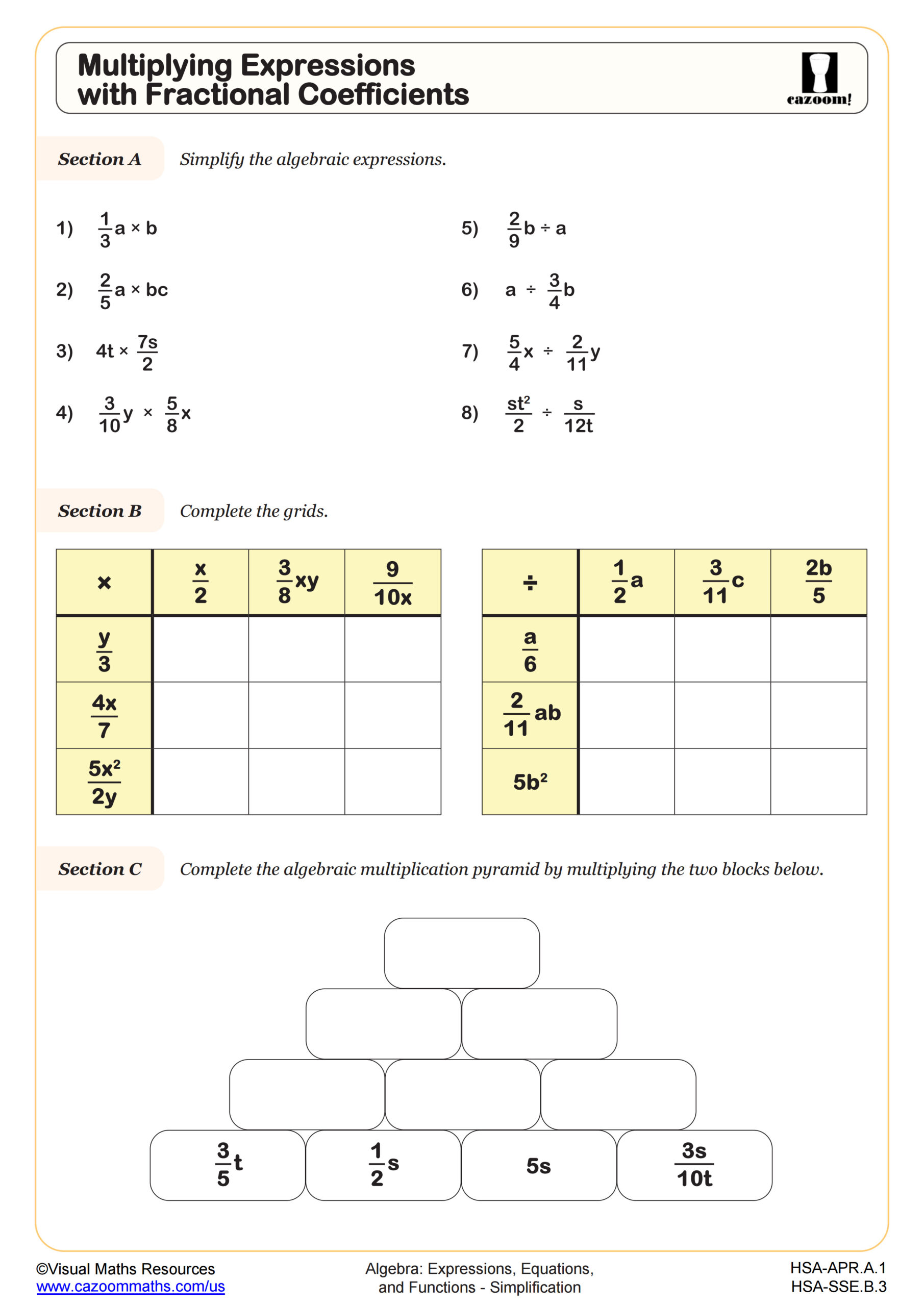
Multiplying Expressions with Fractional Coefficients
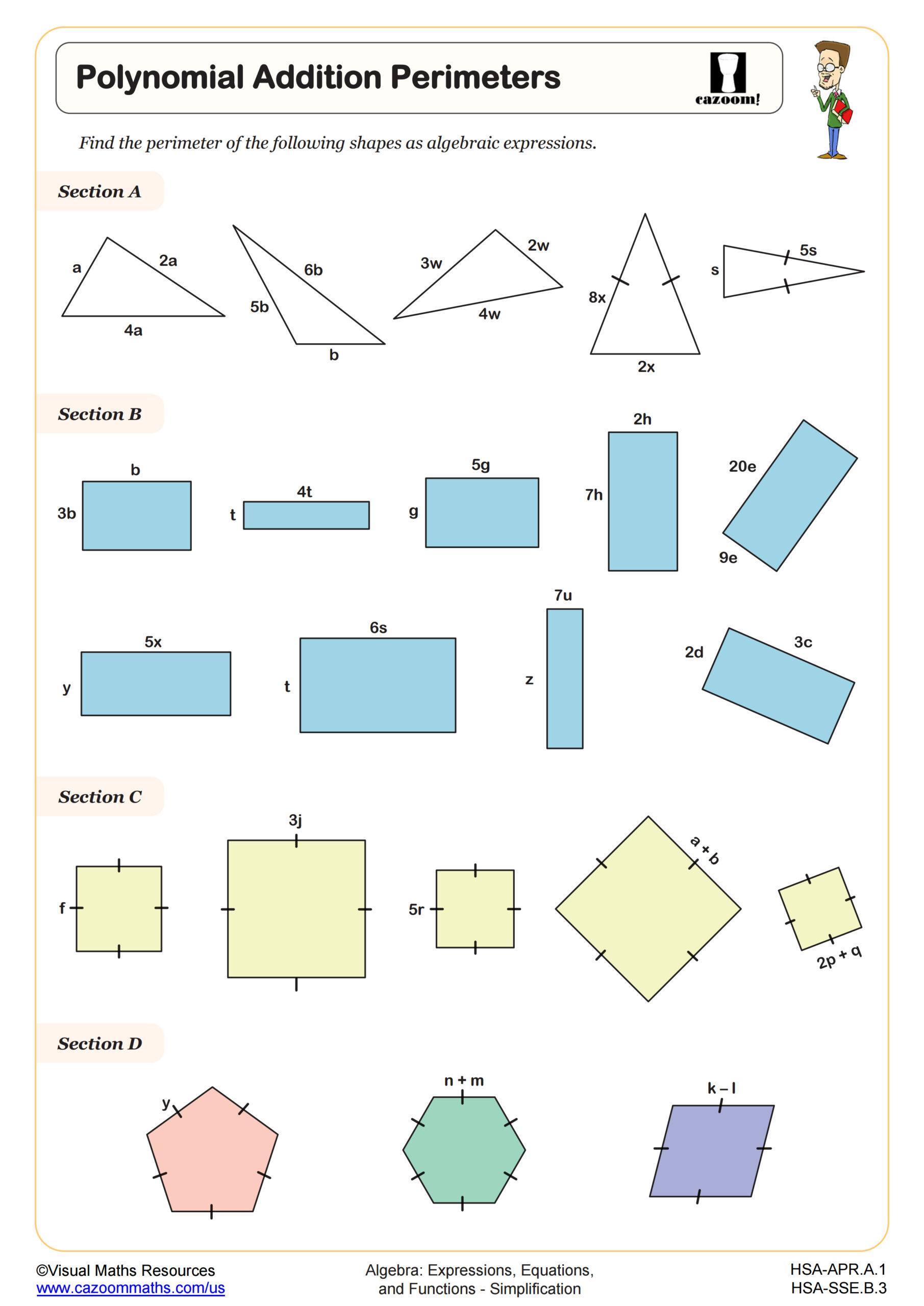
Polynomial Addition Perimeters
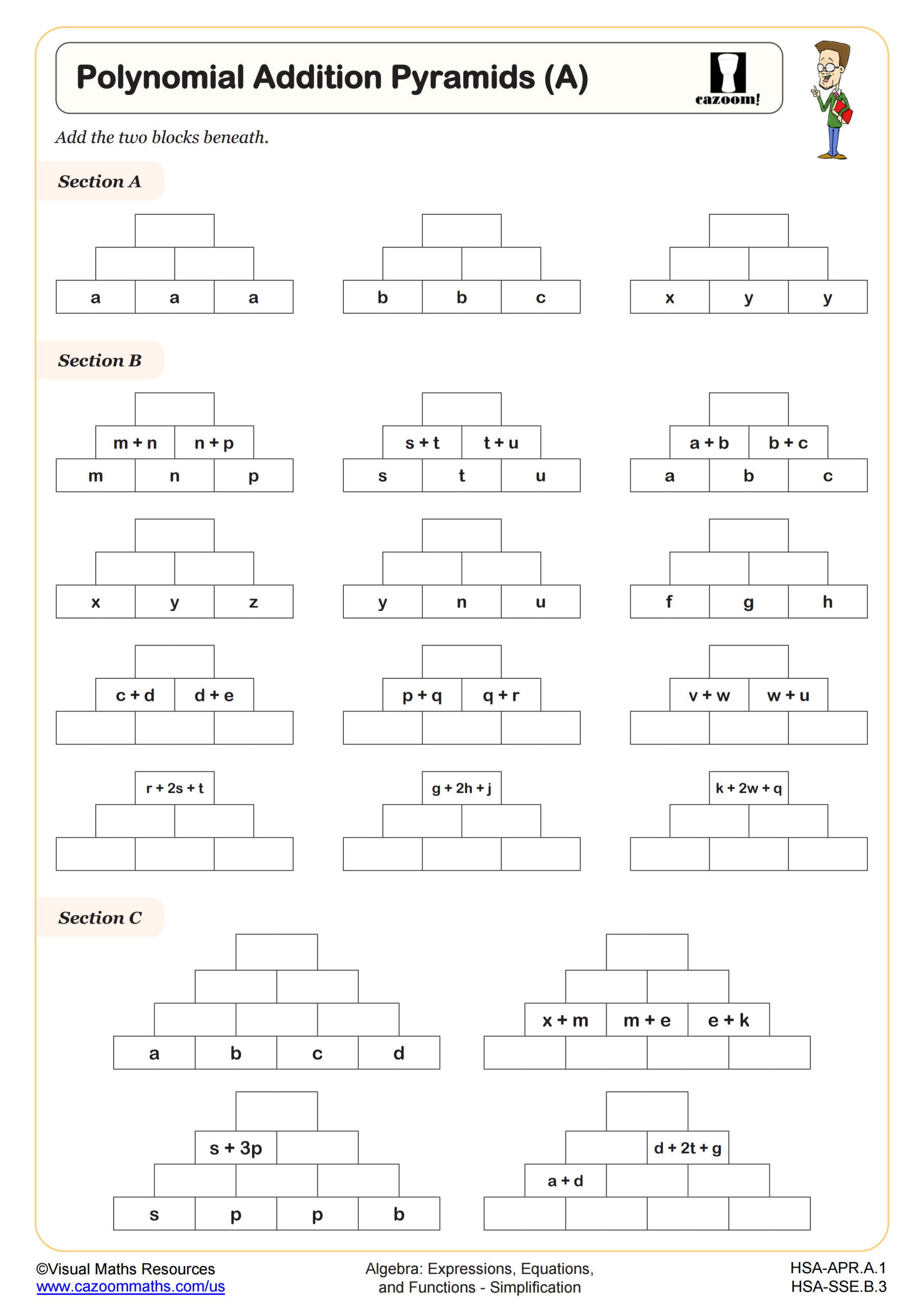
Polynomial Addition Pyramids (A)
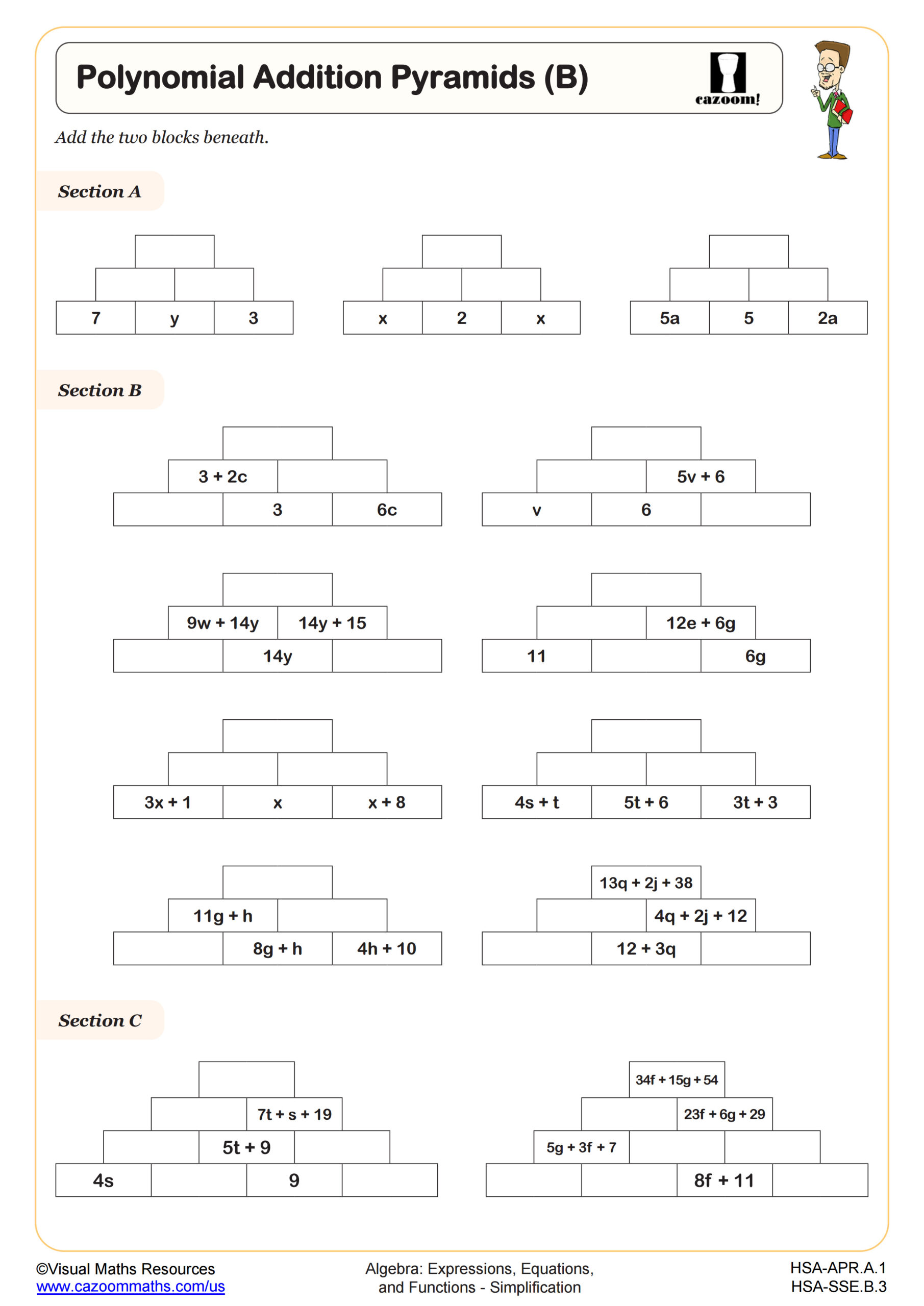
Polynomial Addition Pyramids (B)
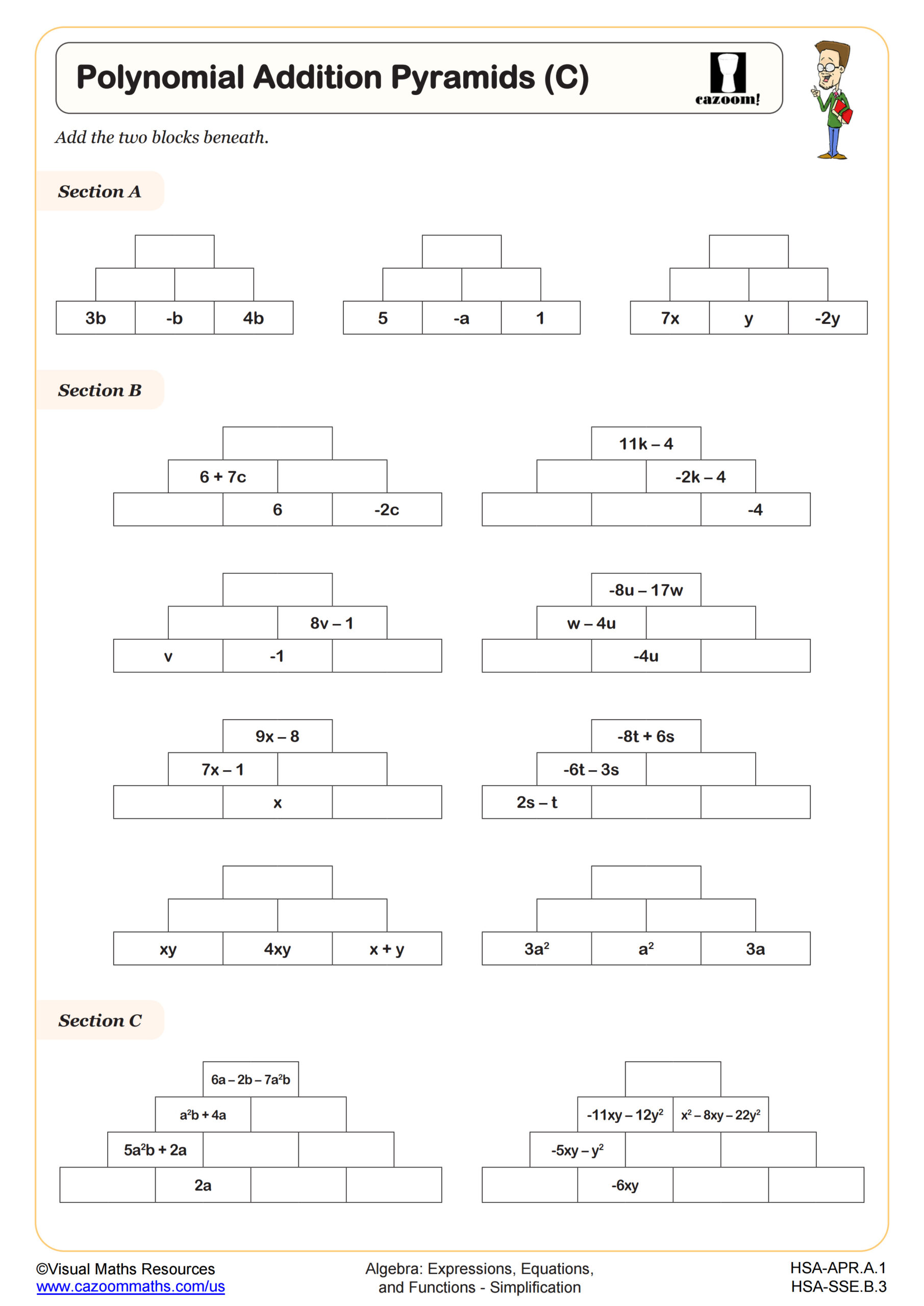
Polynomial Addition Pyramids (C)
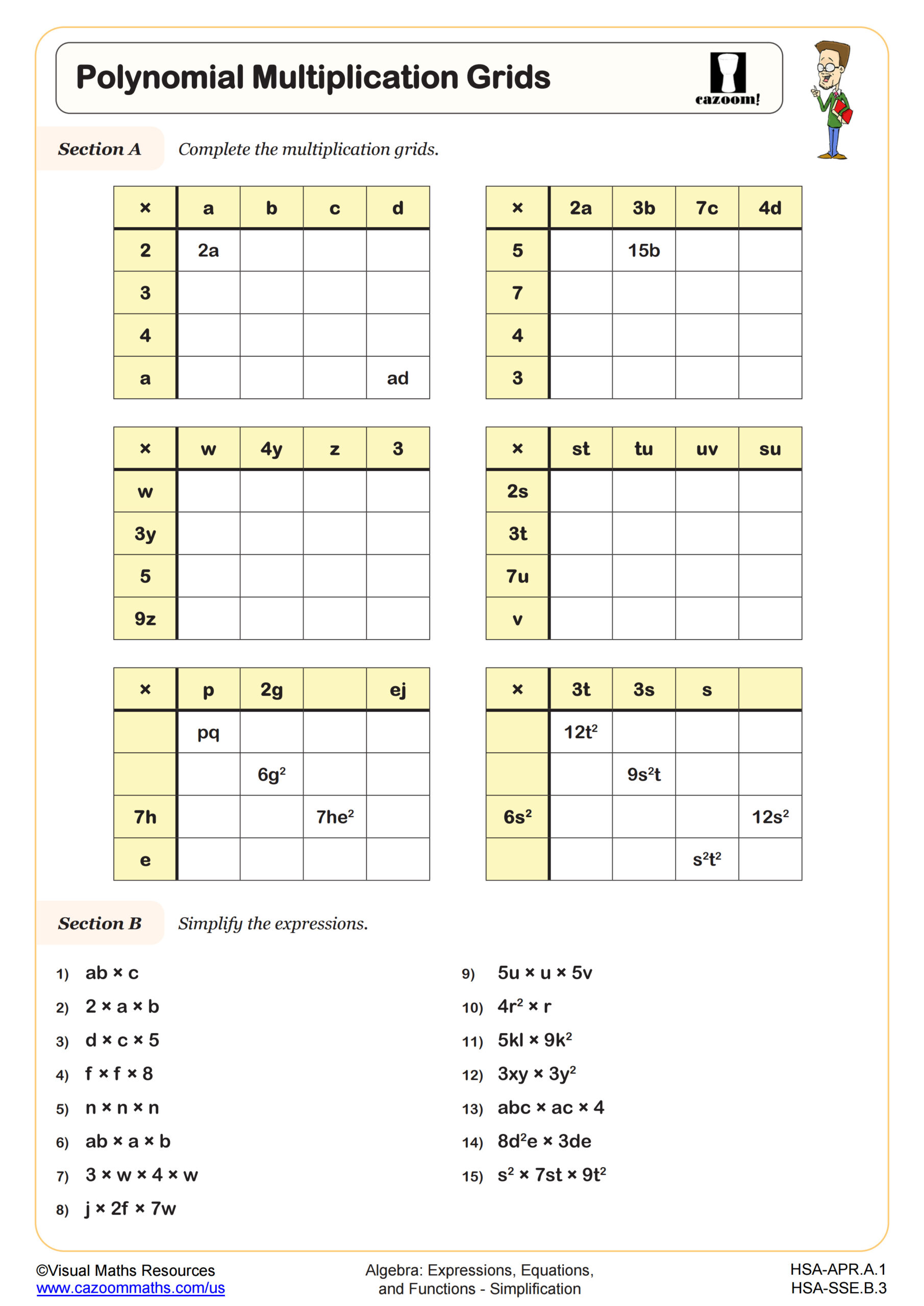
Polynomial Multiplication Grids
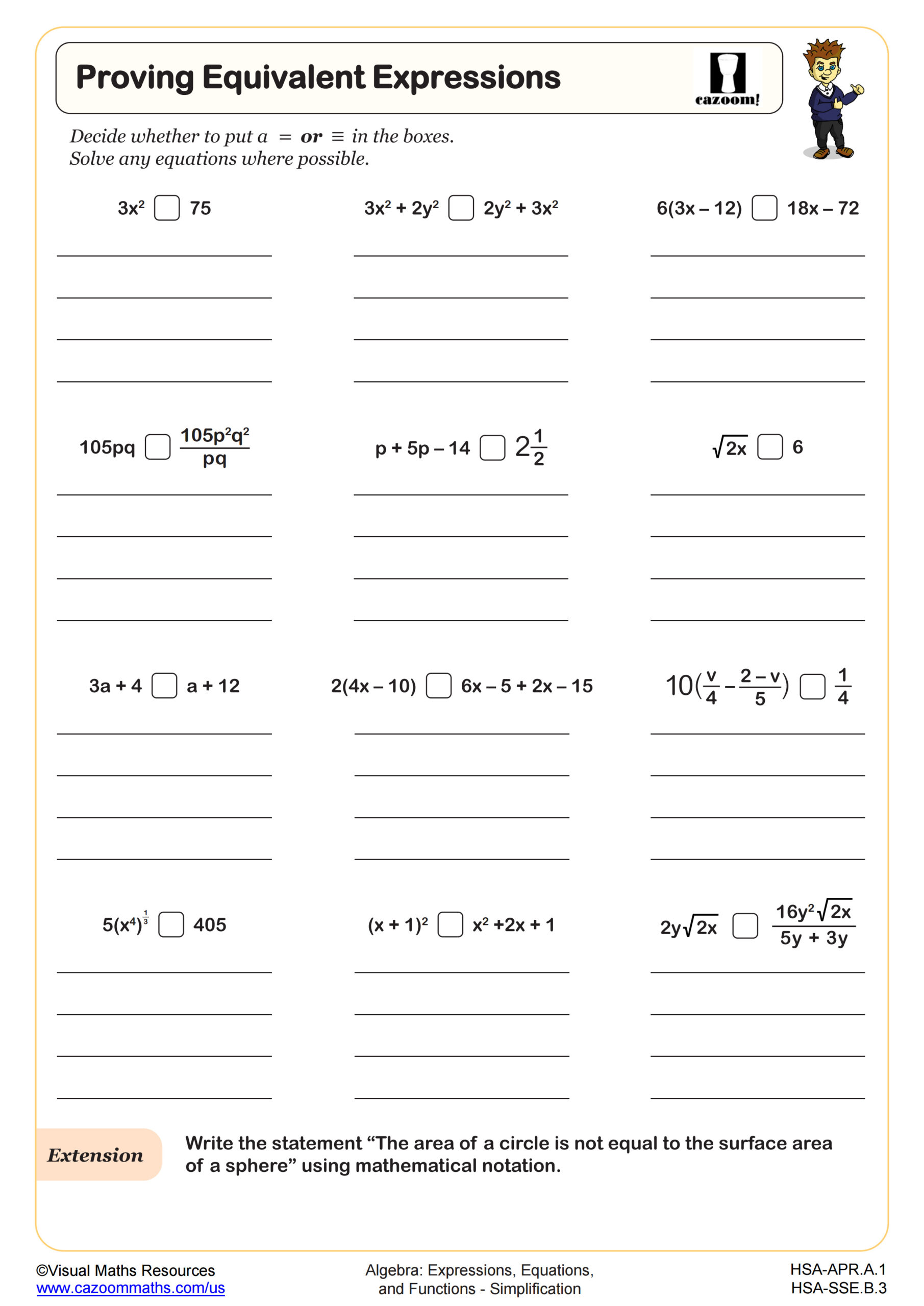
Proving Equivalent Expressions
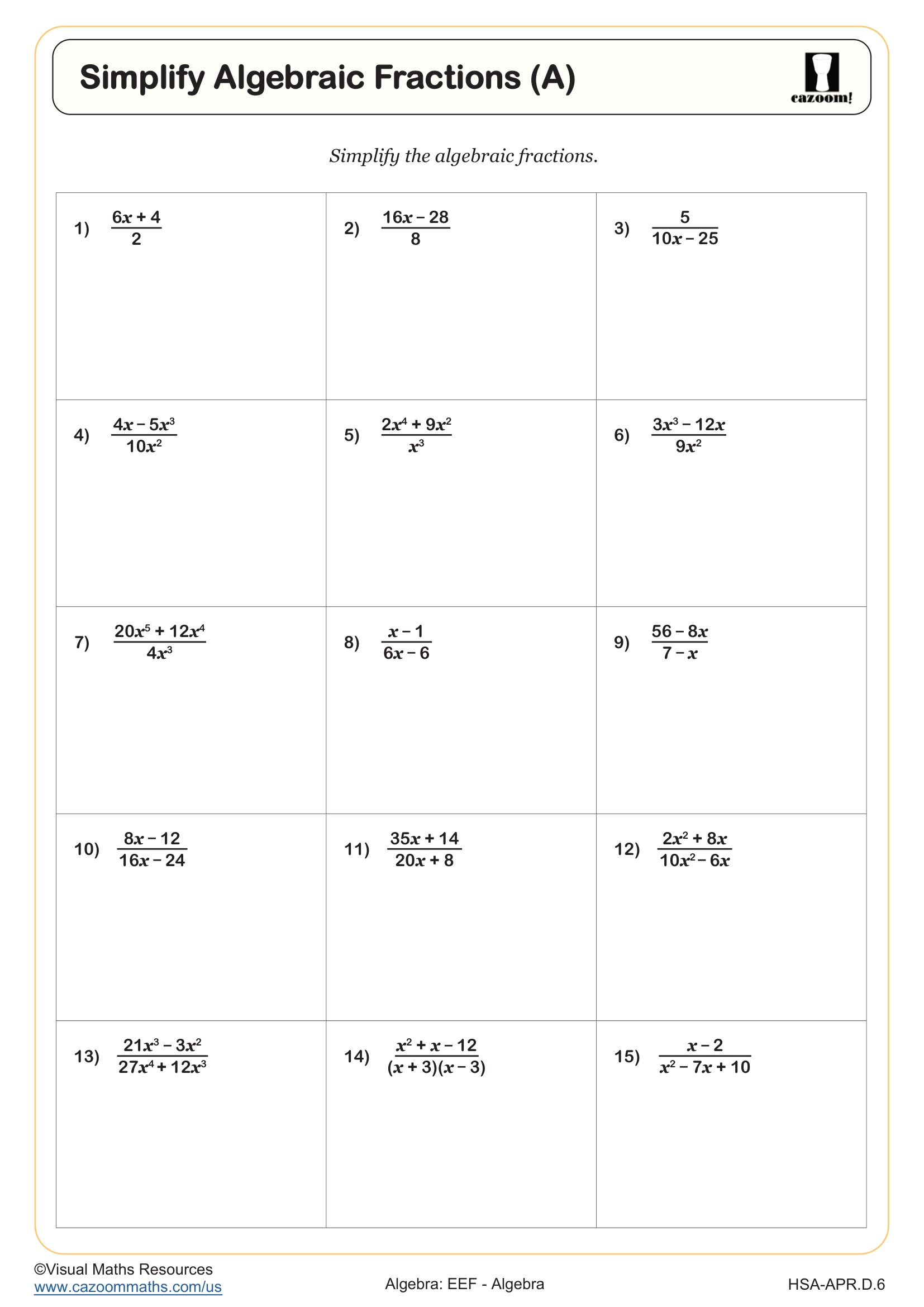
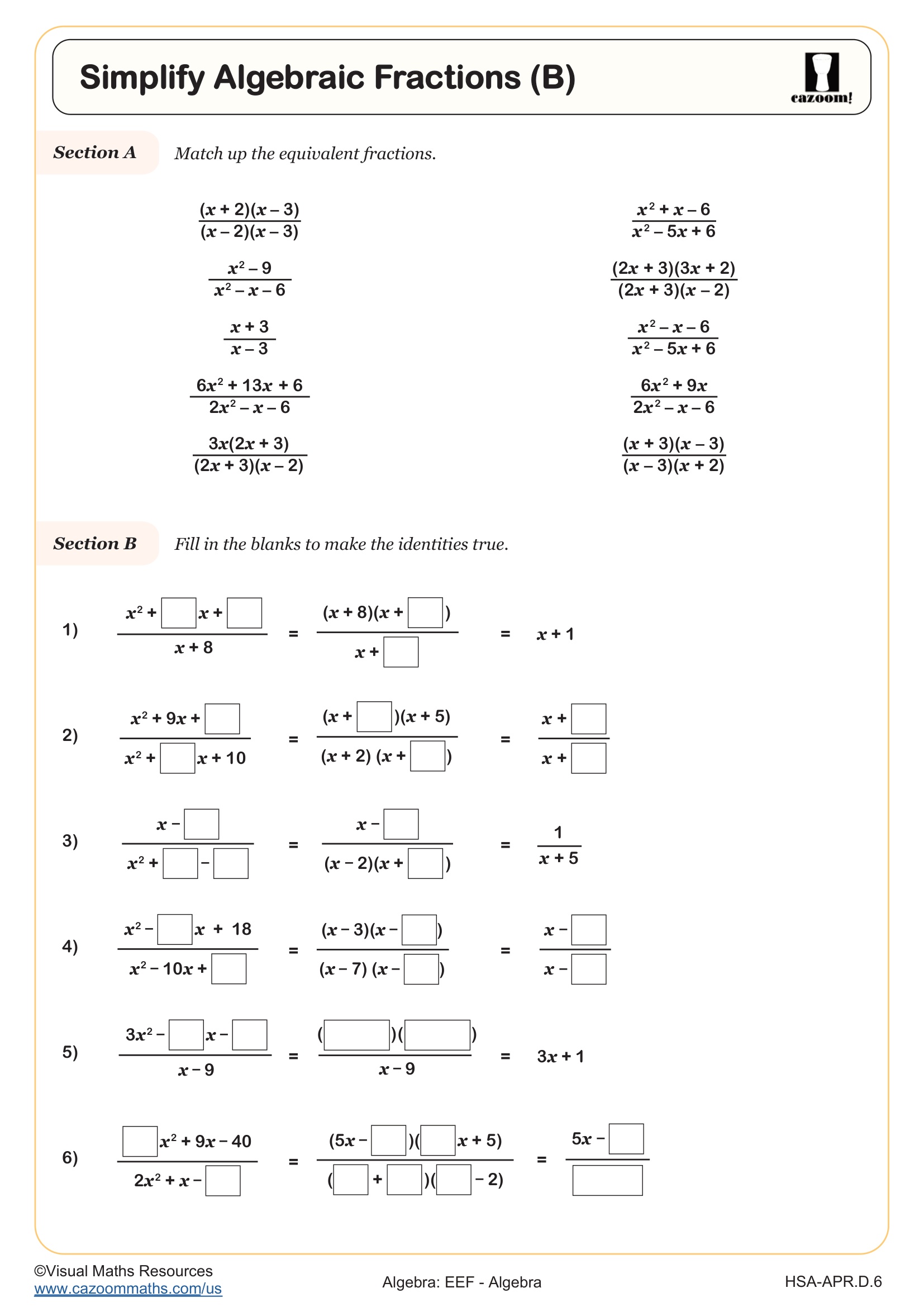
Simplify Algebraic Fractions (A)
Simplify Algebraic Fractions (B)
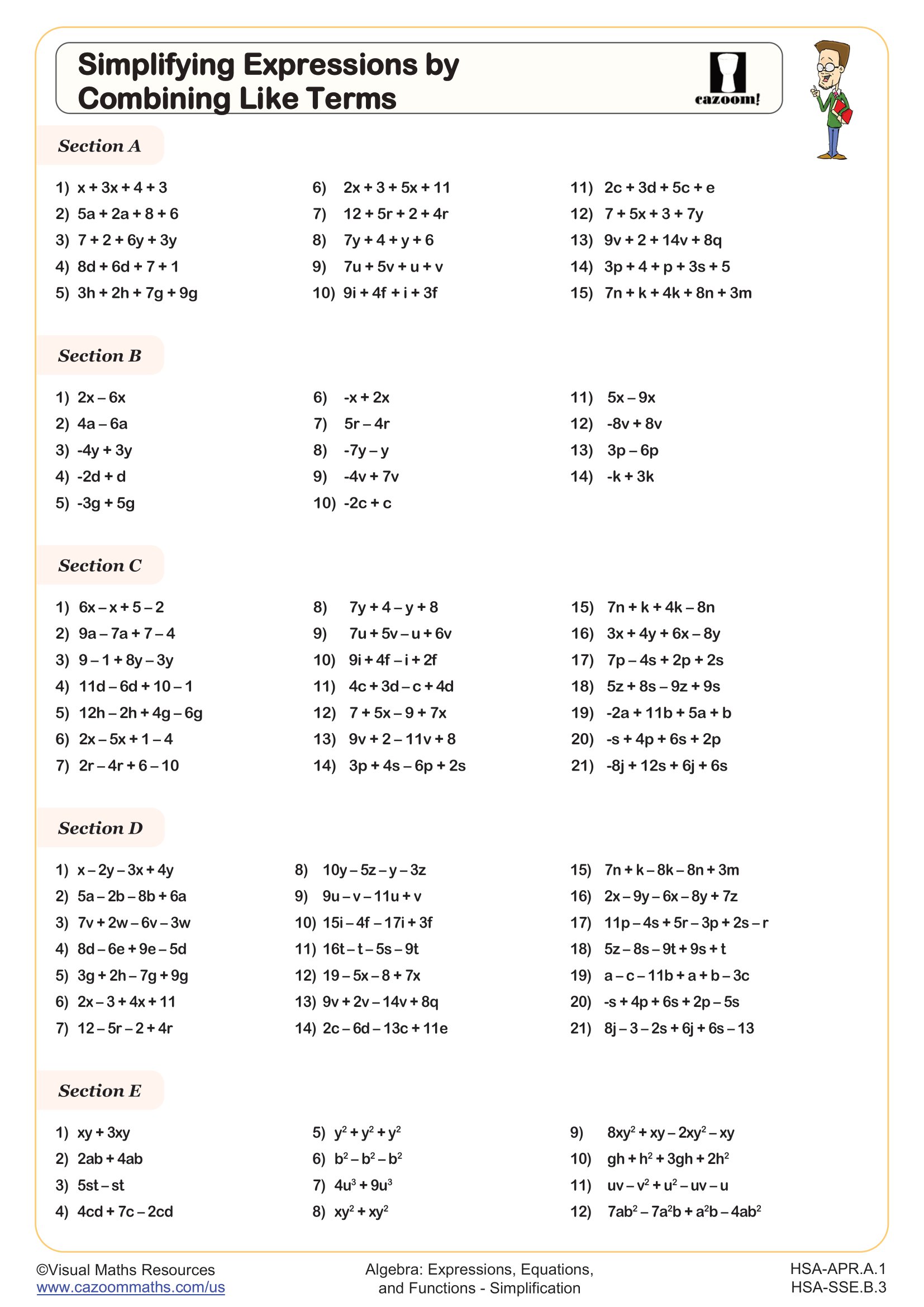
Simplifying Expressions by Combining Like Terms
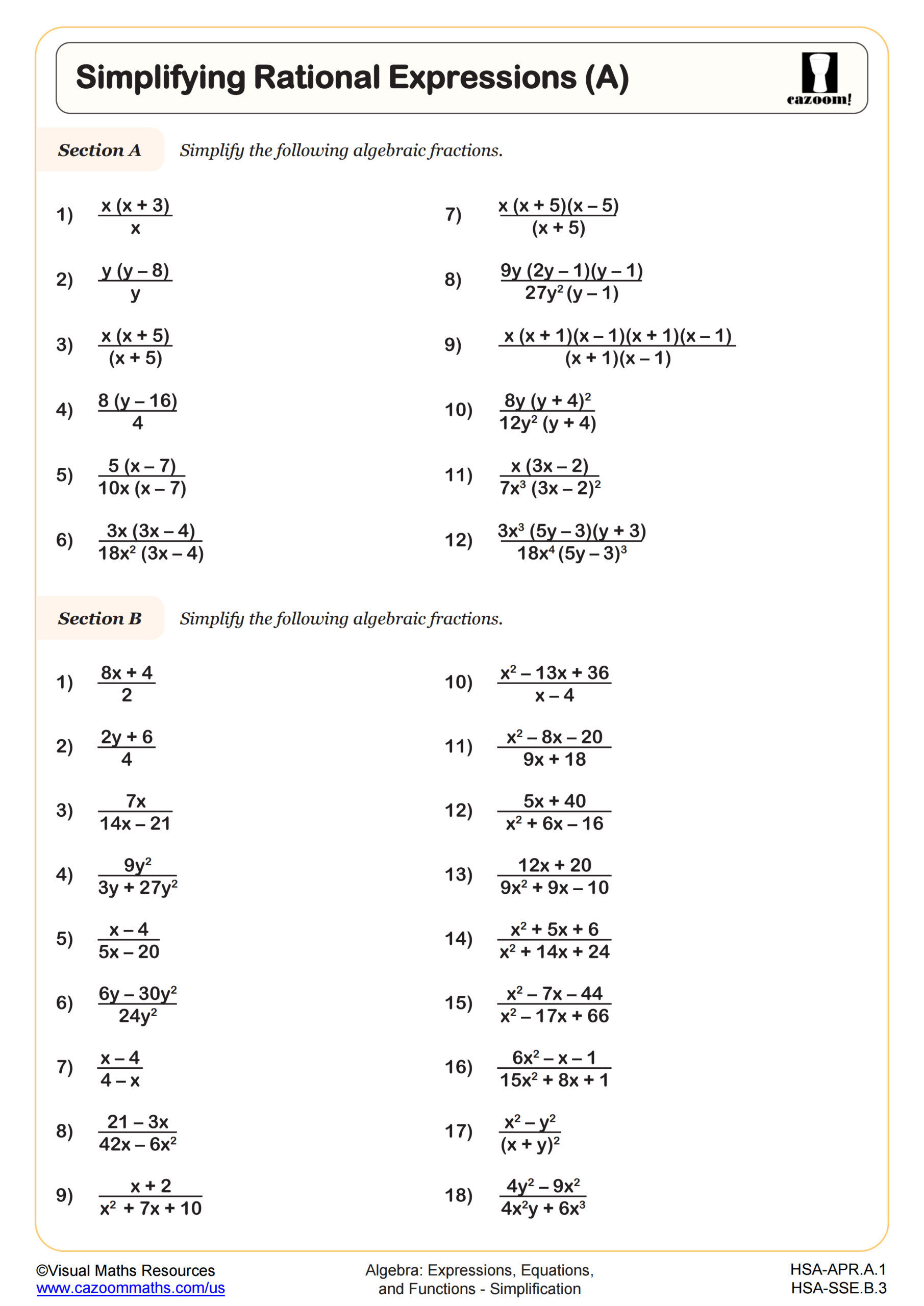
Simplifying Rational Expressions (A)
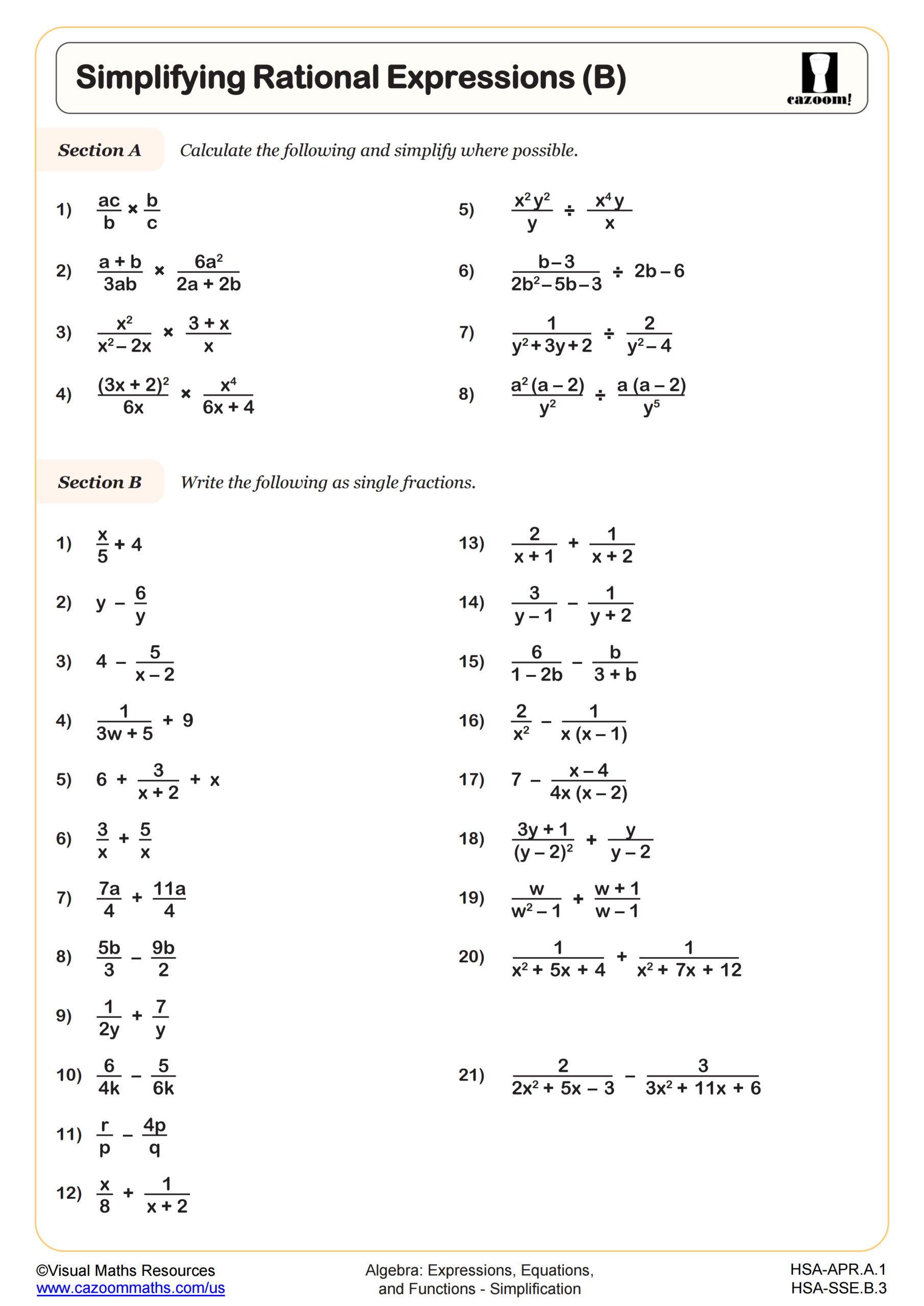
Simplifying Rational Expressions (B)
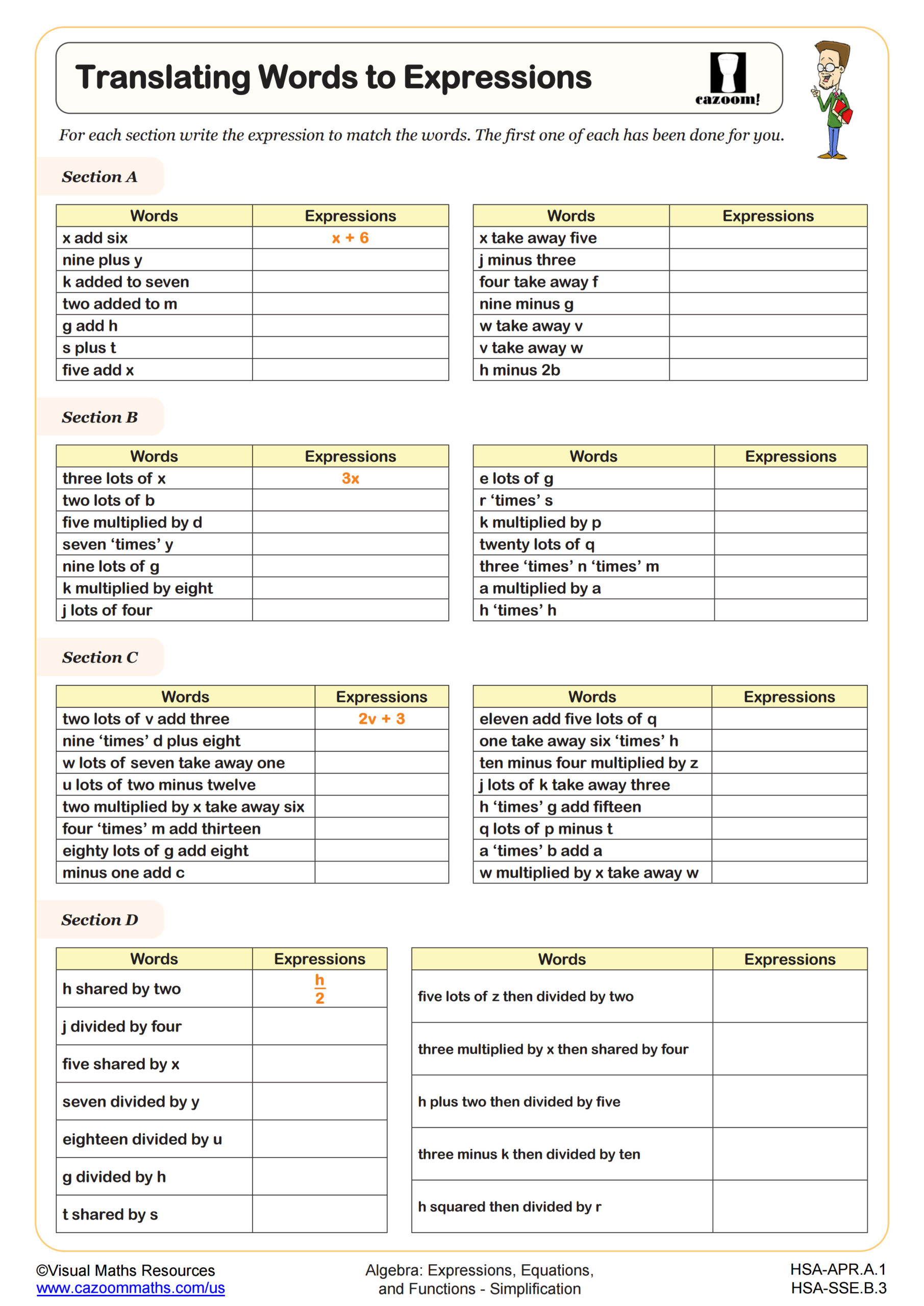
Translating Words to Expressions
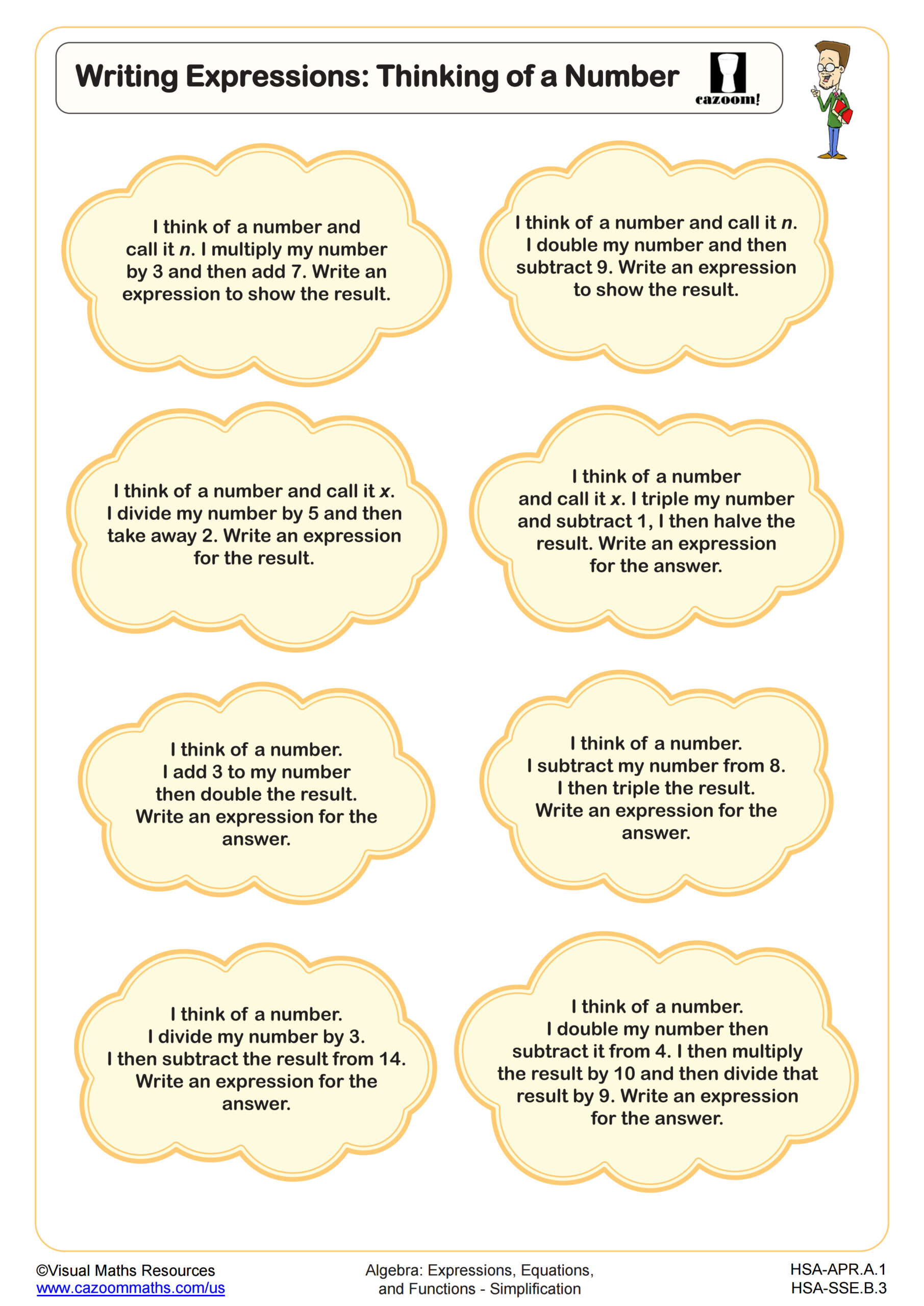
Writing Expressions: Thinking of a Number
All worksheets are created by the team of experienced teachers at Cazoom Math.
What is the process of simplification and reasoning?
The process of simplification and reasoning in high school mathematics involves systematically reducing expressions to their most concise form while maintaining mathematical equivalence. Students learn to identify like terms, factor polynomials, cancel common factors in rational expressions, and combine radicals using properties of exponents and roots. This aligns with Common Core standards for algebra and prepares students for calculus-level work.
Math teachers frequently notice that students rush through simplification without checking their work against the original expression. A common error occurs when students cancel terms instead of factors, such as incorrectly reducing (x+3)/(x+5) by canceling the x terms. Teaching students to verify their simplified expressions by substituting values helps build stronger reasoning skills.
How do simplification skills progress through high school grade levels?
Simplification skills build systematically from Algebra I through Pre-Calculus, with each grade level adding complexity layers. Ninth graders typically focus on combining like terms and basic polynomial operations, while tenth and eleventh graders tackle rational expressions, complex fractions, and radical simplification. By twelfth grade, students work with trigonometric expressions and logarithmic functions.
Teachers observe that students who master foundational simplification in early high school perform significantly better in advanced courses. However, gaps in basic skills often surface during Pre-Calculus when students encounter expressions like (sin²x + cos²x)/tan x and struggle to apply multiple simplification strategies simultaneously. Regular practice with progressively complex expressions builds the pattern recognition important for success.
What are the most challenging aspects of rational expression simplification?
Rational expression simplification challenges students because it requires factoring skills, domain restrictions awareness, and careful attention to mathematical notation. Students must factor both numerator and denominator completely, identify common factors, and recognize when expressions cannot be simplified further. Teachers report that domain restrictions often confuse students who forget that canceled factors still create undefined points.
A frequent misconception involves expressions like (x²-4)/(x-2), where students correctly simplify to (x+2) but fail to note that x≠2. This oversight becomes critical in calculus when finding limits or analyzing discontinuities. Classroom practice with graphing calculators helps students visualize how simplified rational functions relate to their original forms, reinforcing the connection between algebraic manipulation and function behavior.
How can teachers use these worksheets most effectively in their classrooms?
Teachers maximize worksheet effectiveness by using them strategically throughout units rather than as isolated practice sessions. Beginning with diagnostic problems helps identify which students need additional support with prerequisite skills like factoring or exponent rules. The answer keys allow teachers to create self-checking stations or peer review activities where students explain their reasoning to classmates.
Many teachers implement a two-pass approach where students first complete problems independently, then revisit incorrect answers using the provided solutions as learning tools. This method works particularly well for complex multi-step simplifications where students can identify exactly where their reasoning breaks down. Incorporating real-world contexts, such as simplifying formulas used in physics or economics, helps students understand why these skills matter beyond the mathematics classroom.