High School Space Worksheets
All worksheets are created by the team of experienced teachers at Cazoom Math.
How Does Space Math Connect to High School Curriculum Standards?
Space-themed math worksheets align with Common Core State Standards across algebra and geometry by requiring students to work with quadratic and polynomial functions, coordinate plane applications, geometric transformations, and proportional reasoning. These worksheets address standards like modeling with mathematics (MP4) and applying mathematical concepts to real-world scenarios, which standardized tests increasingly emphasize through STEM-focused problems.
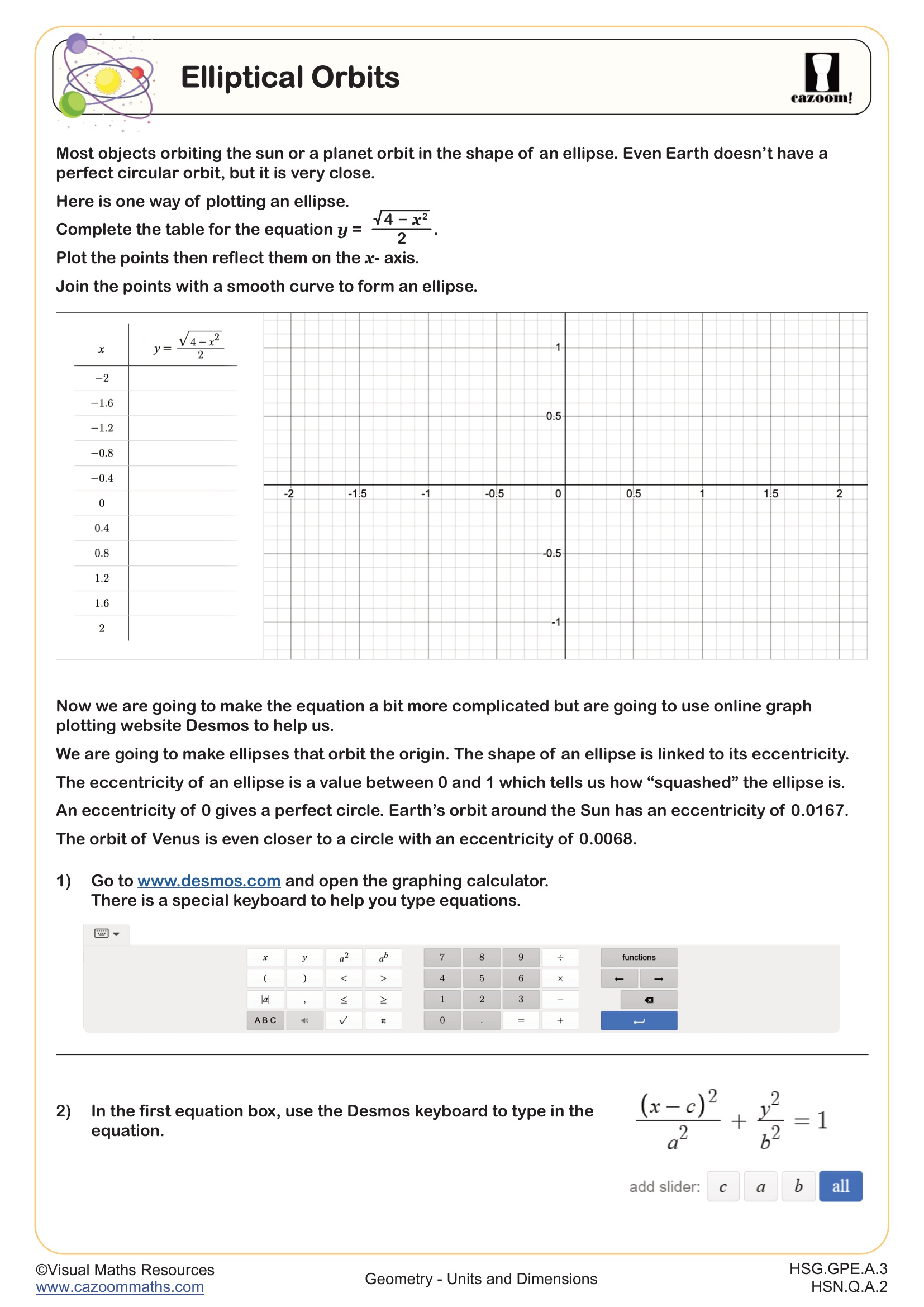
Teachers frequently use space applications when introducing conic sections in Algebra II and Precalculus because elliptical orbits provide an authentic context for why students need to understand these equations. Students lose points on assessments when they can graph an ellipse but can't interpret what the parameters mean in a planetary motion problem, making these application-focused worksheets valuable for building that conceptual bridge.
What Grade Levels Use Space Math Worksheets?
These space worksheets serve high school students across Algebra I, Algebra II, Geometry, Precalculus, and Integrated Math 1, 2, and 3 pathways. The collection addresses the full high school mathematics sequence, allowing teachers in traditional or integrated curricula to incorporate space applications into their instruction.
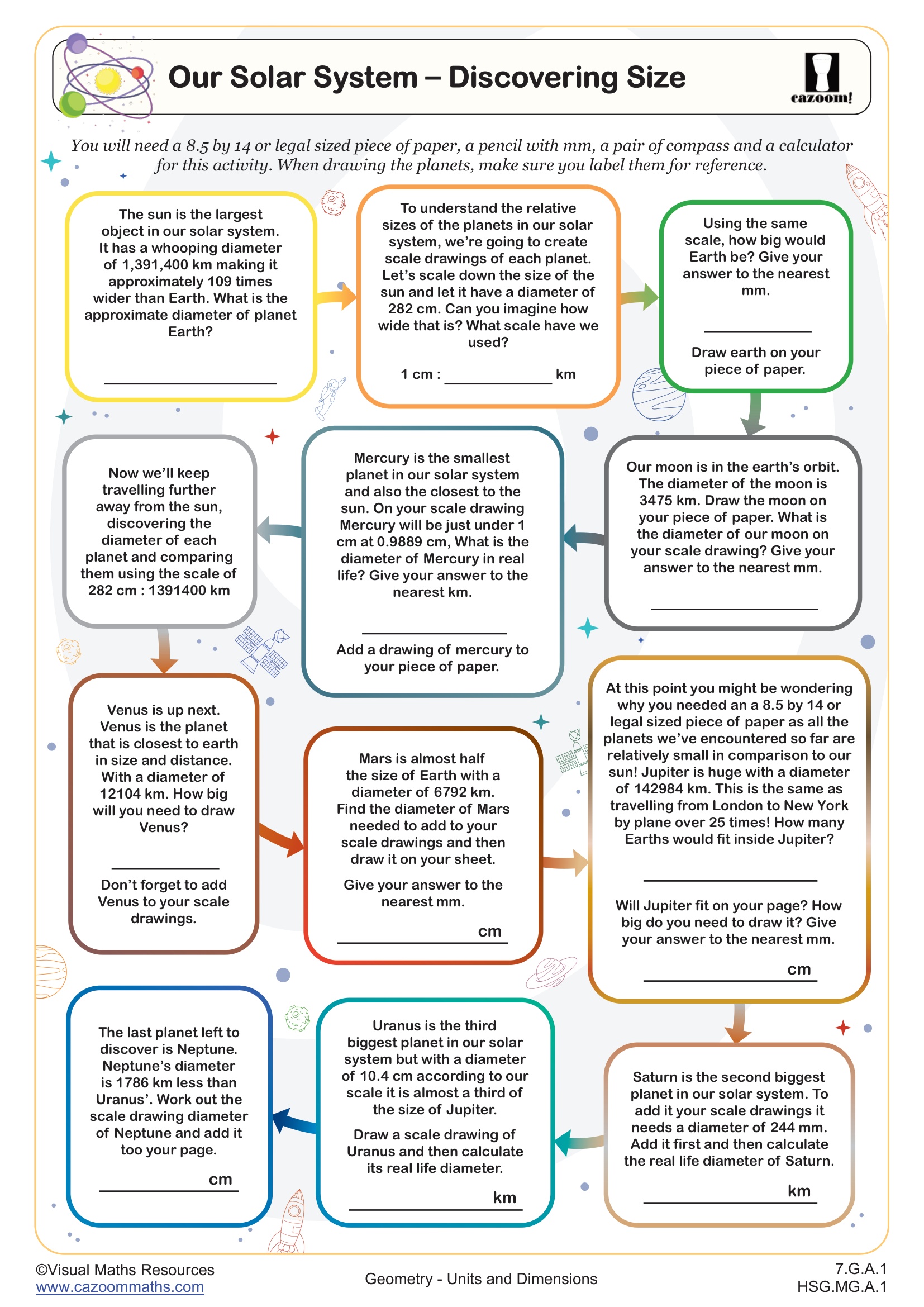
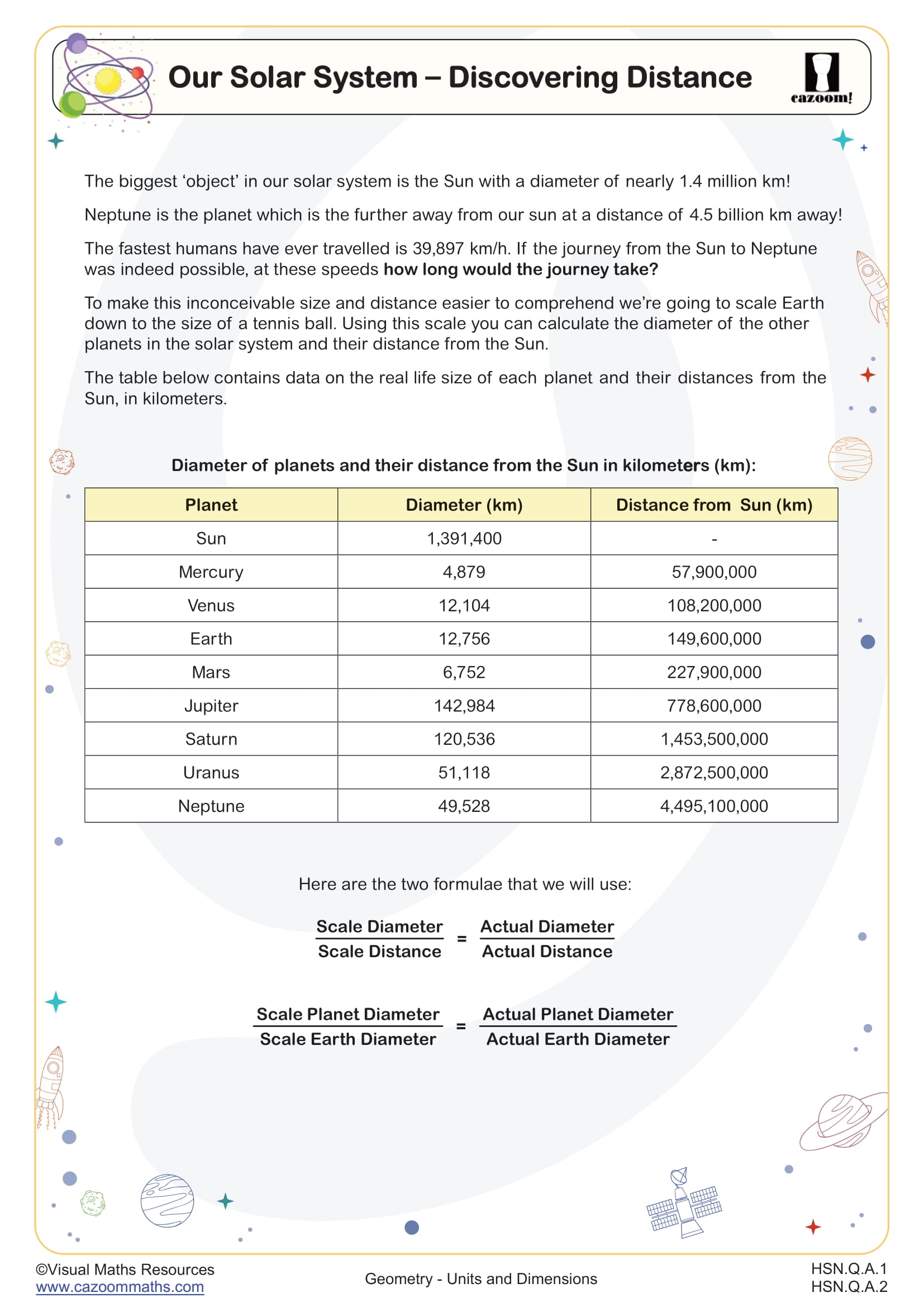
The difficulty progression mirrors the mathematical complexity students encounter across these courses. Algebra I students might work with linear scale models of the solar system, while Geometry students apply transformations to spacecraft designs. Algebra II and Precalculus students tackle elliptical orbit equations and parametric representations. Integrated Math pathways revisit space contexts at increasing sophistication levels, reinforcing how different mathematical tools approach the same real-world phenomena from different angles.
Why Do Students Study Elliptical Orbits in Math Class?
Elliptical orbits provide one of the most accessible real-world applications of conic sections, requiring students to work with equations in standard form, identify key features like foci and vertices, and understand how eccentricity affects orbital shape. Students learn that Earth's orbit isn't perfectly circular but slightly elliptical, with the Sun at one focus, making abstract algebraic parameters suddenly meaningful.
This concept connects directly to aerospace engineering, satellite deployment, and space mission planning. NASA engineers use these same elliptical equations when calculating transfer orbits for spacecraft traveling between planets. Students working with orbital mechanics develop skills that translate to careers in aerospace, astrophysics, and satellite communications, where predicting orbital paths requires precise mathematical modeling of elliptical trajectories.
How Should Teachers Use Space Worksheets in Class?
These worksheets work effectively as application activities after students have developed foundational skills with the underlying mathematical concepts. Teachers often introduce the pure mathematical content first, then use space-themed problems to demonstrate why those skills matter beyond the classroom. The visual elements, like drawing the International Space Station using geometric shapes or reflecting spacecraft designs, help kinesthetic learners engage with otherwise abstract transformations.
Many teachers assign these worksheets during STEM units, as review before standardized tests that include modeling questions, or as differentiated challenges for students who finish early. The answer keys make them practical for independent work, homework, or math centers. Some teachers pair students to work through the solar system scale problems collaboratively, since discussing magnitude and proportional reasoning aloud helps students catch calculation errors before they compound.