High School Transformations Worksheets
All worksheets are created by the team of experienced teachers at Cazoom Math.
What are transformations in high school math?
Transformations describe how shapes move, flip, turn, or resize on the coordinate plane while maintaining specific properties. High school students work with four main types: translations (slides), reflections (flips across a line), rotations (turns around a point), and dilations (enlargements or reductions). These concepts appear throughout Geometry courses and connect directly to function transformations in Algebra II and Precalculus, where students apply the same principles to graphs of equations.
Students lose points on standardized tests when they confuse the notation for rotations, particularly the difference between 90° and -90° turns. Teachers observe that writing out transformation rules using coordinate notation—such as (x, y) → (x + 3, y - 2) for translations—helps students catch sign errors before plotting points. The visual nature of transformations makes them accessible, but precision with coordinates separates superficial understanding from mastery that transfers to more abstract applications.
Which grade levels study transformations?
These worksheets cover transformations for Algebra I, Geometry, Algebra II, and Precalculus, as well as Integrated Math 1, 2, and 3 courses at the high school level. Students encounter transformations across multiple years because the concept builds in complexity, starting with basic coordinate rules and progressing to compositions, matrix representations, and function transformations. Common Core State Standards introduce rigid motions in eighth grade, but high school courses deepen this work with formal proofs of congruence and similarity.
The progression typically moves from identifying single transformations in Algebra I and Geometry to performing compositions of transformations and using them to prove geometric relationships. By Precalculus, students apply transformation concepts to parent functions, analyzing how parameters in equations shift, stretch, or reflect graphs. Integrated Math pathways distribute these same concepts across IM 1, 2, and 3, often connecting transformations to other topics like symmetry and function behavior within the same unit.
How do rotations work on the coordinate plane?
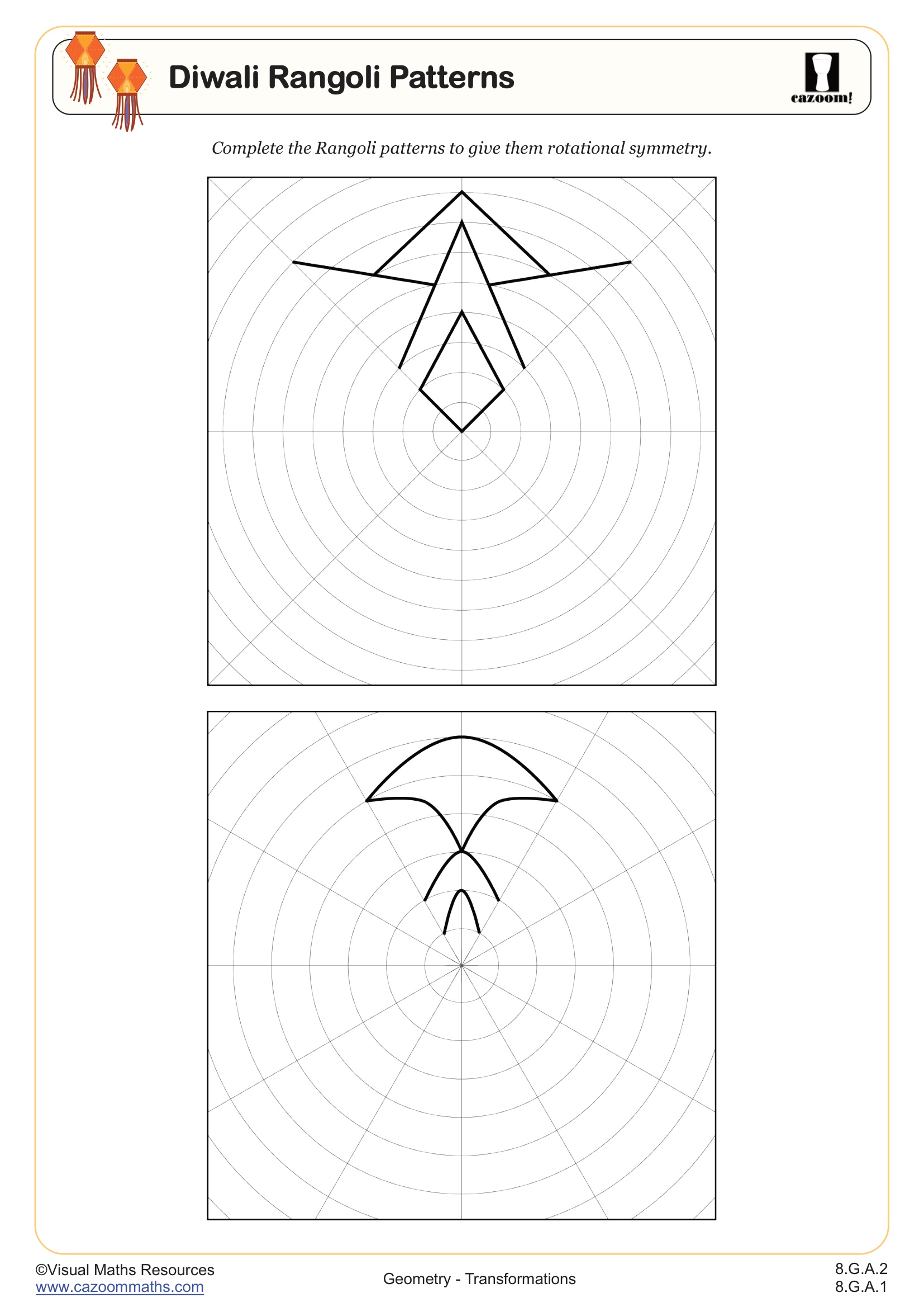
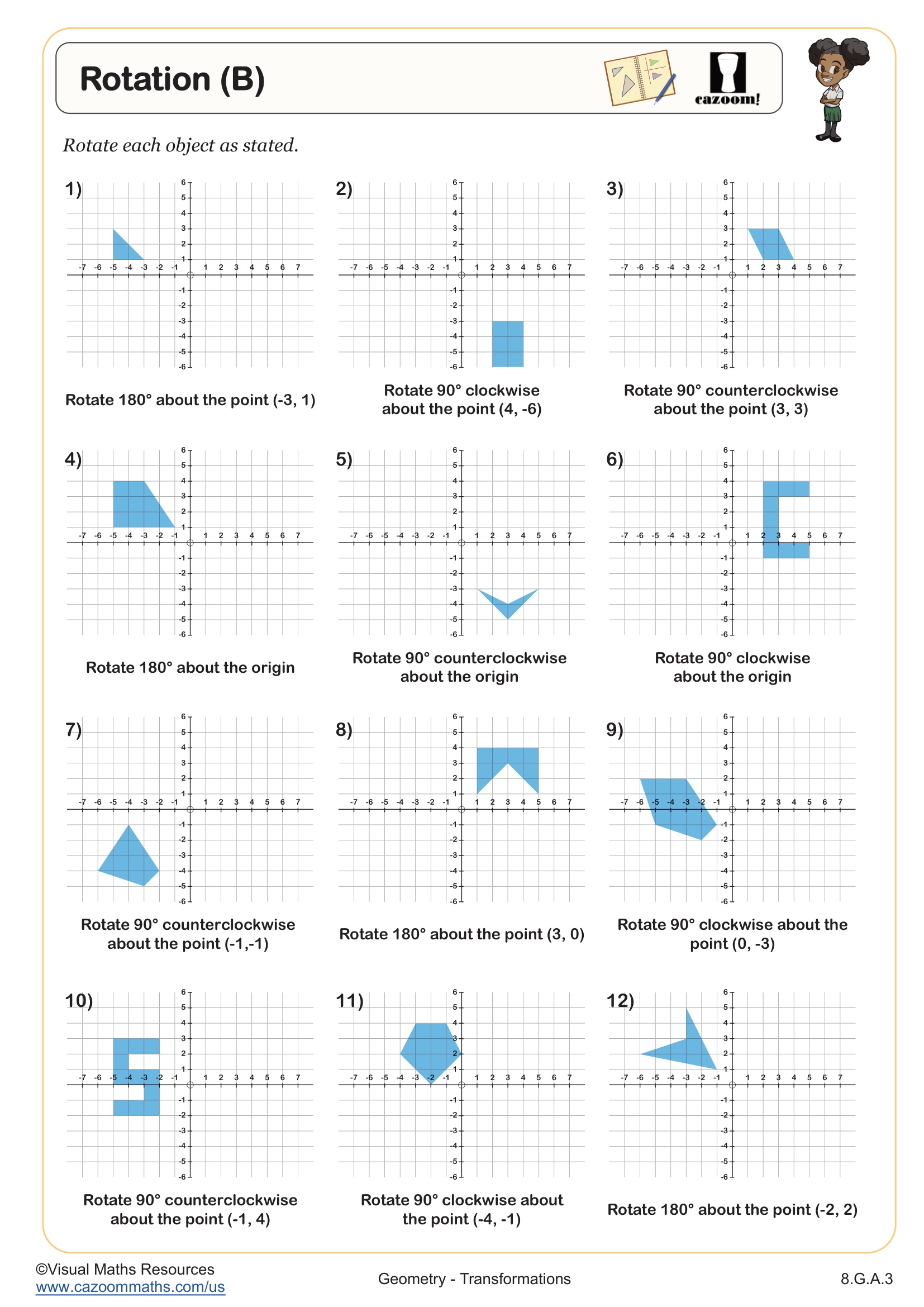
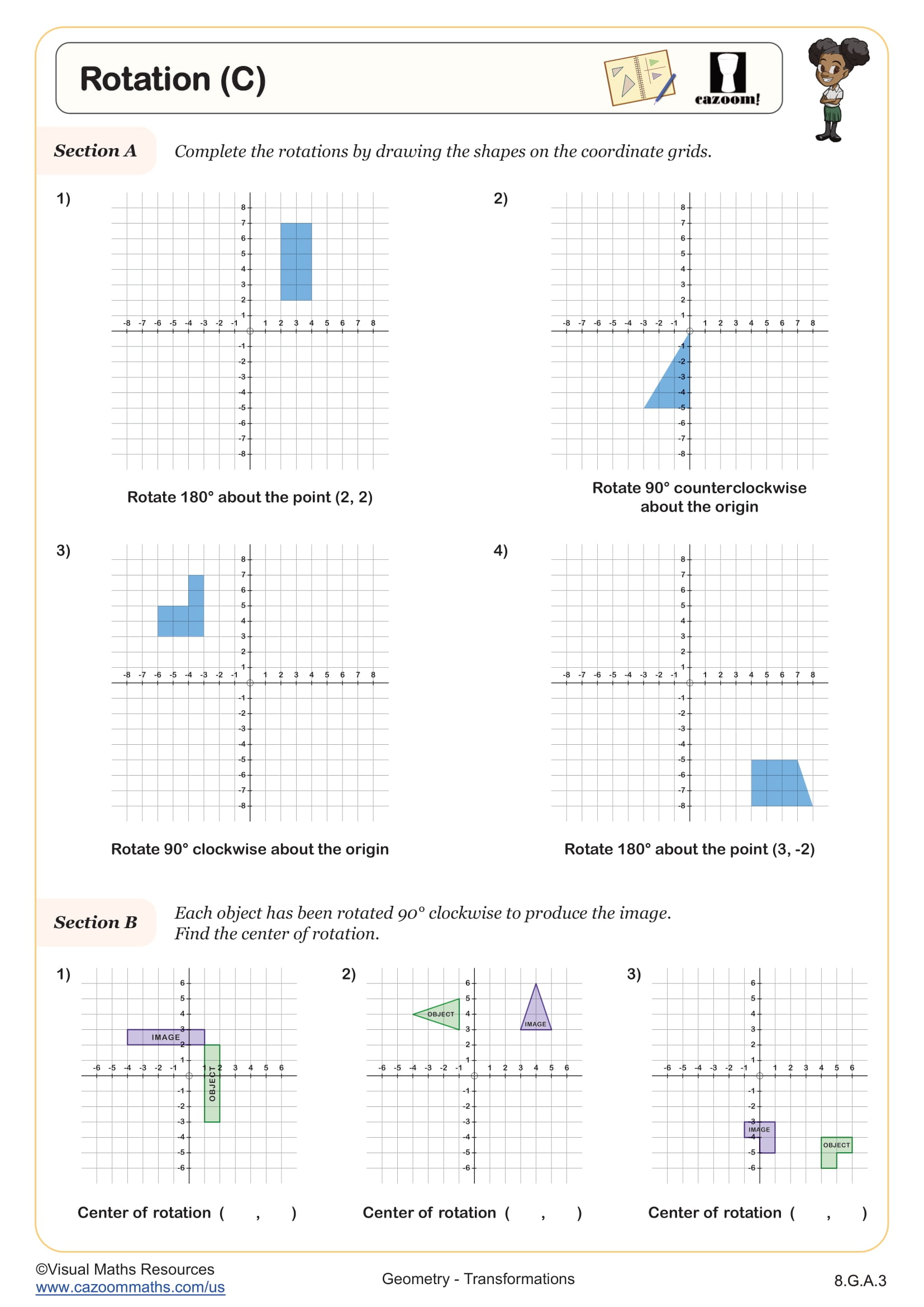
Rotations turn a figure around a fixed point (usually the origin) by a specified angle and direction, with positive angles indicating counterclockwise movement. Students learn specific coordinate rules for common rotations: 90° counterclockwise transforms (x, y) to (-y, x), while 180° changes (x, y) to (-x, -y). A common misconception involves mixing up clockwise and counterclockwise directions—students confidently tackle rotation problems once they recognize that 90° clockwise equals -90° or equivalently 270° counterclockwise.
Rotations appear throughout STEM fields, particularly in computer graphics, robotics, and physics simulations. Game developers use rotation matrices to animate characters turning in 3D space, while engineers apply rotational transformations when designing mechanical parts that pivot or spin. Understanding rotations on paper translates directly to programming languages that manipulate objects on screen, making this geometric concept unexpectedly practical for students interested in technology careers.
How should teachers use these transformation worksheets?
The worksheets scaffold learning by starting with visual grid-based problems before progressing to pure coordinate work and compositions of multiple transformations. Answer keys allow students to check their plotting accuracy immediately, which matters considerably since one coordinate error early in a composition creates incorrect results throughout the problem. Teachers find that students benefit from color-coding different transformation types when working through compositions, helping them track which transformation they're applying at each step.
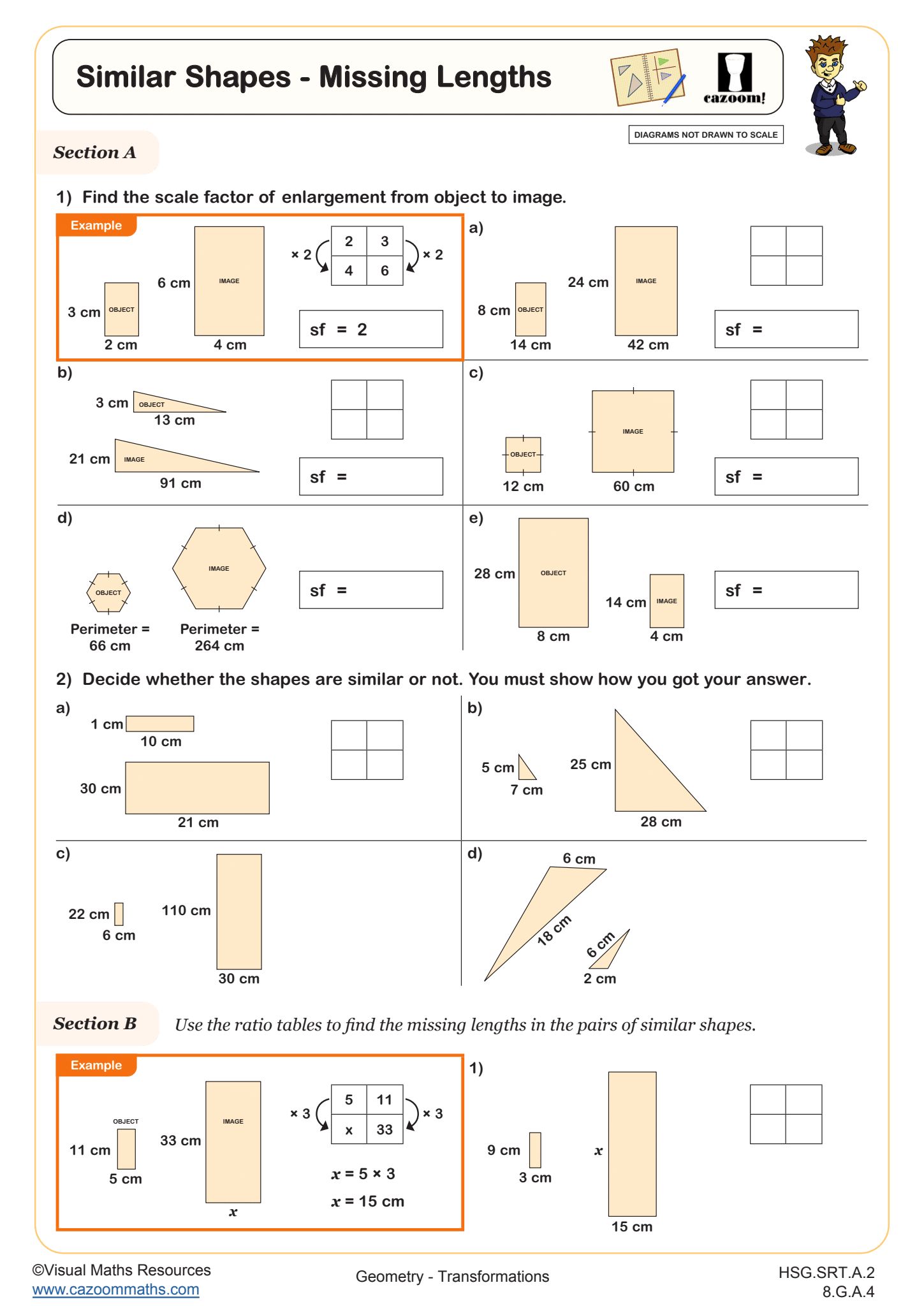
These worksheets work well for differentiated instruction since the subtopic variety allows teachers to assign rotation practice to students who need it while others work on similarity transformations. Many teachers use them for intervention sessions with students preparing for state geometry assessments, where transformation questions regularly appear. The worksheets also function effectively as homework following hands-on activities with patty paper or transparencies, reinforcing the connection between physical manipulations and coordinate algebra. Paired work encourages students to explain their reasoning about transformation sequences, building the precise mathematical language assessments expect.