High School Volume and Surface Area Worksheets
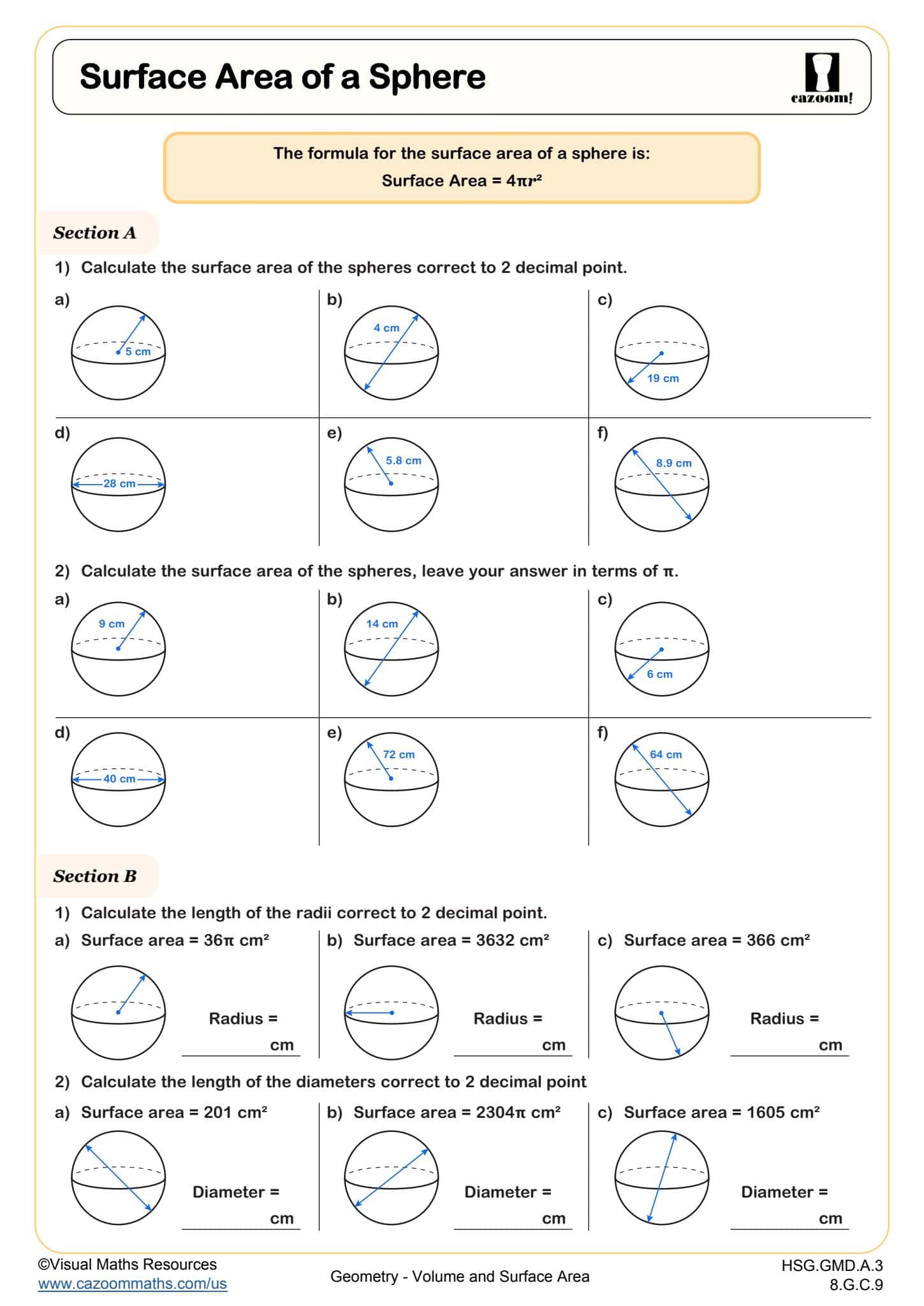
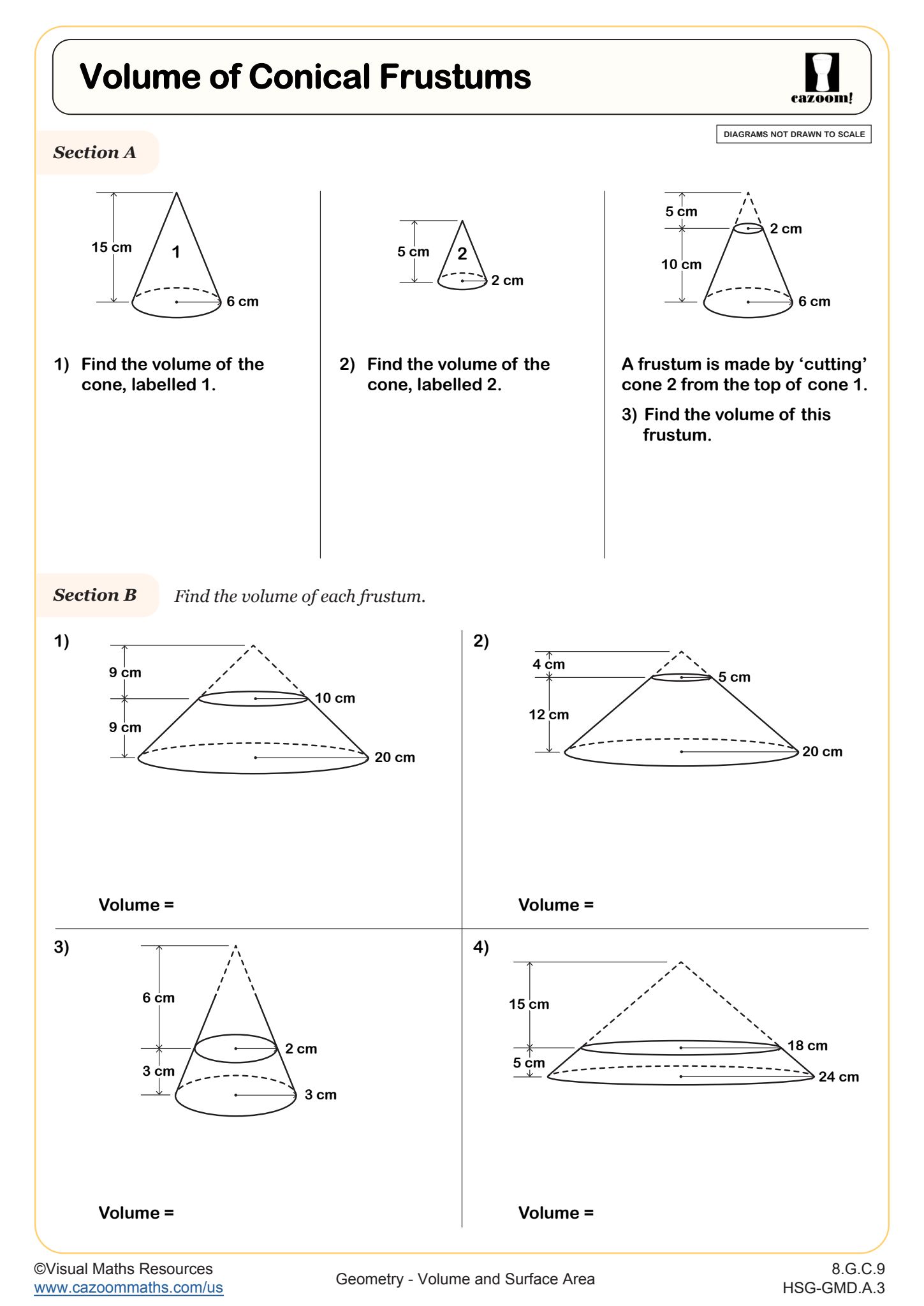
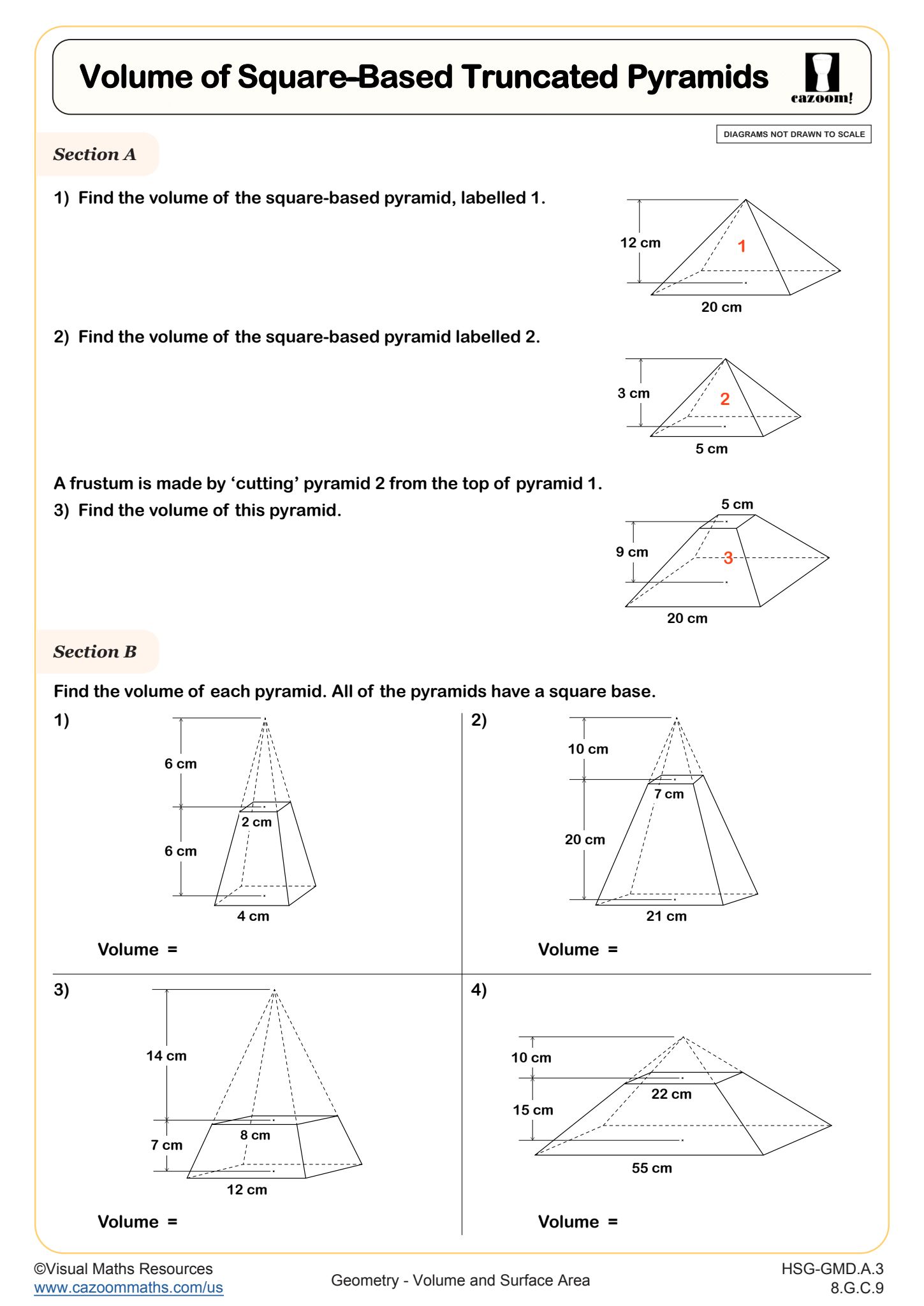
All worksheets are created by the team of experienced teachers at Cazoom Math.
What volume and surface area concepts do high school students need to master?
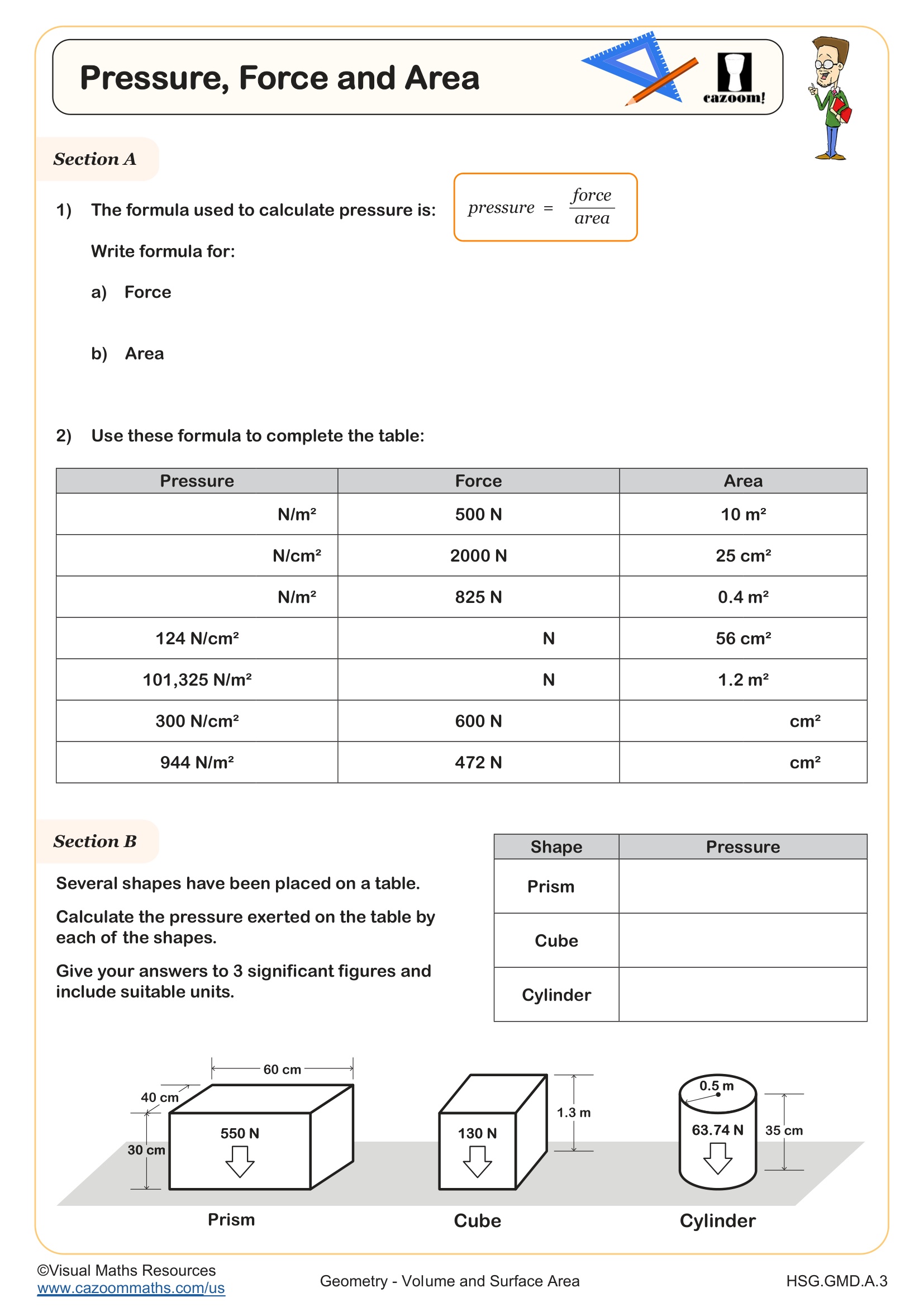
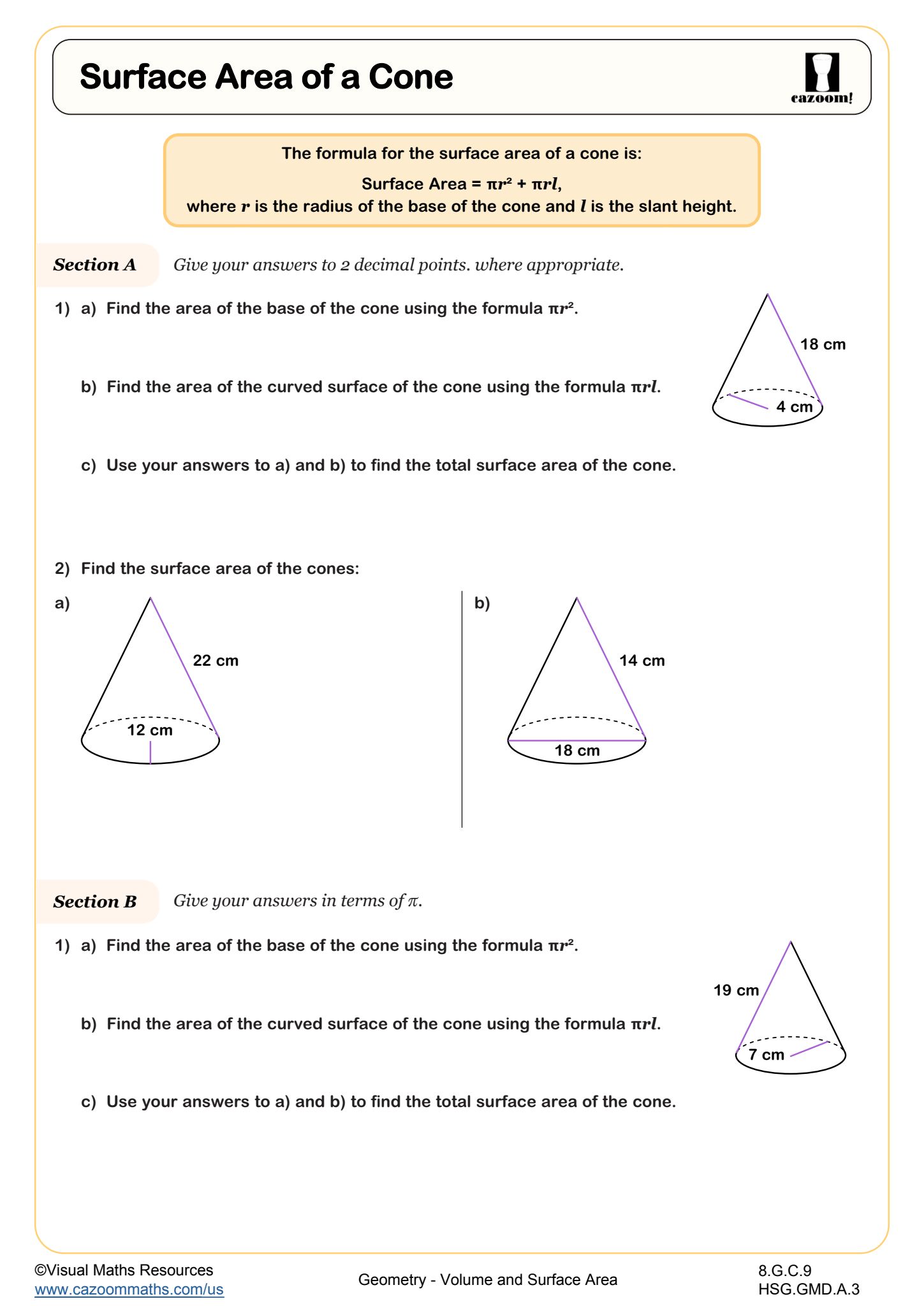
High school students work with three-dimensional geometry that builds from middle school foundations to college-level applications. Core concepts include calculating surface area and volume for prisms, pyramids, cylinders, cones, and spheres, plus composite figures combining multiple shapes. Students also explore frustums (truncated pyramids or cones) and apply volume calculations to solve density, mass, and volume relationships commonly found in chemistry and physics.
Standardized tests expect students to match three-dimensional shapes with their correct formulas and recognize when to apply surface area versus volume. Students lose points when they forget to account for all faces of a prism or when they mix up radius and diameter in circular calculations. The relationship between density, mass, and volume particularly challenges students because it requires algebraic manipulation and unit conversion alongside geometric calculation.
Which grade levels use volume and surface area worksheets?
These worksheets serve high school students across Algebra I, Algebra II, Geometry, and Precalculus courses, as well as Integrated Math 1, 2, and 3 sequences. Geometry courses provide the primary focus on three-dimensional shapes and formula application, while algebra courses incorporate these skills within equation-solving contexts and real-world problem scenarios.
The progression across grade levels moves from direct formula application to multi-step problem solving. Geometry students typically start with basic surface area and volume calculations for single shapes, then advance to composite figures. Algebra II and Precalculus students encounter these concepts within optimization problems, function modeling, and applications involving rates of change. Integrated Math sequences distribute these skills across all three years, building complexity as students develop algebraic and geometric reasoning simultaneously.
How do students apply density, mass, and volume calculations?
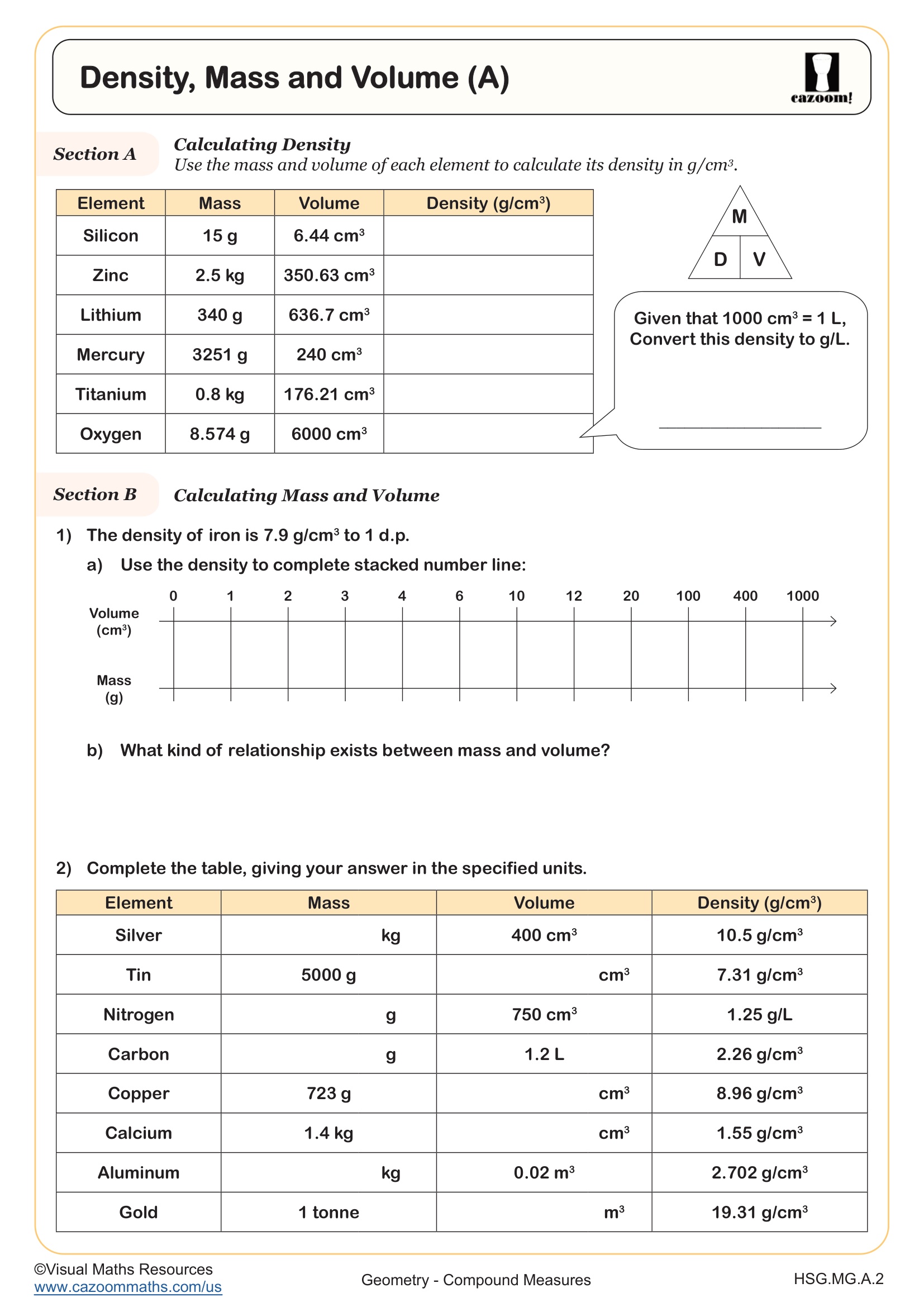
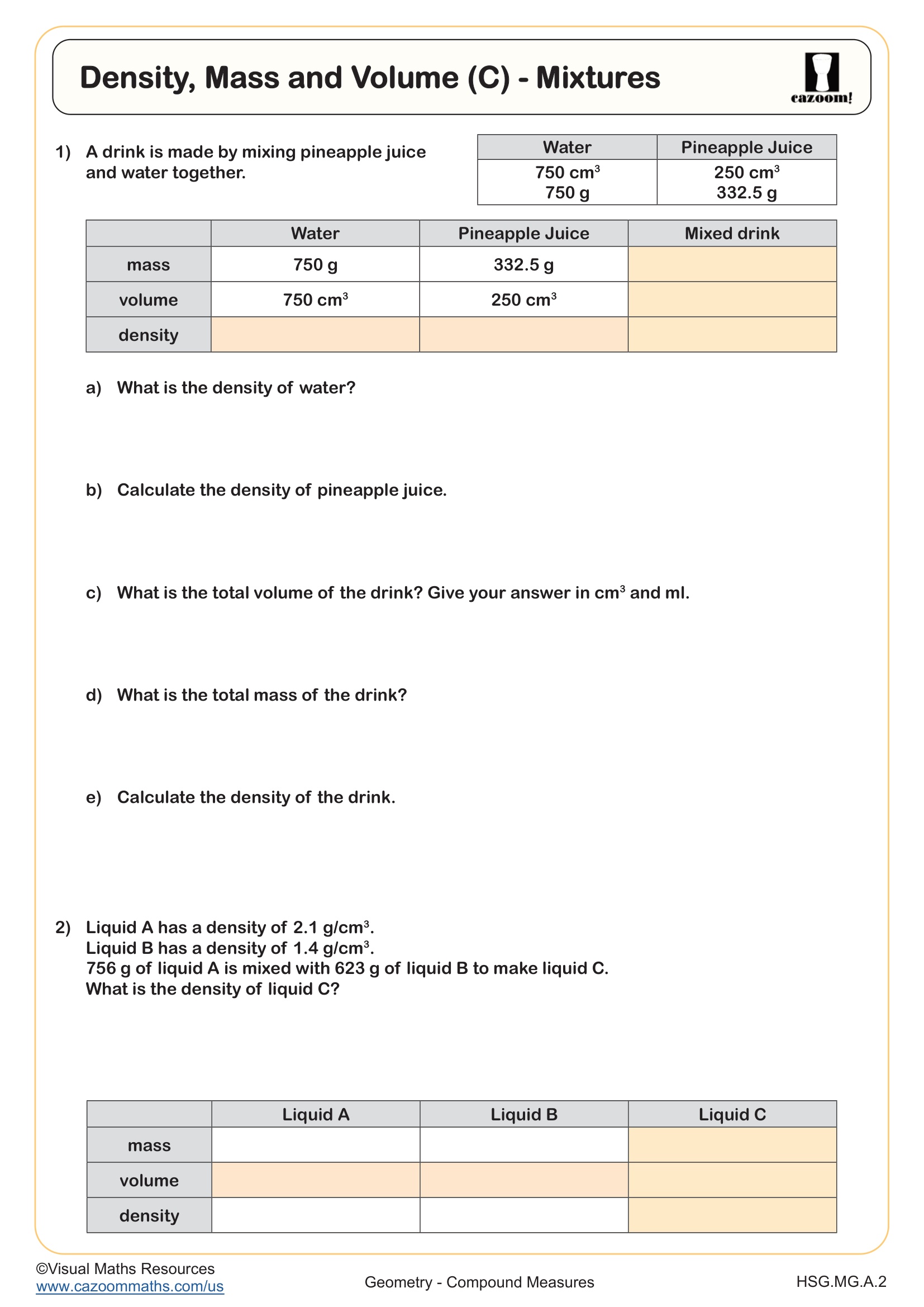
Density calculations connect geometric volume with physical science by using the formula d = m/v, where density equals mass divided by volume. Students solve for any of the three variables by algebraically manipulating the equation, requiring them to apply both geometry skills and algebraic reasoning. Mixture problems add complexity by combining materials with different densities in the same container, challenging students to work with weighted averages and proportional reasoning.
These calculations appear throughout STEM fields, from materials science to environmental engineering. Chemists use density to identify unknown substances and determine solution concentrations. Engineers calculate material mass based on volume and density when designing structures or vehicles where weight impacts performance. Geologists apply these relationships when analyzing rock samples and soil composition. Students who master these connections recognize mathematics as a practical tool rather than isolated formulas.
How can teachers use these worksheets effectively in the classroom?
The worksheets include worked examples and formula reference sections that help students build confidence with three-dimensional calculations. The matching exercises where students connect 3D shapes with their formulas create valuable visual associations before numerical problem-solving begins. Answer keys allow students to check their work immediately, helping them identify calculation errors or formula misapplications while the problem-solving process remains fresh in their minds.
Teachers use these worksheets for differentiated instruction by assigning different subtopics based on student readiness levels. Basic surface area problems work well for students still developing spatial visualization, while frustum calculations and density applications challenge advanced learners. The worksheets fit naturally into station rotations, homework assignments, or intervention sessions for students preparing for geometry assessments. Paired work encourages students to verbalize their reasoning about which formula to apply, strengthening conceptual understanding alongside procedural fluency.