Integrated Math 1 2D Shapes Worksheets
All worksheets are created by the team of experienced teachers at Cazoom Math.
What Do Students Learn About 2D Shapes in Integrated Math 1?
In Integrated Math 1, students move beyond basic shape identification to analyze geometric properties, transformations, and relationships between figures. The curriculum emphasizes understanding why shapes behave as they do—exploring angle measures, symmetry lines, rotational symmetry, and how regular and irregular polygons tessellate to fill a plane without gaps or overlaps. Students apply coordinate geometry to verify properties and use transformations to determine congruence.
Teachers often observe that students initially assume all regular polygons tessellate, only to discover through hands-on exploration that pentagons and most other regular polygons cannot tile a plane alone. This misconception surfaces because students remember seeing pentagon-adjacent shapes in real-world patterns but don't recognize that those designs use multiple polygon types. Worksheets focused on tessellating shapes help students test these assumptions systematically and develop geometric reasoning skills.
How Do Standardized Tests Assess 2D Shape Knowledge?
The SAT, ACT, and state assessments test 2D shape concepts through questions about angle relationships, area and perimeter calculations, properties of special quadrilaterals, and coordinate geometry applications. Students must identify congruent shapes after transformations, determine missing angle measures using polygon interior angle formulas, and solve multi-step problems involving composite figures. Tessellation questions occasionally appear as logic or pattern recognition problems requiring students to explain why certain shapes tile successfully.
Students lose points when they confuse properties of similar shapes—for example, applying rectangle properties to all parallelograms or assuming a quadrilateral with one pair of parallel sides is automatically a trapezoid without checking the second pair. Another common error occurs when students misapply the interior angle sum formula, forgetting to divide by the number of sides when finding individual angle measures in regular polygons. Standardized tests specifically target these conceptual gaps rather than simple recall.
What Makes a Shape Capable of Tessellating?
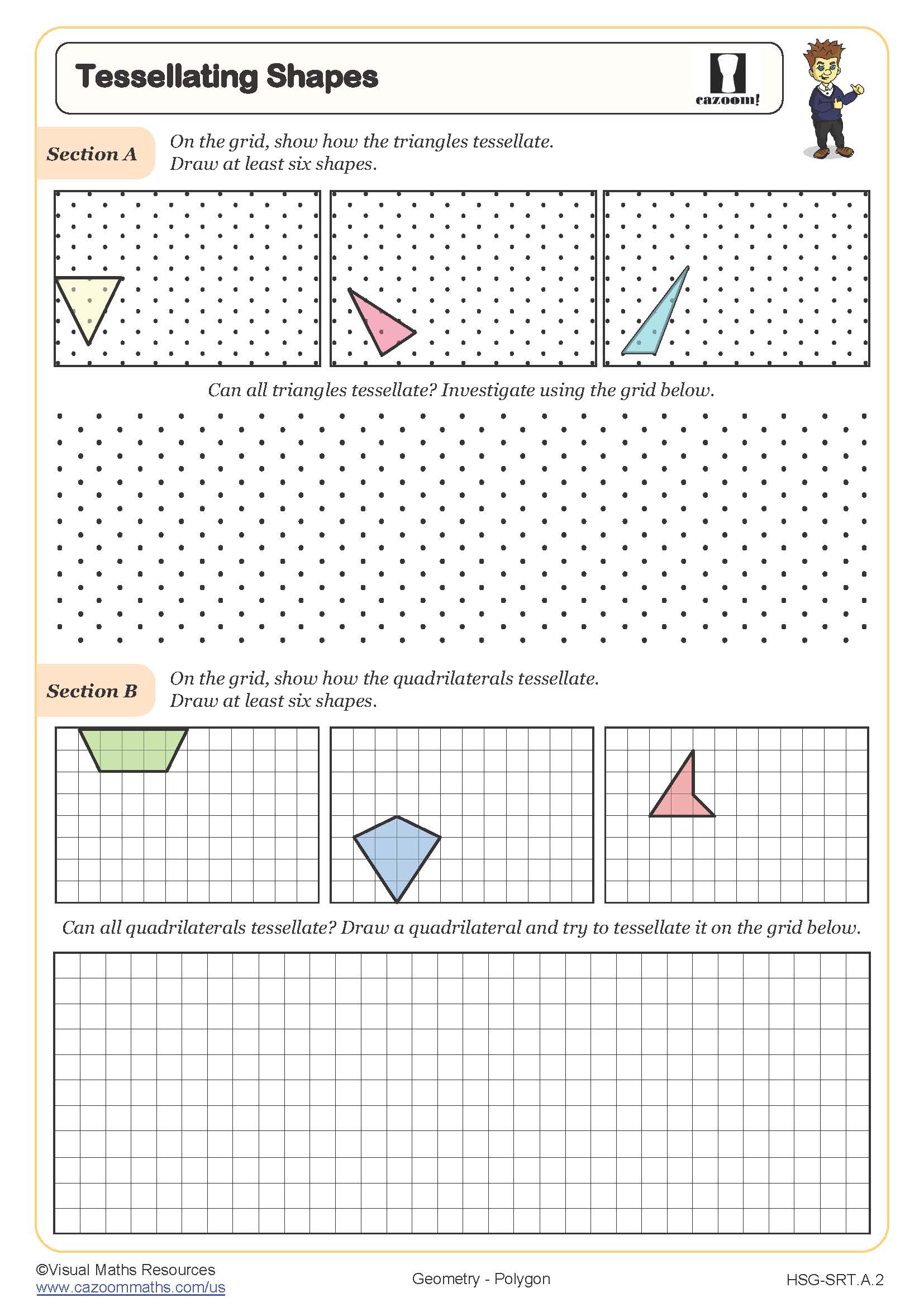
A shape tessellates when identical copies fit together to completely cover a plane with no gaps or overlaps. The key requirement involves vertex angles: at every point where shapes meet, the angles must sum to exactly 360 degrees. All triangles and quadrilaterals tessellate because their interior angles can always be arranged to meet this condition. Among regular polygons, only equilateral triangles, squares, and regular hexagons tessellate independently because their interior angles (60°, 90°, and 120°) divide evenly into 360°.
Architects and designers use tessellation principles when creating floor tiles, wall patterns, and decorative mosaics. Manufacturing engineers apply these concepts to minimize material waste when cutting shapes from sheet metal or fabric. Understanding tessellations connects to crystallography in chemistry, where molecular structures form repeating patterns, and to computer graphics, where efficient screen rendering requires seamless pattern algorithms. These applications demonstrate why geometric reasoning extends far beyond the math classroom into professional STEM fields.
How Can Teachers Use These 2D Shape Worksheets in Integrated Math 1?
These worksheets provide structured practice in geometric reasoning and pattern recognition, with answer keys that allow students to check their understanding independently or enable quick grading during formative assessments. The tessellation problems encourage students to test hypotheses visually and algebraically, building the experimental approach needed for proof writing later in the course. Teachers can use these materials to reinforce concepts introduced through hands-on activities with pattern blocks or digital geometry software.
Many teachers assign these worksheets after hands-on exploration to formalize student observations about which shapes tessellate and why. They work effectively as warm-up problems to activate prior knowledge before transformation units or as review materials before chapter tests on polygons and angle relationships. Pair work encourages mathematical discourse as students defend their reasoning about whether specific shapes will tessellate. The structured format helps struggling students organize their geometric thinking while challenging advanced learners to explore semi-regular tessellations combining multiple polygon types.