Integrated Math 1 Function Machines Worksheets
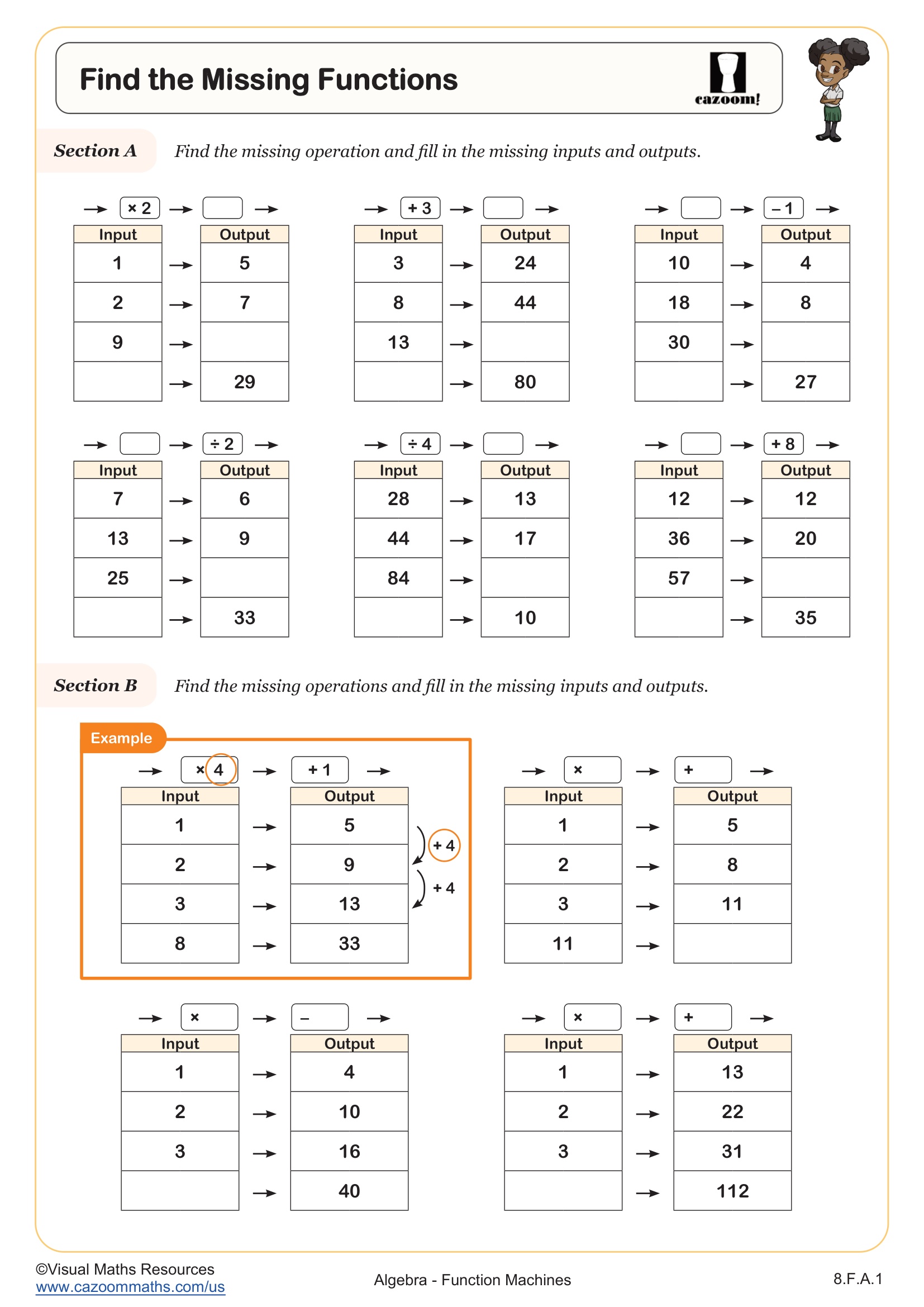
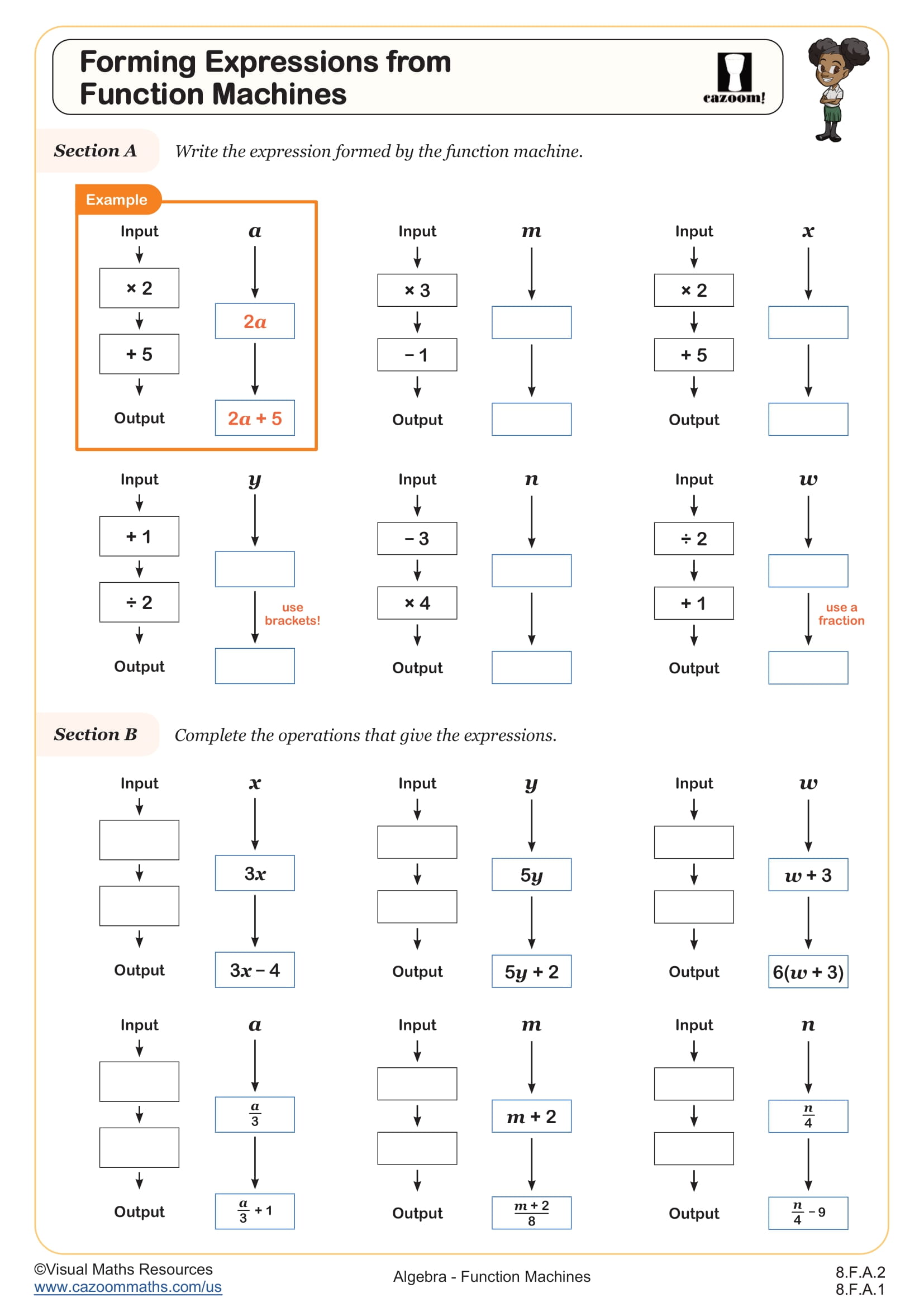
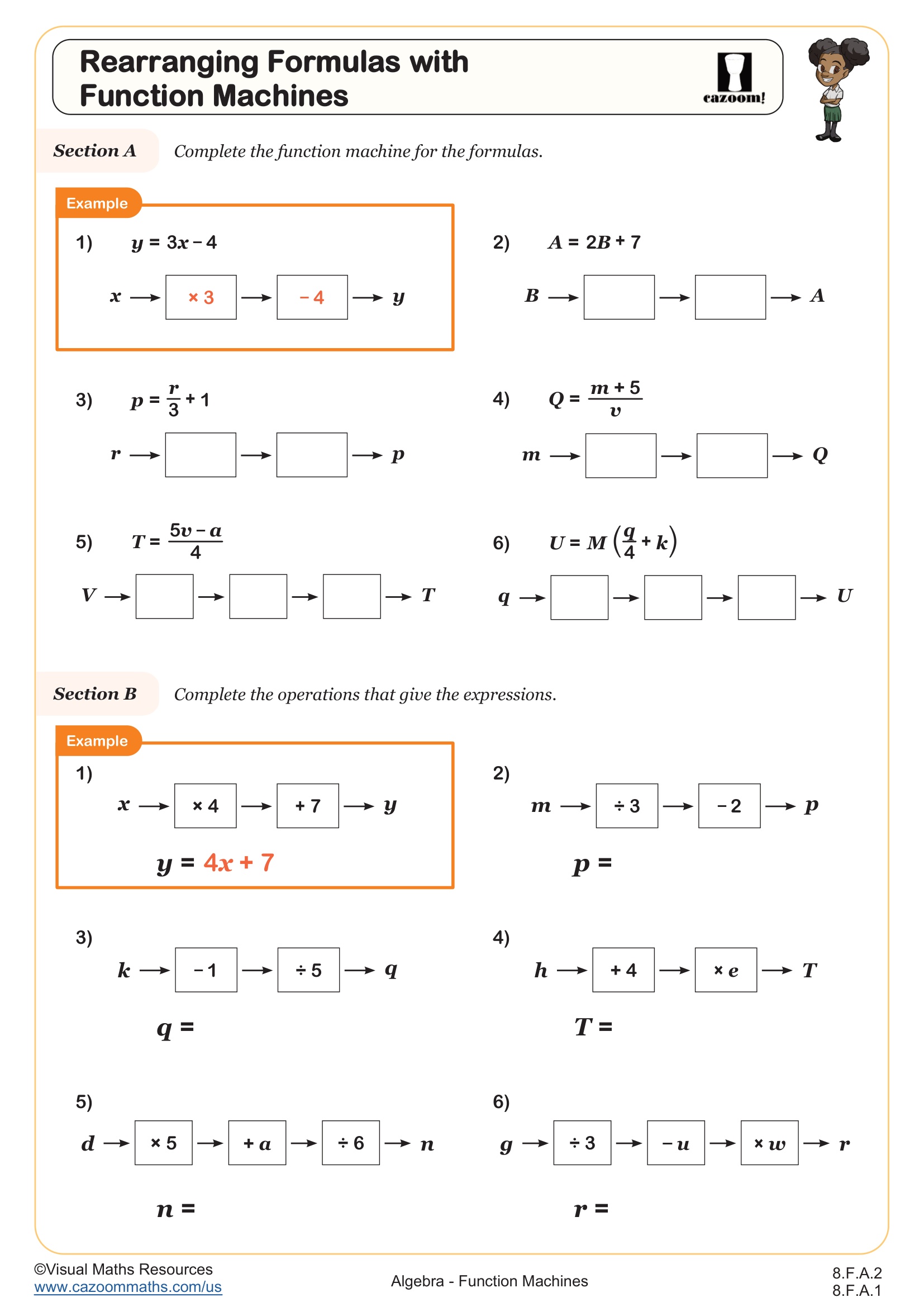
All worksheets are created by the team of experienced teachers at Cazoom Math.
What are function machines in Integrated Math 1?
Function machines represent functions as visual diagrams where an input value enters a "machine," undergoes one or more operations, and produces an output value. This concrete representation helps students understand that functions are rules that consistently transform inputs into outputs, laying groundwork for formal function notation like f(x) = 2x + 3. The visual metaphor bridges arithmetic operations and algebraic thinking.
Students often struggle when function machines involve multiple operations, forgetting to apply the order of operations correctly within the machine. A common error occurs when the function rule is x → 3x - 5 and students subtract first, then multiply, rather than following the left-to-right flow of the machine. Teachers find that color-coding each operation step within the machine diagram helps students track the transformation sequence accurately.
What grade level learns function machines?
Function machines appear in Integrated Math 1, typically taught in high school as part of a three-year integrated mathematics sequence. This course combines algebra, geometry, and statistics, and function machines serve as an introductory tool for understanding linear functions, which form a substantial portion of the Integrated Math 1 curriculum. Students encounter this topic after working with expressions and equations.
The worksheets progress in complexity, starting with simple one-step function machines that use basic operations, then advancing to multi-step machines requiring multiple operations in sequence. Later worksheets challenge students to work backward from outputs to determine the function rule itself, requiring algebraic reasoning and inverse thinking. This reverse engineering of function machines directly prepares students for solving equations and working with inverse functions in later courses.
How do function machines help with forming algebraic expressions?
Function machines bridge the gap between numerical patterns and algebraic expressions by showing students how operations on a variable create expressions. When students see "multiply by 4, then add 7" in a function machine, they learn to translate this sequence into the expression 4x + 7. This visualization makes the abstract process of writing expressions more concrete and systematic, helping students understand that algebraic expressions represent general rules for transformations.
This skill connects directly to computer programming and data science, where functions transform input data into outputs. In spreadsheet applications, formulas work exactly like function machines, taking cell values as inputs and applying operations to produce results. Students learning to code encounter this same concept when writing functions that process user input, making function machines a gateway to computational thinking that extends far beyond traditional mathematics into STEM careers requiring data transformation and algorithm design.
How should teachers use function machine worksheets in class?
These worksheets support learning through careful scaffolding, beginning with identifying simple input-output pairs before progressing to reverse-engineering the function rule from given data. The variety of subtopics allows teachers to select specific aspects of function machines based on where students need practice, whether that's basic operation sequencing or the more challenging task of finding missing function rules from incomplete information.
Teachers effectively use these worksheets during small group instruction when students need targeted support with algebraic thinking, or as independent practice after introducing function notation. The complete answer keys make them valuable for homework assignments where students can check their work and identify errors before class discussion. Paired work proves particularly effective, with one student calling out inputs while their partner works through the function machine to predict outputs, then switching roles to build fluency with function transformations.