Integrated Math 1 Lines and Angles Worksheets
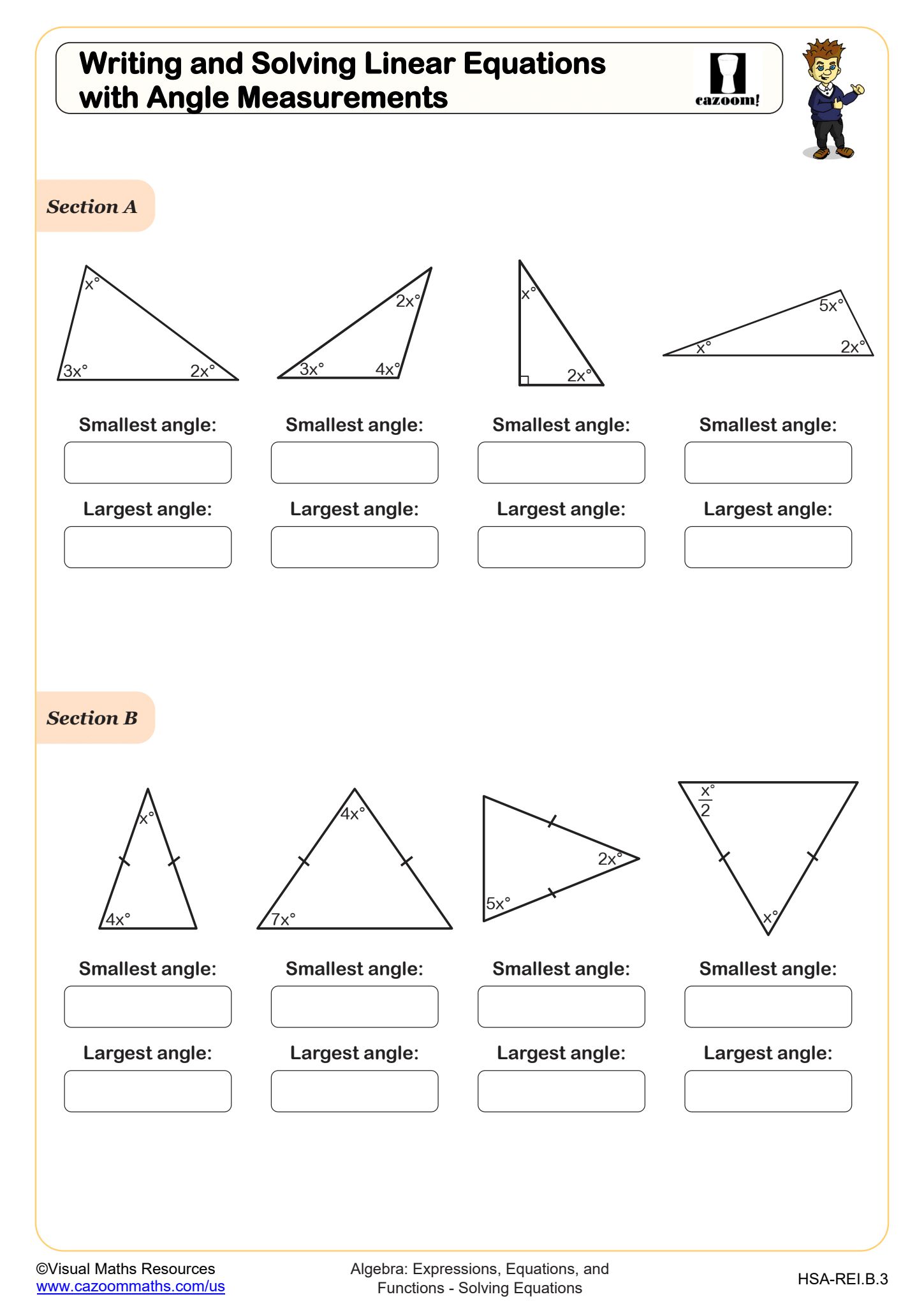
All worksheets are created by the team of experienced teachers at Cazoom Math.
What Do Lines and Angles Worksheets Cover in Integrated Math 1?
Lines and angles worksheets for Integrated Math 1 emphasize the intersection of geometry and algebra by having students write equations based on angle relationships, then solve for unknown values. Students work with complementary and supplementary angles, vertical angles, linear pairs, and angles formed when parallel lines are cut by a transversal. The curriculum addresses Common Core standards that require applying geometric properties to solve problems algebraically.
A common error occurs when students correctly identify that two angles are supplementary but write the equation as x + y = 90 instead of x + y = 180. Teachers notice this mistake appears most often when students rush through the setup phase, confusing the definitions of complementary and supplementary. Providing a quick reference chart during initial practice helps students internalize these definitions before moving to more complex multi-step problems.
How Do Lines and Angles Appear on Standardized Tests?
Standardized tests like the SAT and state assessments regularly include questions where students must identify angle relationships in a diagram, set up an equation, and solve for an unknown angle measure. These questions often combine multiple concepts, such as finding an angle formed by parallel lines cut by a transversal while also solving a two-step equation. Test makers expect students to demonstrate both geometric reasoning and algebraic fluency within the same problem.
Students lose points when they solve the equation correctly but fail to answer what the question actually asks. For example, they might find x = 25 but the question asks for the measure of angle ABC, which requires substituting back to calculate 3x + 10 = 85 degrees. Teaching students to circle what the question asks for before solving reduces this preventable error significantly on timed assessments.
How Do Students Write Equations from Angle Diagrams?
Writing equations from angle diagrams requires students to translate geometric relationships into algebraic statements. Students identify the relationship between angles (such as vertical angles are congruent or consecutive interior angles are supplementary), then express each angle algebraically and set up an equation. For instance, if two supplementary angles measure (2x + 15) and (3x - 5), students write the equation 2x + 15 + 3x - 5 = 180, then solve for x.
This skill connects directly to architectural design and construction, where contractors calculate angles for roof pitch, staircase design, and structural supports. Engineers use these same principles when designing bridges, determining the angles needed for load-bearing beams based on stress requirements. Understanding how geometric constraints translate into solvable equations prepares students for technical fields where precision matters and calculations must account for multiple variables simultaneously.
How Can Teachers Use These Worksheets in Integrated Math 1 Classes?
The worksheets provide structured practice that scaffolds from identifying basic angle relationships to writing and solving multi-step equations involving variables. Each problem includes a diagram that students must analyze before setting up their equation, reinforcing the connection between visual geometric information and algebraic representation. Answer keys allow students to check their work independently, helping them identify whether errors occurred during the setup phase or the solving phase.
Many teachers use these worksheets during differentiated instruction, assigning them to students who need additional practice after direct instruction on angle relationships. The problems work well as warm-up activities before standardized test review sessions or as intervention materials for students who struggled with this concept on formative assessments. Paired work encourages mathematical discussion, as students explain their reasoning for choosing specific angle relationships and compare solution strategies.