Integrated Math 1 Properties of Shapes Worksheets
All worksheets are created by the team of experienced teachers at Cazoom Math.
What Do Properties of Shapes Worksheets Cover in Integrated Math 1?
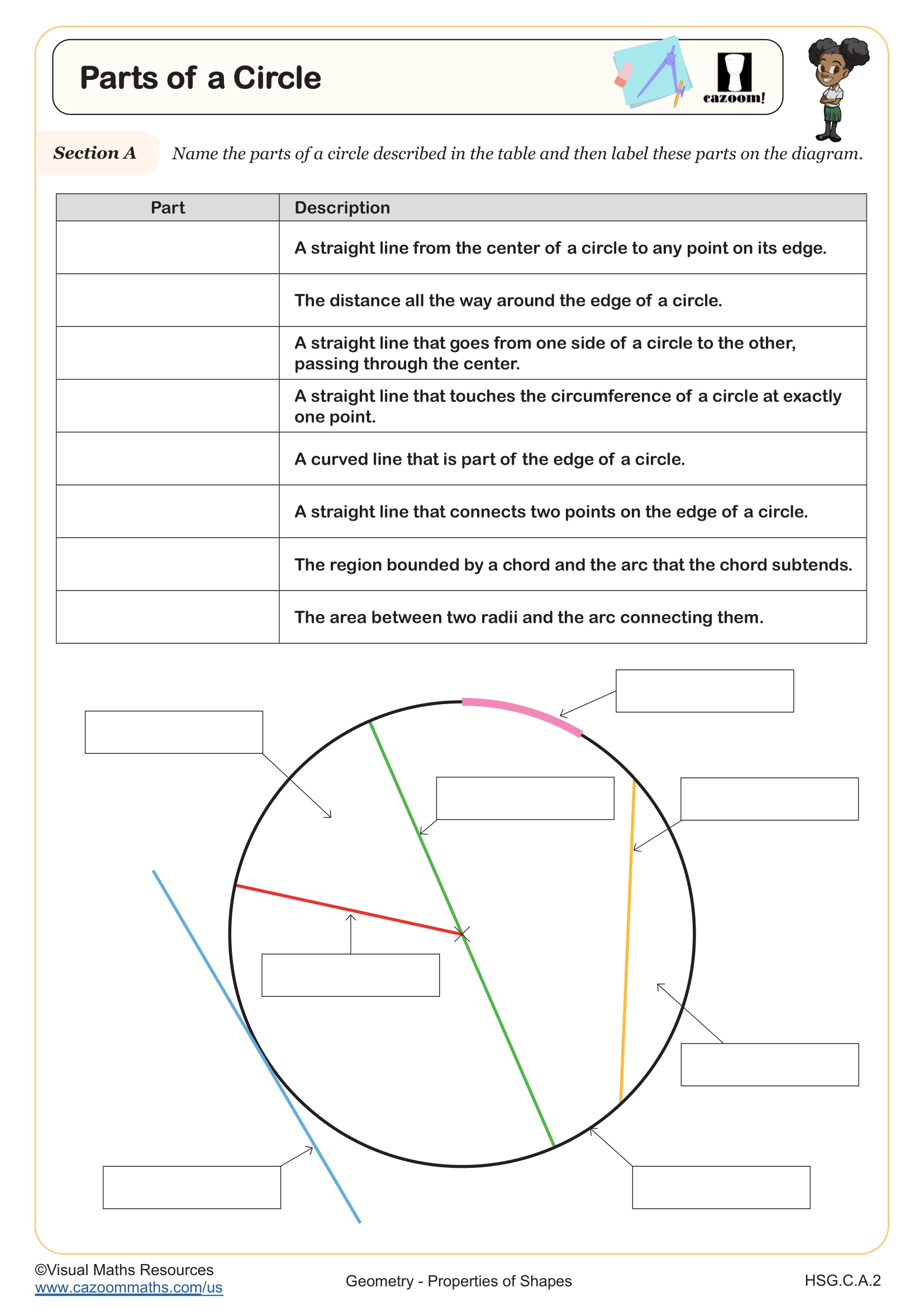
Properties of shapes worksheets in Integrated Math 1 focus on the foundational vocabulary and characteristics that students need to analyze two-dimensional figures. The materials address circle components including radius, diameter, chord, arc, tangent, and sector, which align with Common Core standards for understanding geometric relationships. Students practice identifying these parts visually and applying correct terminology in problem-solving contexts.
A common error teachers notice is students labeling any line segment in a circle as a diameter, not recognizing that diameters must pass through the center point. Worksheets that require students to justify why a segment is or isn't a diameter help reinforce this distinction. This precision matters because diameter-radius confusion leads to calculation errors when students later work with circumference and area formulas, where using the wrong measurement doubles or halves their answer.
How Do Properties of Shapes Appear on Standardized Tests?
Standardized tests like the SAT and state assessments embed properties of shapes within multi-step geometry problems rather than testing vocabulary in isolation. Students might need to identify that a chord divides a circle into two regions or recognize that a tangent forms a right angle with a radius at the point of tangency. These tests expect students to apply terminology within coordinate geometry contexts, area calculations, or proof scenarios that combine multiple geometric concepts.
Students lose points when they misidentify circle parts in diagrams that aren't drawn to scale or when figures appear in non-standard orientations. Many students also struggle when test questions use formal terminology like "secant" or "central angle" without visual cues. Teachers find that regular exposure to varied diagram styles, including circles positioned on coordinate planes or intersecting with other figures, builds the flexibility students need to recognize these properties regardless of presentation format.
Why Are Circle Properties Important for STEM Fields?
Understanding circle properties provides the foundation for analyzing circular motion, rotational systems, and wave patterns that appear throughout science and engineering. Students learn to distinguish between radial measurements (distance from center) and arc measurements (distance along the curve), a distinction that becomes important when studying angular velocity, satellite orbits, or gear mechanics. Recognizing that tangent lines are perpendicular to radii supports later work in physics with centripetal force and in calculus with instantaneous rates of change.
Real-world applications appear in architecture, where designers use circle properties to create domes and arches, and in computer graphics, where programmers define circular objects using center points and radii. Manufacturing processes involving gears, pulleys, and rotating machinery depend on precise relationships between circle components. College-bound students heading toward engineering, computer science, or physics programs benefit from automatic recognition of these properties, as they reappear in trigonometry, vectors, and parametric equations without the same level of explicit instruction provided in high school courses.
How Can Teachers Use These Worksheets in Integrated Math 1 Classrooms?
The worksheets provide structured practice that helps students develop fluency with geometric vocabulary before tackling computational problems involving circles. Teachers can use them as introductory activities when beginning a geometry unit, ensuring all students share common terminology before exploring formulas and theorems. The included answer keys make these resources practical for stations, self-checking practice, or homework assignments where students need immediate feedback to correct misconceptions before they become ingrained habits.
Many teachers find these materials effective for differentiated instruction, assigning them to students who need additional vocabulary reinforcement while others work on application problems. The worksheets work well as warm-up activities to reactivate prior knowledge before lessons on circle theorems or as review materials before unit assessments. For students preparing for state tests or the SAT, the vocabulary practice builds confidence in interpreting geometry questions accurately, reducing errors caused by misreading diagram labels or confusing similar terms under time pressure.