Integrated Math 1 Pythagorean Theorem Worksheets
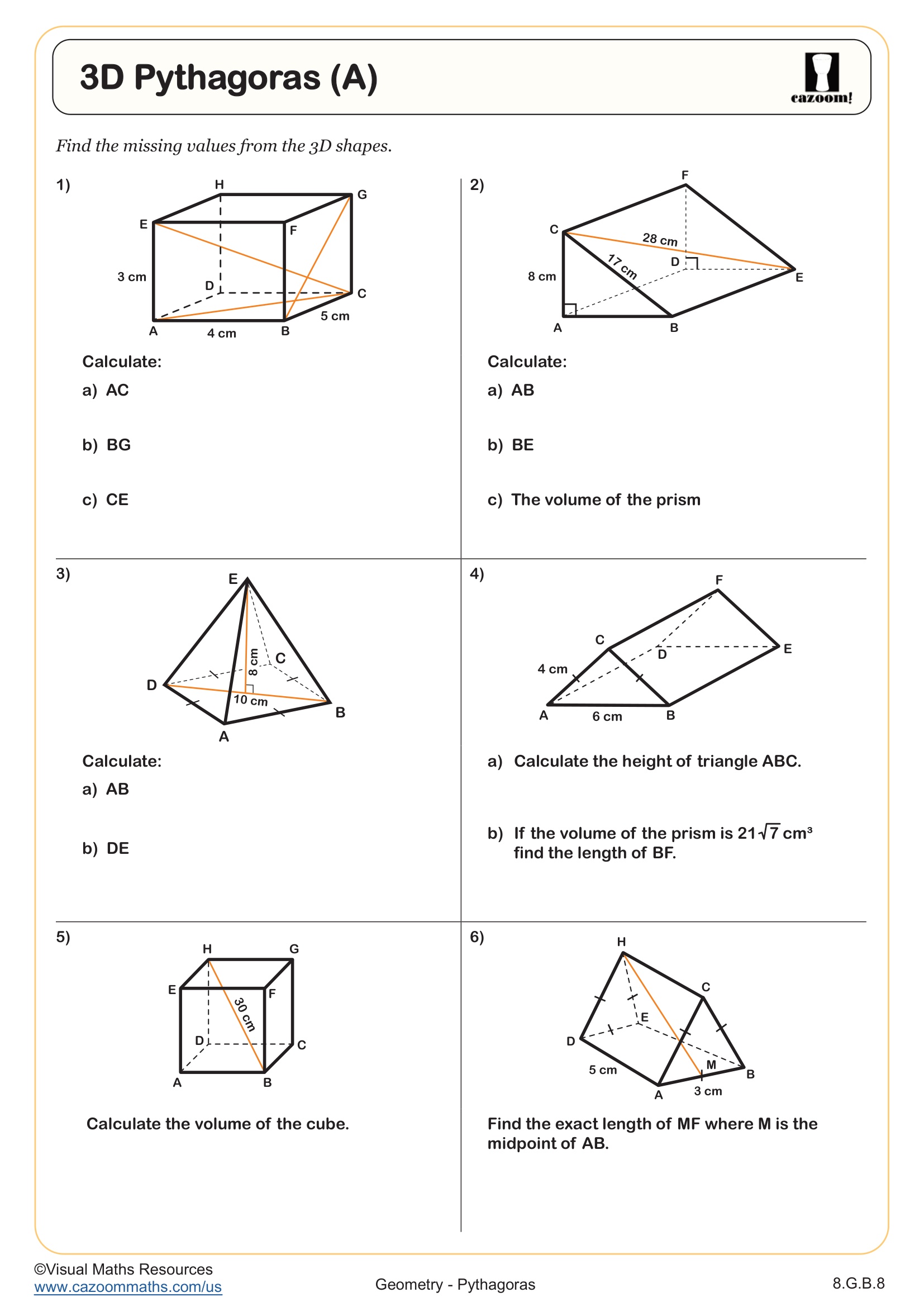
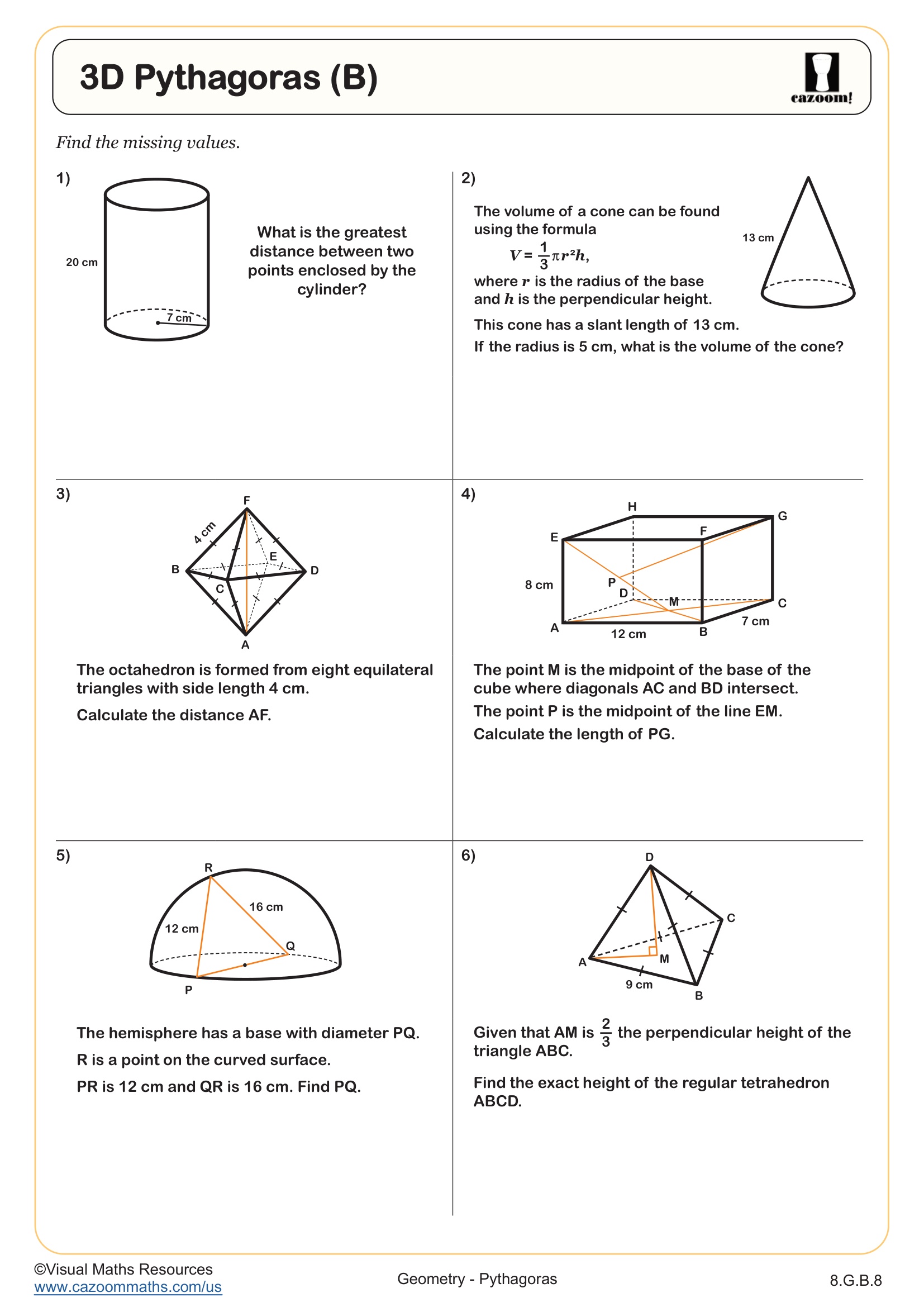
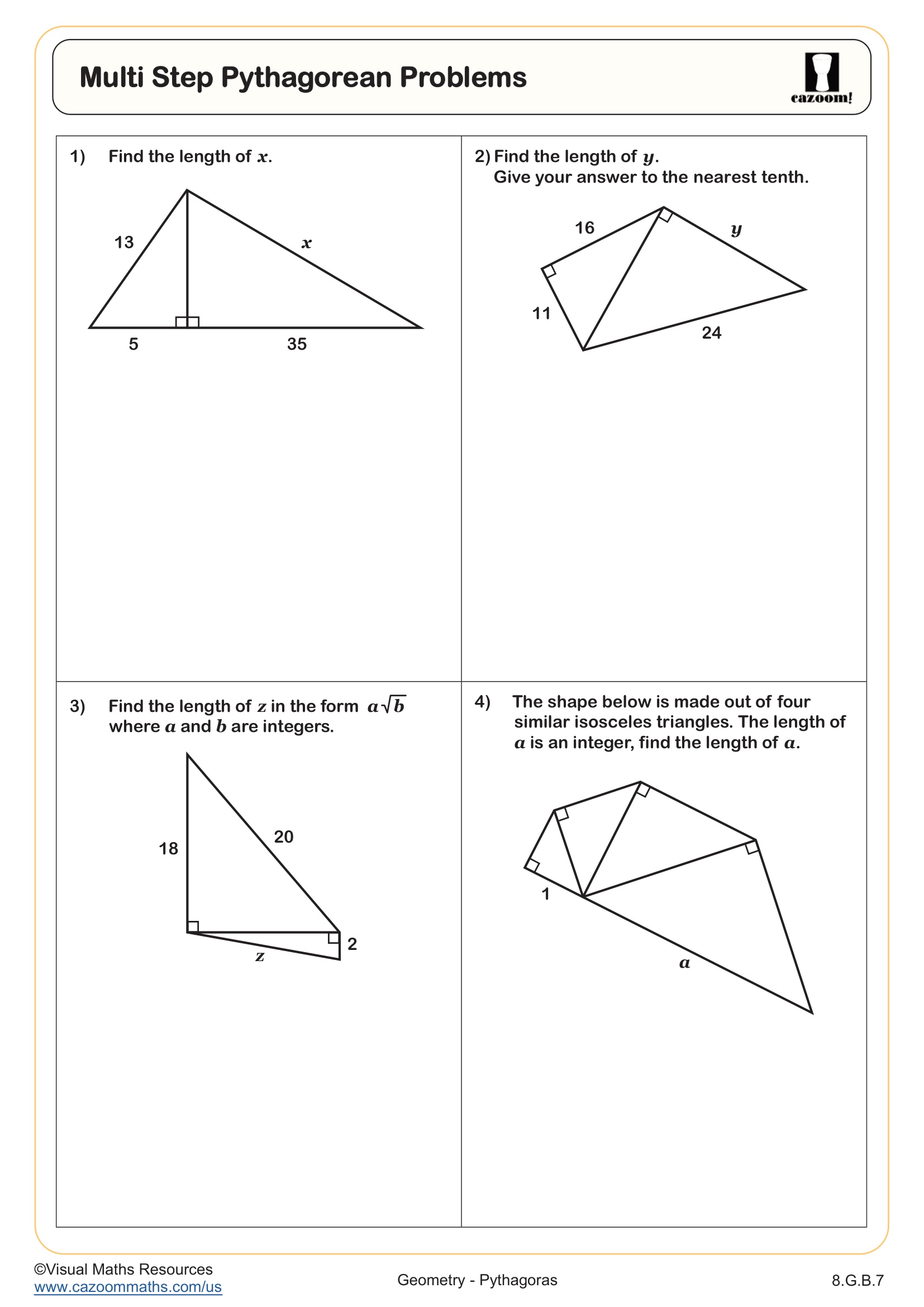
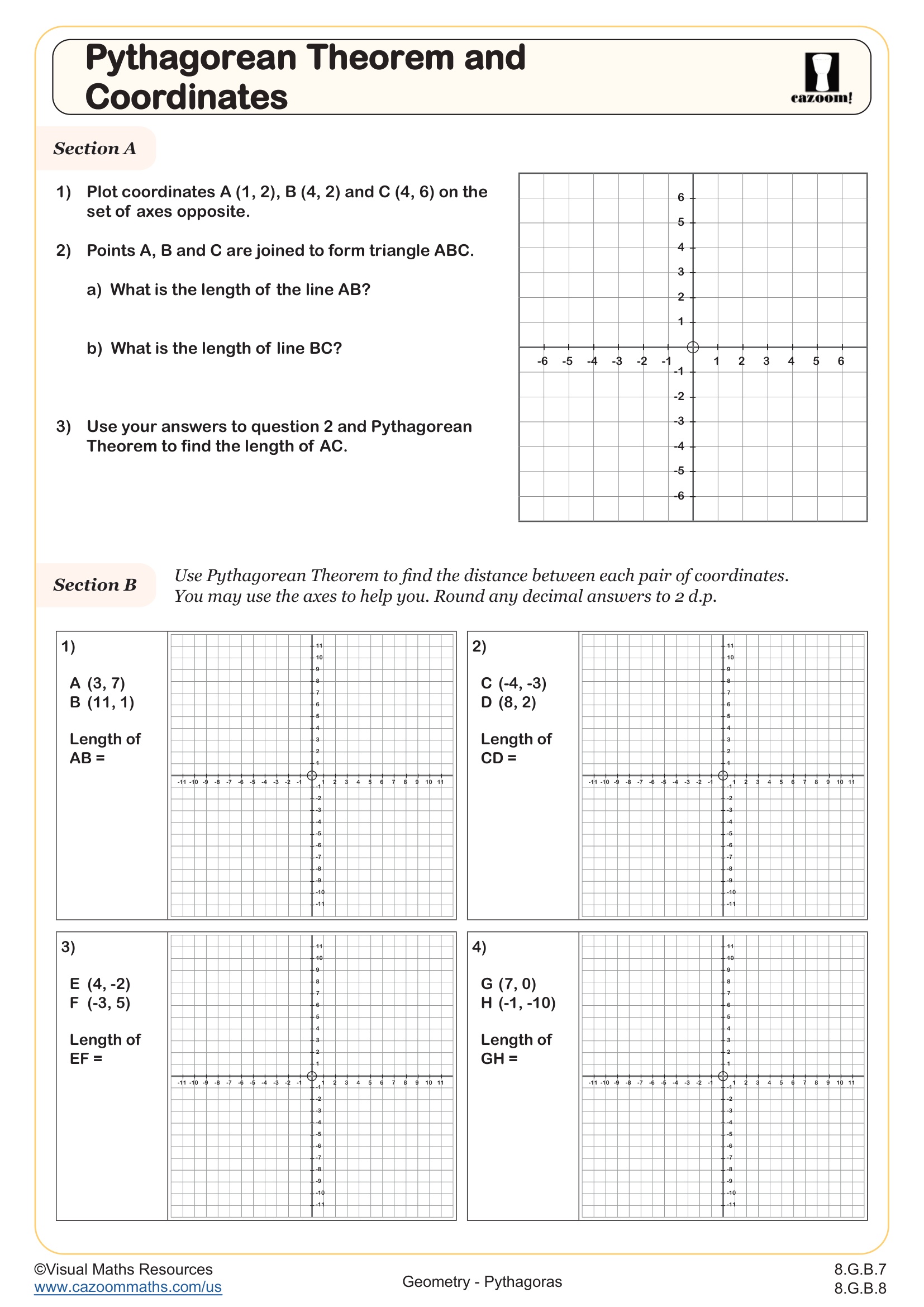
All worksheets are created by the team of experienced teachers at Cazoom Math.
What is the Pythagorean Theorem and why do students learn it in Integrated Math 1?
The Pythagorean Theorem states that in any right triangle, the square of the hypotenuse equals the sum of the squares of the two legs: a² + b² = c². This fundamental relationship appears throughout high school mathematics, from calculating distances on coordinate planes to solving trigonometry problems. Integrated Math 1 introduces this theorem as students transition from middle school geometry to more complex mathematical reasoning, connecting algebraic skills with spatial understanding.
Students often lose points on assessments when they forget to take the square root as their final step, writing c² = 25 as their answer instead of c = 5. The theorem also requires fluency with perfect squares and square roots, so students who struggle with these prerequisite skills benefit from targeted review before tackling Pythagorean applications. Many state assessments include both direct computation problems and application questions where students must first identify whether the Pythagorean Theorem applies to the situation presented.
What grade level learns the Pythagorean Theorem?
The Pythagorean Theorem is a core component of Integrated Math 1 courses at the high school level, typically taken in 9th or 10th grade depending on a student's mathematics pathway. While the Common Core State Standards introduce the theorem in 8th grade, Integrated Math 1 revisits and extends these concepts, building connections between geometry, algebra, and coordinate systems that students will use throughout their high school mathematics sequence.
The progression within Integrated Math 1 starts with straightforward right triangle problems where students find missing side lengths, then advances to identifying whether triangles are right triangles by checking if the Pythagorean relationship holds. Multi-step problems require students to set up equations, work with radical expressions, and apply the theorem in coordinate geometry contexts. This scaffolded approach prepares students for the more complex applications they'll encounter in Geometry and Integrated Math 2, including three-dimensional problems and trigonometric ratios.
How does the Pythagorean Theorem work with coordinate geometry?
When applied to coordinate planes, the Pythagorean Theorem becomes the foundation for the distance formula. Students calculate the horizontal distance between two points (the difference in x-coordinates) and the vertical distance (the difference in y-coordinates), then use these as the legs of a right triangle to find the straight-line distance between the points. This connection helps students understand that d = √[(x₂-x₁)² + (y₂-y₁)²] isn't an arbitrary formula but rather the Pythagorean Theorem in action.
This coordinate application has direct STEM relevance in GPS technology and navigation systems, which constantly calculate distances between coordinate positions. Engineers use this same principle when designing robot pathways or programming drones to travel efficiently between waypoints. Computer graphics programmers apply it thousands of times per second to determine distances between objects in video games and simulations. Students who recognize this connection between abstract theorem and practical technology often develop stronger motivation for mastering the underlying mathematics.
How should teachers use these Pythagorean Theorem worksheets in the classroom?
These worksheets provide graduated practice that moves from basic applications to complex multi-step problems, allowing teachers to select appropriate challenge levels based on student readiness. The included answer keys support efficient grading and enable students to check their own work during independent practice or homework review. Teachers can use worked examples from the simpler worksheets to demonstrate problem-solving strategies before assigning more challenging coordinate geometry applications.
Many teachers find these worksheets effective for differentiated instruction, assigning foundational worksheets to students who need additional support while challenging advanced learners with multi-step problems. The worksheets work well as warm-up activities to maintain skills throughout the unit, intervention materials for students who struggled on initial assessments, or structured practice during station rotations. Paired work sessions where students compare solution methods often reveal computational errors early, particularly the common mistakes of forgetting square roots or misidentifying which side length represents the hypotenuse.