Integrated Math 1 Substitution Worksheets
All worksheets are created by the team of experienced teachers at Cazoom Math.
What Does Substitution Cover in Integrated Math 1?
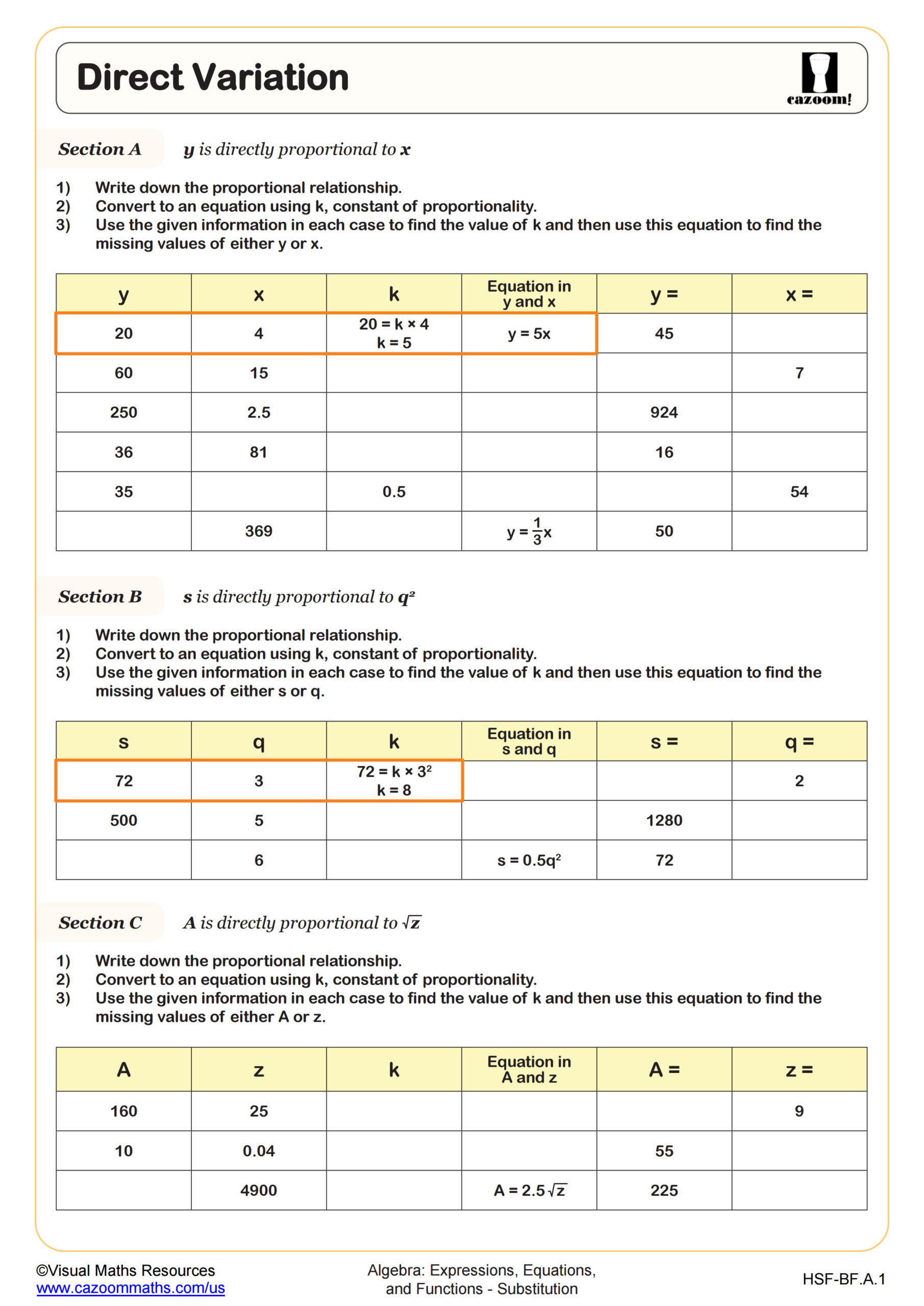
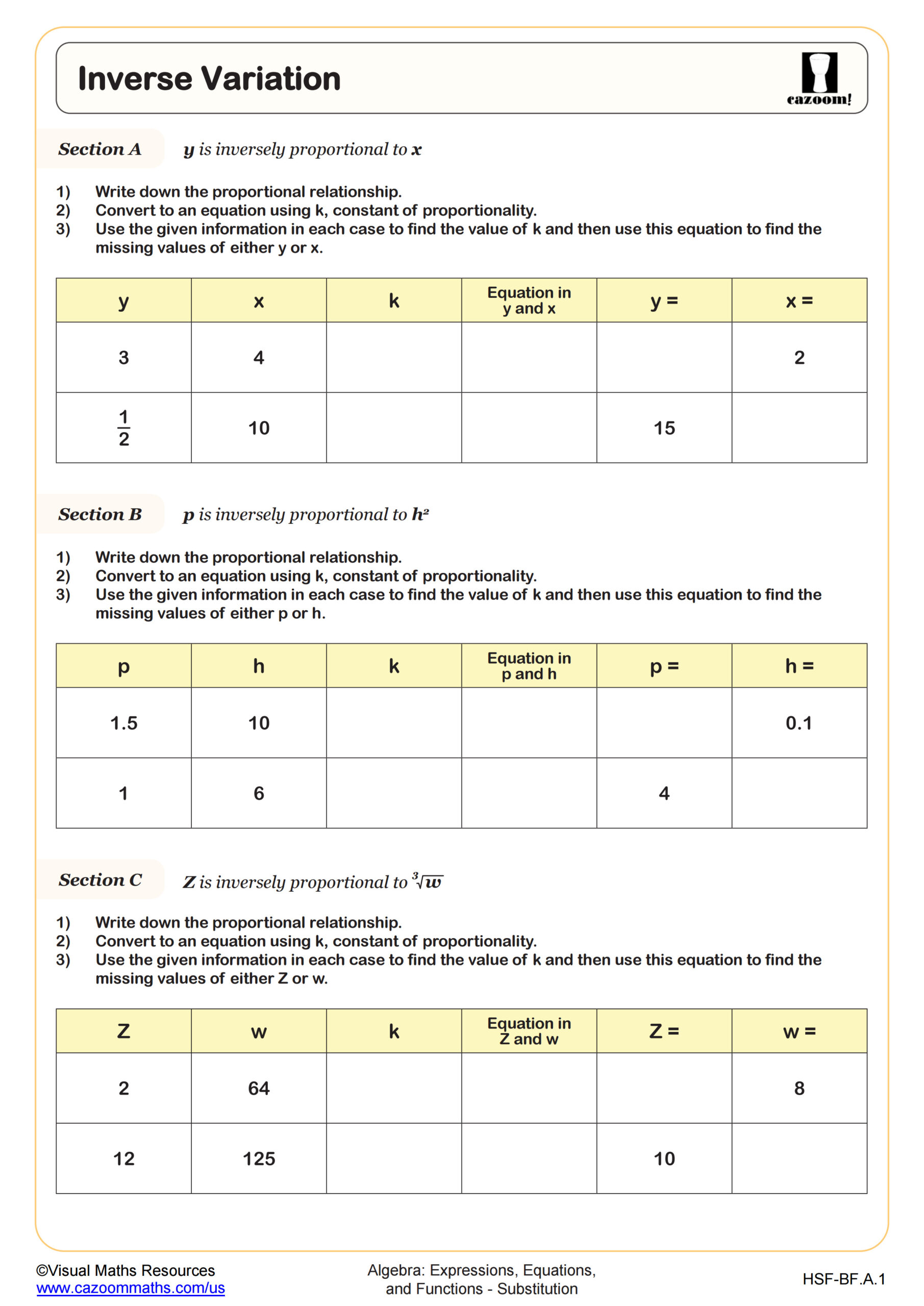
In Integrated Math 1, substitution involves replacing variables with numerical values to evaluate algebraic expressions and verify relationships. Students work with direct variation (y = kx) and inverse variation (y = k/x), substituting values to find constants of variation, solve for unknown variables, and determine whether data sets represent these proportional relationships. This skill aligns with Common Core standards for understanding functions and recognizing patterns in relationships between quantities.
A common error occurs when students substitute into inverse variation problems—they often write the equation incorrectly, placing the constant in the numerator when it belongs in a different position based on the problem context. Teachers find that having students write out the general form first, then carefully substitute each known value while labeling what each variable represents, significantly reduces these mistakes and builds systematic problem-solving habits.
How Is Substitution Tested on the SAT and State Assessments?
Standardized tests like the SAT and state assessments frequently embed substitution within multi-step problems rather than testing it in isolation. Students might encounter questions where they must substitute values into formulas for area, volume, or scientific relationships, or evaluate function notation like f(3) when given an algebraic expression. The SAT calculator section often includes variation problems in real-world contexts where students must identify the type of relationship and use substitution to find missing values.
Students lose points when they rush through the order of operations after substituting, particularly with negative values or fractions. Another testing pitfall involves misreading which variable to solve for—students might correctly substitute but then solve for the wrong quantity. Practice with clearly showing substitution steps, even on multiple-choice questions, helps students catch these errors before selecting answers.
What's the Difference Between Direct and Inverse Variation?
Direct variation describes relationships where two quantities increase or decrease together proportionally, expressed as y = kx where k is the constant of variation. Inverse variation describes relationships where one quantity increases as the other decreases, expressed as y = k/x or xy = k. Students substitute known coordinate pairs to calculate k, then use that constant to find unknown values. Teachers notice that graphing both types helps students visualize the difference—direct variation produces straight lines through the origin while inverse variation creates hyperbolas.
These relationships appear throughout STEM fields and everyday situations. Direct variation models distance-time relationships at constant speed, pricing based on quantity, or currency conversion. Inverse variation describes relationships like the connection between car speed and travel time for a fixed distance, the relationship between the number of workers and time to complete a job, or how gear ratios work in mechanical systems. Recognizing these patterns helps students set up equations correctly in applied contexts.
How Can Teachers Use These Substitution Worksheets in Integrated Math 1?
These worksheets provide focused practice on evaluating expressions within variation contexts, allowing students to build computational fluency while reinforcing the conceptual understanding of proportional relationships. The progression from direct to inverse variation helps students distinguish between these relationship types and recognize which equation form applies to different situations. Answer keys enable students to self-check their work, identify calculation errors, and develop independence in recognizing where they need additional support.
Teachers use these resources for targeted intervention when students struggle with function notation or equation solving—mastering substitution first removes computational obstacles that often mask deeper conceptual understanding. The worksheets work well as warm-up activities before lessons on solving variation equations, as homework to reinforce classroom learning, or as stations during differentiated instruction. Pairing students to compare their substitution steps helps them catch sign errors and builds mathematical communication skills that benefit all areas of algebra.