Integrated Math 1 Volume and Surface Area Worksheets
All worksheets are created by the team of experienced teachers at Cazoom Math.
What Volume and Surface Area Concepts Do Integrated Math 1 Students Learn?
Integrated Math 1 students work with volume and surface area of three-dimensional solids, focusing on shapes like prisms, cylinders, pyramids, cones, and composite figures. The curriculum emphasizes understanding how changing dimensions affects volume and surface area, developing proportional reasoning alongside formula application. Students learn to visualize cross-sections and identify the components needed to calculate measurements for more complex shapes like conical frustums, which appear in manufacturing and construction contexts.
A common misconception occurs when students confuse the formulas for volume and surface area, particularly with cones and pyramids where the factor of one-third appears in volume but not surface area calculations. Teachers notice that students who sketch and label diagrams before calculating tend to select the correct formula more consistently. Understanding that volume measures space inside while surface area measures the covering helps students distinguish between these related but distinct concepts.
How Do Standardized Tests Assess Volume and Surface Area Skills?
The SAT and state assessments typically present volume and surface area problems in applied contexts, requiring students to interpret diagrams, select appropriate formulas, and work with both exact answers and decimal approximations. Test questions often involve composite figures where students must break down complex shapes into recognizable components, or they require students to work backwards from a given volume to find a missing dimension. Calculator and no-calculator sections both include these problems, testing whether students can estimate reasonably and recognize when an answer doesn't make sense.
Students lose points when they forget to cube units for volume or square them for surface area, a seemingly minor detail that significantly impacts scores. Another frequent error involves using diameter instead of radius in formulas for cylinders and cones, or failing to identify which measurement represents the slant height versus the perpendicular height. Standardized tests expect students to show dimensional analysis clearly, so practicing proper unit notation prevents careless mistakes under time pressure.
What Makes Conical Frustums Important in Volume Calculations?
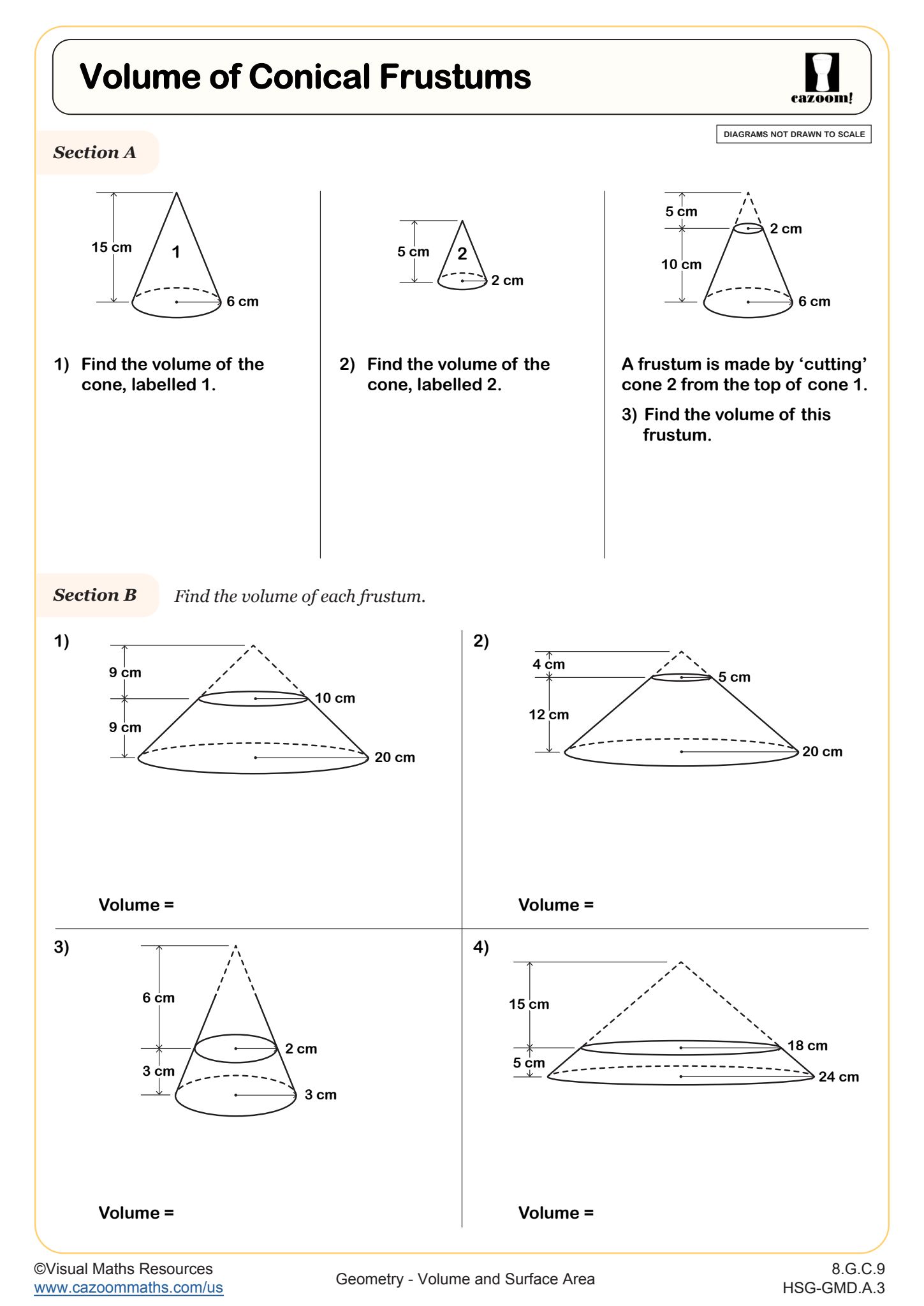
A conical frustum is the solid remaining when a smaller cone is removed from the top of a larger cone, creating a shape with two circular bases of different radii. Students calculate frustum volume by finding the difference between the larger cone's volume and the removed smaller cone's volume, or by applying the frustum-specific formula that incorporates both radii and the height. This requires careful attention to which measurements belong to which cone and understanding how the shapes relate proportionally through similar triangles.
Conical frustums appear frequently in real-world applications including lamp shades, beverage cups, traffic cones, and industrial hoppers used in manufacturing. Engineers design silos and storage containers using frustum calculations to optimize material usage while maintaining structural integrity. Understanding frustum volume connects geometry to practical problem-solving in architecture, product design, and civil engineering, where calculating material quantities and weight distribution requires precise three-dimensional measurement skills.
How Can Teachers Use These Worksheets in Integrated Math 1 Classes?
These worksheets provide focused practice on calculating volumes of complex three-dimensional shapes, with problems that require students to identify given information, select appropriate formulas, and execute multi-step calculations accurately. The progression helps students build confidence with frustum calculations before encountering them in more complex problem-solving contexts. Answer keys allow students to verify not just final answers but also intermediate steps, helping them pinpoint exactly where calculation errors occurred.
Teachers use these materials for differentiated instruction, assigning them during independent practice while working with small groups who need additional support on prerequisite skills like working with radicals or applying the Pythagorean theorem to find missing dimensions. The worksheets work well as warm-up problems to review previously taught content, homework assignments that reinforce classroom learning, or targeted practice before assessments. Paired work encourages students to explain their reasoning to each other, which often reveals misunderstandings about which formula applies to which situation.