Integrated Math 2 Angles Worksheets
All worksheets are created by the team of experienced teachers at Cazoom Math.
What do Integrated Math 2 students learn about angles in relation to lines?
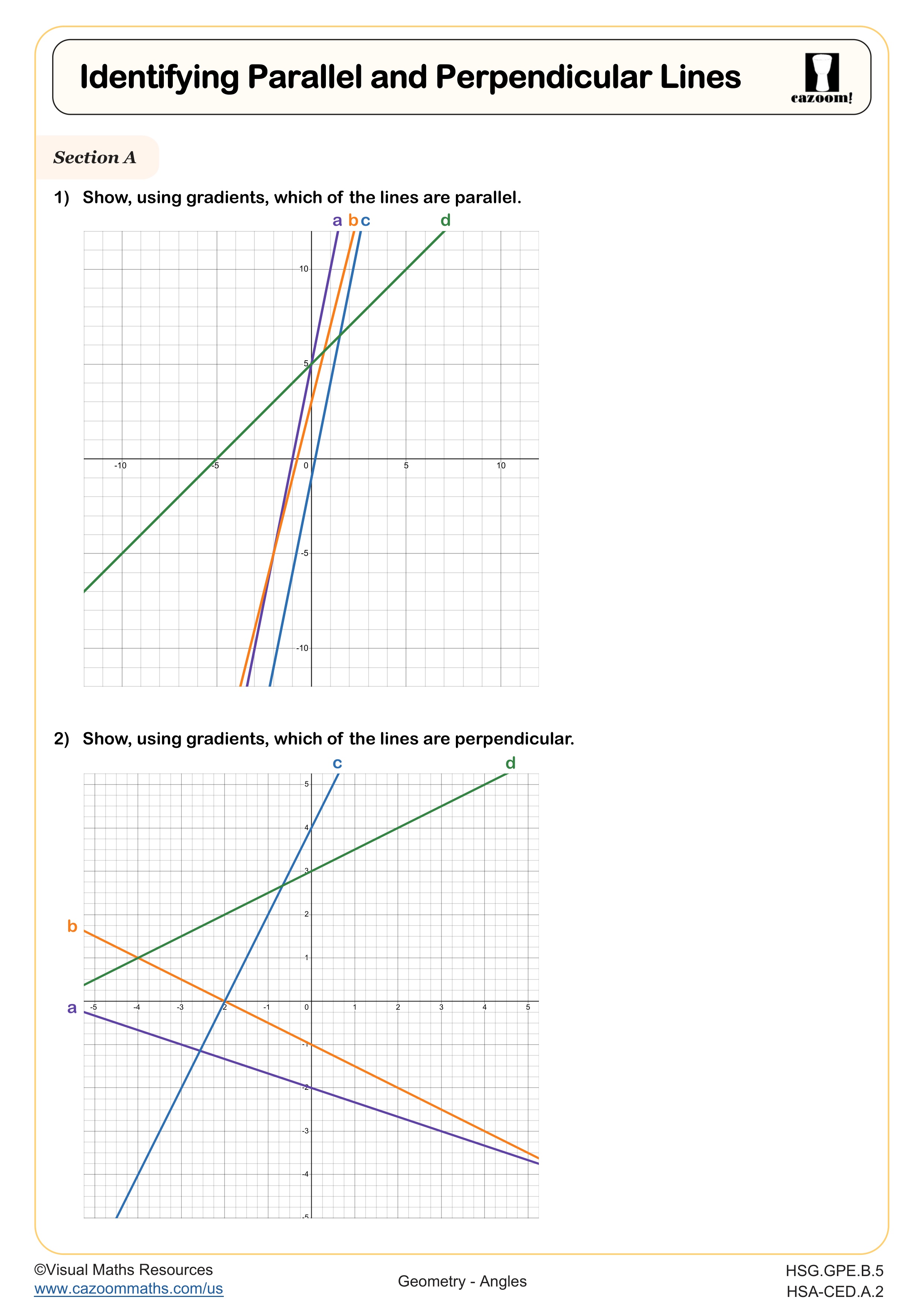
In Integrated Math 2, angles concepts focus heavily on the relationship between parallel and perpendicular lines through coordinate geometry. Students analyze slopes to determine line relationships, understanding that parallel lines never intersect because they maintain identical slopes, while perpendicular lines intersect at right angles because their slopes are negative reciprocals. This topic connects algebraic representations with geometric properties, requiring students to work fluidly between equations, graphs, and numerical calculations.
A common error occurs when students attempt to find perpendicular slopes: many incorrectly flip the sign without taking the reciprocal, or take the reciprocal without changing the sign. Teachers frequently see students write that the perpendicular slope to 2/3 is -3/2 correctly, but then claim the perpendicular slope to 4 is -4 instead of -1/4. Providing consistent practice with whole number and fractional slopes helps students internalize this two-step process.
How do standardized tests assess understanding of angles and line relationships?
The SAT and ACT regularly test parallel and perpendicular line concepts within coordinate geometry questions, often requiring students to identify which equation represents a line parallel or perpendicular to a given line. State assessments typically present these problems in multiple formats: given two equations, students determine the relationship; given one equation and a relationship, students find the missing slope or equation; or given a graph, students identify line relationships visually and algebraically.
Students lose points when they confuse the conditions for parallel and perpendicular lines under time pressure. A typical mistake involves selecting an equation with the same y-intercept when the question asks for a parallel line, ignoring that parallel lines must have equal slopes but can have different intercepts. Another frequent error occurs in multiple-choice questions where students correctly identify perpendicular slopes but select an equation with an incorrect y-intercept because they didn't verify the line passes through a specified point.
Why is understanding slope relationships critical for geometry proofs?
Slope relationships provide the algebraic foundation for proving geometric properties in the coordinate plane. When students can demonstrate that opposite sides of a quadrilateral have equal slopes, they've proven those sides are parallel, which is necessary for identifying parallelograms, rectangles, and trapezoids. Similarly, proving that adjacent sides have slopes that are negative reciprocals establishes right angles, distinguishing rectangles and squares from other parallelograms. This analytical approach replaces measurement-based arguments with logical, algebraic reasoning.
Architects and engineers apply these slope relationships when designing structures with parallel supports or perpendicular bracing. Roof trusses require precise perpendicular angles for structural integrity, while road designers use parallel slopes to create uniform lanes and exit ramps. Computer graphics programmers use slope calculations to render parallel edges and perpendicular corners in 3D modeling software, demonstrating how coordinate geometry translates directly into visual design and construction fields that college-bound STEM students will encounter.
How can teachers use these angles worksheets in Integrated Math 2 classes?
These worksheets provide targeted practice in identifying parallel and perpendicular lines through multiple representations, allowing students to strengthen their understanding of slope relationships before tackling more complex coordinate geometry proofs. The structured format helps students develop systematic approaches: converting equations to slope-intercept form, calculating slopes from two points, and applying the parallel and perpendicular conditions accurately. Answer keys enable students to self-check their work and identify exactly where errors occur in their solution process.
Teachers find these worksheets particularly useful as warm-up activities before introducing coordinate proofs of geometric properties, or as review stations when students struggle with quadrilateral classification problems. The practice works well for paired learning, where one student solves while their partner verifies using the answer key, then they switch roles. Many teachers assign these for homework before unit assessments, as the immediate answer key feedback helps students correct misconceptions without waiting for teacher grading, building confidence and accuracy before tests.