Integrated Math 2 Constructions Worksheets
All worksheets are created by the team of experienced teachers at Cazoom Math.
What Do Students Learn in Integrated Math 2 Constructions?
Integrated Math 2 constructions focus on using compass and straightedge to create geometric figures with precision, including perpendicular bisectors, angle bisectors, equilateral triangles, and circles inscribed in polygons. Students learn the formal steps for each construction and understand why these methods produce exact geometric relationships rather than approximations. This work aligns with Common Core standards for congruence and construction, preparing students for more advanced work with triangle centers and circle theorems.
A common misconception is that constructions are merely art projects rather than mathematical proofs. Students often struggle initially with the precision required, particularly keeping compass width consistent throughout multi-step constructions. Teachers notice that students gain confidence once they recognize that each arc intersection represents the solution to a geometric relationship, such as finding all points equidistant from two given points when constructing a perpendicular bisector.
How Do Constructions Appear on Standardized Tests?
The SAT and state assessments typically test constructions conceptually rather than asking students to physically perform them. Questions often present a series of construction steps and ask students to identify what figure results, or they may show a completed construction and ask which property it demonstrates. Students need to recognize the purpose of each construction type and connect it to underlying geometric theorems about congruence, perpendicularity, and equidistance.
Students lose points when they confuse which construction produces which result, particularly mixing up perpendicular bisectors (which create right angles and find midpoints) with angle bisectors (which divide angles into congruent parts). Another frequent error occurs when students don't recognize that inscribed circle constructions require angle bisectors from all vertices to locate the incenter. Standardized tests expect students to justify why a construction works, not just memorize the steps.
Why Are Perpendicular and Angle Bisectors Important in Constructions?
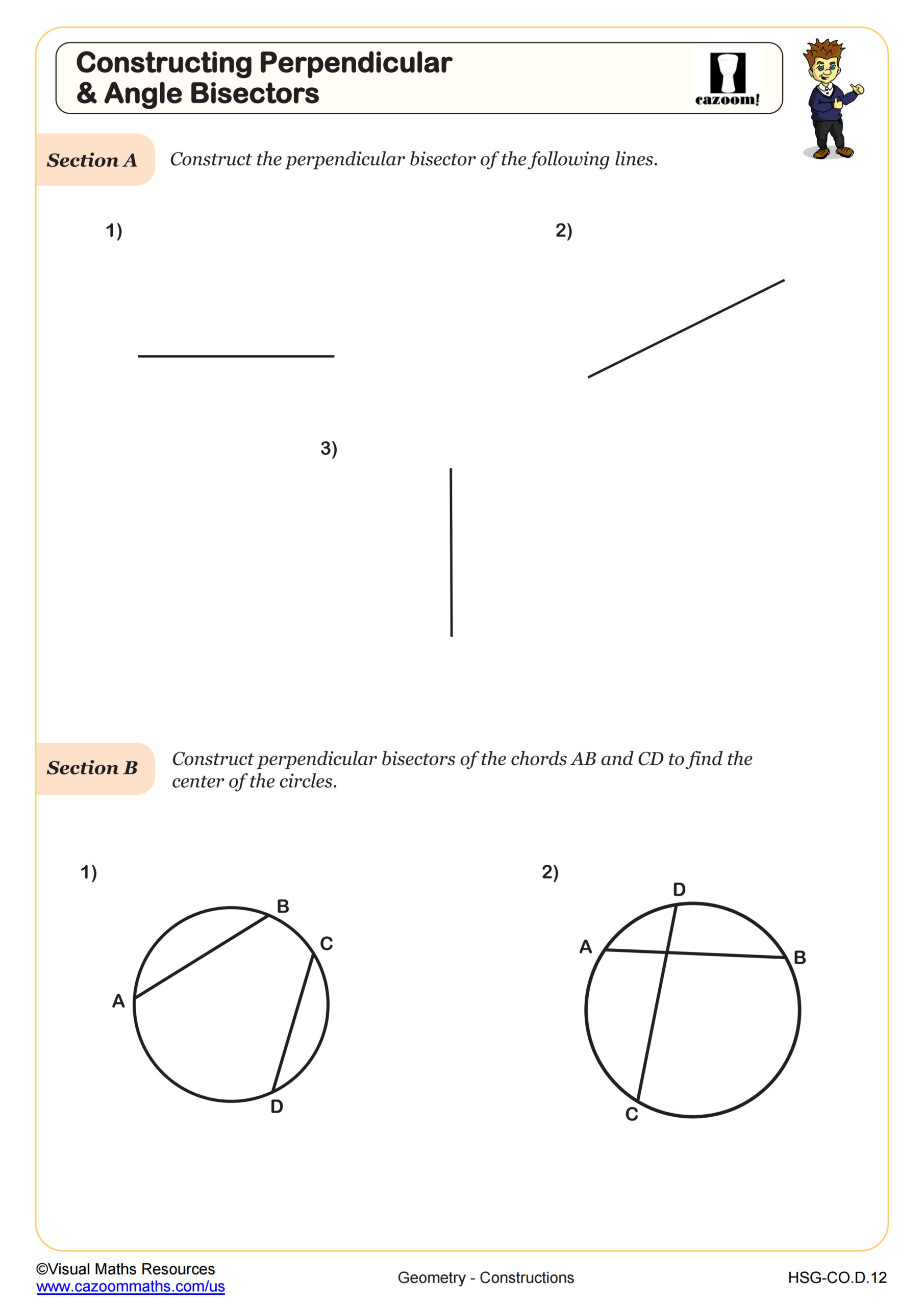
Perpendicular and angle bisectors serve as foundational constructions because they establish precise relationships that underlie more complex figures. A perpendicular bisector creates a line through a segment's midpoint at exactly 90 degrees, while an angle bisector divides an angle into two congruent parts. These constructions rely on the principle that compass arcs identify points equidistant from given locations, transforming abstract geometric definitions into concrete, repeatable procedures that students can verify visually.
These bisector skills appear frequently in architecture and engineering contexts where symmetry and precision matter. Structural engineers use perpendicular bisector concepts when centering support beams, while landscape architects apply angle bisector principles when designing irrigation systems that need equal coverage from a central point. Students preparing for STEM fields benefit from understanding that these classical constructions represent early problem-solving methods that modern CAD software now automates but still follows the same geometric logic.
How Can Teachers Use These Construction Worksheets in Integrated Math 2?
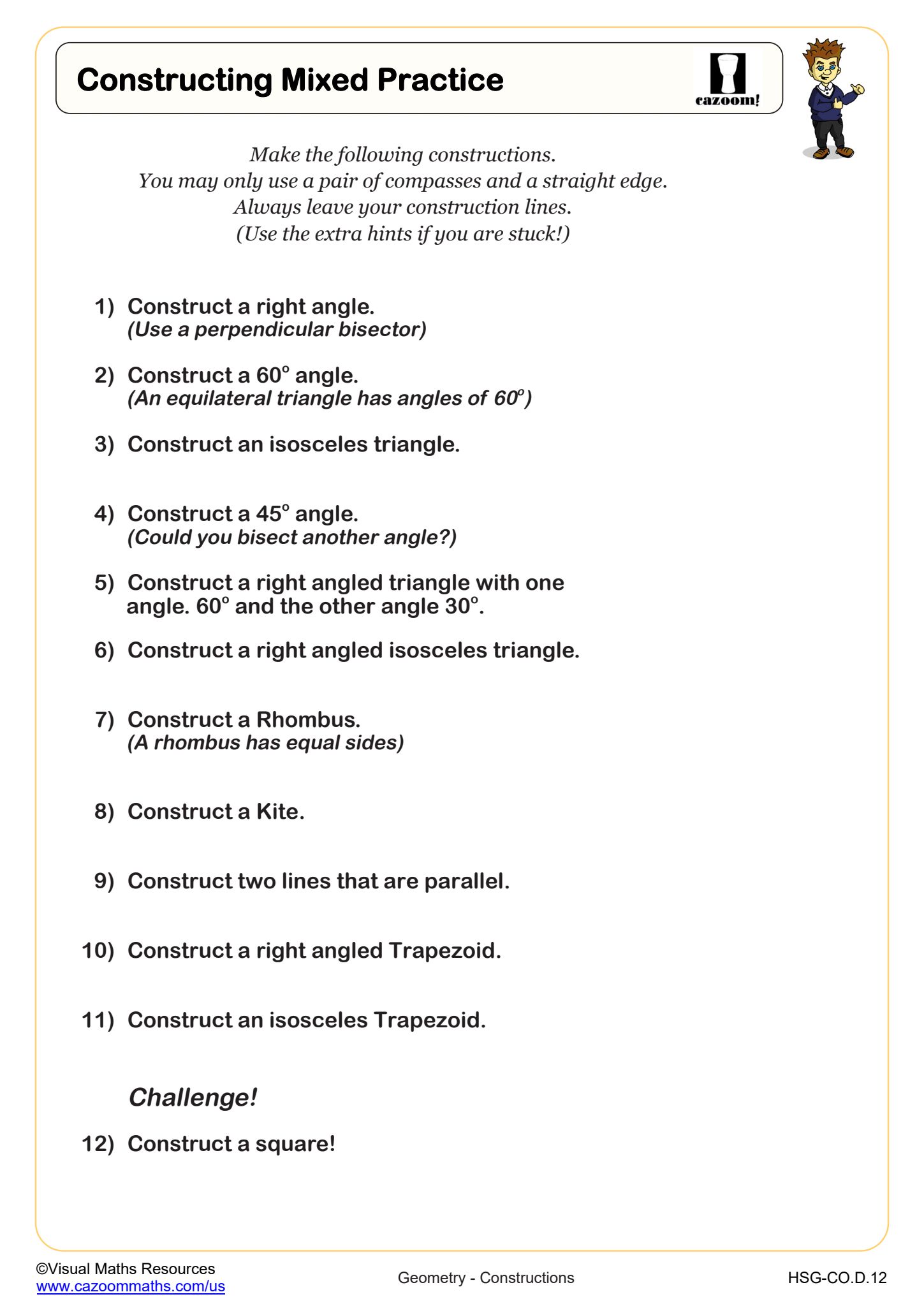
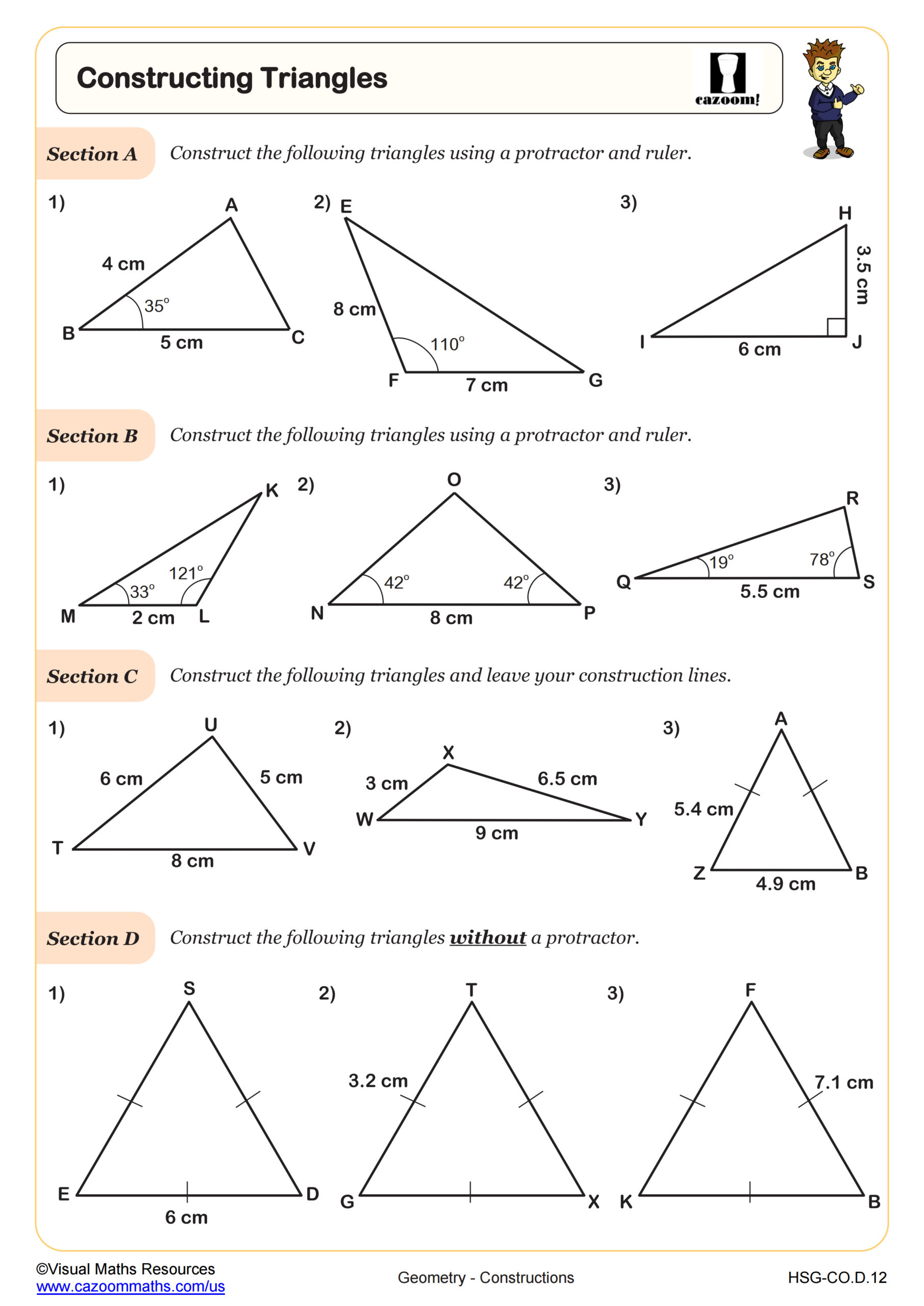
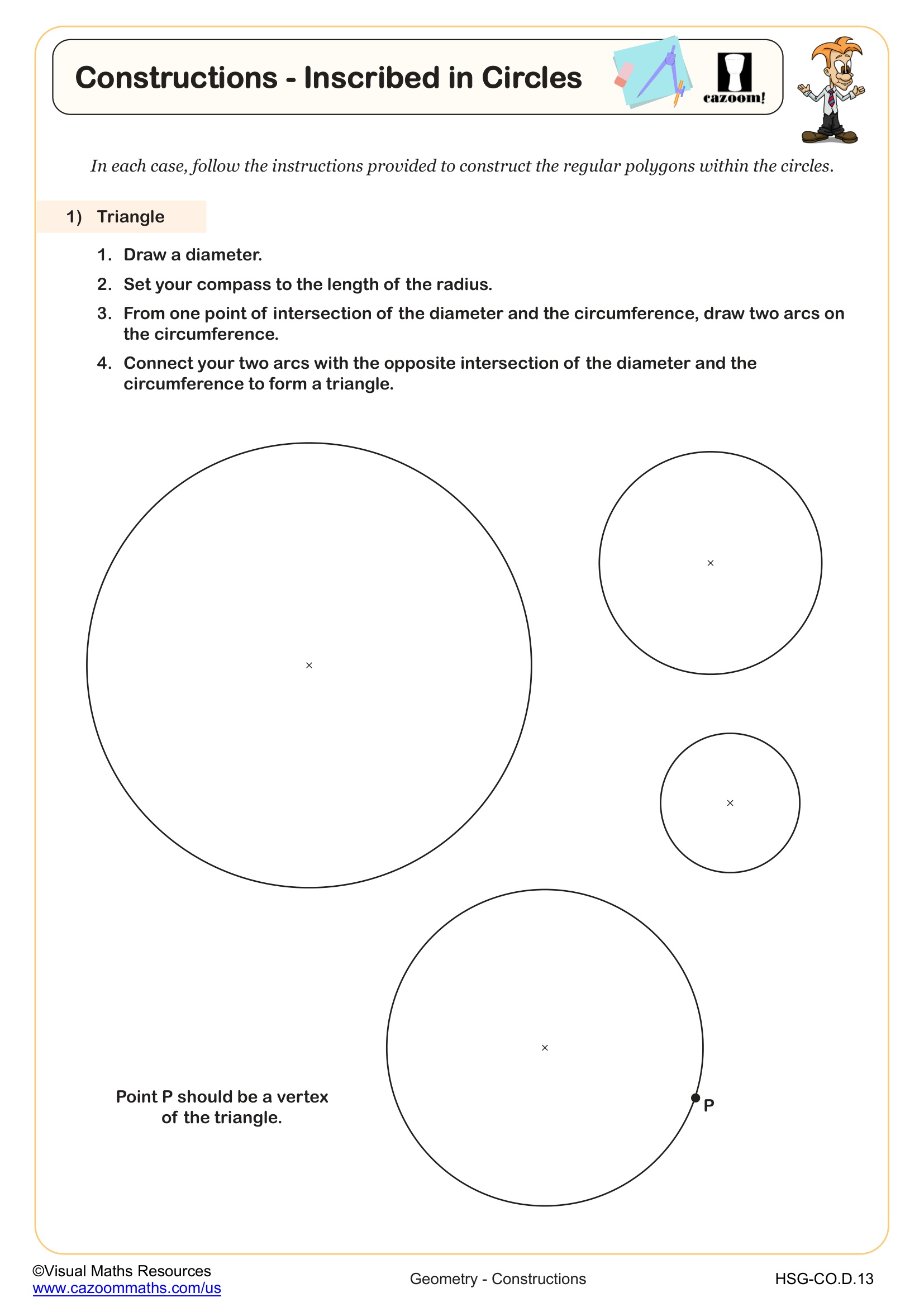
These worksheets provide structured practice with each construction type, progressing from basic bisectors to more complex figures like inscribed circles and specialized triangles. The mixed practice worksheet helps students discriminate between construction types and choose appropriate methods for different geometric problems. Answer keys allow students to self-check their work by comparing final figures, which is particularly valuable since construction errors compound through multi-step problems.
Many teachers use these worksheets for stations or paired activities where students can compare their construction techniques and troubleshoot errors together. They work well as review before geometry proof units since constructions provide visual evidence for theorems students will later prove algebraically. The worksheets also serve as intervention tools for students who struggle with spatial visualization, offering hands-on practice that builds geometric intuition before tackling more abstract coordinate geometry or transformational approaches to proving congruence.