Integrated Math 2 Percentages Worksheets
All worksheets are created by the team of experienced teachers at Cazoom Math.
What Percentage Skills Do Students Practice in Integrated Math 2?
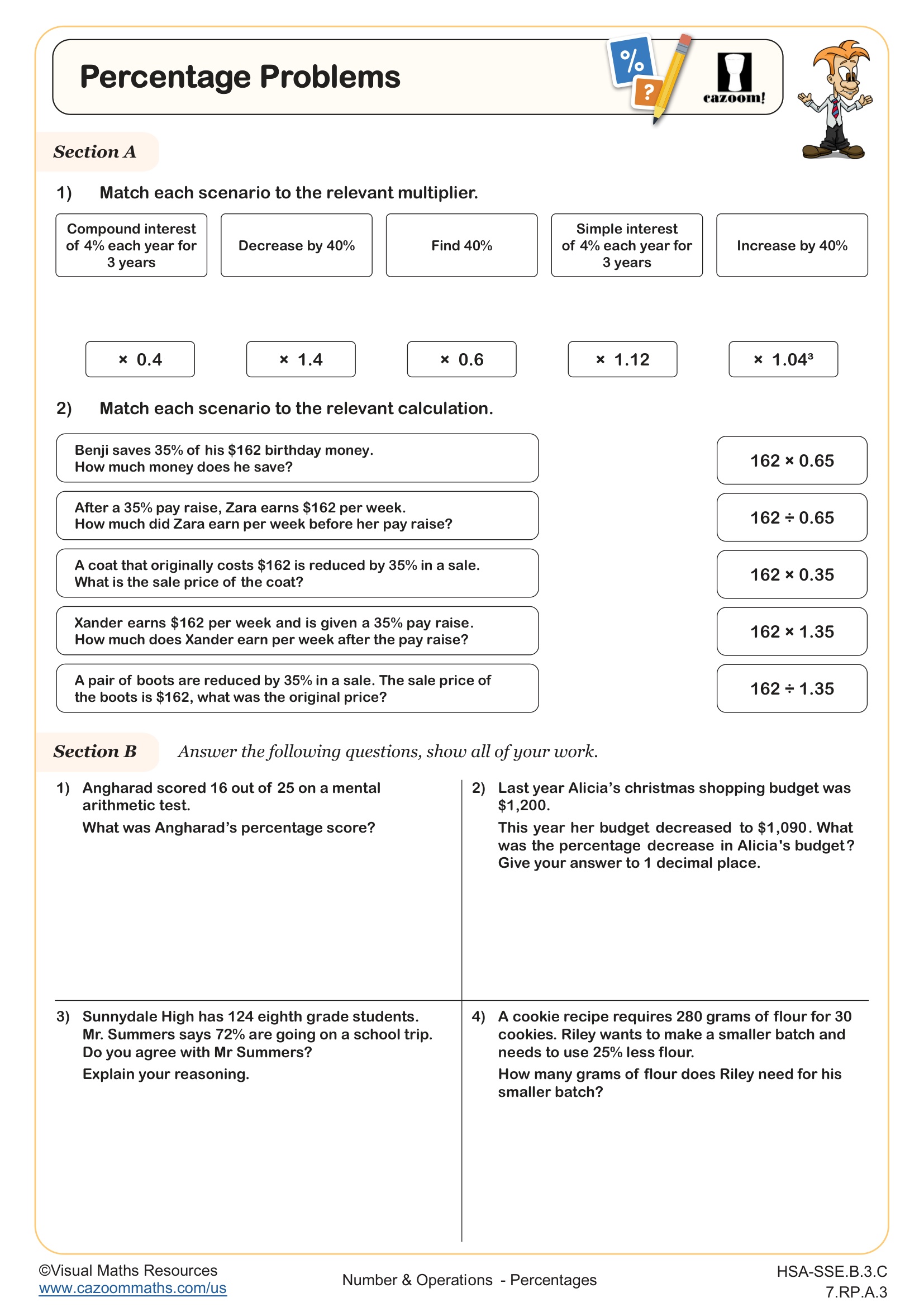
Integrated Math 2 percentage work extends beyond basic calculations to applications involving percent change, growth and decay models, and financial literacy contexts. Students calculate percentage increase and decrease, work with compound interest scenarios, and analyze depreciation in real-world situations. This aligns with Common Core standards for ratios and proportional relationships while preparing students for the exponential functions they'll study later in the course.
Teachers frequently notice students struggle when problems require multiple steps, such as finding an original price after a discount has been applied. Students lose points when they add percentage increases to 100% instead of multiplying by 1.15 (for a 15% increase), indicating they haven't fully transitioned from procedural thinking to multiplicative reasoning. These worksheets provide targeted practice with these multi-step scenarios.
How Do Percentages Appear on the SAT and State Assessments?
Standardized tests like the SAT and ACT embed percentage questions within word problems, data interpretation tasks, and algebraic contexts. Students must calculate percent change from tables or graphs, determine unknown values when given percentage relationships, and solve problems involving successive percentage changes. The SAT Math section particularly favors real-world percentage scenarios involving taxes, tips, discounts, and interest rates that require students to set up and solve equations.
Students lose points when they confuse percentage of a number with percentage change, or when they fail to distinguish between simple and compound percentage applications. Many students incorrectly assume a 20% decrease followed by a 20% increase returns to the original value—a misconception that reveals incomplete understanding of how percentages interact. Test preparation should emphasize reading comprehension alongside computation, as many errors stem from misinterpreting what the question actually asks.
What Is Depreciation and Why Do Students Study It?
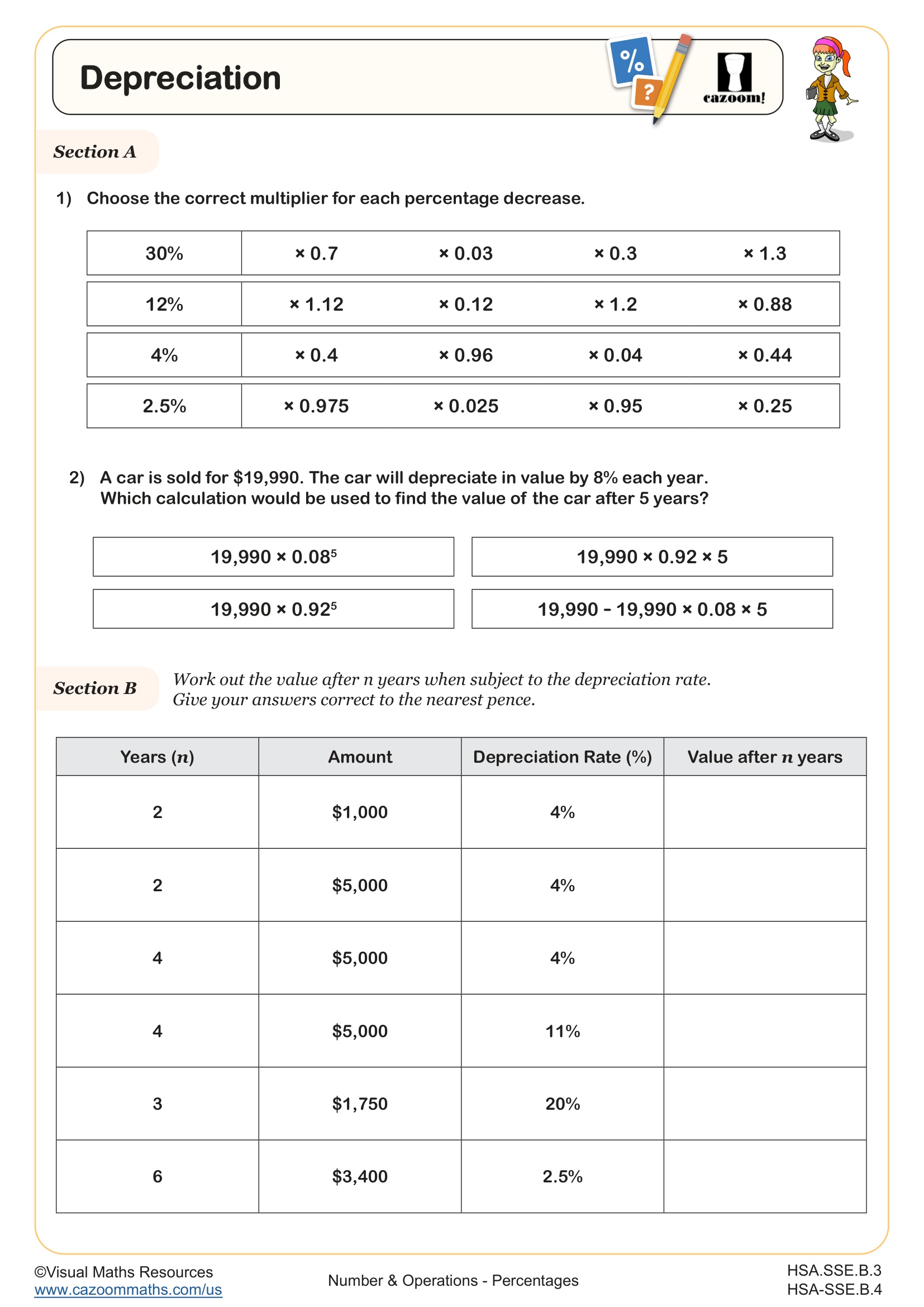
Depreciation represents the decrease in value of an asset over time, typically expressed as a percentage rate applied annually or over specific periods. In Integrated Math 2, students calculate depreciated values using exponential decay models, such as determining a car's value after several years given its purchase price and annual depreciation rate. This concept builds the foundation for exponential functions students will explore more formally later in the curriculum, connecting percent change to algebraic modeling.
This skill appears throughout STEM and business contexts—engineers factor depreciation into equipment lifecycle planning, accountants calculate asset values for financial statements, and economists model market dynamics. College-bound students encounter depreciation in business courses, economics classes, and any field requiring financial analysis. Understanding depreciation also supports financial literacy, helping students make informed decisions about major purchases like vehicles or technology where resale value matters.
How Can Teachers Use These Integrated Math 2 Percentage Worksheets Effectively?
These worksheets provide structured practice that bridges computational fluency with problem-solving application. The progression from percentage problems to depreciation calculations allows teachers to scaffold instruction, starting with familiar concepts before introducing exponential decay contexts. Answer keys enable students to check their work during independent practice or allow teachers to quickly review homework submissions, identifying which students need additional support before summative assessments.
Many teachers use these worksheets during differentiated instruction—students who grasp percentage concepts quickly can move to depreciation problems while others receive targeted intervention on foundational skills. The worksheets work well for SAT preparation sessions focused on problem-solving and heart-of-algebra questions. Teachers also assign these as warm-up activities to maintain previously learned skills or as paired work where students explain their reasoning to partners, reinforcing both computational accuracy and conceptual understanding.