Integrated Math 2 Quadratic and Cubic Functions Worksheets
All worksheets are created by the team of experienced teachers at Cazoom Math.
What Do Students Learn About Quadratic and Cubic Functions in Integrated Math 2?
In Integrated Math 2, students extend their function knowledge to quadratic expressions in standard form (ax² + bx + c), factored form, and vertex form. They solve quadratic equations through factoring, completing the square, and applying the quadratic formula, while also interpreting graphs of parabolas and understanding key features like vertex, axis of symmetry, and intercepts. The curriculum introduces cubic functions as a natural extension, showing students how degree affects graph behavior and the number of possible solutions.
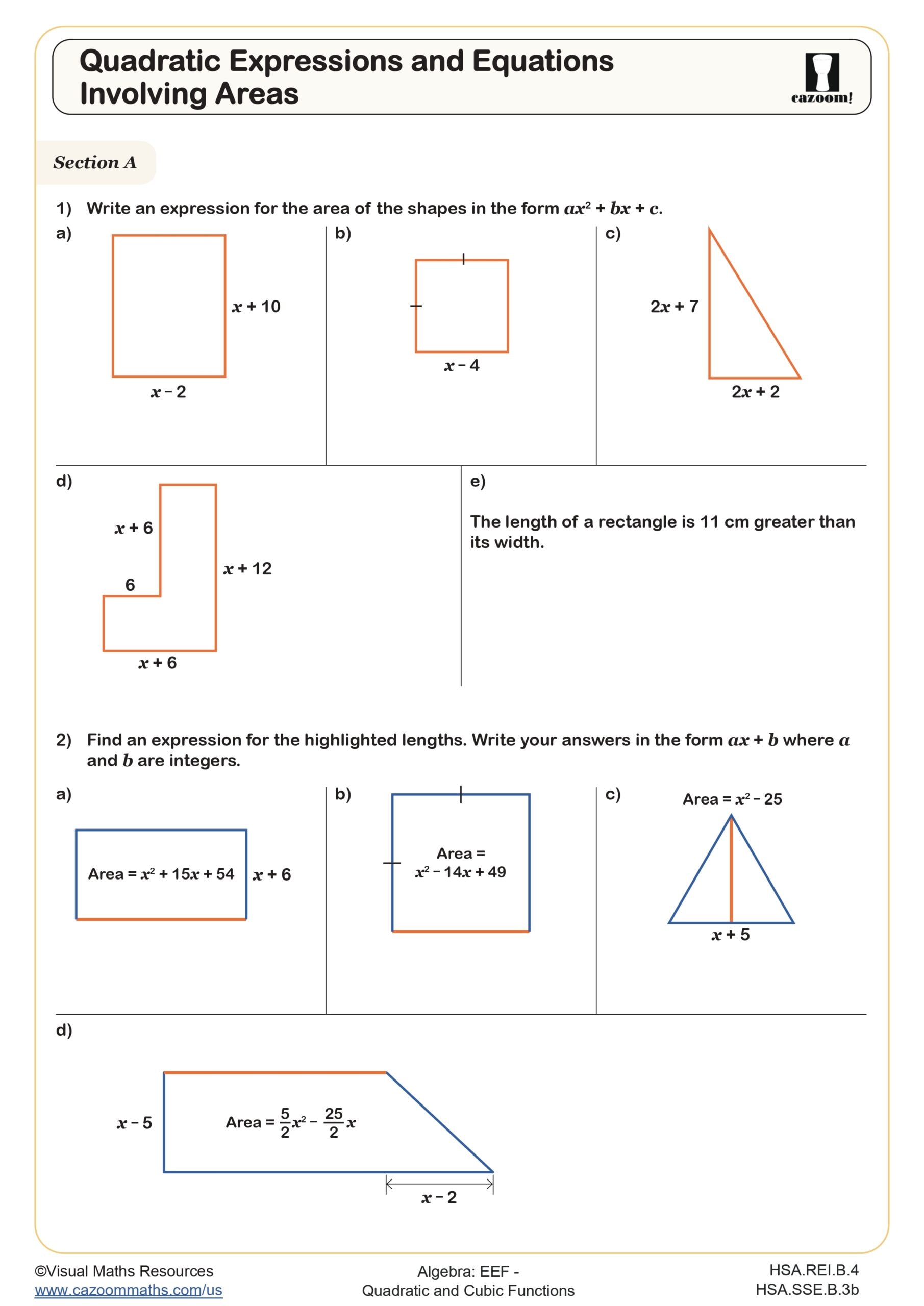
Students often lose points on assessments when they correctly factor a quadratic expression but forget to set each factor equal to zero to find solutions. Teachers frequently see this disconnect between algebraic manipulation and equation solving, particularly when quadratics appear in word problems about area or projectile motion. The worksheets emphasize this critical step through problems that require students to interpret solutions in context, such as finding dimensions of rectangles given area constraints.
How Do Quadratic and Cubic Functions Appear on the SAT and ACT?
Standardized tests like the SAT and ACT regularly assess quadratic functions through multiple formats: solving equations, interpreting graphs, and applying quadratics to real-world scenarios. Students need to recognize which form of a quadratic reveals specific information most efficiently (factored form for zeros, vertex form for maximum/minimum values). The SAT calculator section often includes questions about projectile motion or area optimization that require setting up and solving quadratic equations. ACT Math questions frequently combine quadratics with coordinate geometry or require students to match equations to their graphs.
Many students struggle on test day because they memorize procedures without understanding when to apply each method. A common error involves choosing the quadratic formula for every problem, even when factoring would be faster and less prone to arithmetic mistakes. Students also lose points when they find correct x-intercepts but fail to identify which represents a maximum or minimum in context, or when they misread vertex form and confuse (x - h) with (x + h) when determining the axis of symmetry.
Why Is Understanding Vertex Form Important for Quadratic Functions?
Vertex form, written as f(x) = a(x - h)² + k, immediately reveals the parabola's vertex at point (h, k) and whether it opens upward or downward based on the sign of a. This form proves particularly valuable when students need to identify maximum or minimum values without graphing, since the vertex represents these extreme points. Teachers notice that students who master vertex form can quickly analyze transformations of the parent function y = x², recognizing how h shifts the parabola horizontally and k shifts it vertically.
This skill connects directly to physics and engineering applications where optimizing outcomes matters. For example, businesses use quadratic functions in vertex form to determine maximum profit by analyzing how revenue changes with price adjustments, where the vertex indicates the optimal price point. Architecture and design fields apply these concepts when calculating the maximum height of arched structures or determining the trajectory of water fountains. College-bound students encounter vertex form again in calculus when finding critical points and analyzing function behavior, making this foundational understanding crucial for STEM pathways.
How Can Teachers Use These Quadratic and Cubic Function Worksheets in Integrated Math 2?
The worksheets provide structured practice that builds from basic quadratic expressions through more complex applications involving both quadratic and cubic functions. Problems progress systematically, allowing students to develop confidence with factoring techniques before applying them to solve equations, then connecting algebraic solutions to graphical representations. The answer keys enable students to check their work independently during practice sessions, helping them identify whether errors stem from arithmetic mistakes or conceptual misunderstandings about how different forms of quadratics relate.
Many teachers use these resources for differentiated instruction, assigning specific problem sets based on individual student needs identified through formative assessment. The worksheets work effectively for test preparation since they mirror the types of multi-step problems students encounter on state assessments and standardized tests. Some teachers find them valuable for warm-up activities that review previously taught concepts, while others incorporate them into stations or paired work where students explain their solution strategies to each other, reinforcing understanding through peer discussion.