Integrated Math 2 Similarity and Congruence Worksheets
All worksheets are created by the team of experienced teachers at Cazoom Math.
What concepts do similarity and congruence worksheets cover in Integrated Math 2?
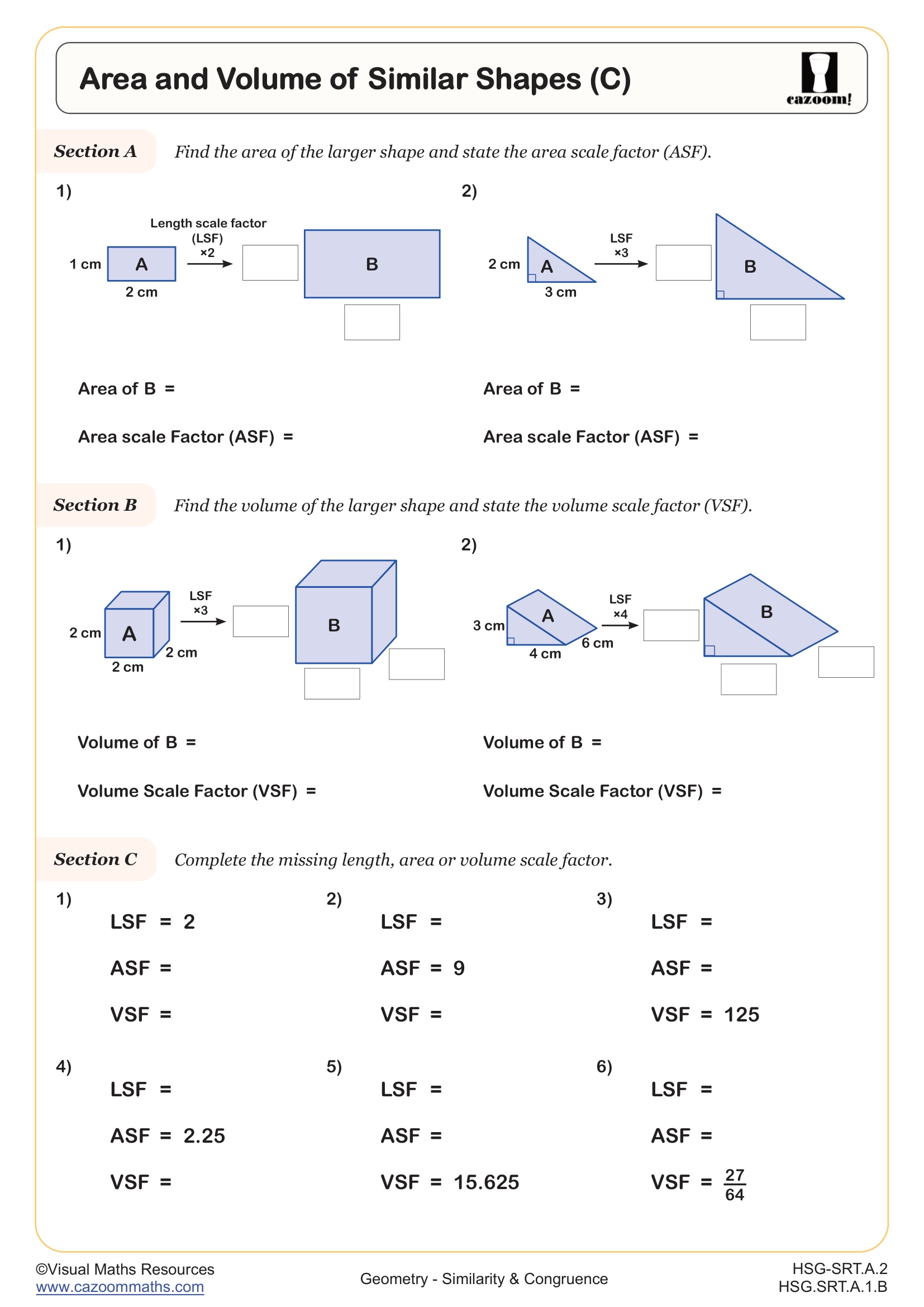
These worksheets address Common Core standards for geometric transformations, including rigid motions that produce congruent figures and dilations that create similar figures. Students work with corresponding angles and sides, scale factors, similarity ratios, and the relationship between linear dimensions and area or volume in similar shapes. The materials integrate proof writing, requiring students to justify why figures are similar or congruent using transformation language rather than memorizing postulate acronyms.
Teachers frequently notice that students lose points when they correctly identify similar figures but incorrectly apply the scale factor to area or volume problems. A common error appears when students use a scale factor of 2 and expect the area to also double, rather than quadruple. Worksheets that explicitly connect linear scale factors to squared and cubed relationships in area and volume help students avoid this persistent misconception on assessments.
How do similarity and congruence appear on the SAT and state assessments?
Standardized tests like the SAT expect students to apply similarity and congruence in multi-step problems involving coordinate geometry, algebraic reasoning, and measurement. Questions often present similar triangles embedded within diagrams where students must identify the relationship, set up proportions, and solve for unknown lengths. The ACT frequently tests volume relationships in similar three-dimensional figures, requiring students to recognize that a scale factor of k produces a volume ratio of k³.
Students lose significant points when they fail to identify which parts of complex figures correspond or when they set up proportions incorrectly by matching non-corresponding sides. Another testing challenge occurs when problems require students to prove triangles are similar using AA, SAS, or SSS similarity criteria before calculating missing measurements. Practice with proof-based justification before computation builds the reasoning skills assessments demand.
How do scale factors affect area and volume in similar figures?
When two figures are similar with a linear scale factor of k, their corresponding lengths maintain a ratio of k:1, but their areas relate by k²:1 and their volumes by k³:1. Students must recognize that scaling affects different dimensions differently. For example, if a sculpture is enlarged with a scale factor of 3, its surface area increases ninefold and its volume increases twenty-seven-fold. This relationship explains why worksheets often pair linear dimension problems with area and volume calculations to reinforce the exponential nature of scaling.
This concept connects directly to architecture, engineering, and biology. Structural engineers use similarity principles when creating scale models, knowing that doubling all dimensions produces a structure eight times heavier but only four times stronger in cross-sectional area. Students preparing for STEM fields benefit from understanding why large animals require proportionally thicker bones than small animals, a direct application of how volume scales faster than surface area in similar forms.
How can teachers use these similarity and congruence worksheets effectively in Integrated Math 2?
The worksheets provide graduated practice that moves from identifying similar and congruent figures to applying scale factors and writing transformation-based proofs. Answer keys allow students to check their reasoning immediately, which proves particularly valuable when they're determining whether triangles are similar using angle-angle relationships or side-side-side ratios. Teachers find that having worked solutions helps students self-diagnose errors in proportion setup, a skill that transfers to trigonometry and coordinate geometry later in the course.
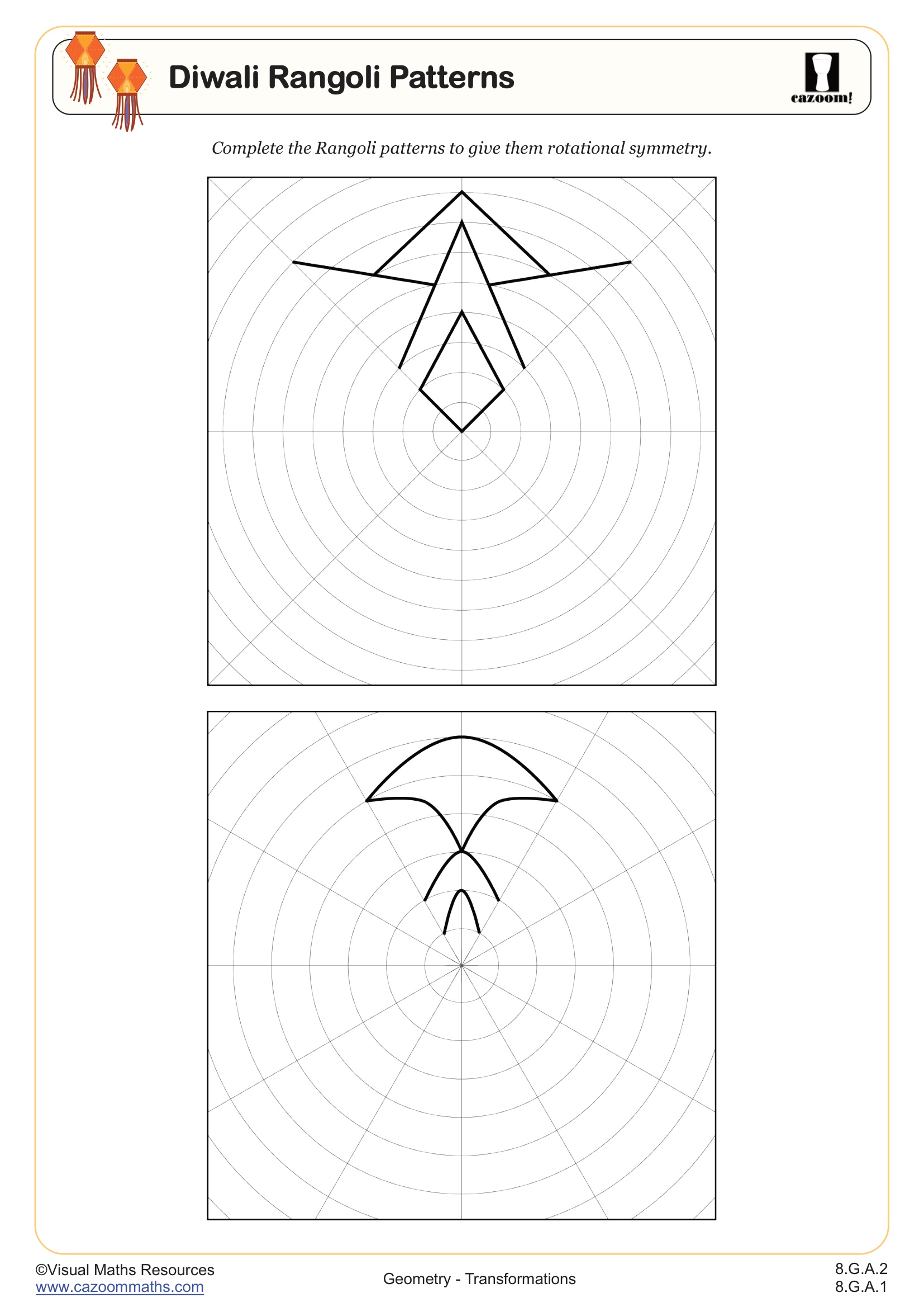
Many teachers use these materials during geometry review units before state assessments, as mixed practice stations during test preparation weeks, or as intervention resources for students who struggled with transformations earlier in the year. The cultural connection in the Diwali Rangoli Patterns worksheet engages students while reinforcing symmetry and congruence concepts. Paired work allows students to justify their congruence arguments to each other, building the communication skills college mathematics courses require.