Integrated Math 2 Simplification Worksheets
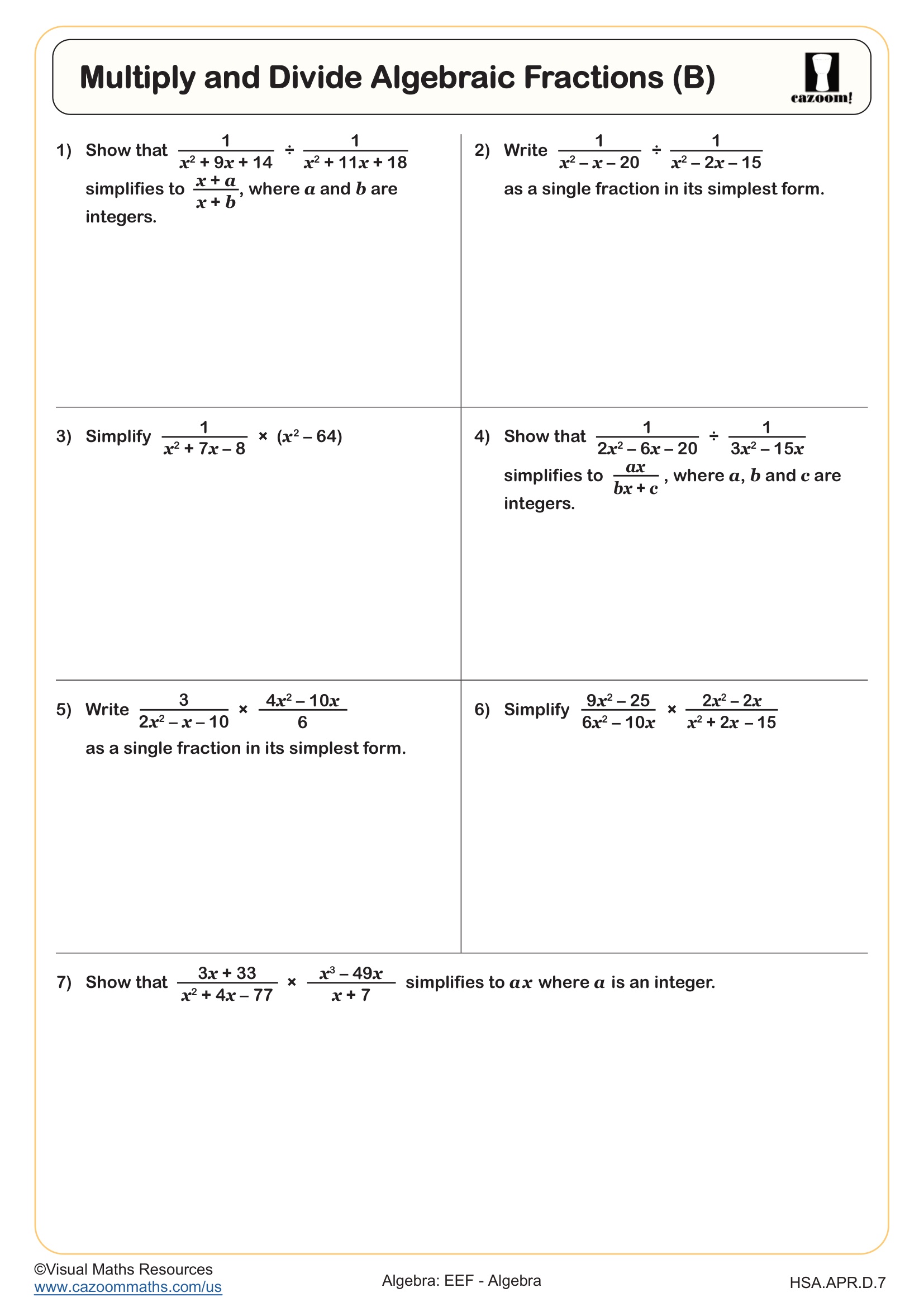
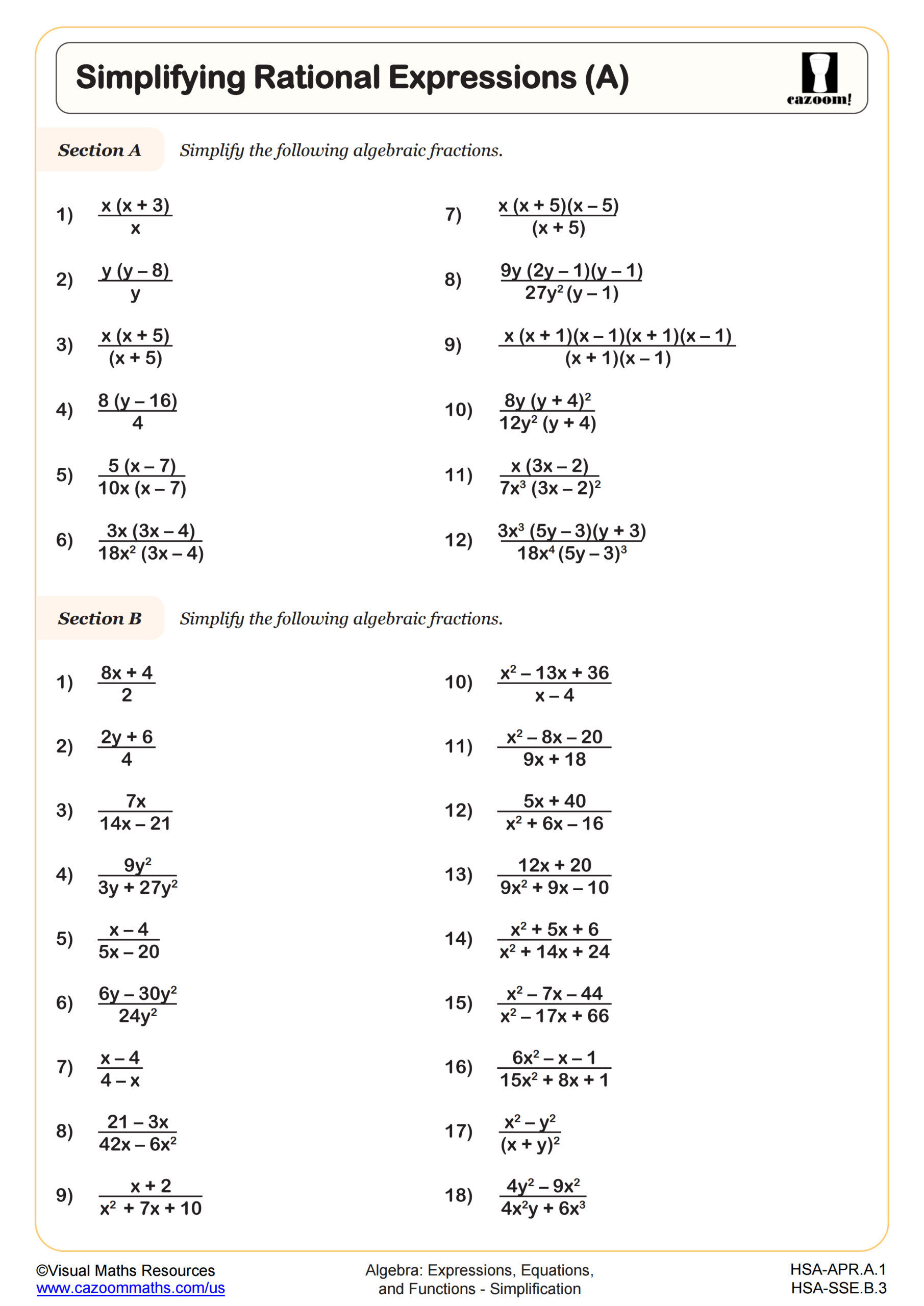
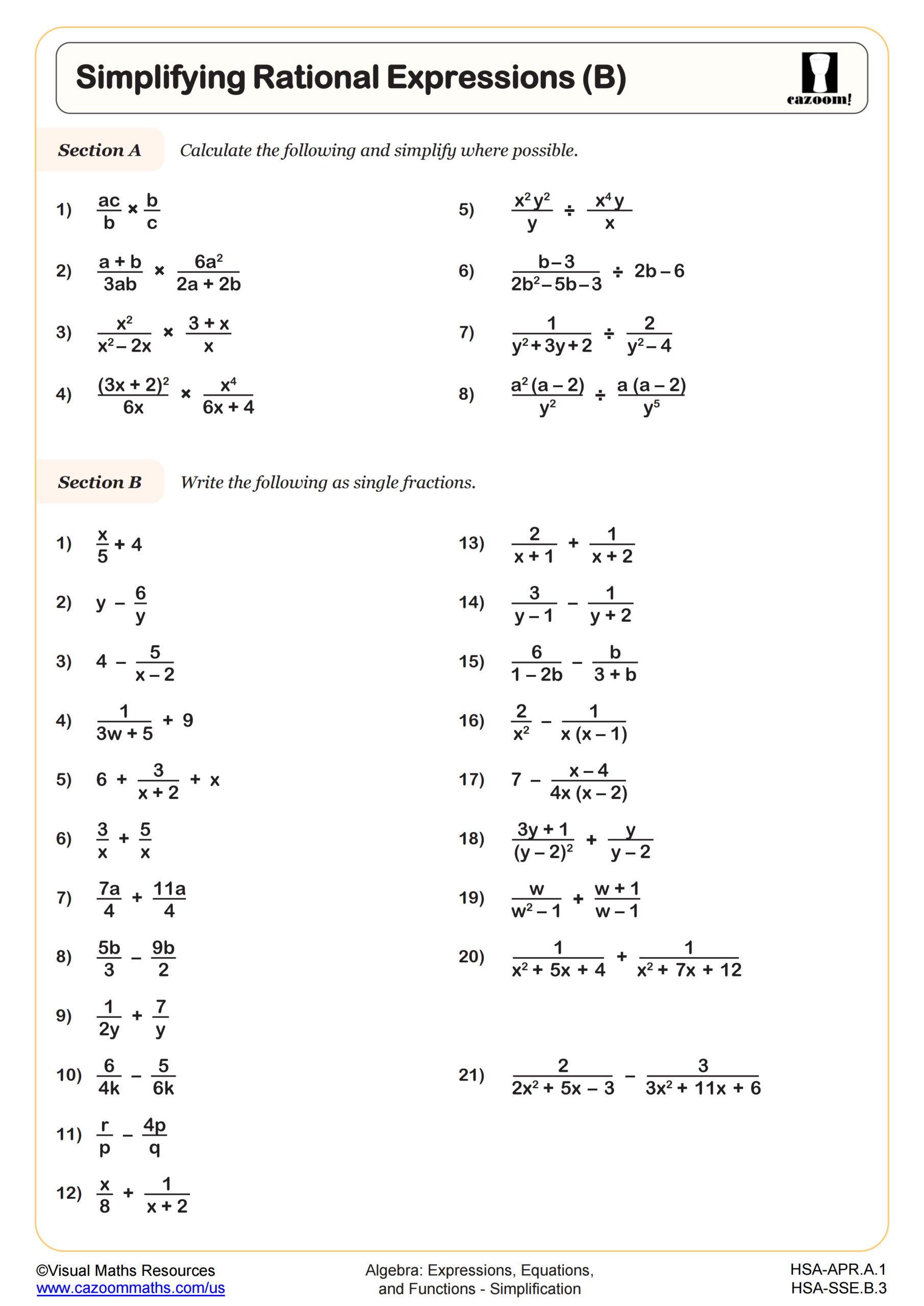
All worksheets are created by the team of experienced teachers at Cazoom Math.
What Simplification Skills Do Students Practice in Integrated Math 2?
In Integrated Math 2, simplification focuses on rational expressions, which are fractions containing polynomials in the numerator, denominator, or both. Students factor quadratic and higher-degree polynomials, identify common factors across numerators and denominators, and reduce expressions to simplest form. They also multiply and divide algebraic fractions by factoring first, then canceling common factors before performing the operation. This work directly extends fraction arithmetic from earlier grades while preparing students for rational equations and complex fractions in future courses.
A common error occurs when students attempt to cancel terms rather than factors. For example, in (x + 3)/(x + 5), students incorrectly cancel the x values, not recognizing that only common factors in a product can be eliminated. Teachers consistently see this mistake decrease when students practice identifying what constitutes a factor versus a term through repeated exposure to properly structured problems.
How Does Simplification Appear on the SAT and State Assessments?
Standardized tests like the SAT and ACT include simplification within algebra questions that require students to manipulate rational expressions before solving equations or comparing expressions. Students might need to simplify a rational expression to match an answer choice, determine equivalent forms, or reduce a complex algebraic fraction as part of a multi-step problem. State assessments aligned with Common Core expect students to rewrite rational expressions in different forms and recognize when expressions are equivalent through simplification.
Students lose points when they forget to state domain restrictions after simplification. If (x² - 4)/(x - 2) simplifies to (x + 2), the original expression is undefined at x = 2, but the simplified form is not. Test questions sometimes specifically ask about values that must be excluded from the domain, catching students who simplify without considering where the original expression was undefined.
Why Is Factoring the Critical First Step in Simplifying Rational Expressions?
Factoring transforms rational expressions into products, revealing common factors that can be canceled between numerators and denominators. Students must recognize patterns like difference of squares, perfect square trinomials, and quadratic expressions that factor into binomials. Once factored, rational expressions like (x² - 9)/(x² + 6x + 9) become ((x + 3)(x - 3))/((x + 3)(x + 3)), making the common factor (x + 3) visible for cancellation. Without this factoring step, students cannot simplify rational expressions beyond basic monomial cases.
This skill connects directly to engineering and physics applications where formulas contain rational expressions. In electrical engineering, combining resistances in parallel circuits requires adding reciprocals and simplifying complex fractions. Students who can factor and simplify efficiently solve these applied problems faster and with fewer algebraic errors, making this a practical STEM skill beyond pure mathematics coursework.
How Can Teachers Use These Simplification Worksheets in Integrated Math 2 Classrooms?
These worksheets provide scaffolded practice that progresses from basic rational expression simplification to more complex operations involving multiplication and division of algebraic fractions. The varied problem sets allow teachers to differentiate instruction, assigning foundational worksheets to students who need additional factoring review while moving confident students to multi-step problems involving operations. Answer keys support independent practice and enable students to check their work immediately, identifying exactly where errors occur in their factoring or cancellation process.
Many teachers use these resources for test preparation review sessions, assigning specific worksheets that target skills appearing frequently on upcoming assessments. The worksheets also work well for intervention with students who performed poorly on initial assessments, providing additional repetitions with immediate feedback. Paired practice sessions allow stronger students to explain their factoring strategies to peers, reinforcing their own understanding while supporting classmates who need extra help recognizing factorable patterns.