Integrated Math 2 Space Worksheets
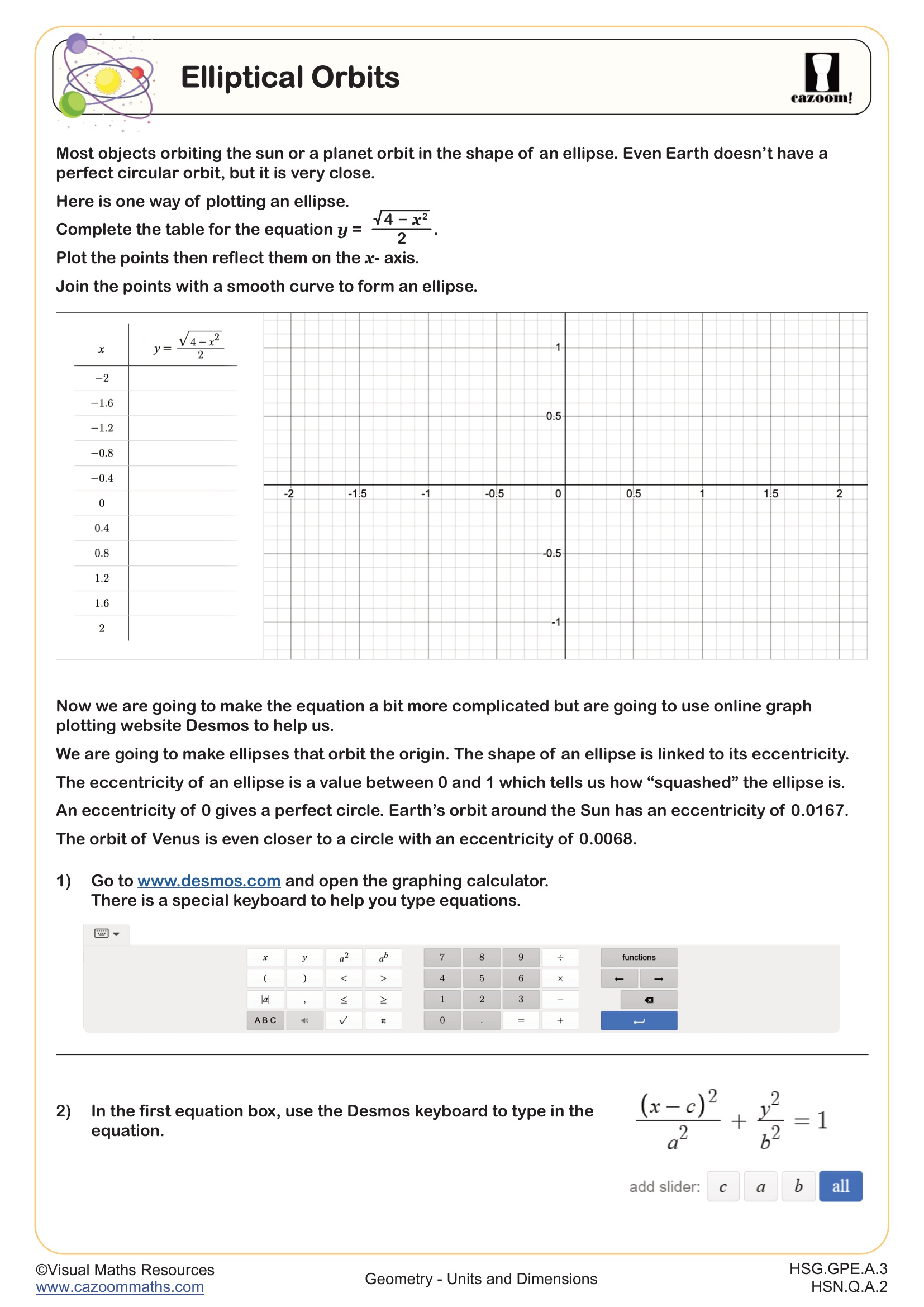
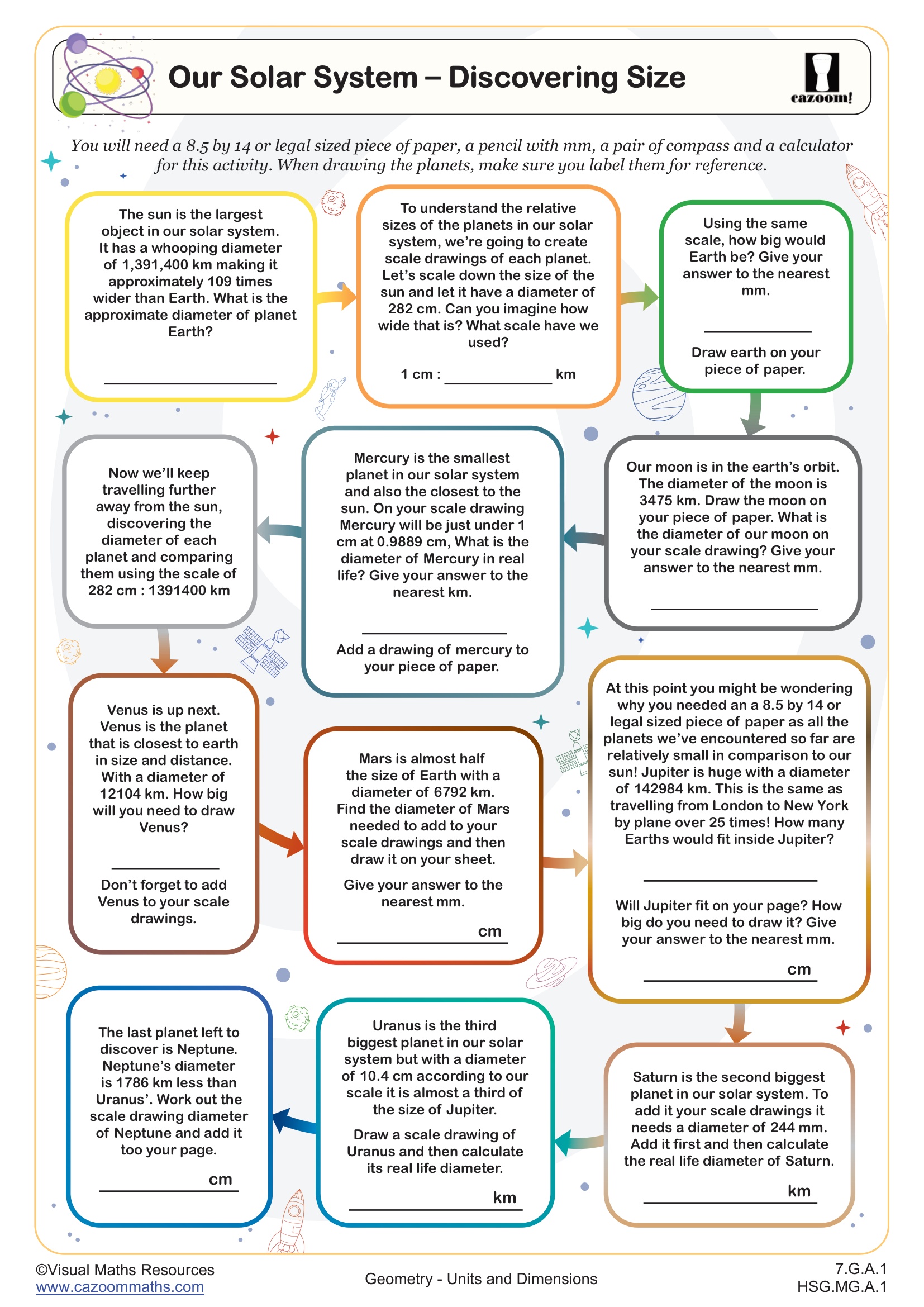
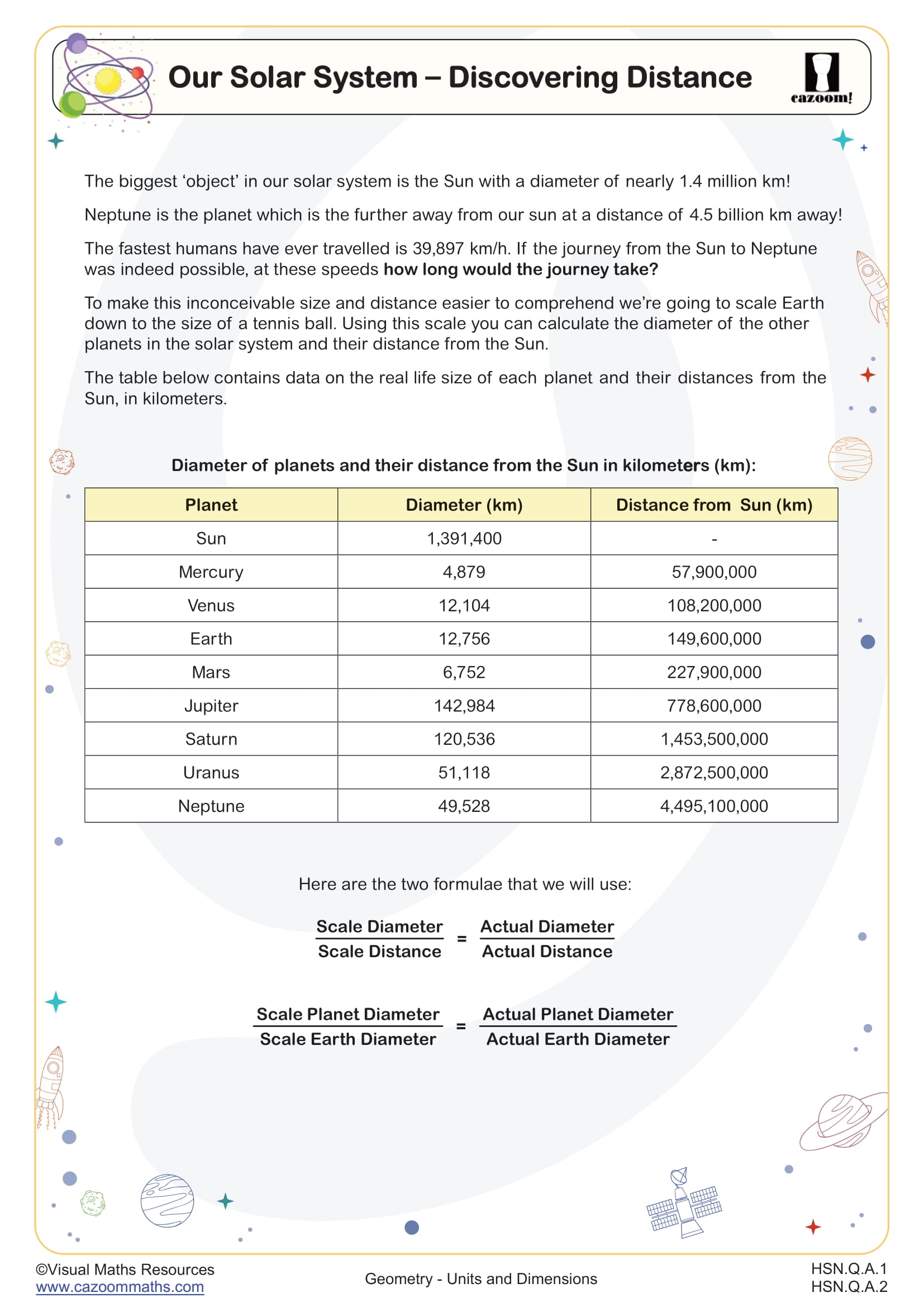
All worksheets are created by the team of experienced teachers at Cazoom Math.
How does space connect to Integrated Math 2 curriculum?
Space-themed problems in Integrated Math 2 provide authentic contexts for applying geometric transformations, coordinate systems, conic sections (particularly ellipses), scale factors, and proportional reasoning. Students work with Kepler's laws of planetary motion, which introduce elliptical orbits as applications of conic sections, and use coordinate geometry to plot and transform spacecraft models. These applications align with Common Core standards for modeling with mathematics and applying geometric concepts to solve real-world problems.
Teachers find that students lose points on assessments when they correctly perform calculations but fail to interpret results in context—for example, calculating a scale factor without recognizing whether their answer makes sense for representing Earth's size compared to Jupiter's. Space problems require students to think critically about reasonableness of answers, strengthening their mathematical reasoning skills beyond procedural fluency.
What grade level are these space math worksheets for?
These worksheets target Integrated Math 2 students in high school, typically 10th graders in school districts that follow the integrated math pathway rather than the traditional Algebra 1, Geometry, Algebra 2 sequence. The integrated approach combines algebraic, geometric, and statistical concepts within each course level, and these space applications reflect that multidisciplinary approach by requiring students to draw on multiple mathematical domains simultaneously.
The complexity increases as students progress through the worksheet collection, starting with fundamental concepts like scale and proportion in solar system sizing, advancing to constructing technical drawings of the International Space Station using rectangles and coordinate systems, and culminating in analyzing elliptical orbits that require understanding of conic sections and their equations. This progression mirrors how Integrated Math 2 builds sophistication in mathematical modeling throughout the school year.
What mathematical concepts are involved in elliptical orbits?
Elliptical orbit problems introduce students to ellipses as conic sections, requiring understanding of foci, major and minor axes, eccentricity, and the relationship between these elements. Students work with the equation of an ellipse in standard form and apply coordinate geometry to determine orbital characteristics. Many students make the connection between abstract ellipse equations they've graphed and the actual paths planets follow, which deepens their understanding of why mathematicians developed these equations centuries ago.
Space agencies like NASA use elliptical orbit calculations daily when planning satellite launches, determining optimal transfer orbits between Earth and Mars, and predicting where spacecraft will be at specific times. Engineers apply these same mathematical principles when calculating fuel requirements for orbital maneuvers—a spacecraft moving from a circular orbit to an elliptical one requires precise calculations of velocity changes at specific points, all derived from the geometric properties students study in these worksheets. This STEM connection shows students that Integrated Math 2 content directly supports careers in aerospace engineering and astrophysics.
How can teachers use these space worksheets effectively?
The worksheets scaffold learning by starting with concrete measurements and visual representations before advancing to abstract calculations and transformations. Students benefit from working through solar system sizing problems that build intuition about astronomical scales before tackling the mathematical precision required for space station construction drawings or transformation activities. The answer keys allow students to self-check their work and identify where their reasoning diverged from correct approaches, making these worksheets valuable for building mathematical independence.
Teachers use these worksheets flexibly across different classroom structures: as anchor activities for students who finish classwork early, as collaborative group projects where students divide tasks like researching actual planetary data or verifying scale calculations, or as homework that connects classroom learning to current space exploration news. The interdisciplinary nature makes these worksheets particularly effective during project-based learning units or when coordinating with science teachers studying astronomy, creating opportunities for students to see mathematics as a tool scientists actually use rather than an isolated subject.