Integrated Math 2 Volume and Surface Area Worksheets
All worksheets are created by the team of experienced teachers at Cazoom Math.
What volume and surface area concepts do Integrated Math 2 students learn?
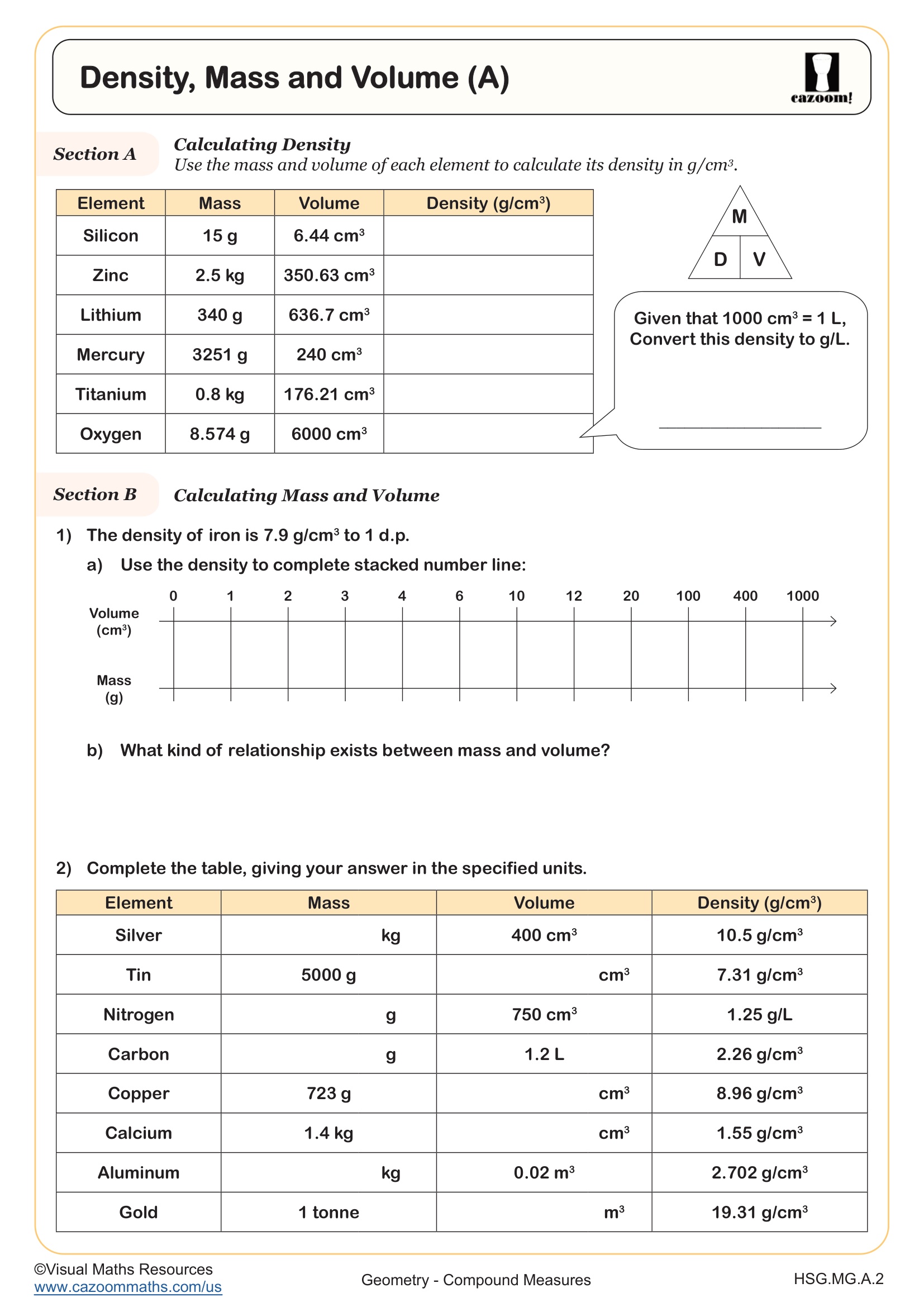
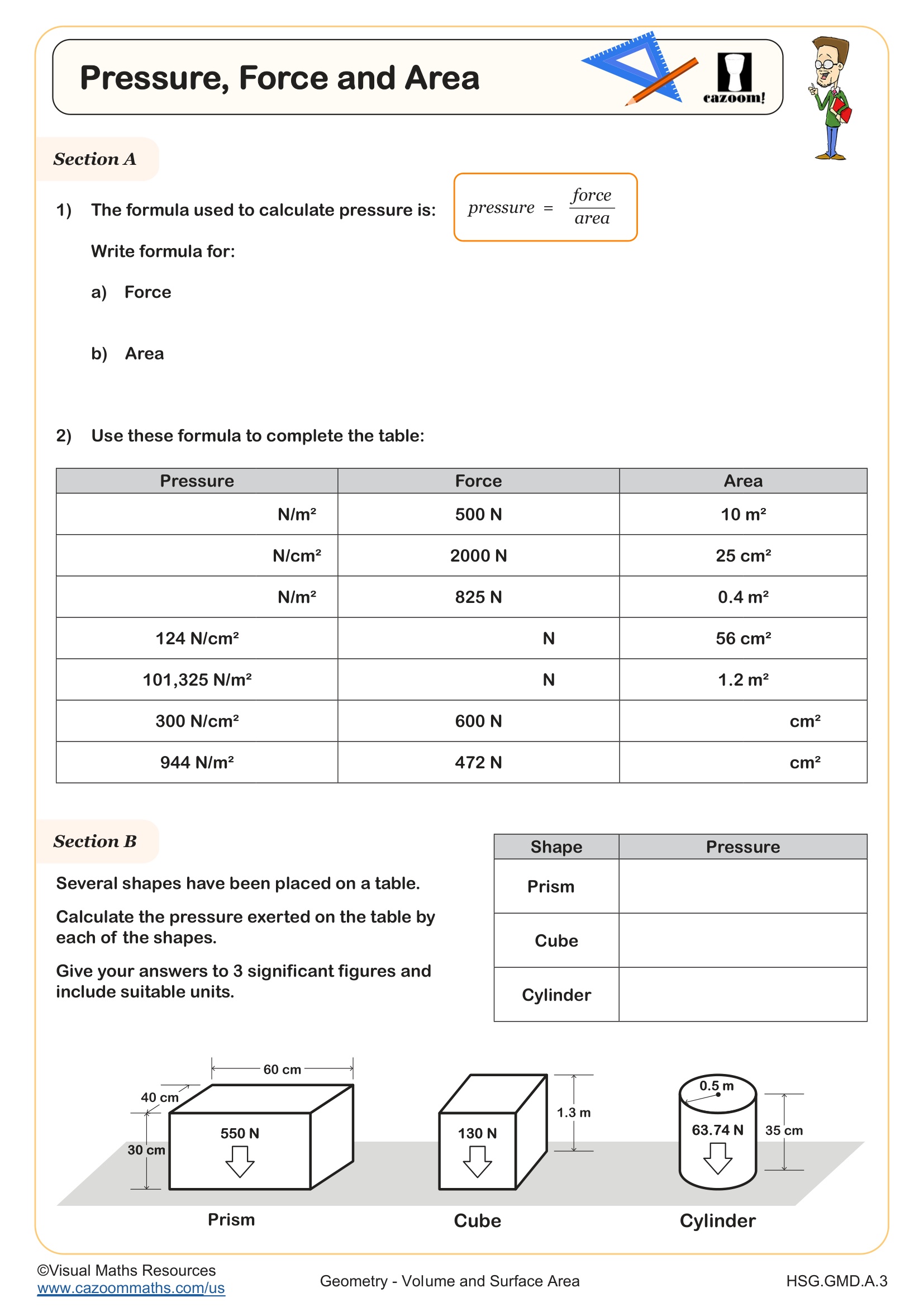
Integrated Math 2 students extend their understanding of three-dimensional geometry by working with triangular prisms, frustums (truncated pyramids or cones), and composite shapes. They apply formulas for surface area and volume while solving problems that require multi-step reasoning, such as calculating the density of materials when given mass and volume. The curriculum connects algebraic manipulation with geometric visualization, requiring students to substitute values accurately and simplify expressions.
A common error occurs when students calculate surface area for triangular prisms but forget to include both triangular bases in their total, counting only the three rectangular faces. Students also lose points on state assessments when they confuse the variables in density problems, solving for mass when the question asks for volume. Matching formulas to their corresponding three-dimensional shapes helps students recognize the structural differences between prisms, pyramids, cylinders, and cones before attempting calculations.
Which grade levels use these volume and surface area worksheets?
These worksheets specifically target Integrated Math 2, which high school students typically take in either ninth or tenth grade, depending on their mathematics pathway. Integrated Math 2 follows the Common Core State Standards' integrated approach, weaving together geometry, algebra, and statistics rather than teaching them as separate year-long courses. This differs from the traditional sequence where students take Geometry as a standalone course.
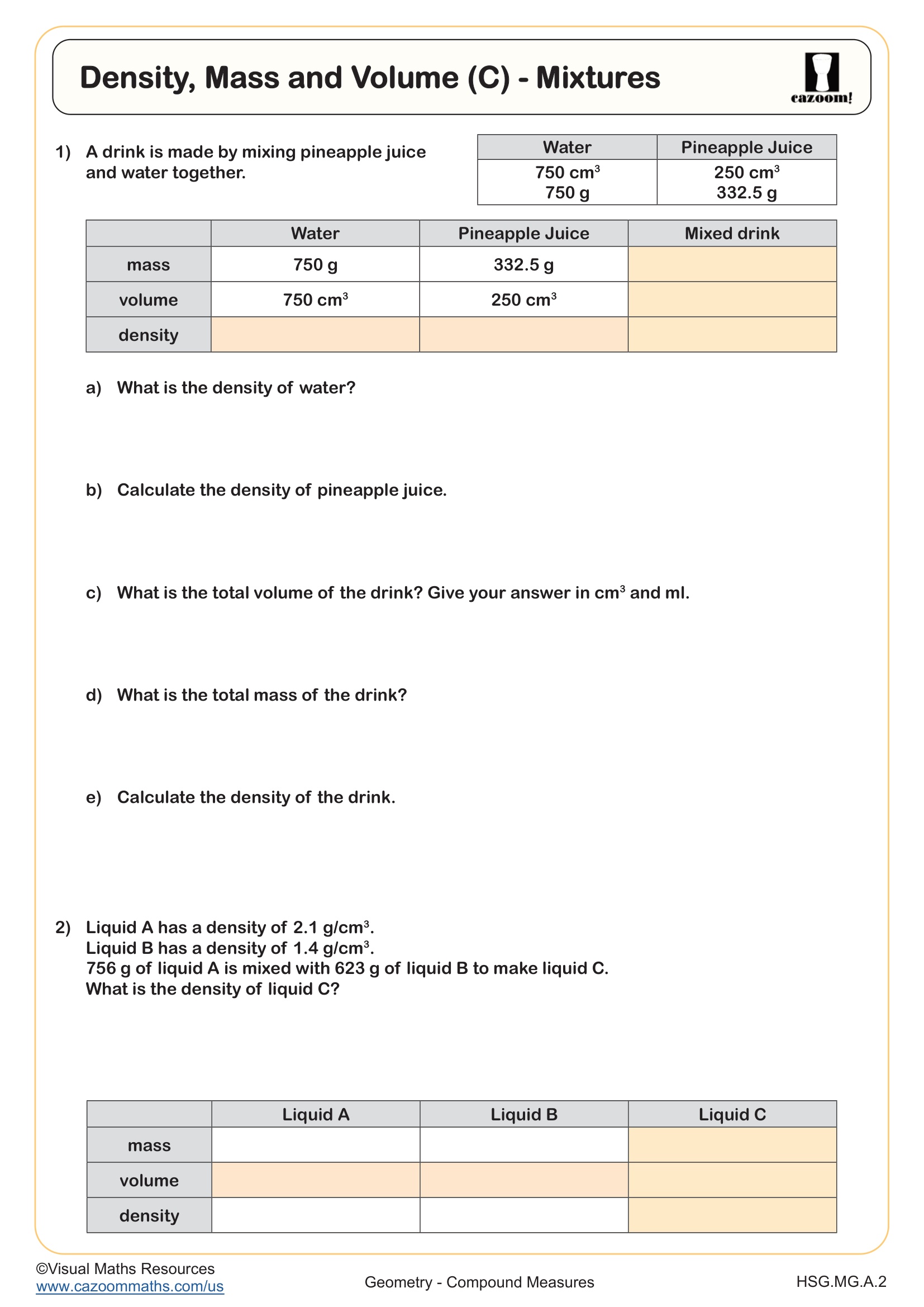
The progression within Integrated Math 2 builds from calculating surface area and volume for familiar shapes like rectangular and triangular prisms toward more complex forms like frustums. Students then apply these calculations in context problems involving density, mass, and volume, including mixture problems where materials with different densities combine. This scaffolded approach prepares students for the spatial reasoning required in Integrated Math 3 and eventually calculus, where they'll work with solids of revolution.
How do students calculate the volume and surface area of a frustum?
A frustum forms when a pyramid or cone is sliced parallel to its base, removing the top portion and creating two parallel bases of different sizes. Students calculate frustum volume using the formula V = (h/3)(B₁ + B₂ + √(B₁B₂)), where h represents the height between bases and B₁ and B₂ represent the areas of the two bases. Surface area requires calculating the lateral area of the slanted faces plus both base areas, which demands careful attention to whether the frustum derives from a pyramid or cone.
Frustums appear throughout engineering and architecture, particularly in structural supports and decorative elements. Civil engineers use frustum calculations when designing bridge pier foundations that widen at the base for stability. Students also encounter frustums when analyzing the capacity of industrial hoppers, grain silos, and water tanks that taper for efficient material flow. Manufacturing processes frequently create frustum-shaped components, making these calculations relevant for students considering STEM careers in mechanical engineering or industrial design.
How do these worksheets help students master volume and surface area?
The worksheets progress from direct calculation problems to multi-step applications, allowing students to build confidence before tackling complex scenarios. Problems that ask students to match three-dimensional shapes with their corresponding formulas strengthen conceptual understanding before numerical practice begins. The density, mass, and volume problems require students to rearrange the density formula (D = M/V) algebraically, reinforcing the connection between geometric measurement and algebraic manipulation that defines Integrated Math 2.
Teachers use these worksheets for differentiated instruction, assigning simpler prism calculations to students needing review while challenging advanced learners with frustum problems and mixture calculations. The answer keys allow students to work independently during math centers or homework, identifying where calculation errors occur without waiting for teacher feedback. Many teachers assign one worksheet for guided practice, then use a similar one for formative assessment the next day, tracking which students need additional support before unit tests.