Integrated Math 3 Sequences Worksheets
All worksheets are created by the team of experienced teachers at Cazoom Math.
What Do Students Learn About Sequences in Integrated Math 3?
Integrated Math 3 sequences instruction focuses on both arithmetic and geometric sequences, emphasizing the distinction between recursive formulas (which define each term based on the previous term) and explicit formulas (which calculate any term directly from its position). Students analyze patterns, determine whether sequences are arithmetic or geometric, write formulas in both forms, and solve for unknown terms or position numbers. This work connects to function concepts since sequences are discrete functions where the domain consists of positive integers.
Teachers often observe that students initially try to apply arithmetic sequence methods to geometric problems and vice versa. A breakthrough typically happens when students create a decision tree: if terms have a constant difference, it's arithmetic; if they have a constant ratio, it's geometric. This systematic approach reduces errors when students encounter mixed problem sets or need to classify sequences before writing formulas.
How Are Sequences Tested on the SAT and State Assessments?
Standardized tests like the SAT and ACT include sequences in both calculator and no-calculator sections, often embedding them within word problems or function contexts. Students must recognize sequence patterns from tables or verbal descriptions, determine the appropriate formula type, and calculate specific terms or sums. Test questions frequently combine sequences with other topics like systems of equations or exponential functions, requiring students to demonstrate conceptual understanding rather than just procedural fluency.
Students lose points when they misidentify the first term's position (some sequences start at n=0, others at n=1) or when they confuse the formula variables. Another common assessment error occurs when students correctly identify a geometric sequence but forget to apply the exponent in the explicit formula, writing a₁·r·n instead of a₁·r^(n-1). Timed practice with mixed sequence types helps students develop the quick classification skills that standardized tests demand.
What Are Explicit Formulas and Why Do They Matter?
Explicit formulas allow students to calculate any term in a sequence directly without finding all previous terms first. For arithmetic sequences, the explicit formula is aₙ = a₁ + (n-1)d, where d represents the common difference. For geometric sequences, it's aₙ = a₁·r^(n-1), where r is the common ratio. Students who master explicit formulas can efficiently solve problems asking for the 50th term or determine which term equals a specific value—tasks that would be impractical using only recursive approaches.
Explicit formulas appear throughout STEM fields wherever patterns follow predictable growth. Financial planners use geometric sequences to model compound interest and investment growth. Engineers apply arithmetic sequences when calculating uniform acceleration or evenly spaced structural supports. Computer scientists rely on sequence formulas to analyze algorithm efficiency and predict computational costs as data sets scale. Understanding explicit formulas prepares students for these applications while building the algebraic manipulation skills needed for calculus sequences and series.
How Can Teachers Use These Sequences Worksheets in Integrated Math 3?
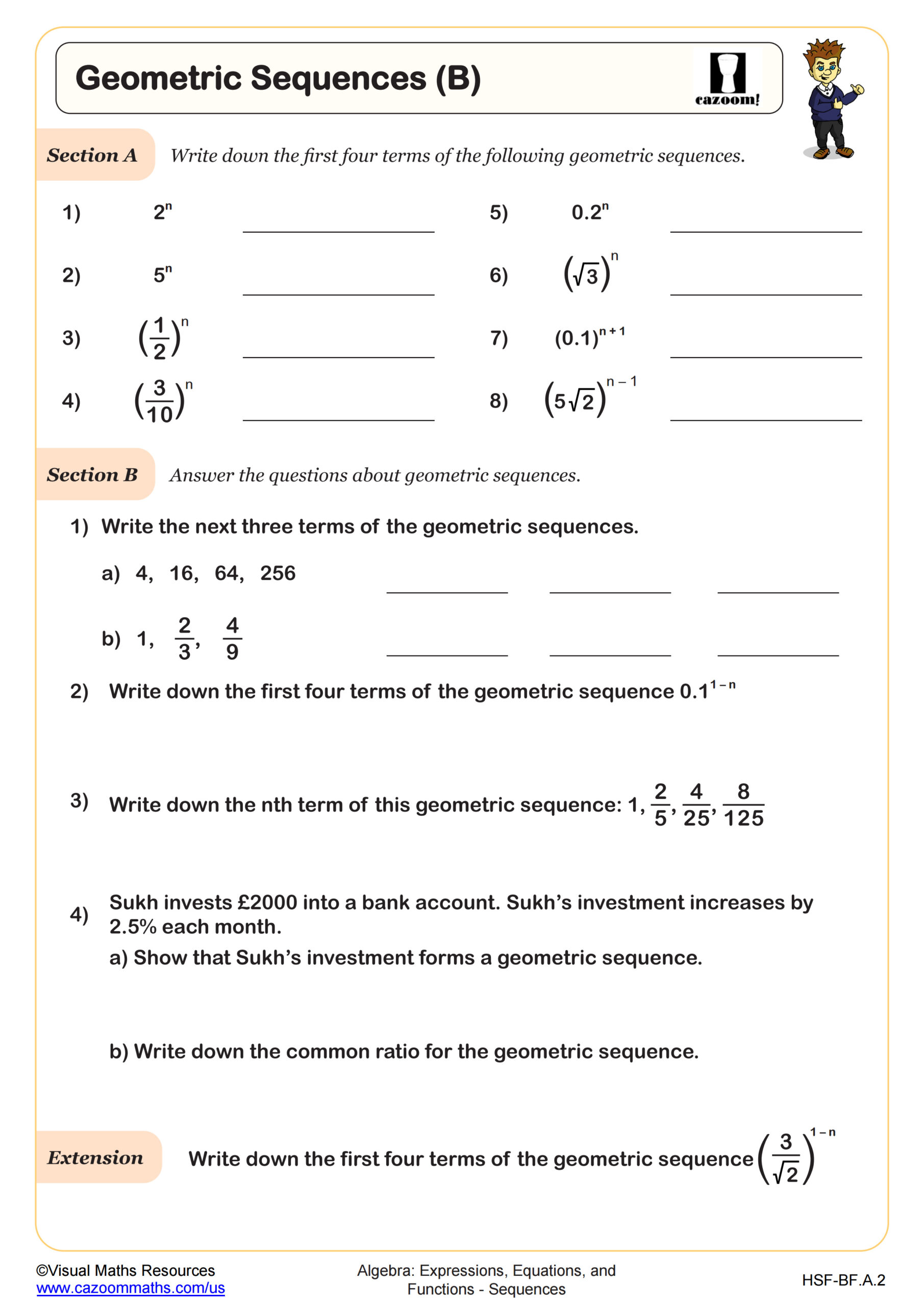
These sequences worksheets provide structured practice that helps students distinguish between arithmetic and geometric patterns while building formula-writing confidence. The problems progress from sequence identification through formula application, allowing teachers to target specific skill gaps that appear during instruction. Complete answer keys enable students to check their work independently, making these worksheets suitable for homework assignments, self-paced learning stations, or flipped classroom models where students review solutions before class discussions.
Many teachers use sequences worksheets during test preparation since this topic consistently appears on end-of-course exams and college entrance tests. The worksheets work well for differentiated instruction—students who grasp concepts quickly can work ahead while those needing additional support receive targeted practice on specific formula types. Paired work sessions where students explain their classification reasoning to partners help solidify understanding, and teachers often assign select problems as warm-up exercises to maintain skills throughout the course since sequences connect to functions, exponential growth, and series topics that appear later.