Integrated Math 3 Simplification Worksheets
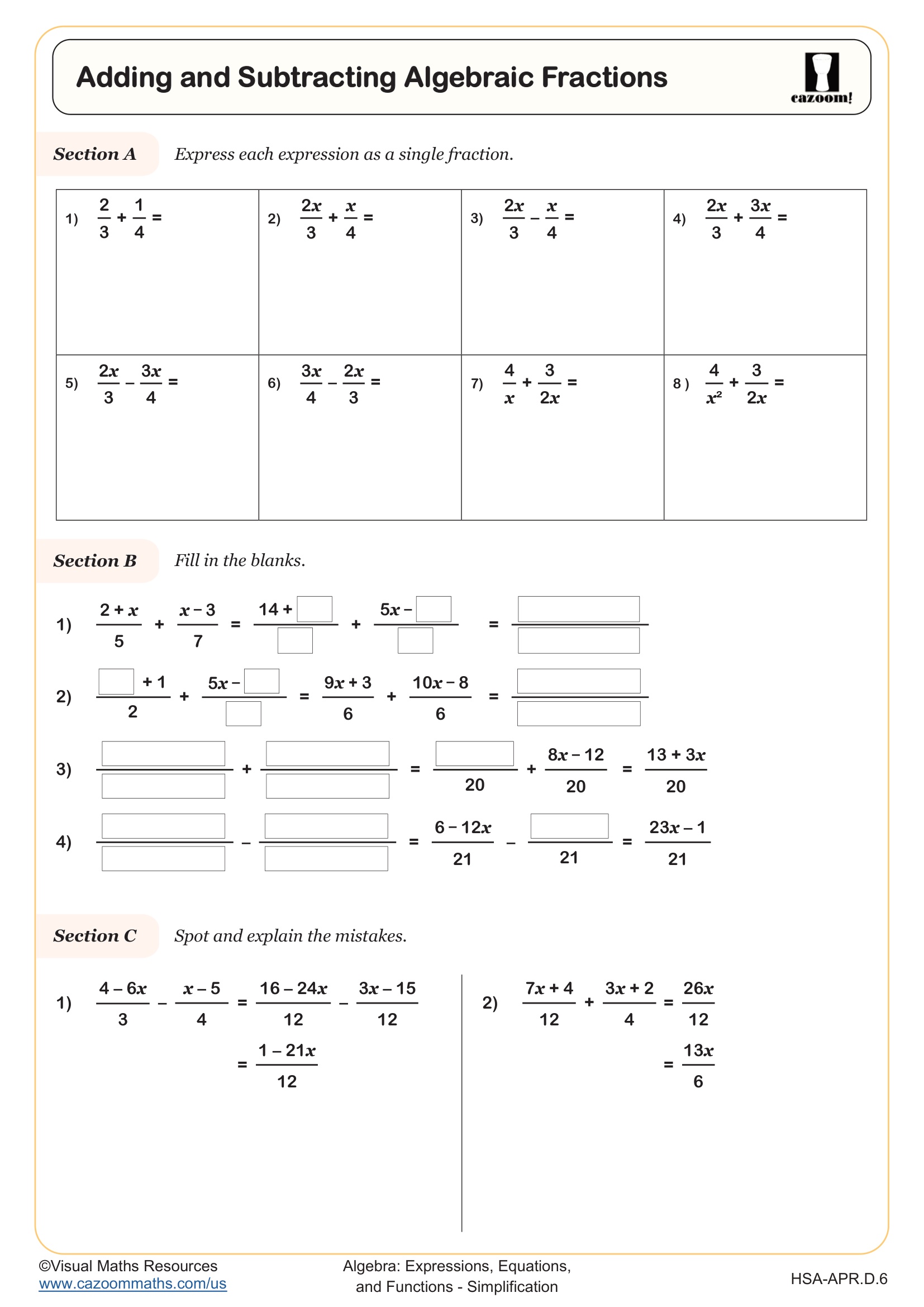
All worksheets are created by the team of experienced teachers at Cazoom Math.
What Does Simplification Cover in Integrated Math 3?
Simplification in Integrated Math 3 builds on earlier fraction operations by requiring students to add and subtract algebraic fractions with polynomial numerators and denominators. Students must find common denominators by factoring expressions, combine like terms in numerators, and simplify results by identifying and canceling common factors. This work directly connects to the study of rational functions, where simplification reveals key features like asymptotes and holes.
A common error pattern emerges when students attempt to cancel terms before establishing a common denominator, treating addition like multiplication. Teachers observe that students who systematically factor denominators first, then verify equivalent fractions before combining, achieve significantly higher accuracy rates. This methodical approach prevents the frequent mistake of canceling across addition symbols.
How Does Simplification Appear on the SAT and State Assessments?
Standardized tests embed algebraic fraction simplification within multi-step problems rather than testing it in isolation. The SAT includes these skills in questions about rational equations, where students must recognize common denominators to solve, or in problems comparing expressions where simplified forms reveal equivalence. State assessments typically require students to simplify results after performing operations, testing whether they recognize fully reduced answers among multiple choice options.
Students lose points when they stop simplifying too early, leaving factorable expressions in denominators or failing to reduce final answers. Another frequent assessment error occurs when students misapply distribution across denominators, particularly when subtracting fractions where the second numerator contains multiple terms. Test-wise students verify their simplified expressions by substituting convenient values to check equivalence with original forms.
What Makes Finding Common Denominators with Polynomials Challenging?
Finding common denominators with polynomial expressions requires students to factor completely, identify all unique factors, and construct the least common denominator using the highest power of each factor. Unlike numeric fractions where common denominators are quickly identified, polynomial denominators may factor into binomials, trinomials, or differences of squares that aren't immediately obvious. Students must recognize when denominators share common factors versus when they're relatively prime, determining whether the LCD is simply the product of both denominators or something more efficient.
This skill proves valuable in physics and engineering contexts where students combine rates, work problems, or electrical resistance calculations expressed as algebraic fractions. Circuit analysis frequently requires adding reciprocals of resistance values expressed as polynomial expressions, making simplification skills directly applicable. College-bound STEM students encounter these techniques repeatedly in calculus when working with partial fraction decomposition and rational function integration.
How Can Teachers Use These Worksheets in Integrated Math 3?
These worksheets provide targeted practice that reinforces algebraic fraction operations before students encounter rational functions and equations later in Integrated Math 3. The structured progression allows teachers to diagnose whether student struggles stem from weak factoring skills, fraction operation errors, or simplification oversights. Answer keys enable students to self-check work during independent practice, helping them identify exactly where errors occur in multi-step problems and adjust their approach accordingly.
Many teachers assign these worksheets as prerequisite review before introducing rational functions, ensuring students can manipulate algebraic fractions fluently before analyzing their graphical behavior. The problems work well for paired practice sessions where students compare solution methods and catch each other's factoring or sign errors. Teachers also use these resources for targeted intervention with students who demonstrate difficulty on rational function assessments, helping isolate whether conceptual understanding or algebraic manipulation needs attention.