Integrated Math 3 Solving Equations Worksheets
All worksheets are created by the team of experienced teachers at Cazoom Math.
What Equation-Solving Skills Do Students Practice in Integrated Math 3?
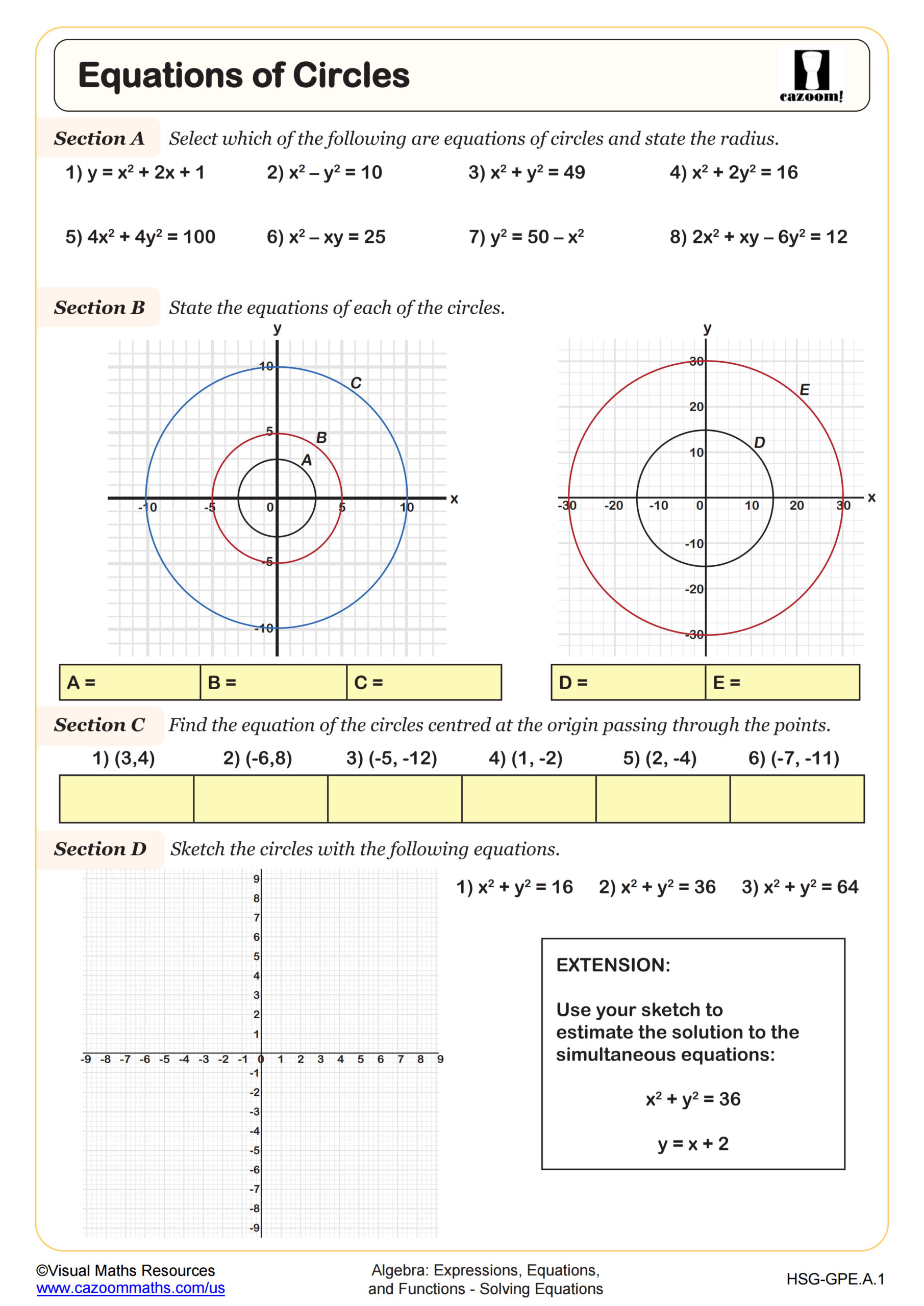
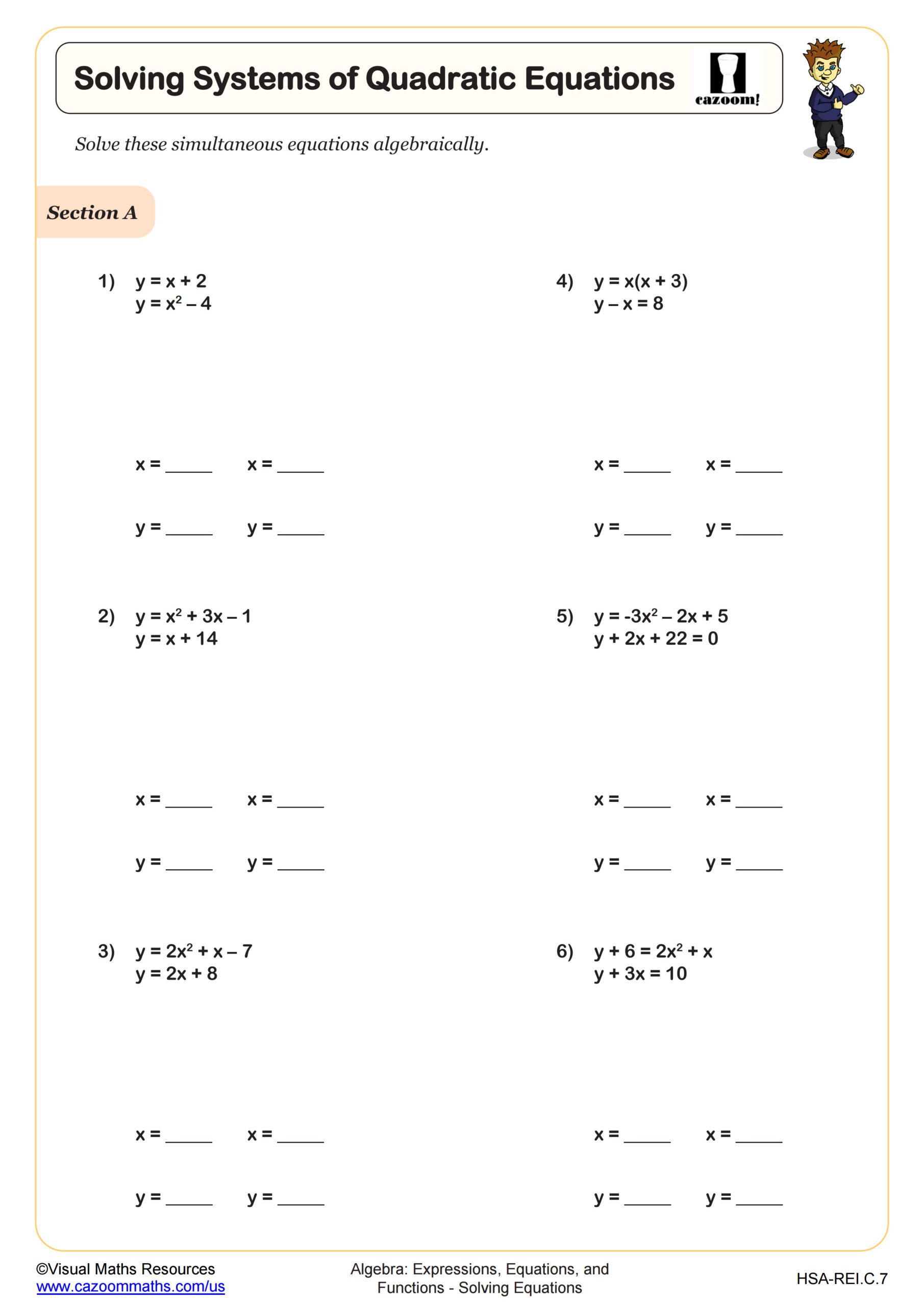
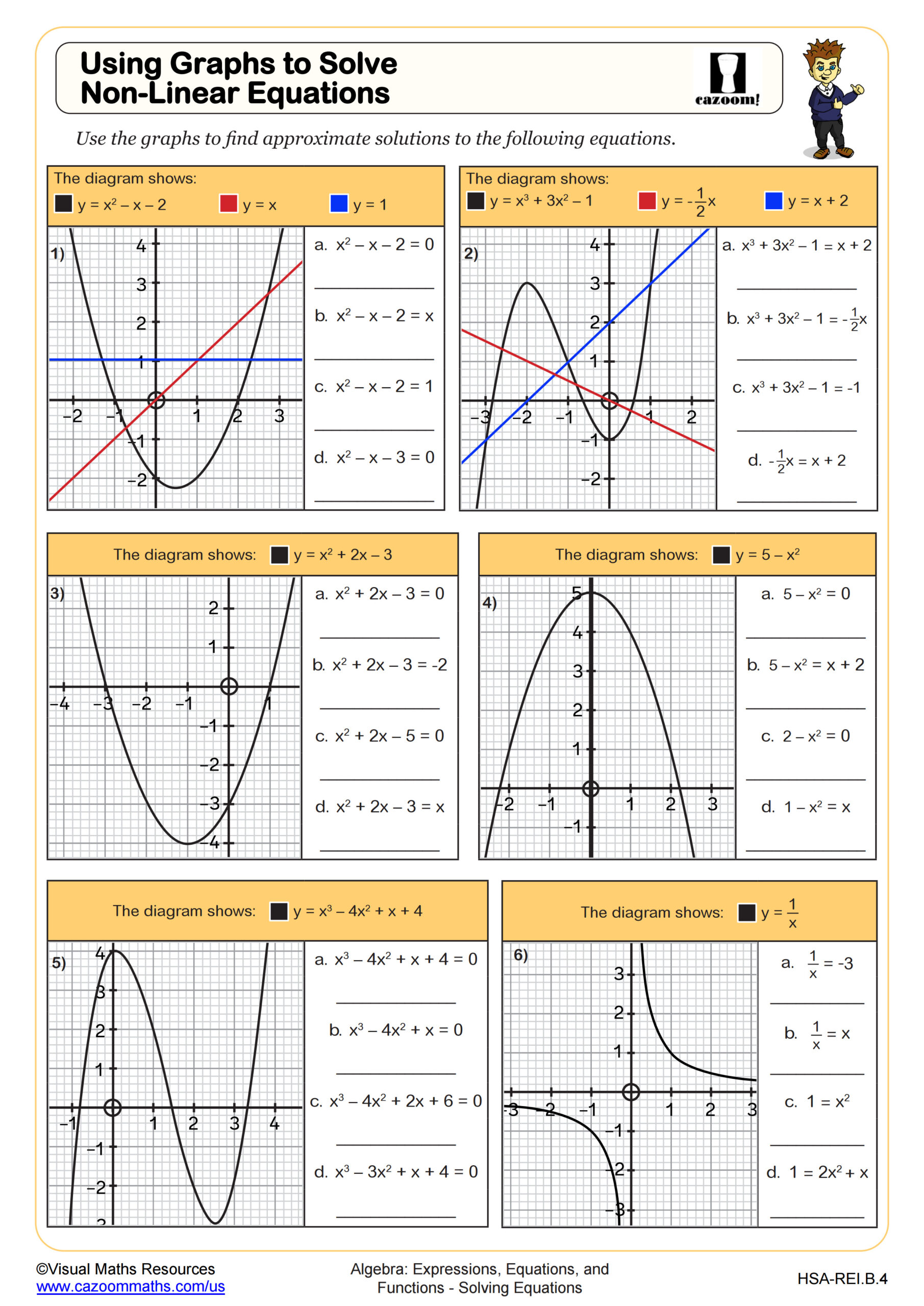
Students work with advanced equation types that integrate algebraic, geometric, and coordinate geometry concepts. This includes solving systems where at least one equation is quadratic, writing and manipulating equations of circles in standard and general form, determining equations of lines tangent to circles, and using graphical methods to solve non-linear equations. These topics align with the integrated pathway's emphasis on connecting multiple representations and deepening understanding of how algebra and geometry interact within the coordinate plane.
A common error occurs when students attempt to solve circle equations without first recognizing whether completing the square is necessary to identify the center and radius. Teachers observe that students who systematically rewrite equations in standard form (x-h)²+(y-k)²=r² before proceeding make fewer calculation mistakes and better understand the geometric meaning of their algebraic work.
How Does Solving Equations Appear on the SAT and State Assessments?
Standardized tests expect students to solve systems graphically and algebraically, interpret solutions in context, and work with circle equations. The SAT frequently presents systems involving a linear and quadratic equation where students must determine the number of solutions by analyzing graphs or discriminants. State assessments often include multi-step problems requiring students to write circle equations from geometric descriptions or find tangent lines at specified points, testing both procedural fluency and conceptual understanding.
Students lose points when they fail to check whether calculated solutions satisfy both equations in a system or when they confuse the radius with the radius squared in circle equations. Another frequent mistake involves finding only one solution to a system when two exist, particularly when relying solely on algebraic methods without confirming graphically or considering both intersection points.
What Makes Finding Tangent Lines to Circles Challenging for Students?
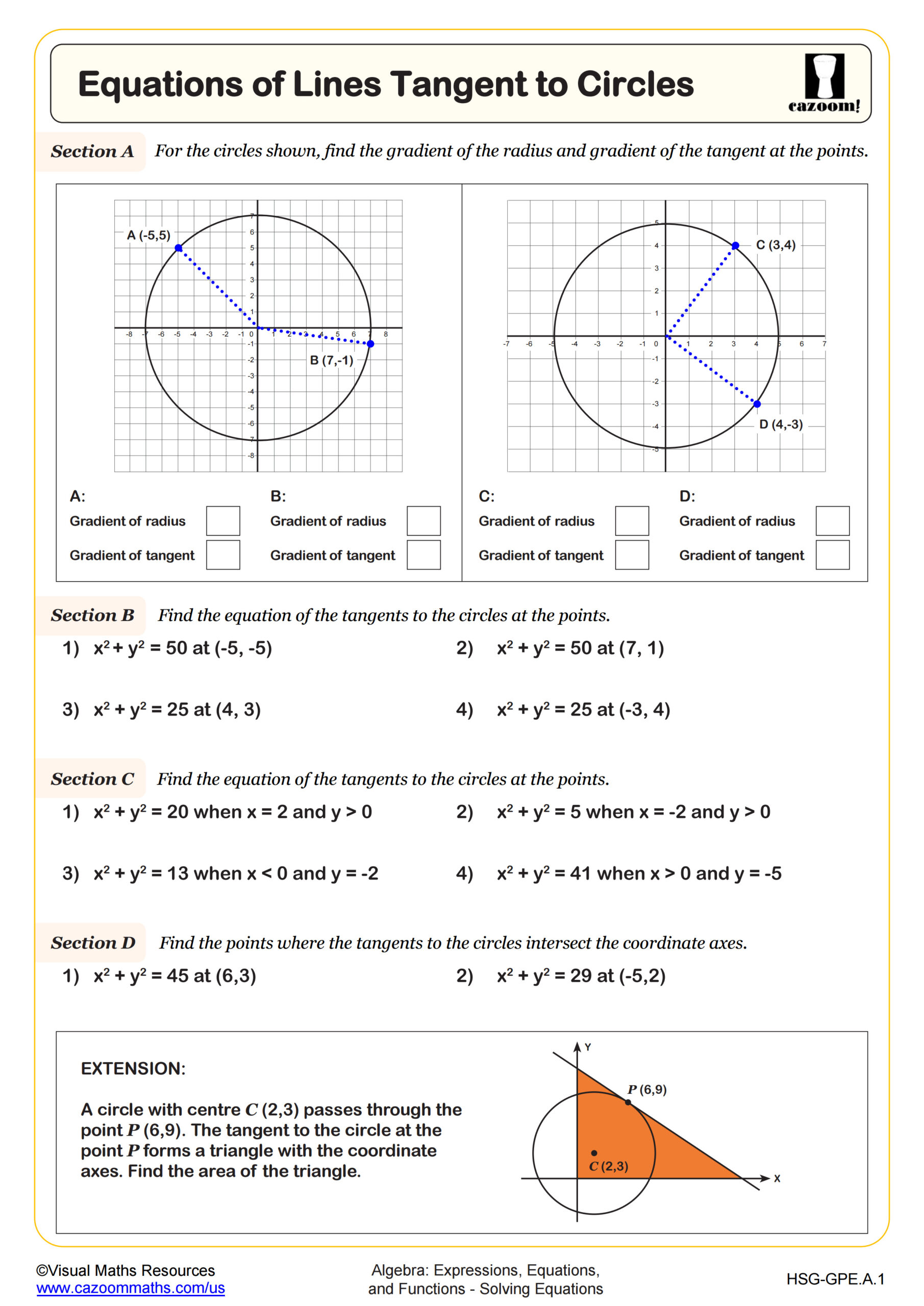
Determining equations of lines tangent to circles requires integrating knowledge of perpendicular slopes, point-slope form, distance formulas, and circle properties. Students must recognize that a tangent line touches the circle at exactly one point and forms a right angle with the radius at that point. This perpendicularity condition provides the key relationship: if a radius has slope m, the tangent line at that point has slope -1/m. Many students successfully find the slope but then struggle with substituting the correct point of tangency into point-slope form.
This skill appears in engineering applications where designers need to create smooth transitions between curved and straight sections, such as highway exit ramps connecting to circular traffic roundabouts or robotic arm paths that approach circular objects. Students preparing for STEM majors benefit from understanding how calculus extends this concept when the slope of the radius itself changes continuously along more complex curves.
How Can Teachers Use These Integrated Math 3 Worksheets Effectively?
These worksheets provide structured progression through equation-solving techniques that require coordinating multiple mathematical representations. Each worksheet targets a specific skill set, allowing teachers to assign practice that matches current instructional focus or addresses gaps identified through formative assessment. The graphical approach worksheets particularly help students who benefit from visual reasoning, while the circle and tangent line worksheets reinforce the algebraic precision necessary for success on standardized assessments.
Teachers use these materials for differentiated test preparation by assigning specific worksheets based on assessment data showing which equation types cause difficulty. The complete answer keys support self-paced review during intervention periods or allow for paired work where students compare solution methods. Many teachers find these worksheets effective as warm-up activities before introducing related Pre-Calculus topics, since confidence with circle equations and graphical solution methods prepares students for conic sections and more advanced systems.