Lines and Angles Worksheets With Answers
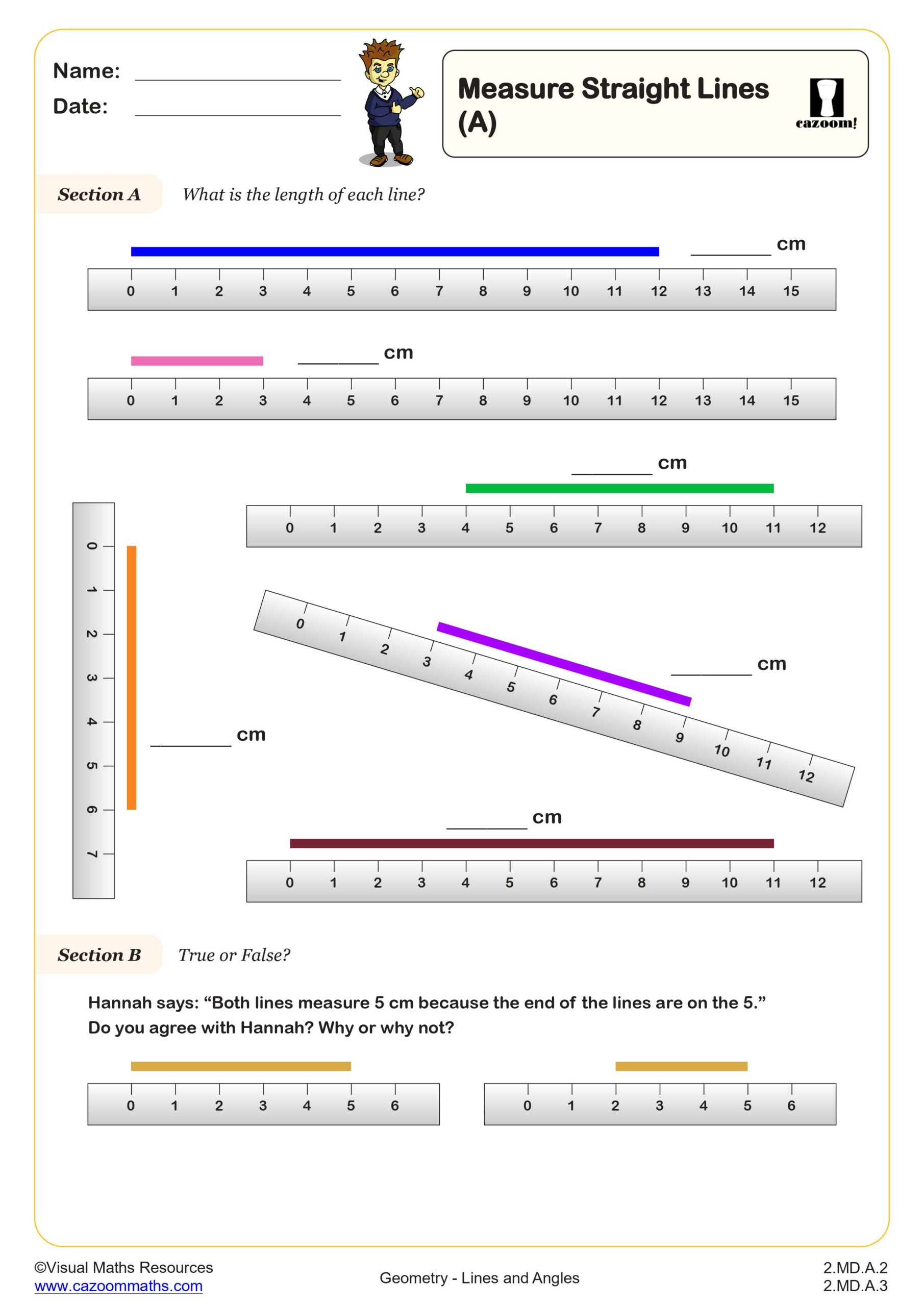
Measure Straight Lines (A)
Grades: 2nd Grade
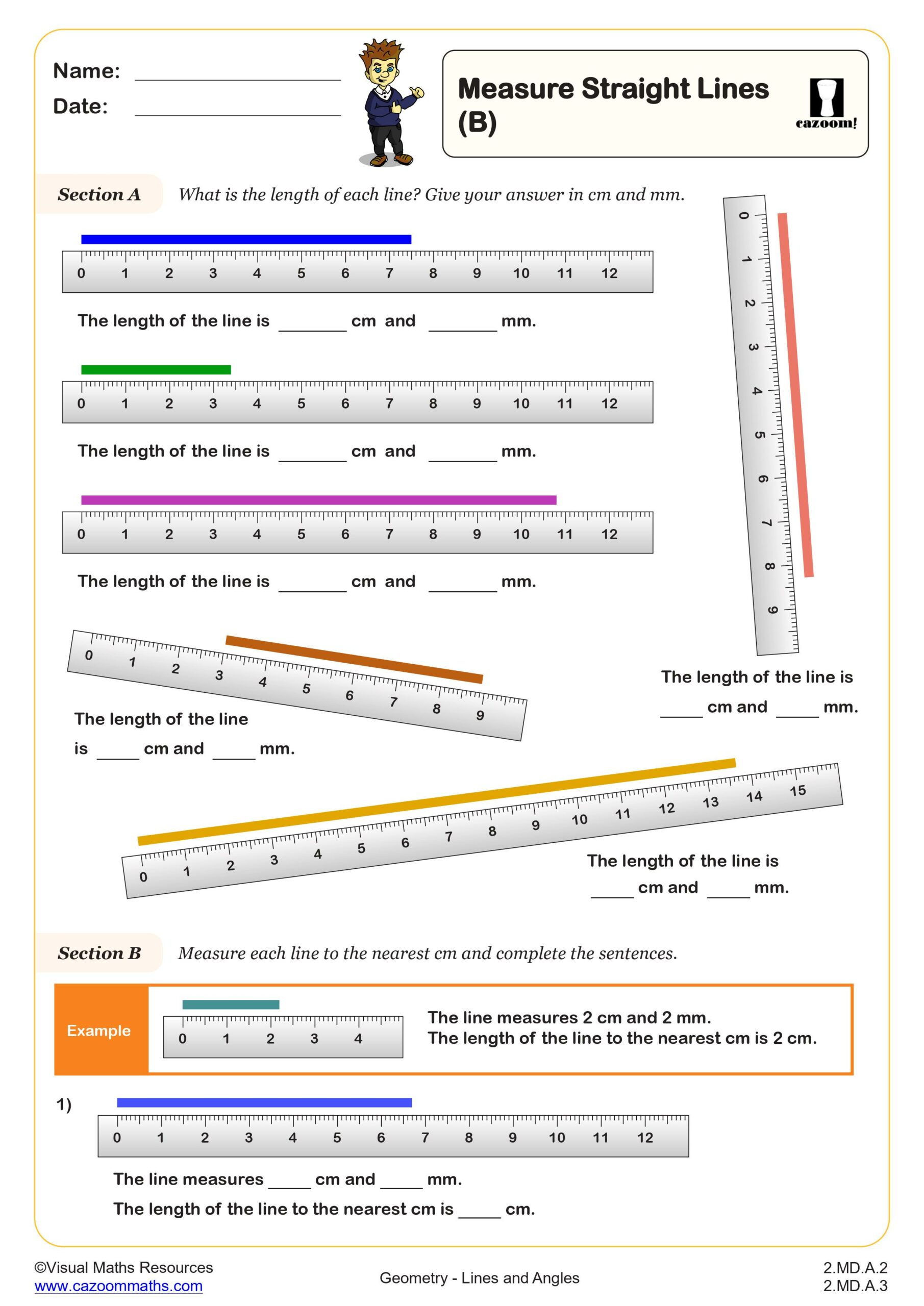
Measure Straight Lines (B)
Grades: 2nd Grade
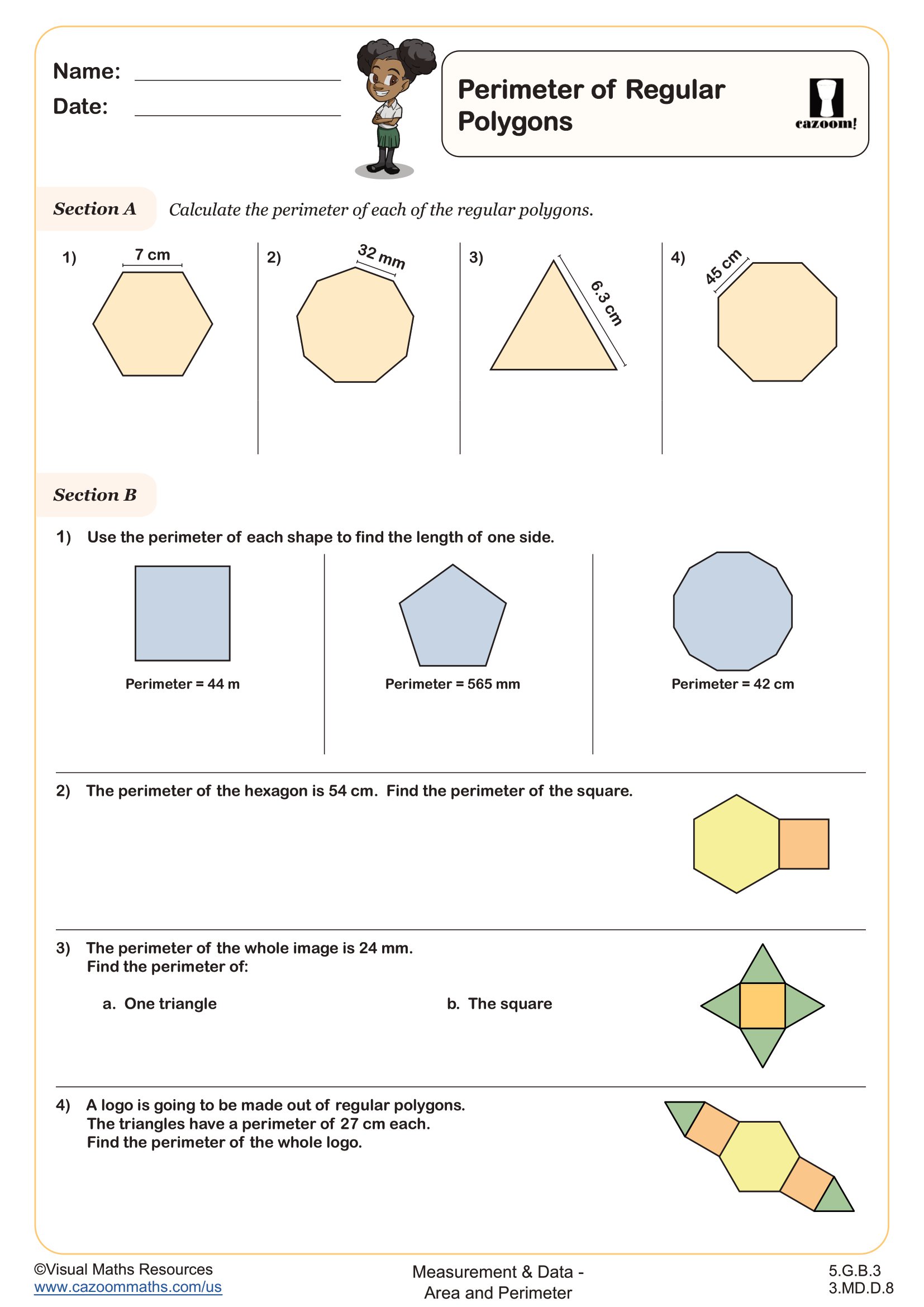
Perimeter of Regular Polygons
Grades: 3rd Grade, 5th Grade
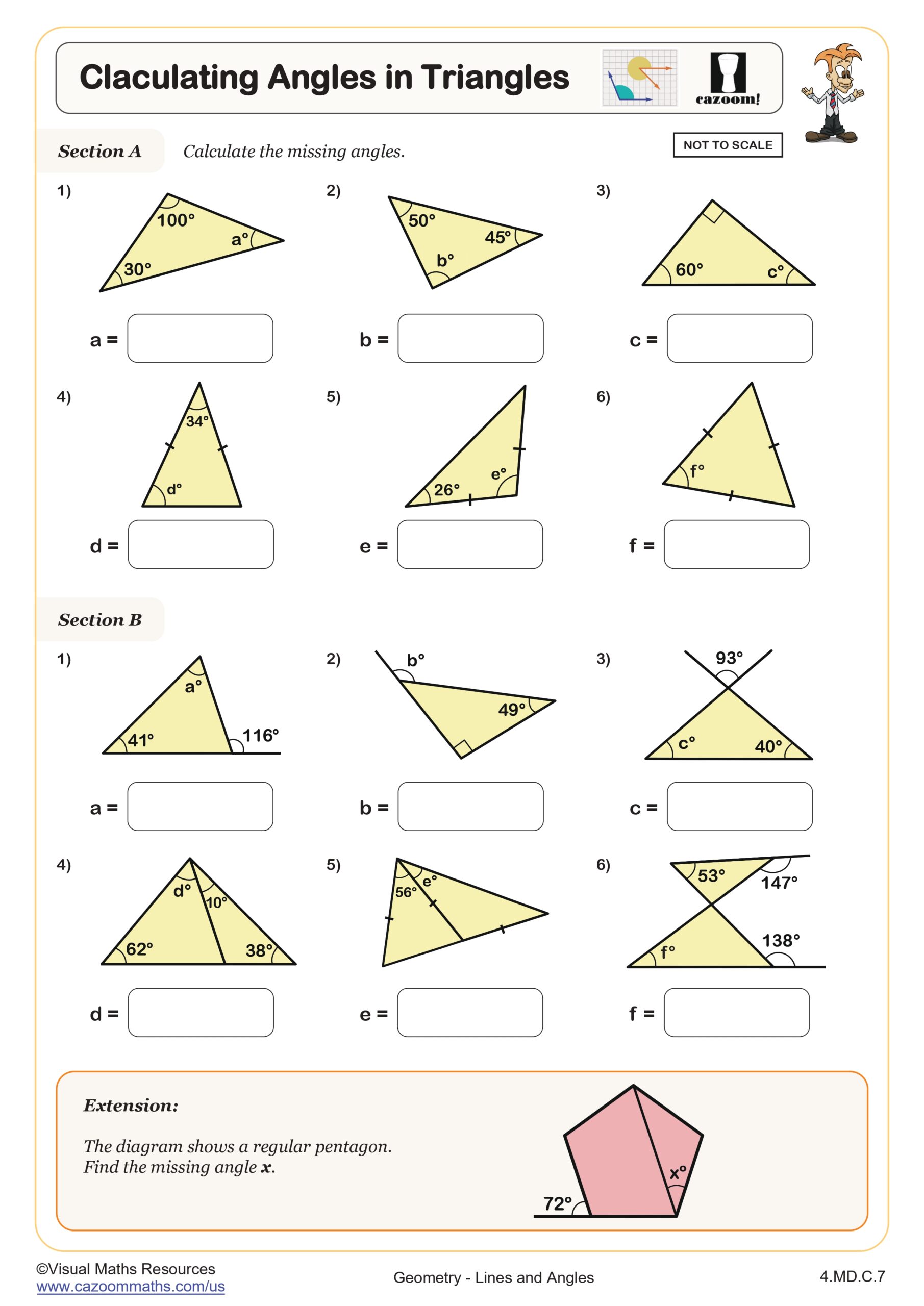
Calculating Angles in Triangles
Grades: 4th Grade
Comparing angles with 90 degrees, 45 degrees and 135 degrees
Grades: 4th Grade
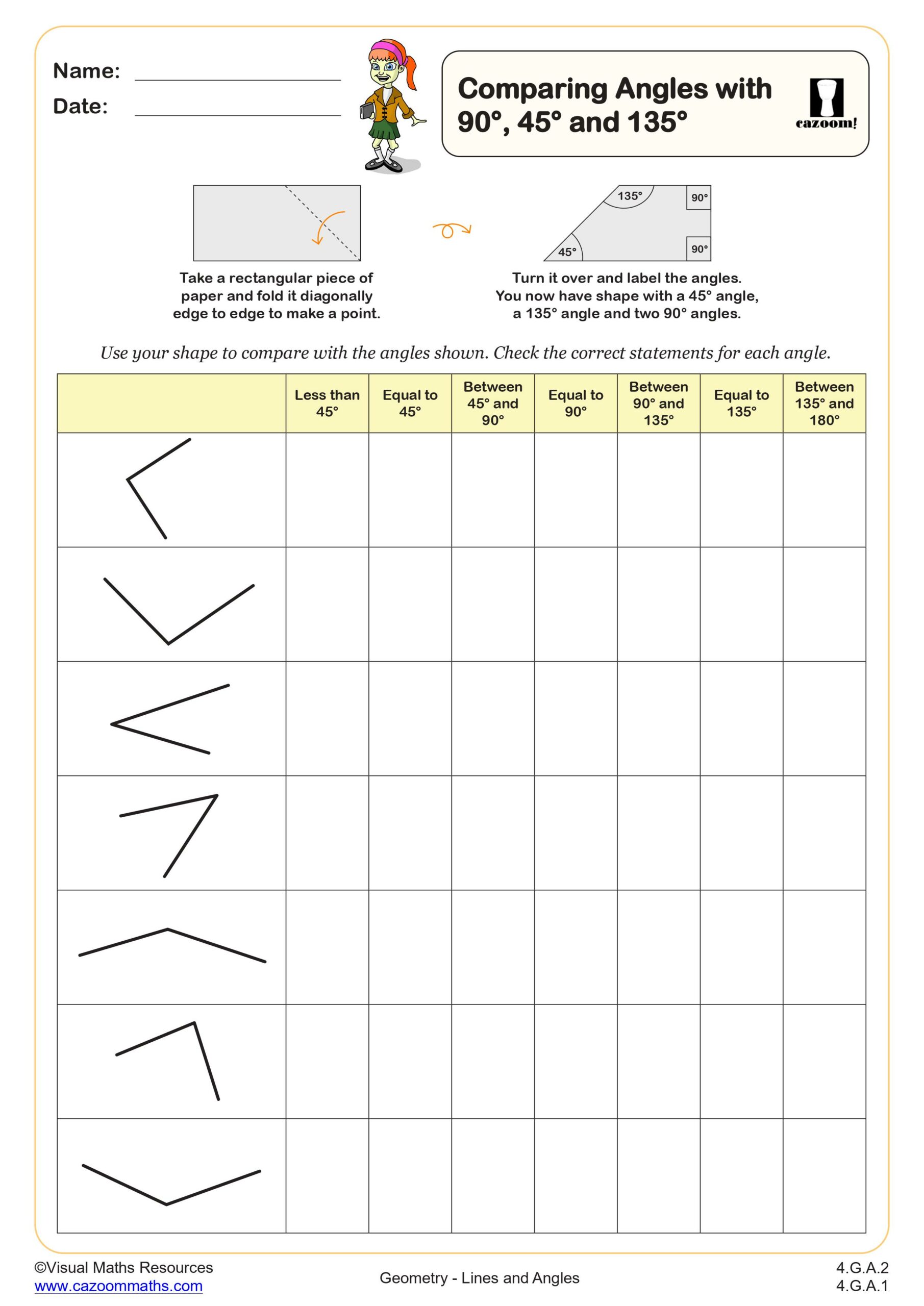
Estimating and Measuring Angles
Grades: 4th Grade
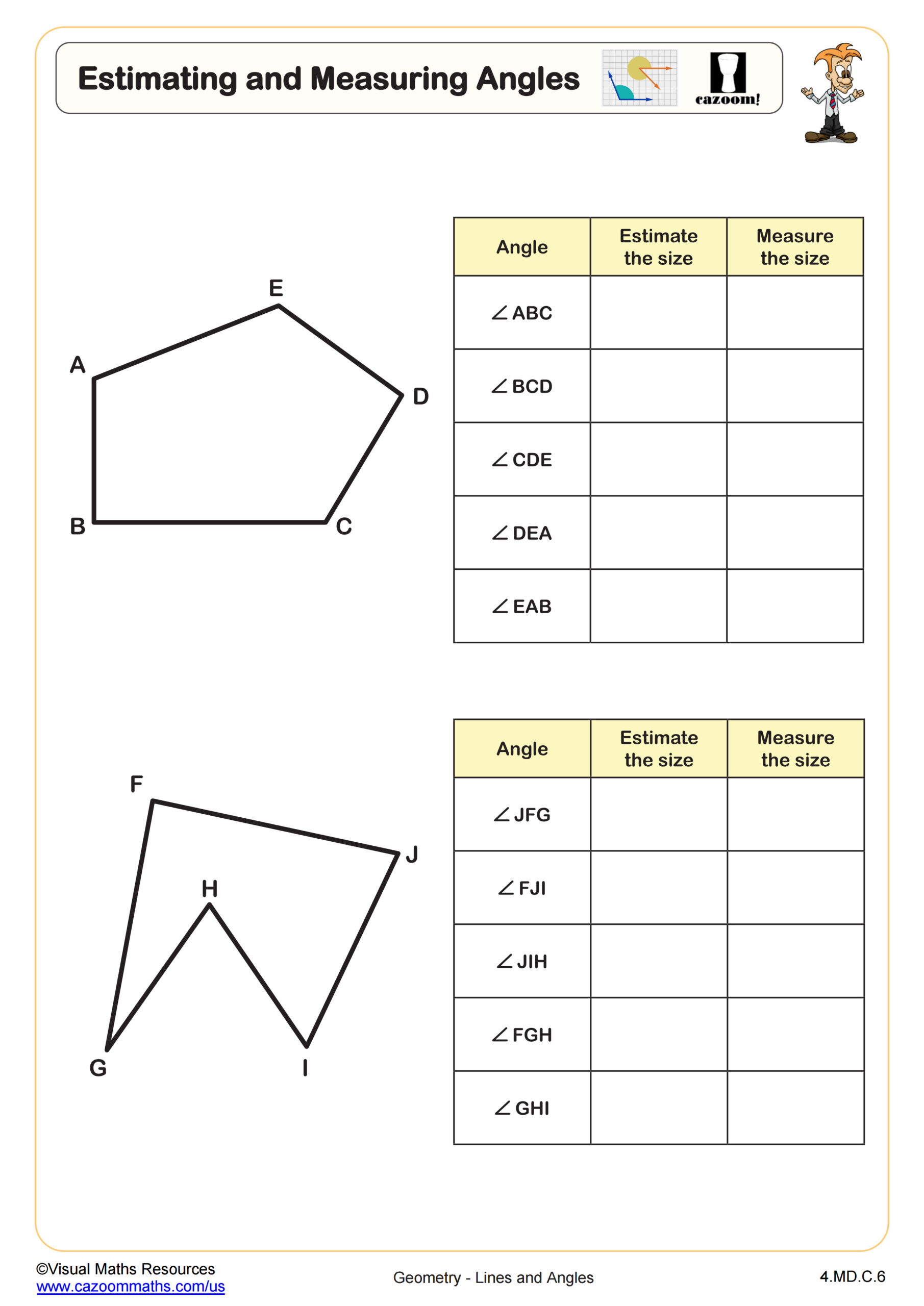
Identifying Angles
Grades: 4th Grade
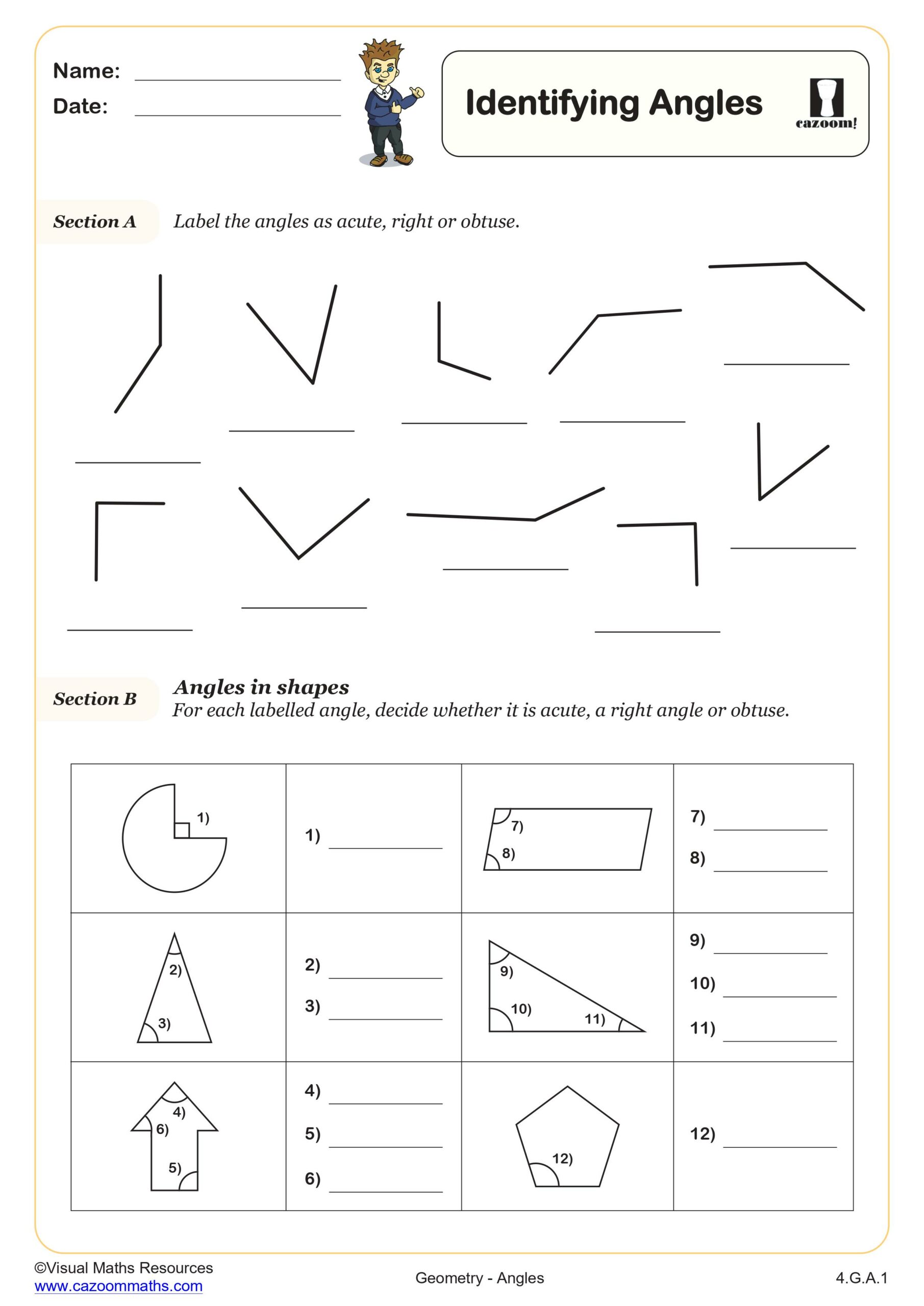
Naming Angles
Grades: 4th Grade
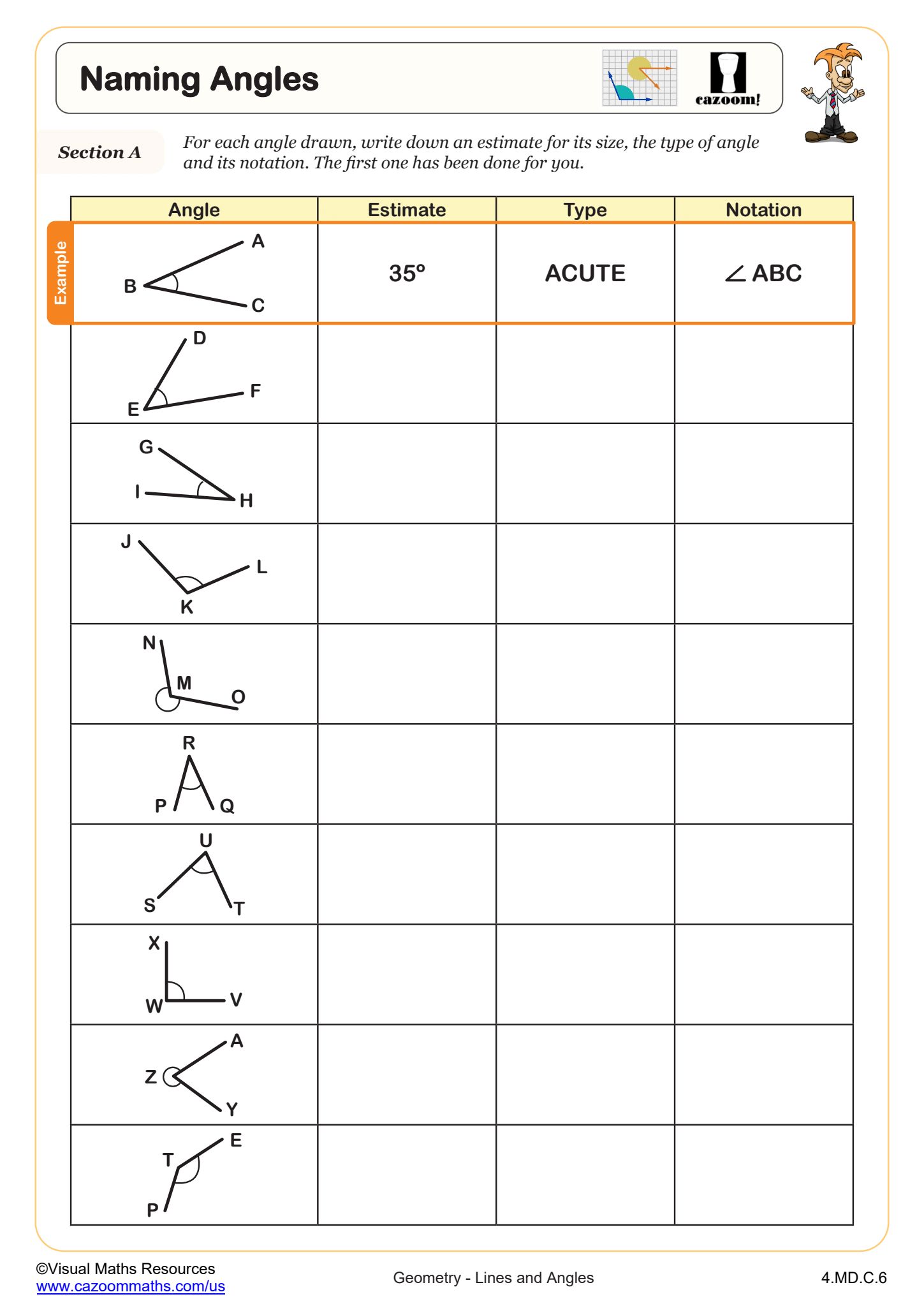
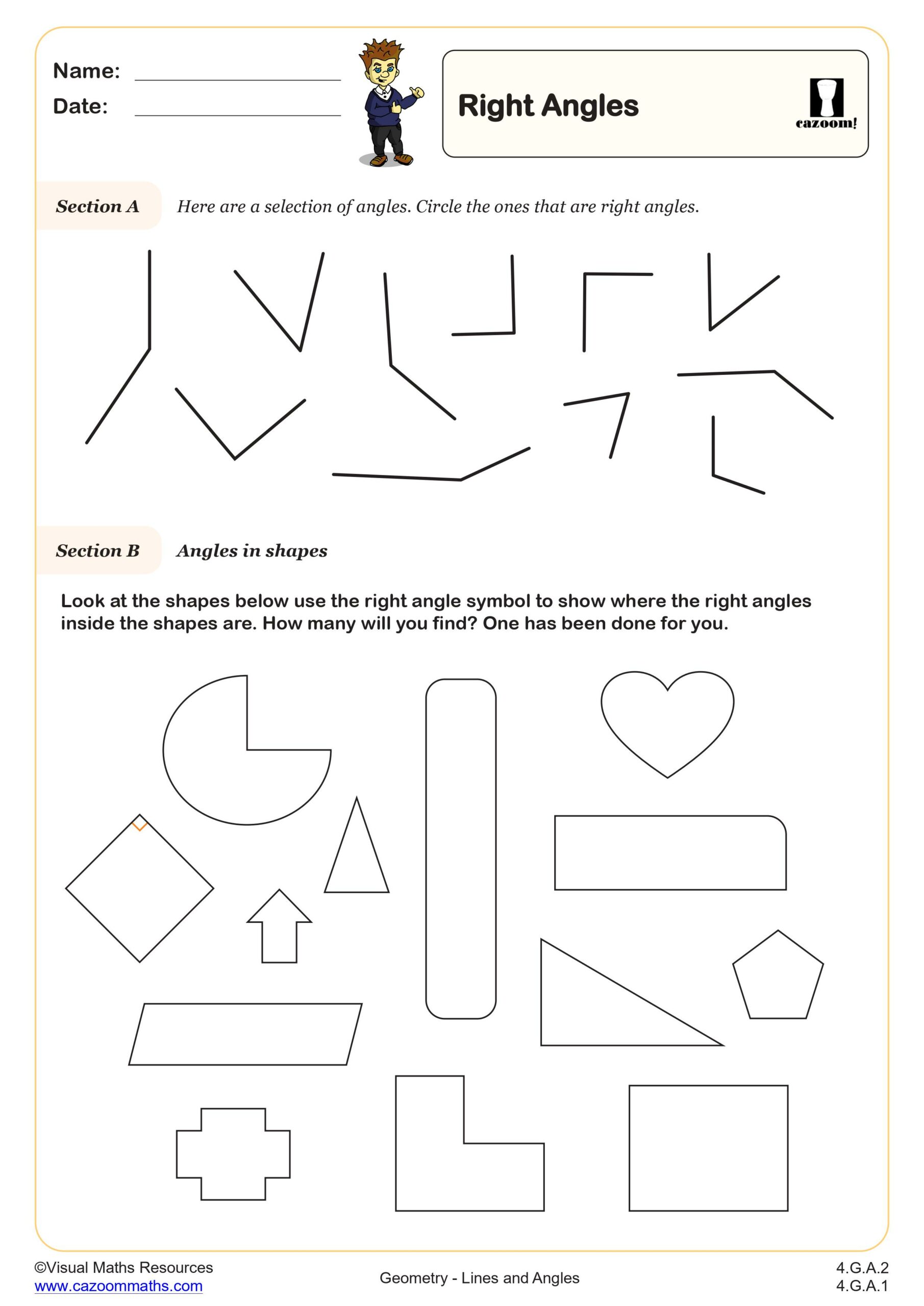
Right angles
Grades: 4th Grade
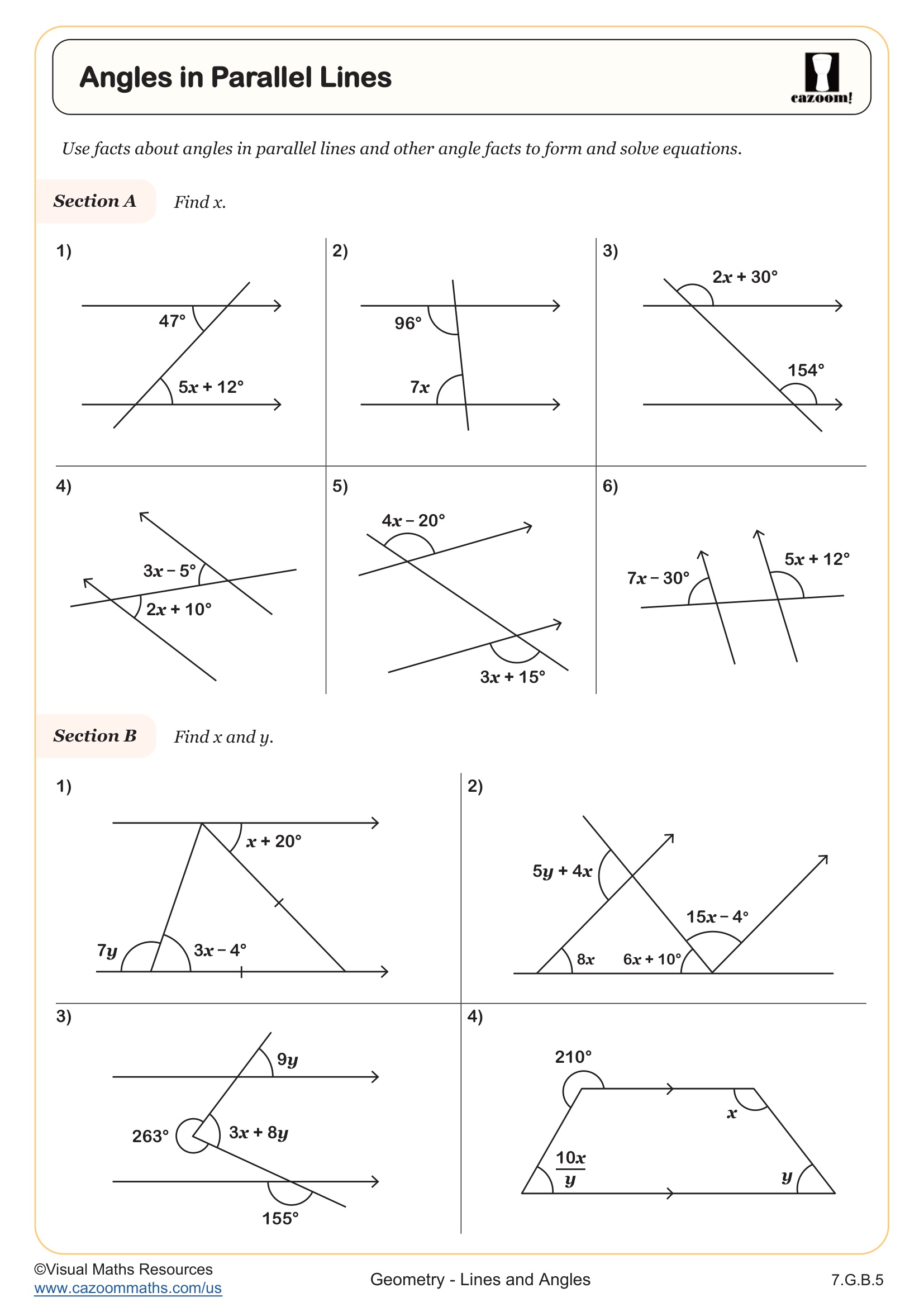
Algebraic Angles in Parallel Lines
Grades: 7th Grade
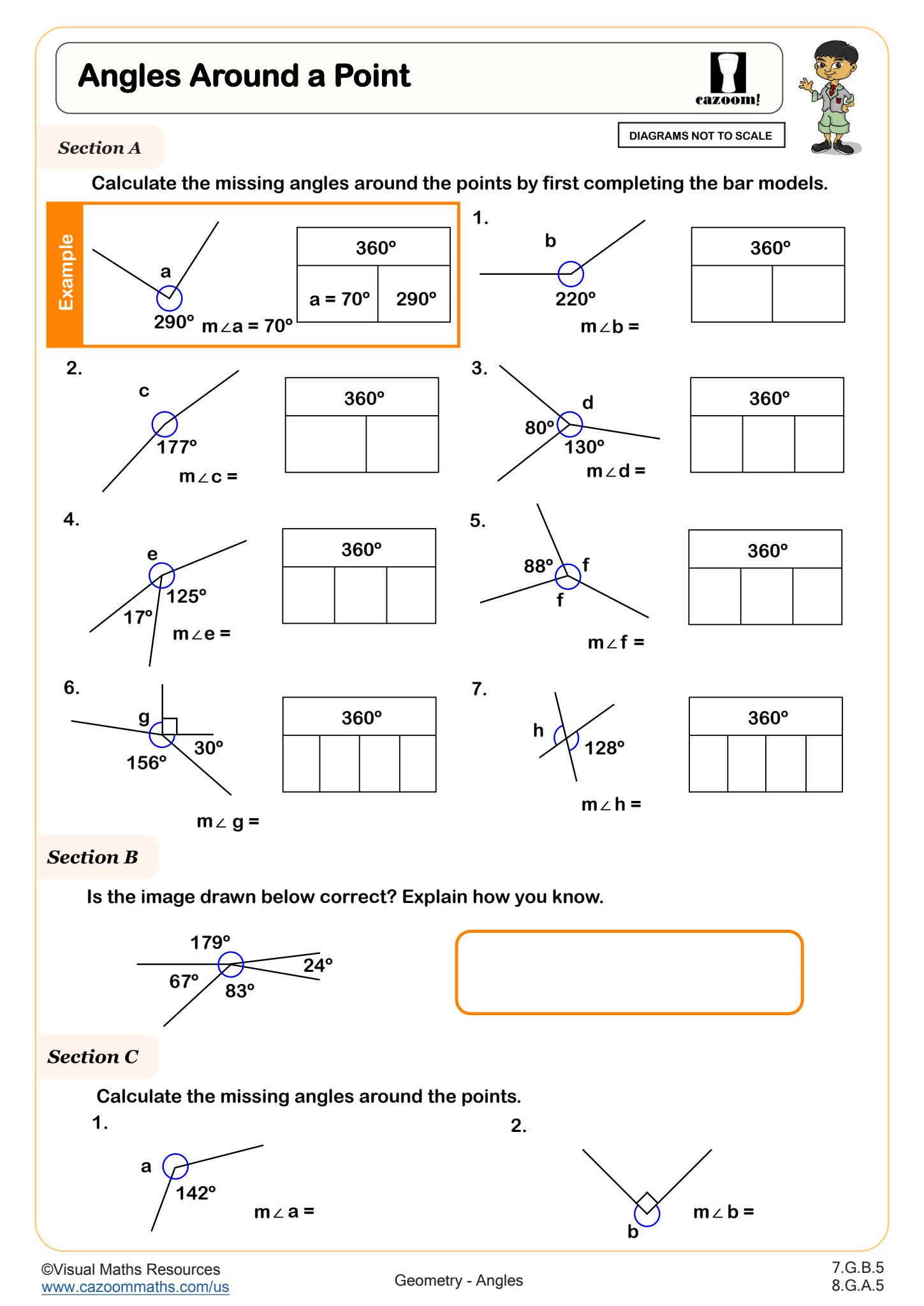
Angles Around a Point
Grades: 7th Grade, 8th Grade
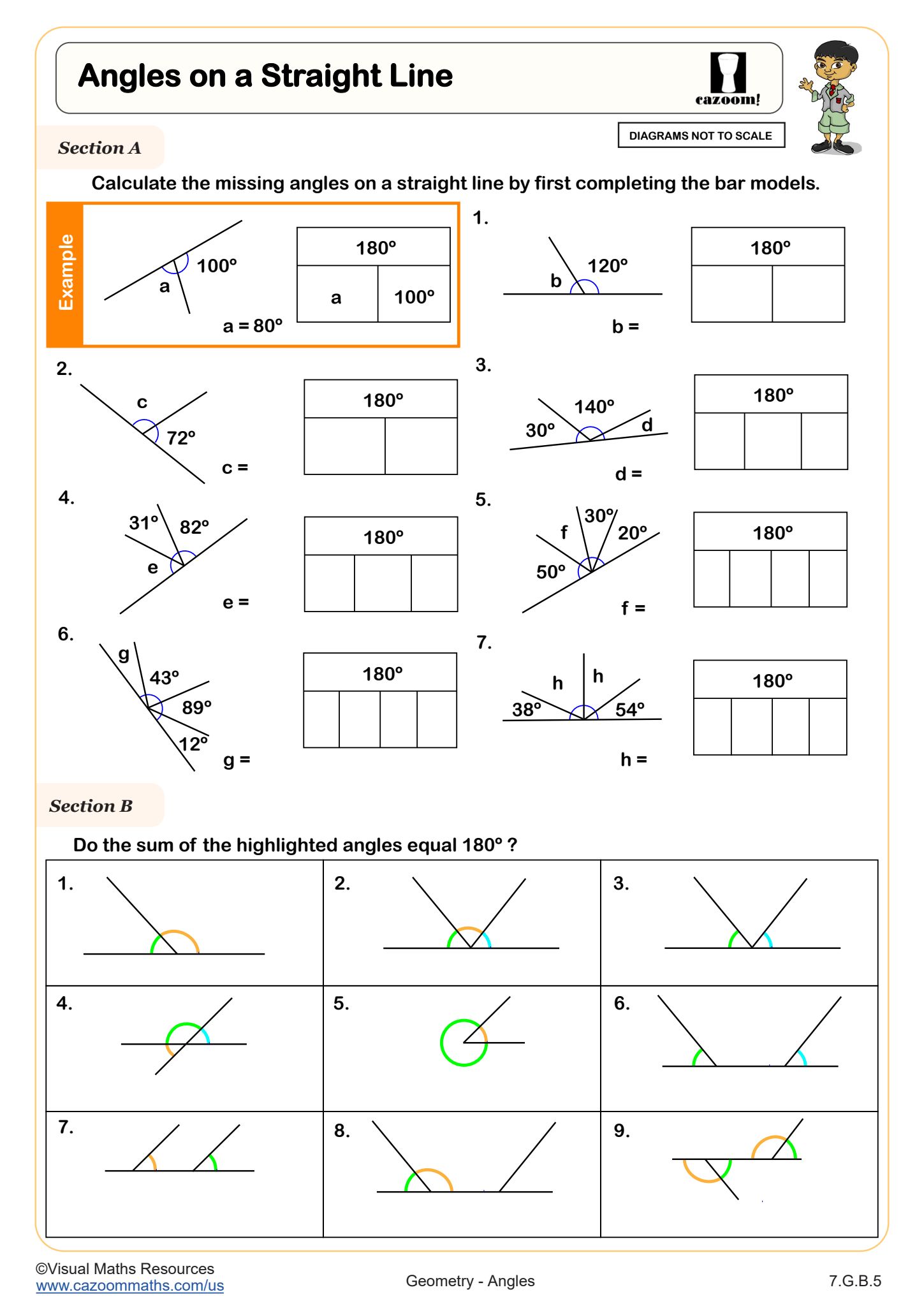
Angles on a Straight Line
Grades: 7th Grade
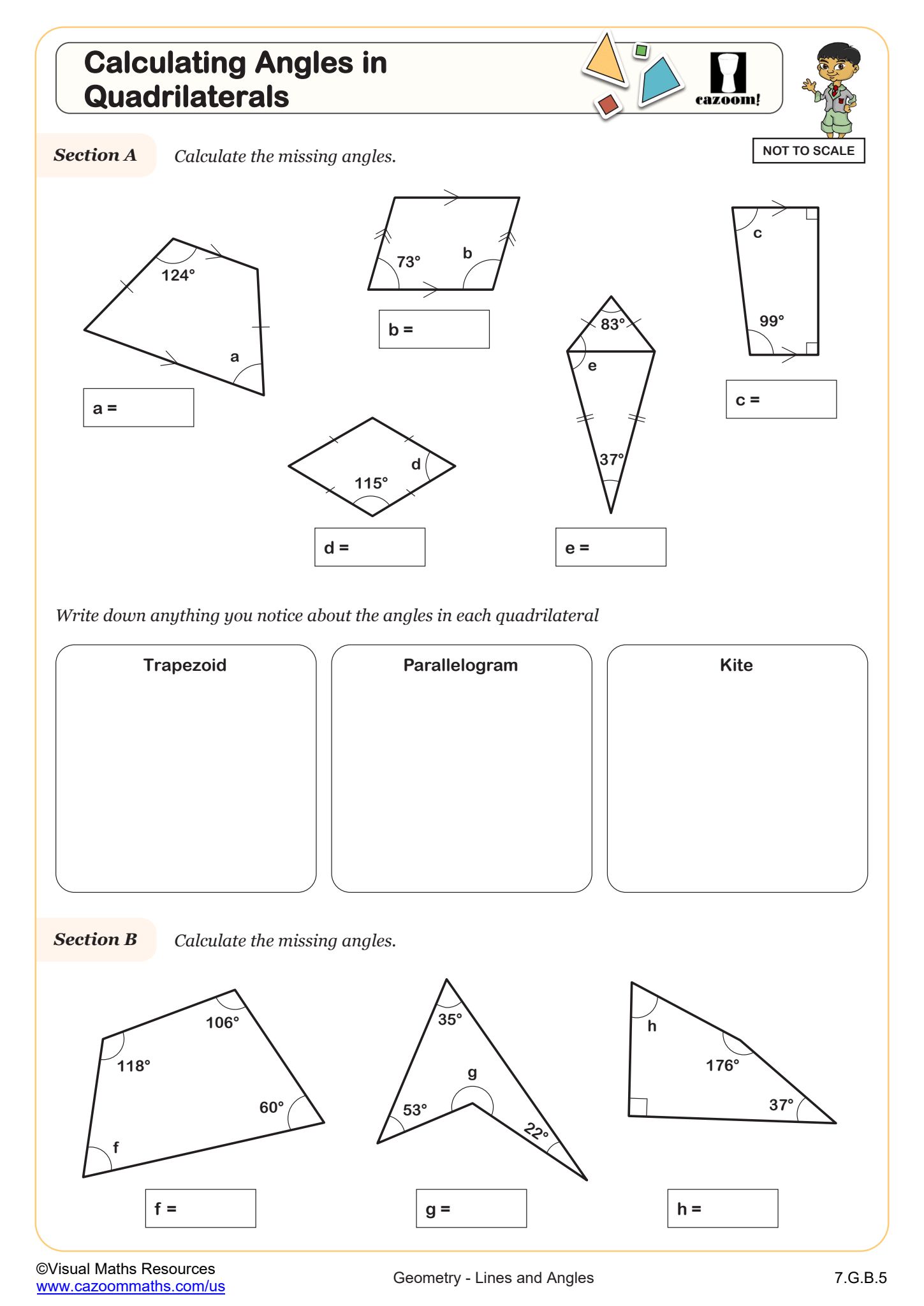
Calculating Angles in Quadrilaterals
Grades: 7th Grade
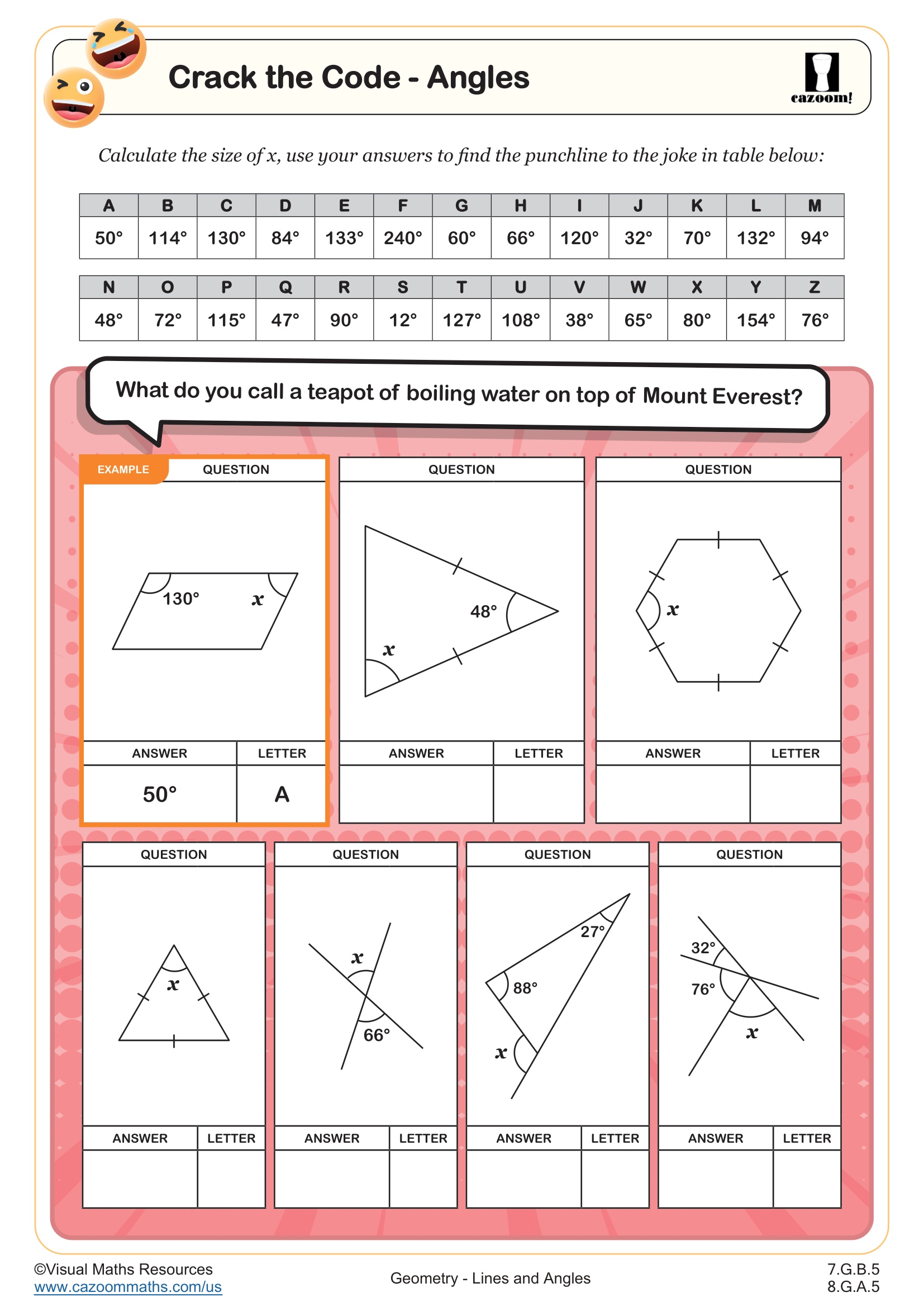
Crack the Code - Angles
Grades: 7th Grade, 8th Grade
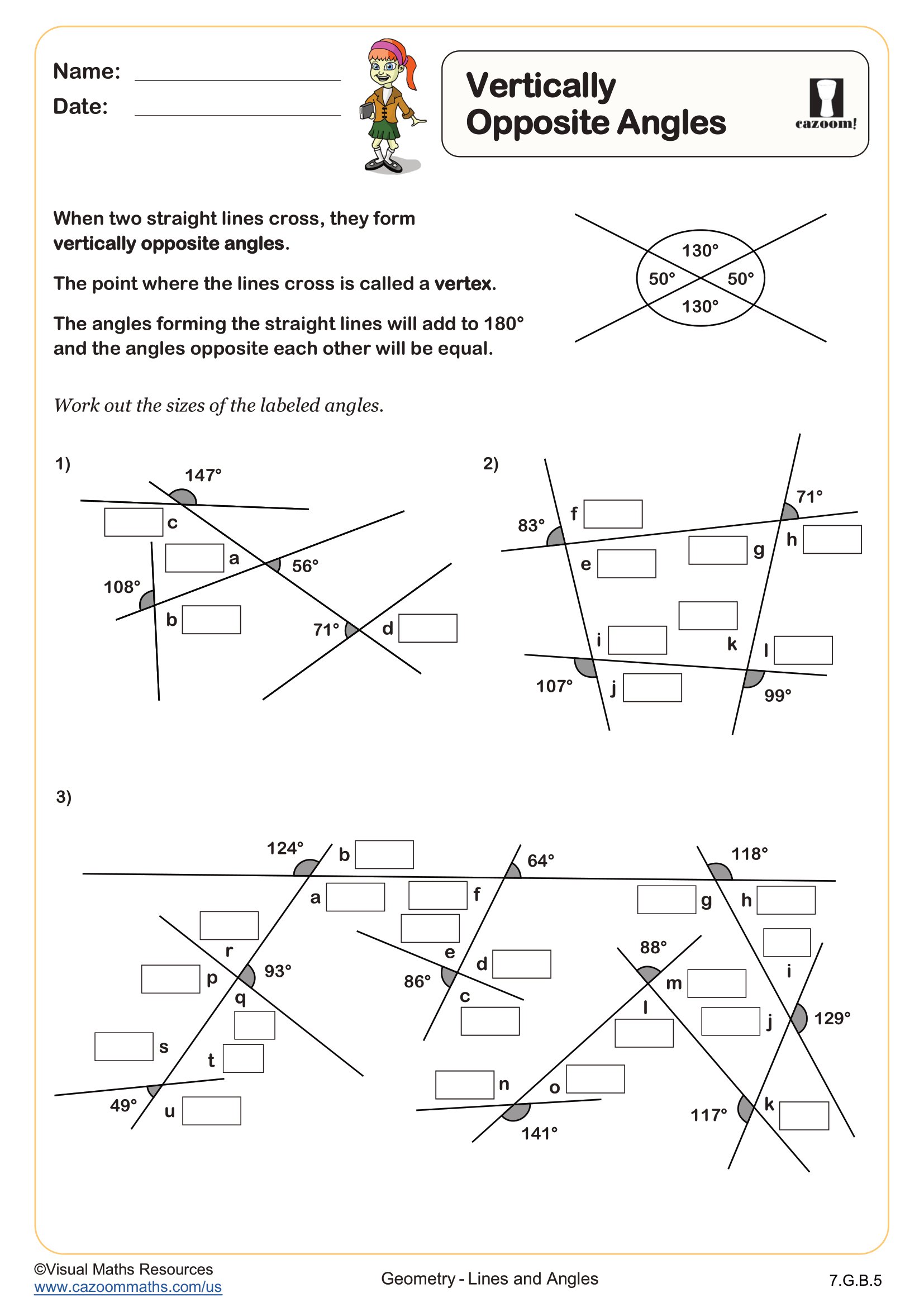
Vertically Opposite Angles
Grades: 7th Grade
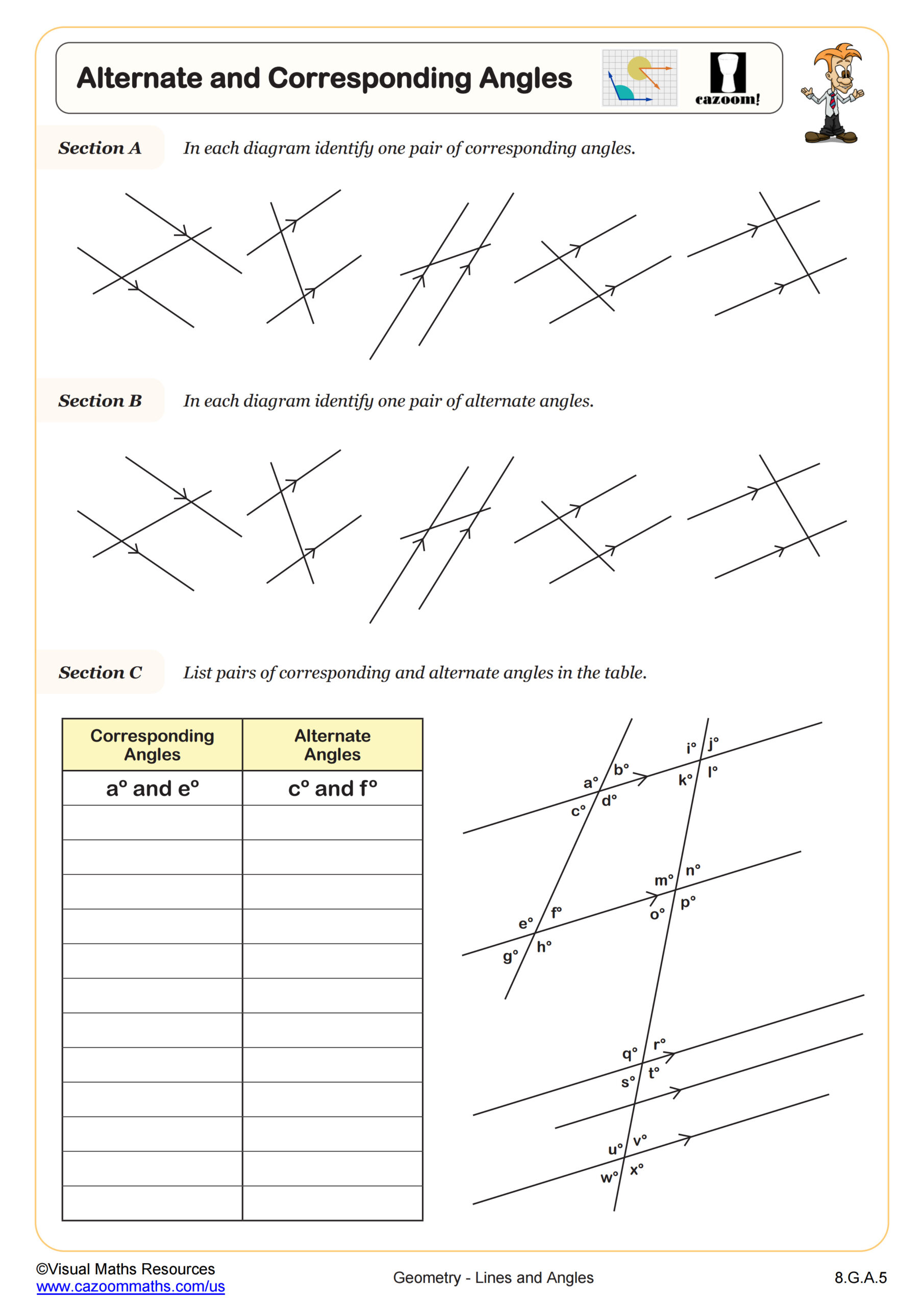
Alternate and Corresponding Angles
Grades: 8th Grade
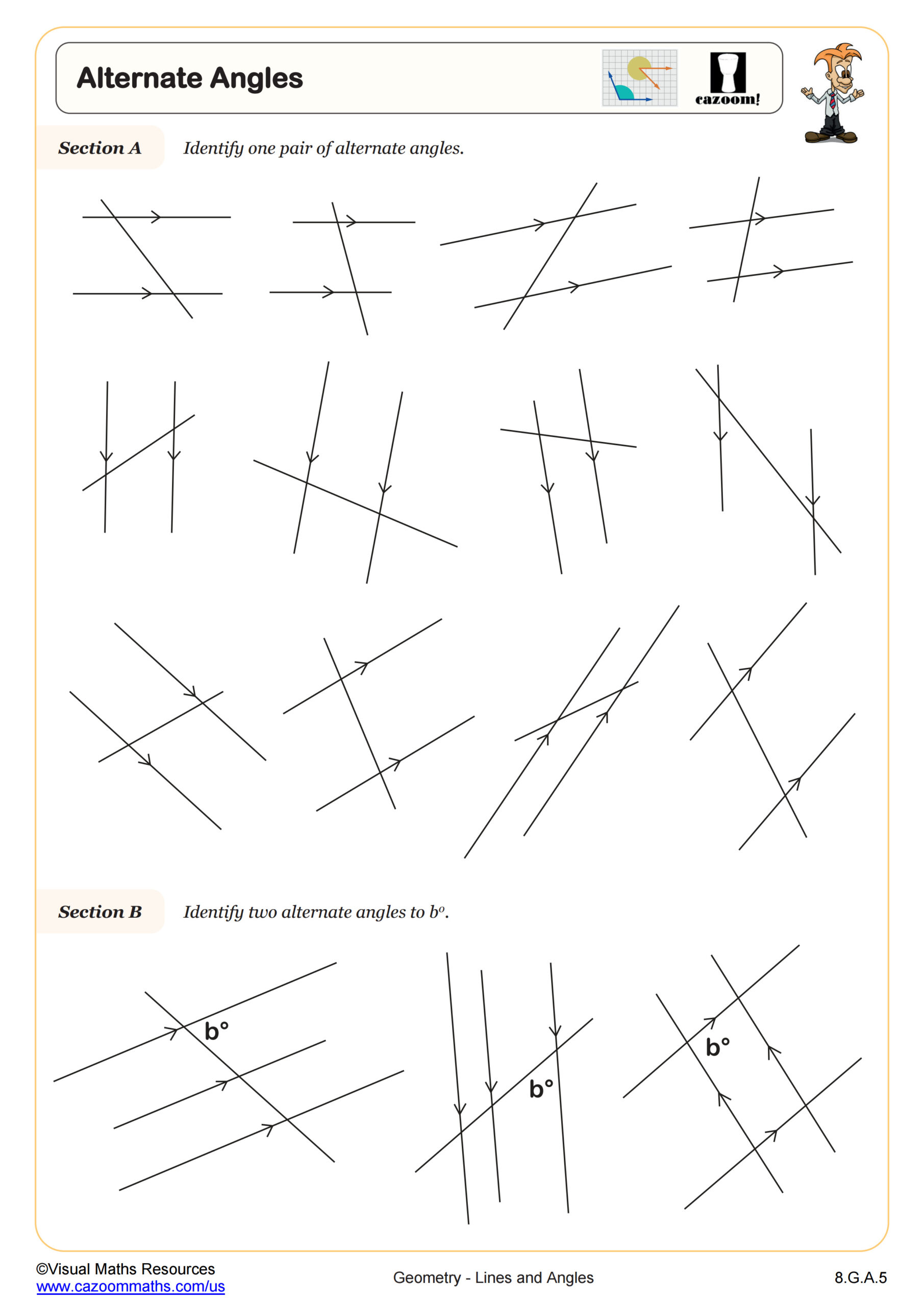
Alternate Angles
Grades: 8th Grade
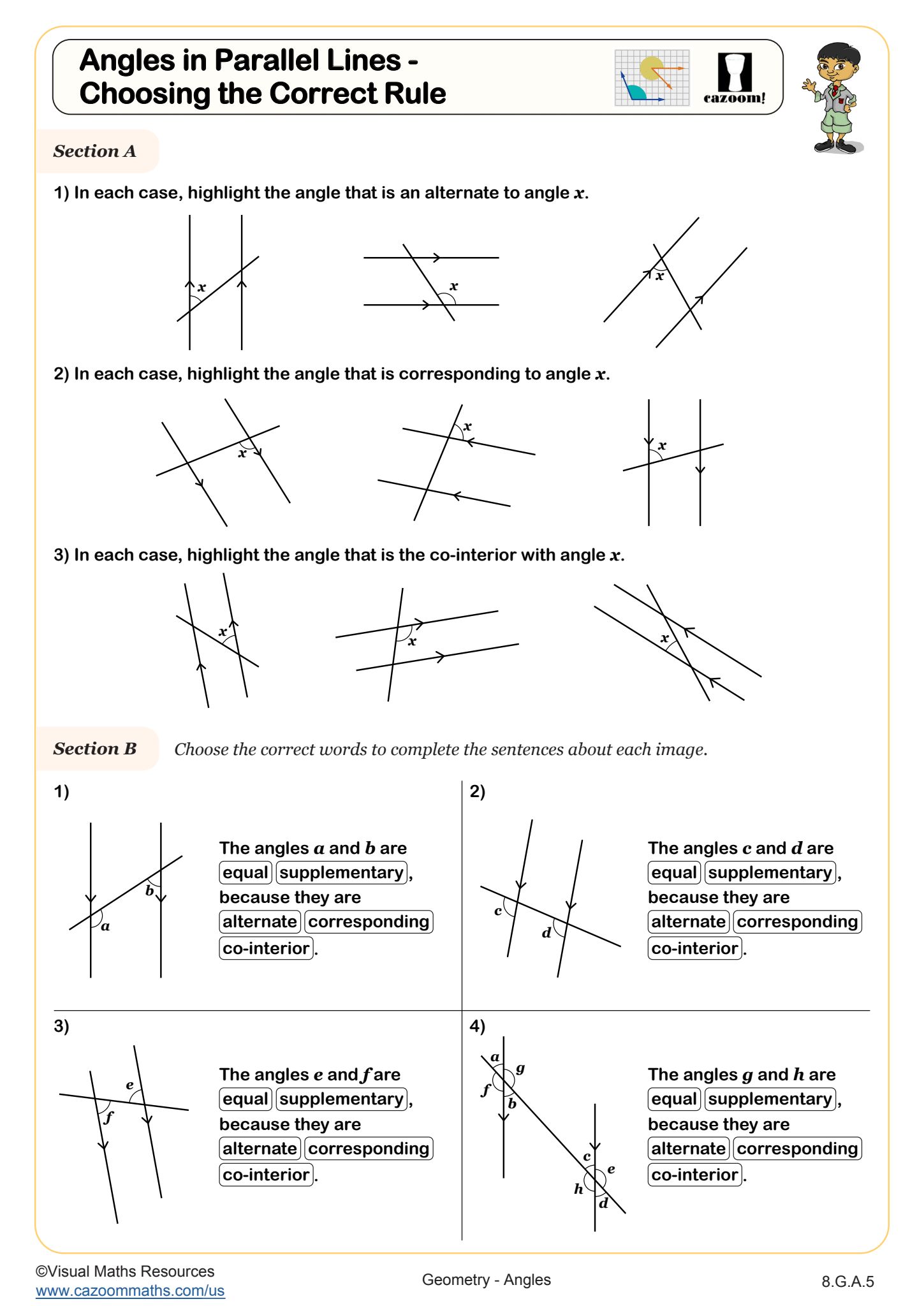
Angles in Parallel Lines - Choosing the Correct Rule
Grades: 8th Grade
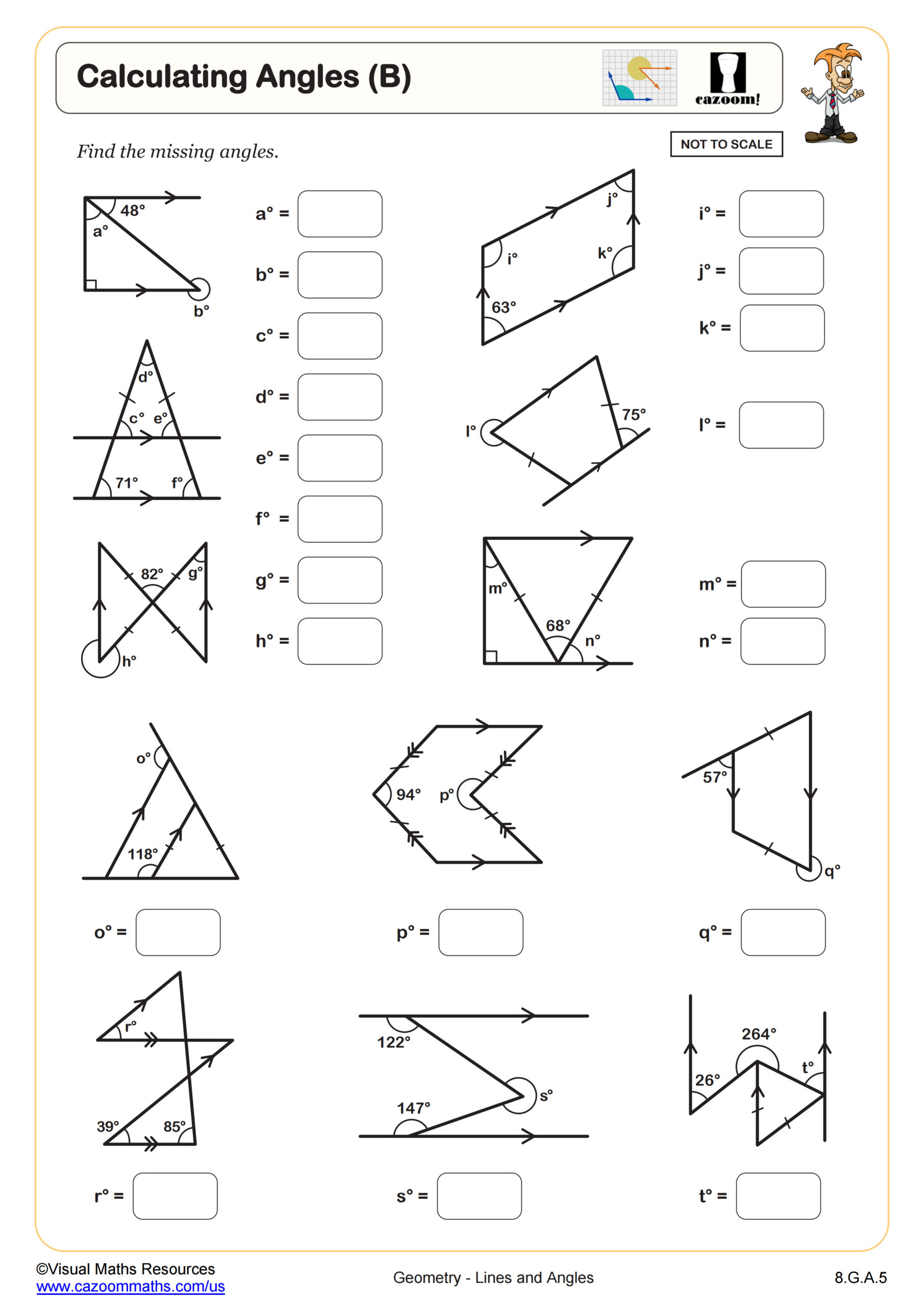
Calculating Angles (B)
Grades: 8th Grade
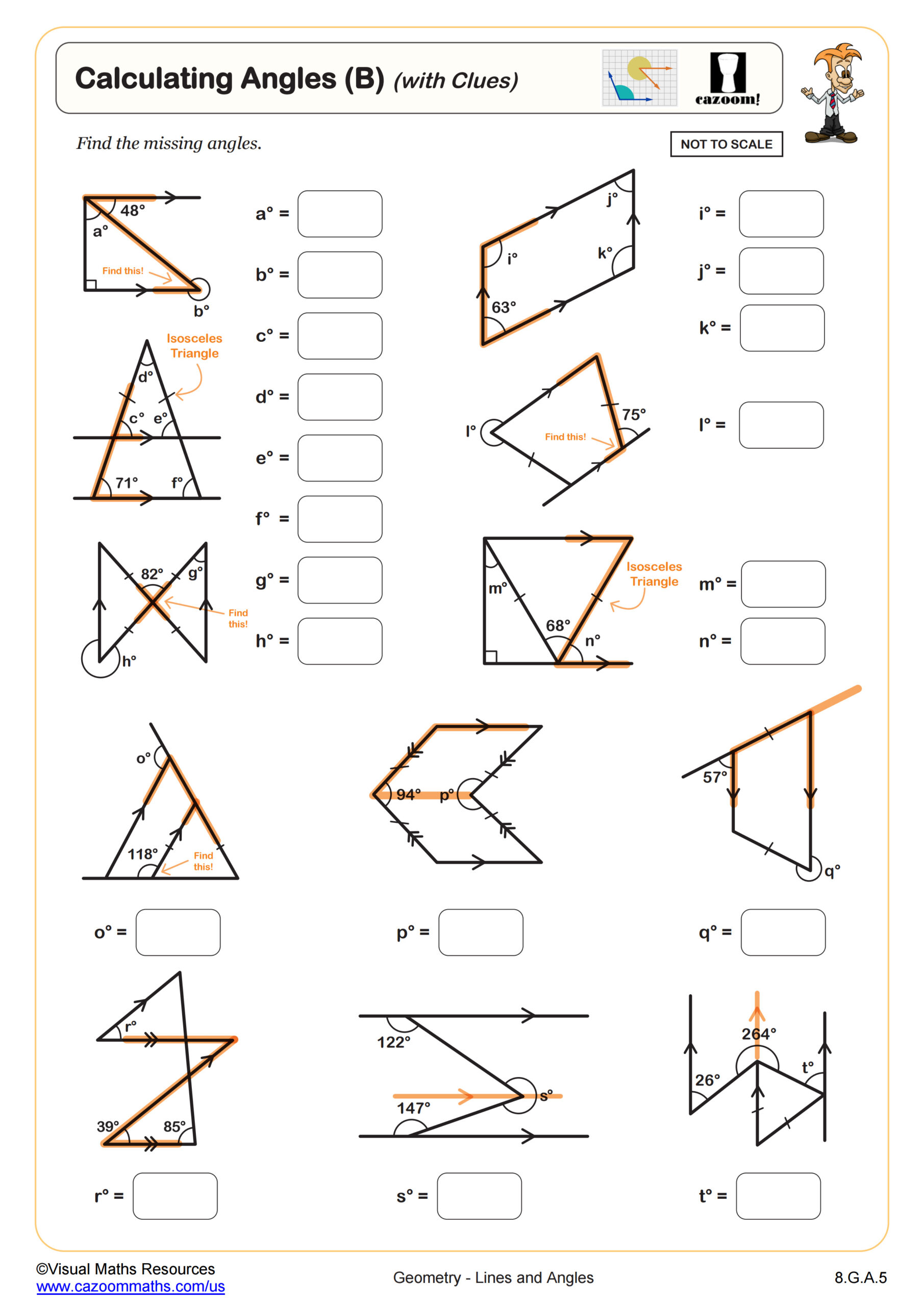
Calculating Angles (B) (With Clues)
Grades: 8th Grade
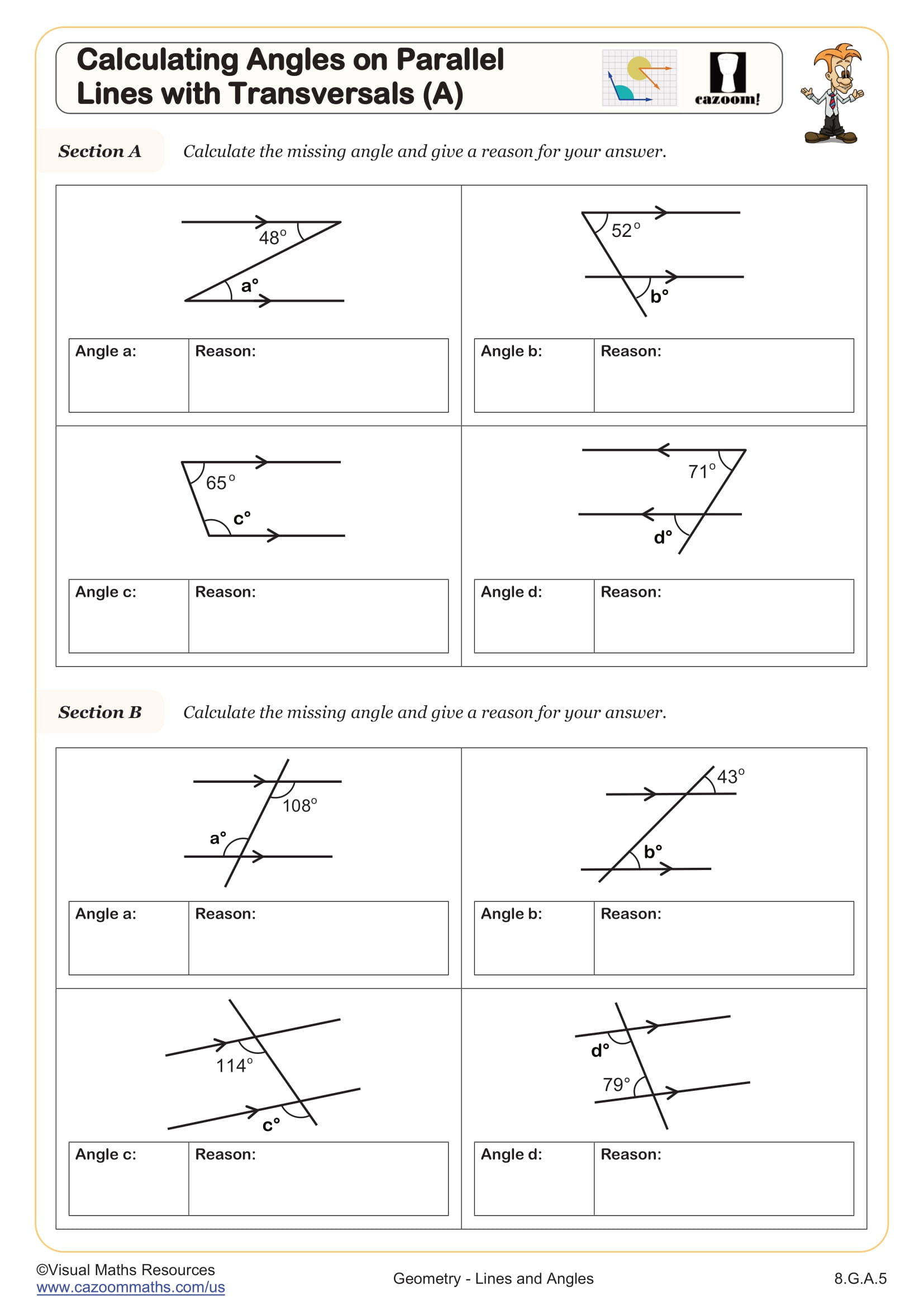
Calculating Angles on Parallel Lines with Transversals (A)
Grades: 8th Grade
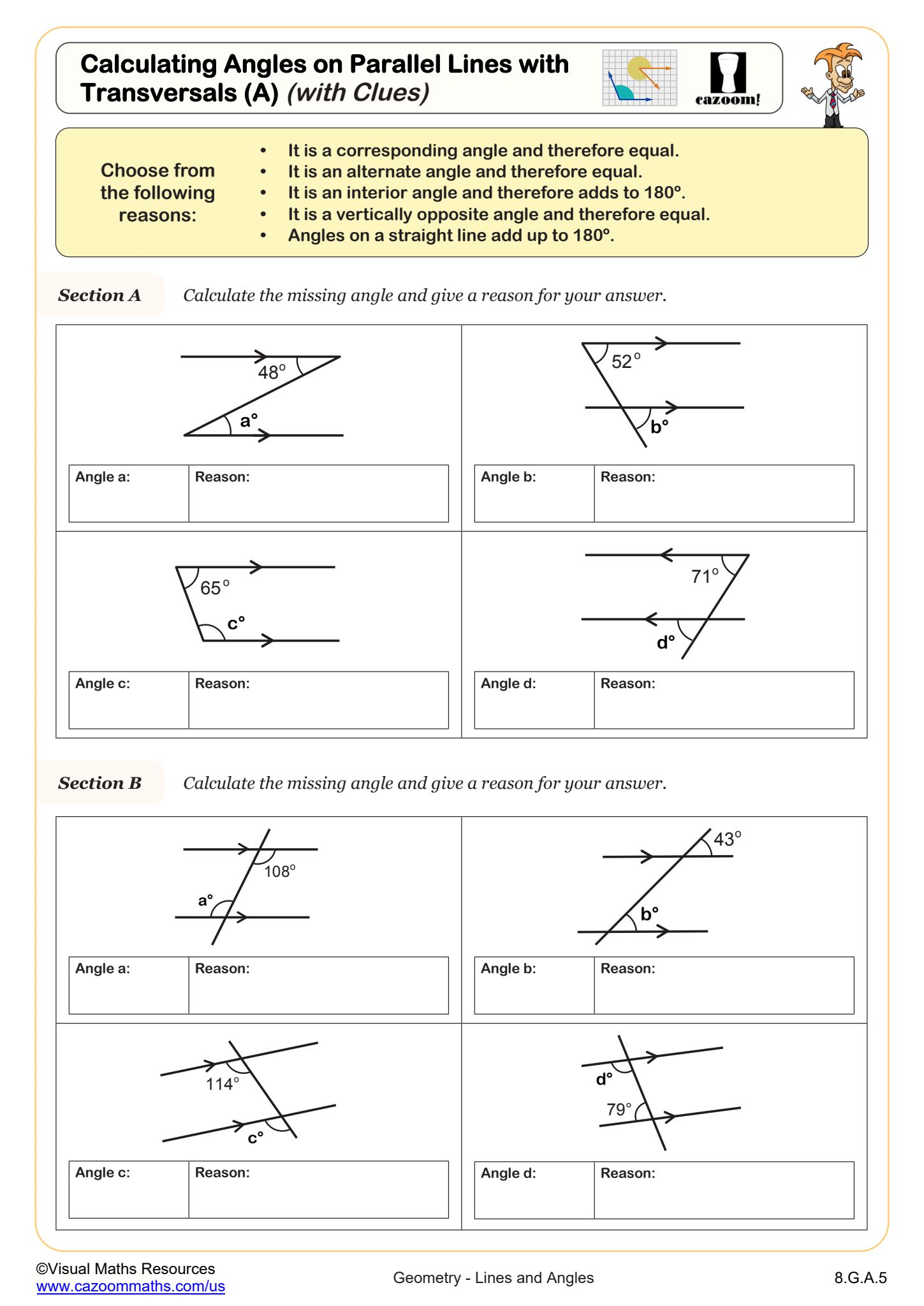
Calculating Angles on Parallel Lines with Transversals (A) (with clues)
Grades: 8th Grade
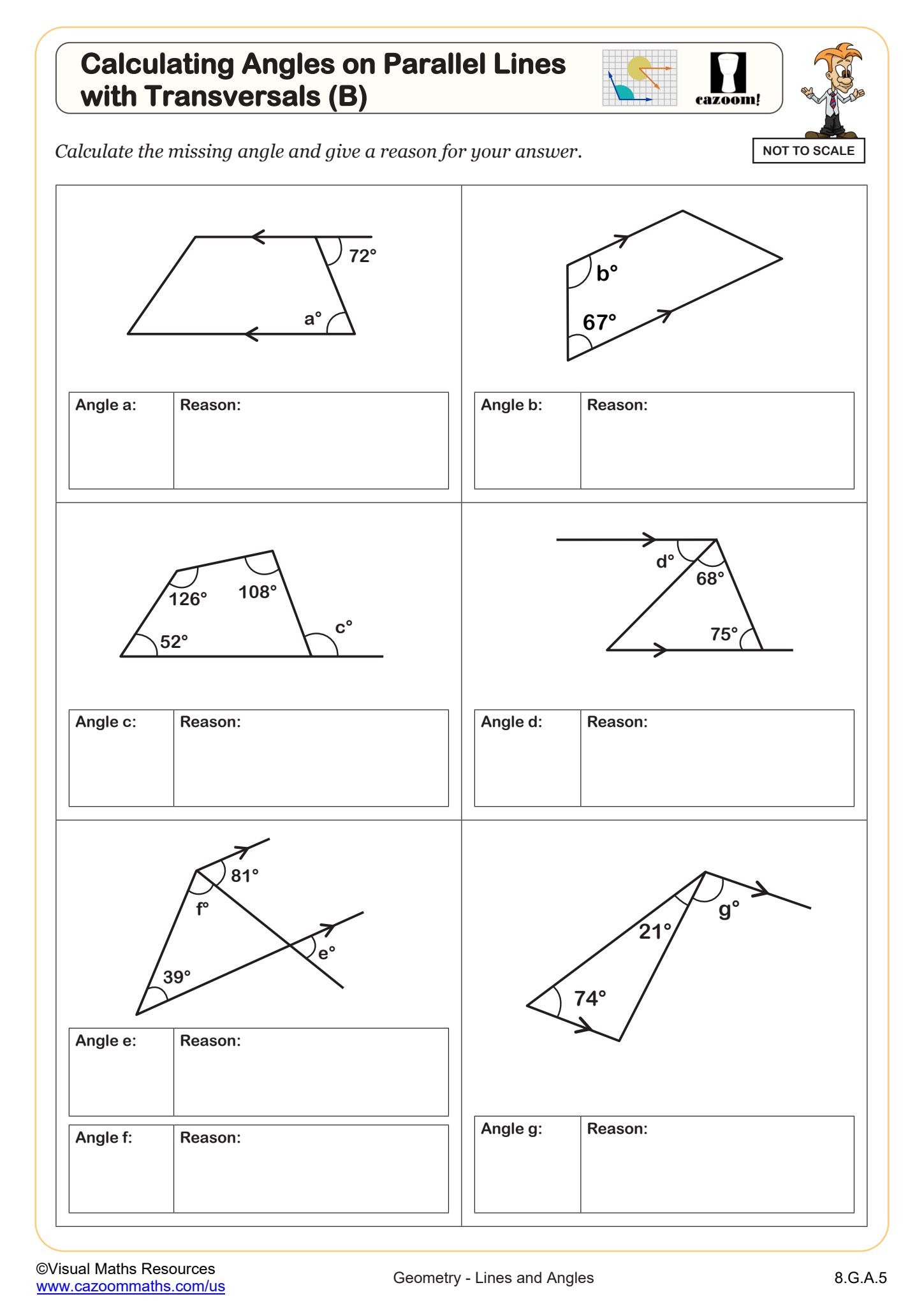
Calculating Angles on Parallel Lines with Transversals (B)
Grades: 8th Grade
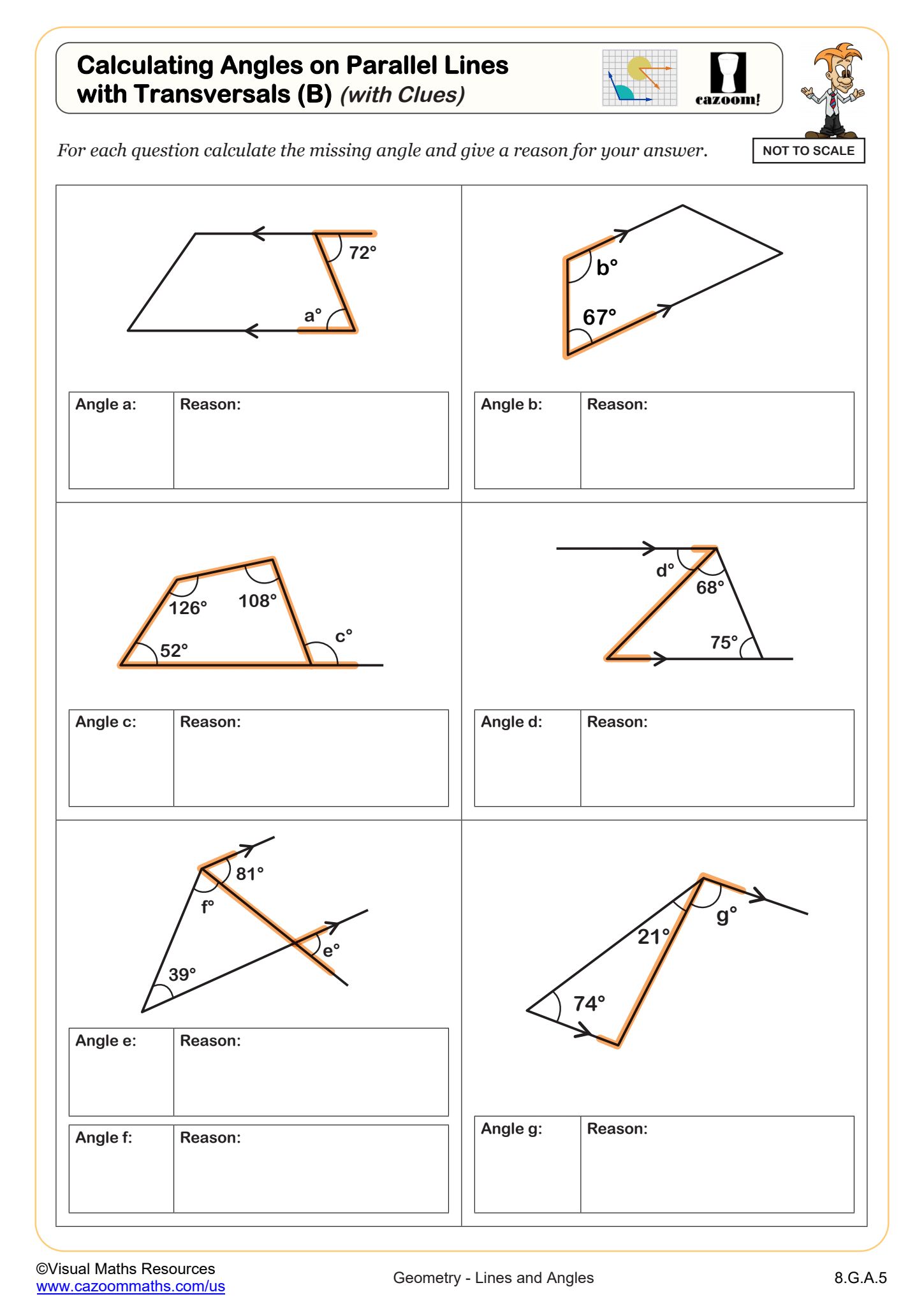
Calculating Angles on Parallel Lines with Transversals (B) (with clues)
Grades: 8th Grade
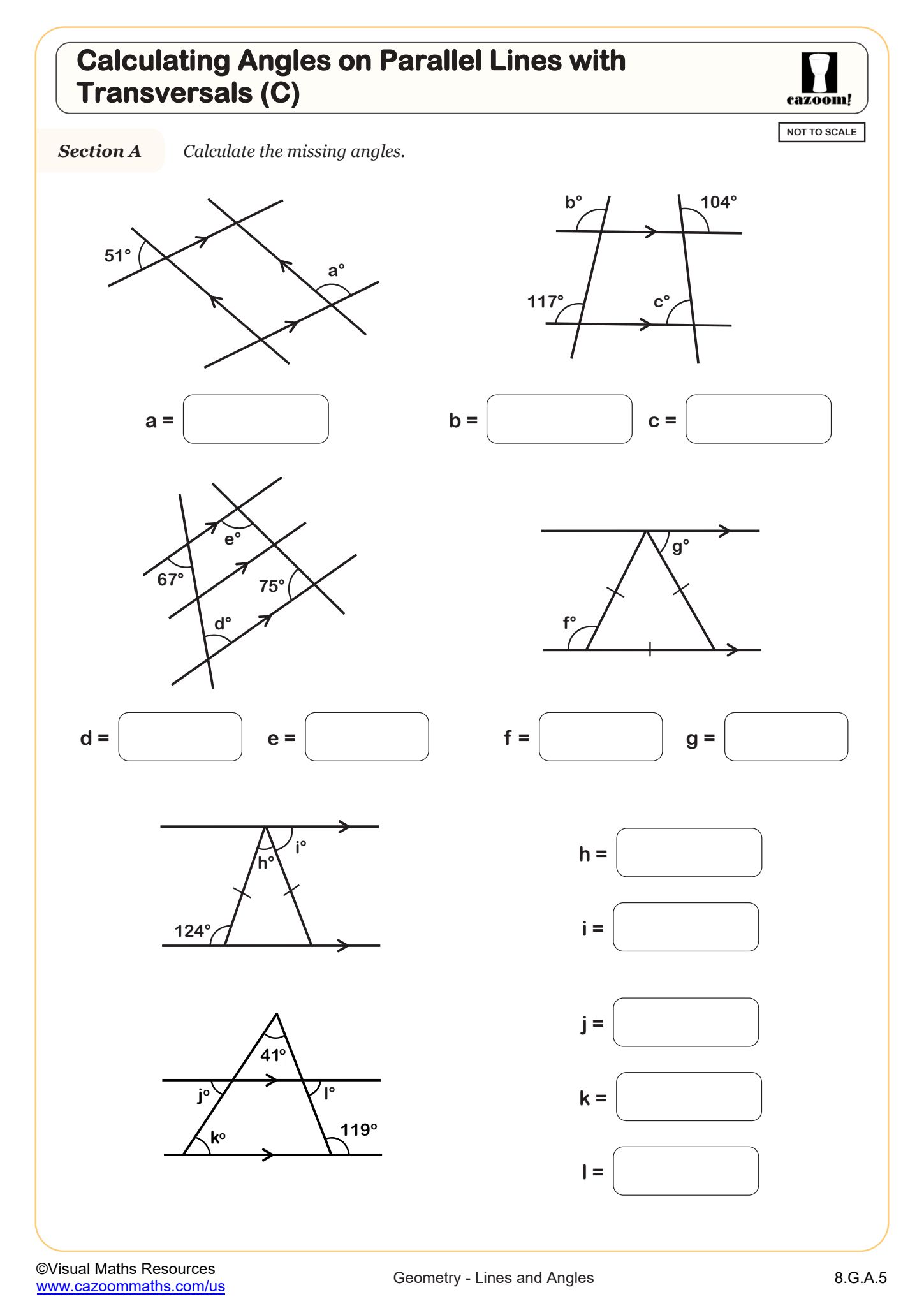
Calculating Angles on Parallel Lines with Transversals (C)
Grades: 8th Grade
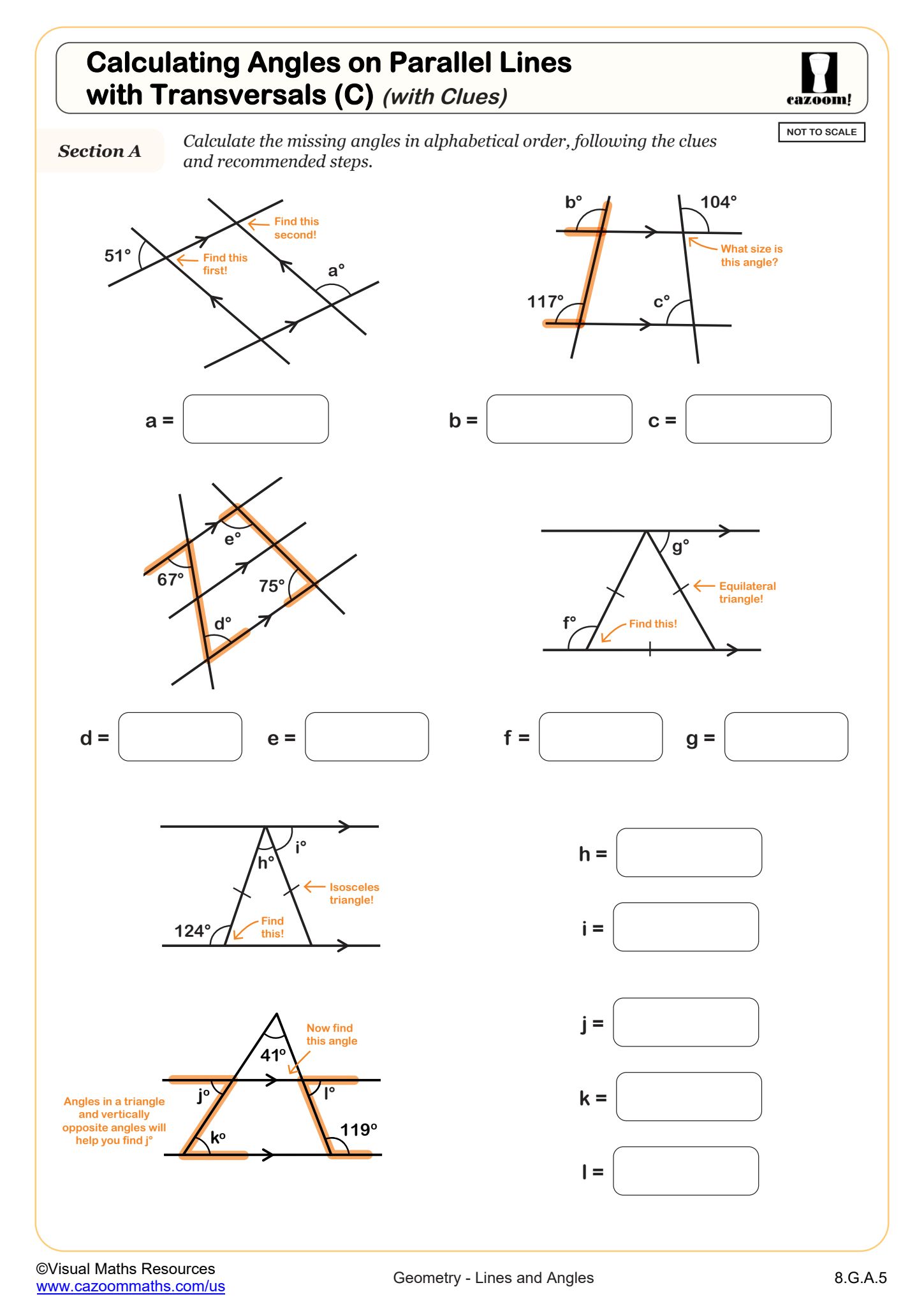
Calculating Angles on Parallel Lines with Transversals (C) (with clues)
Grades: 8th Grade
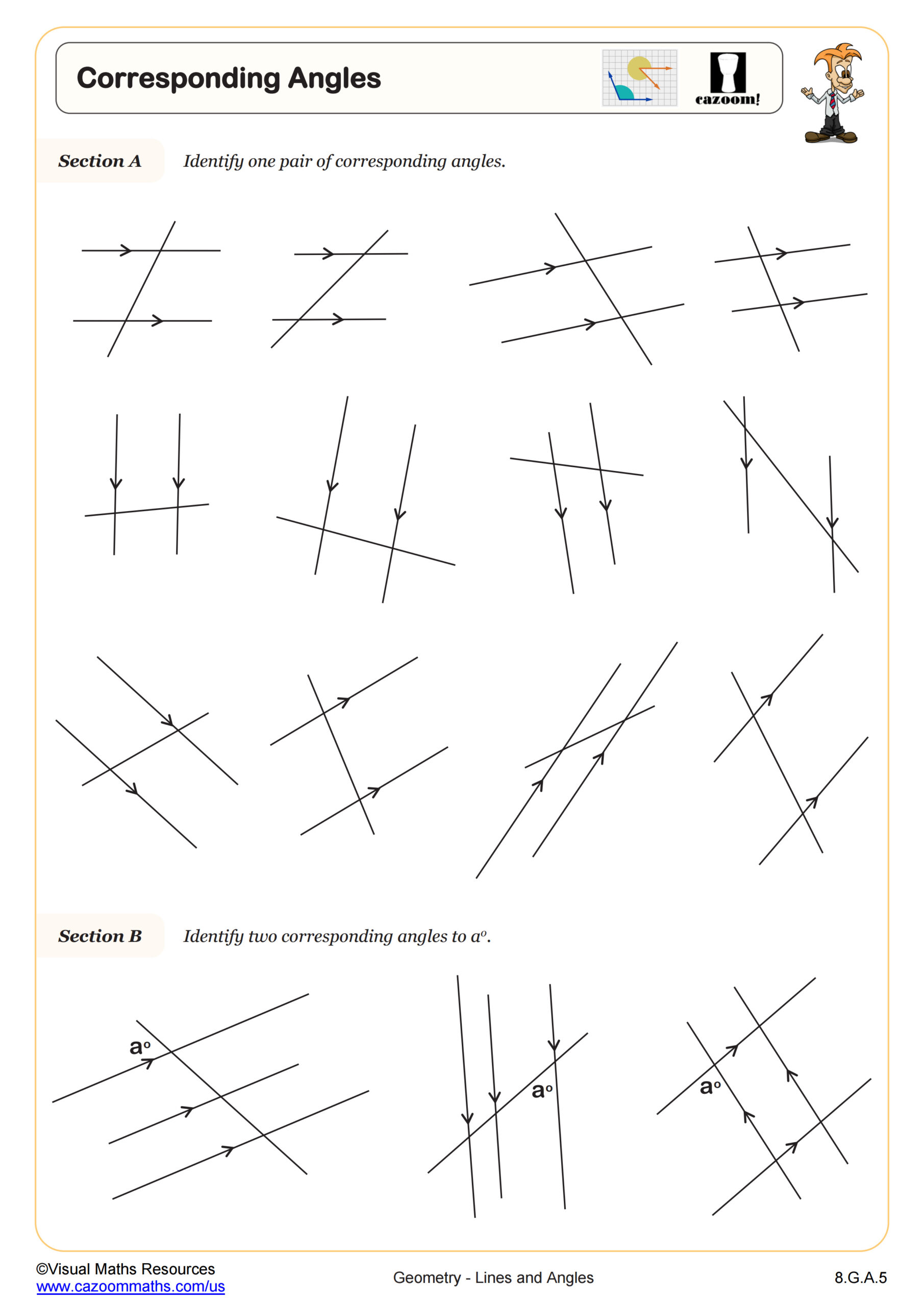
Corresponding Angles
Grades: 8th Grade
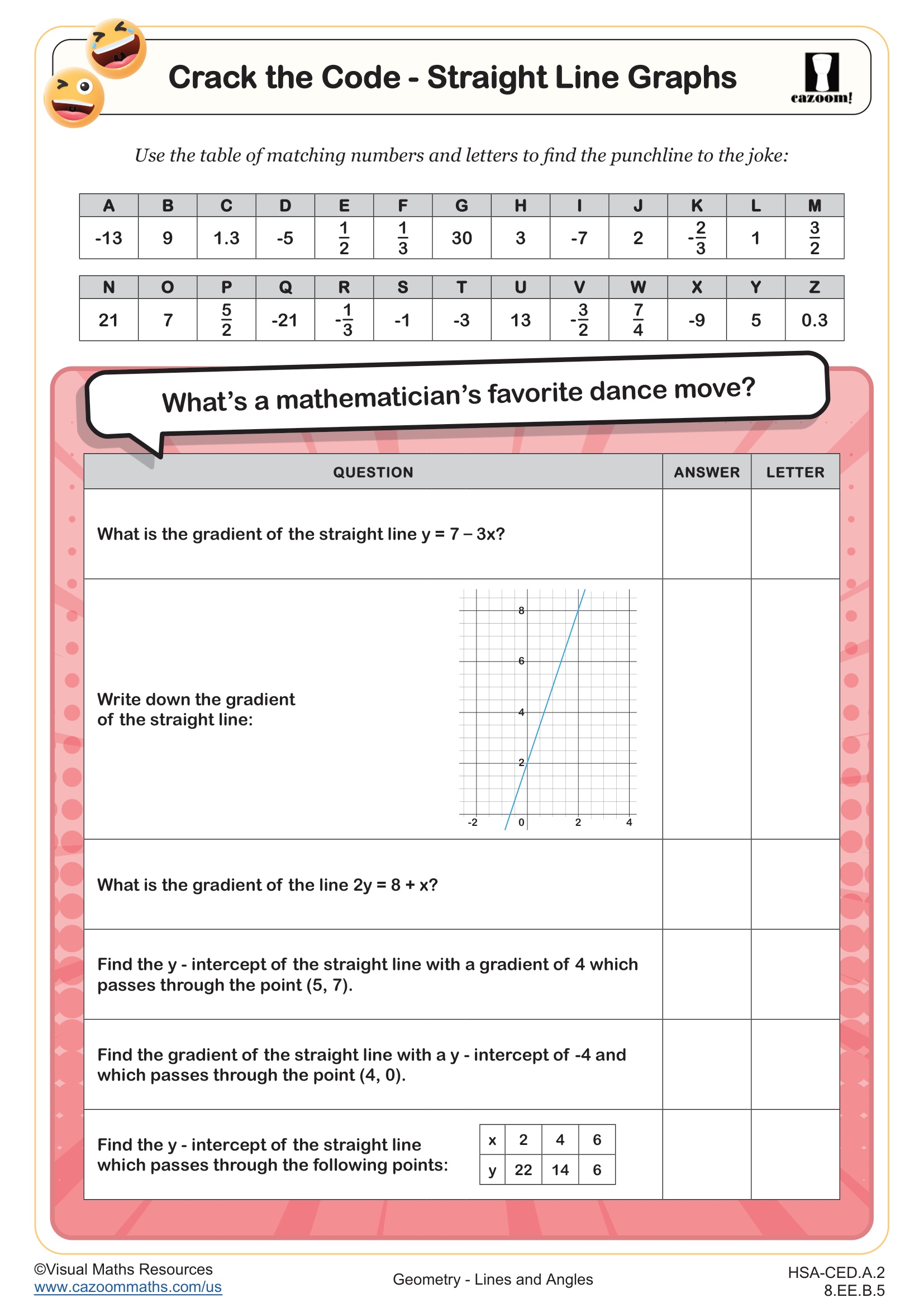
Crack the Code - Straight Line Graphs
Grades: 8th Grade, Algebra I
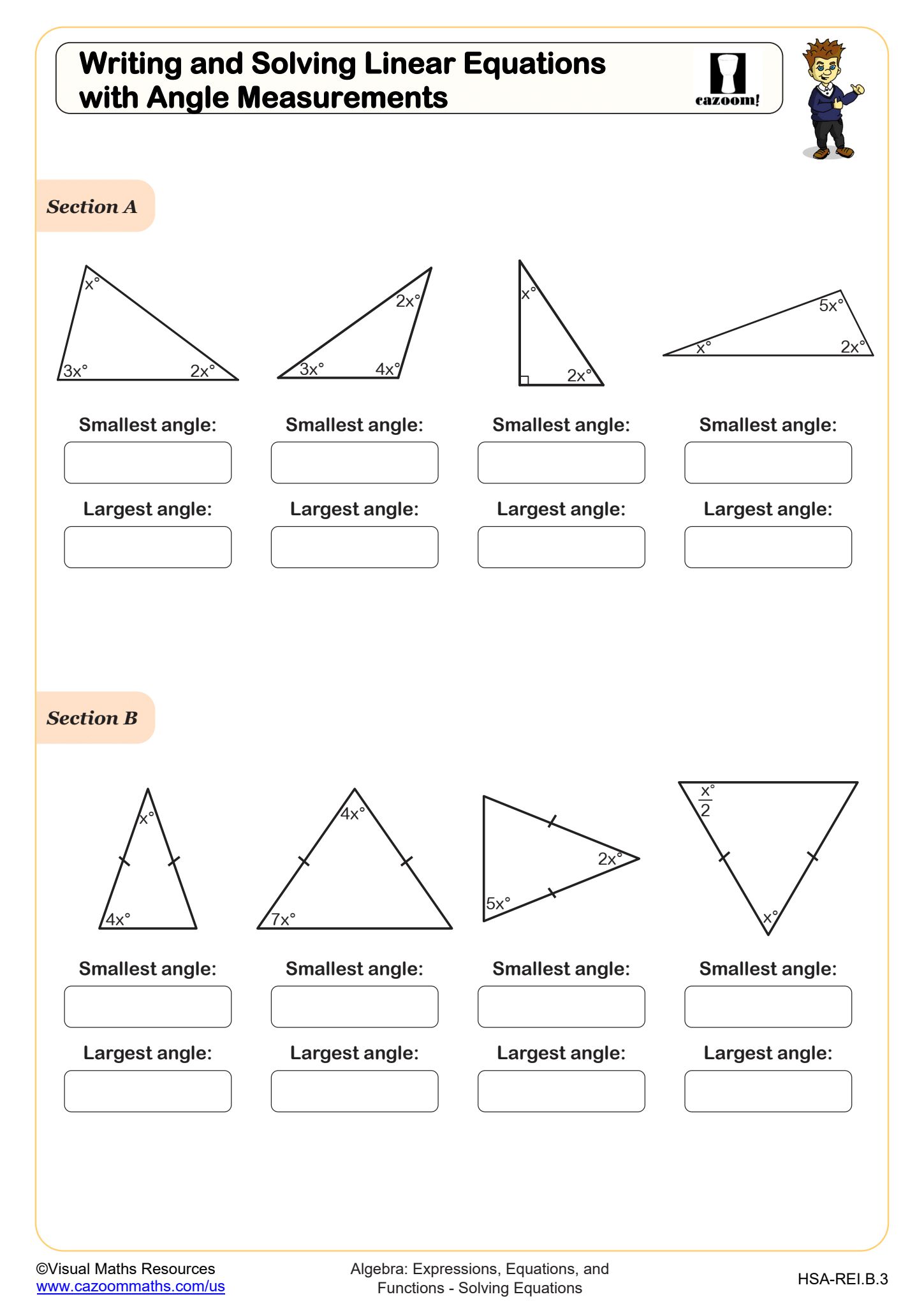
Writing and Solving Linear Equations with Angle Measurements
Grades: Algebra I, IM 1
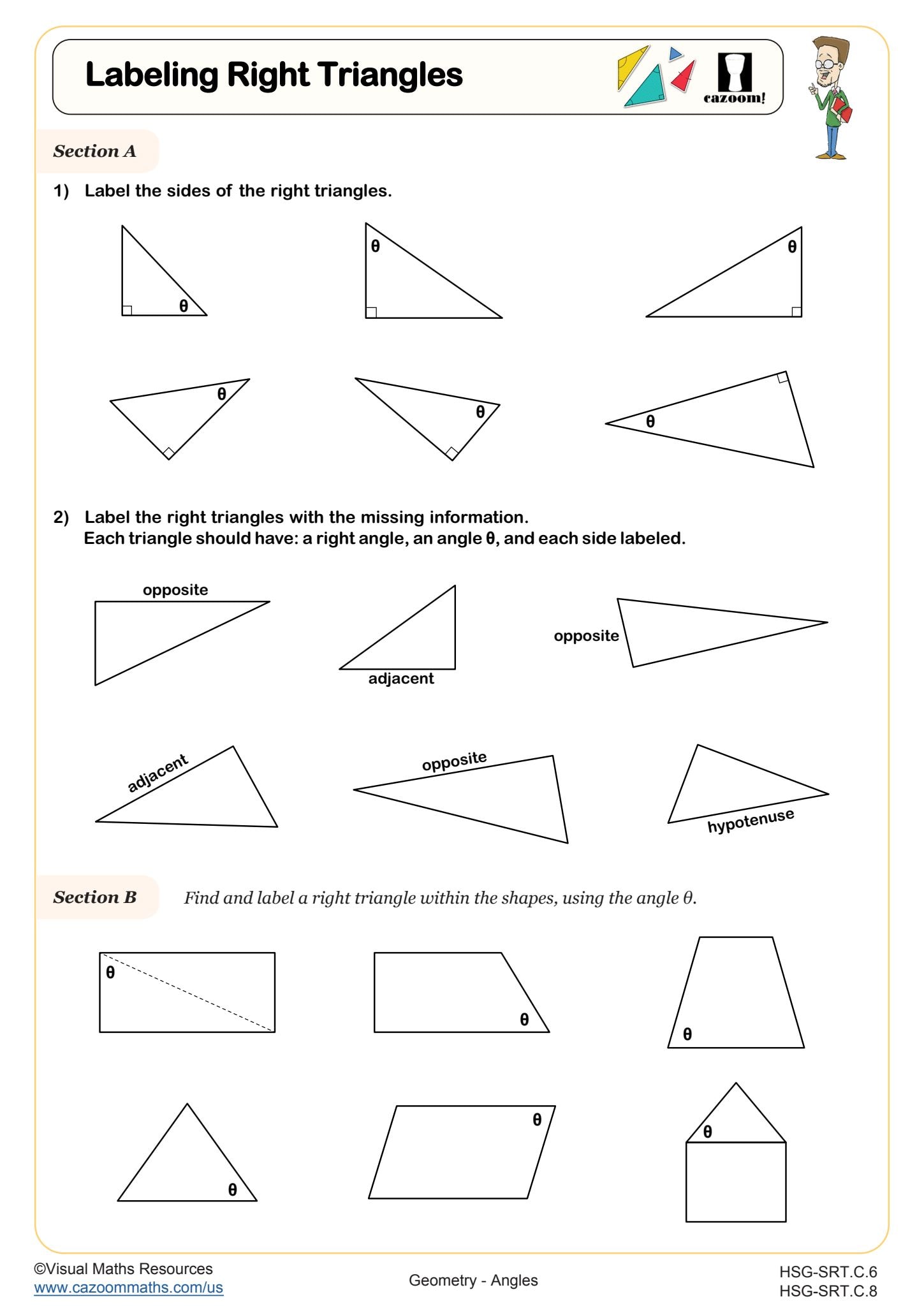
Labeling Right Triangles
Grades: Geometry, IM 3
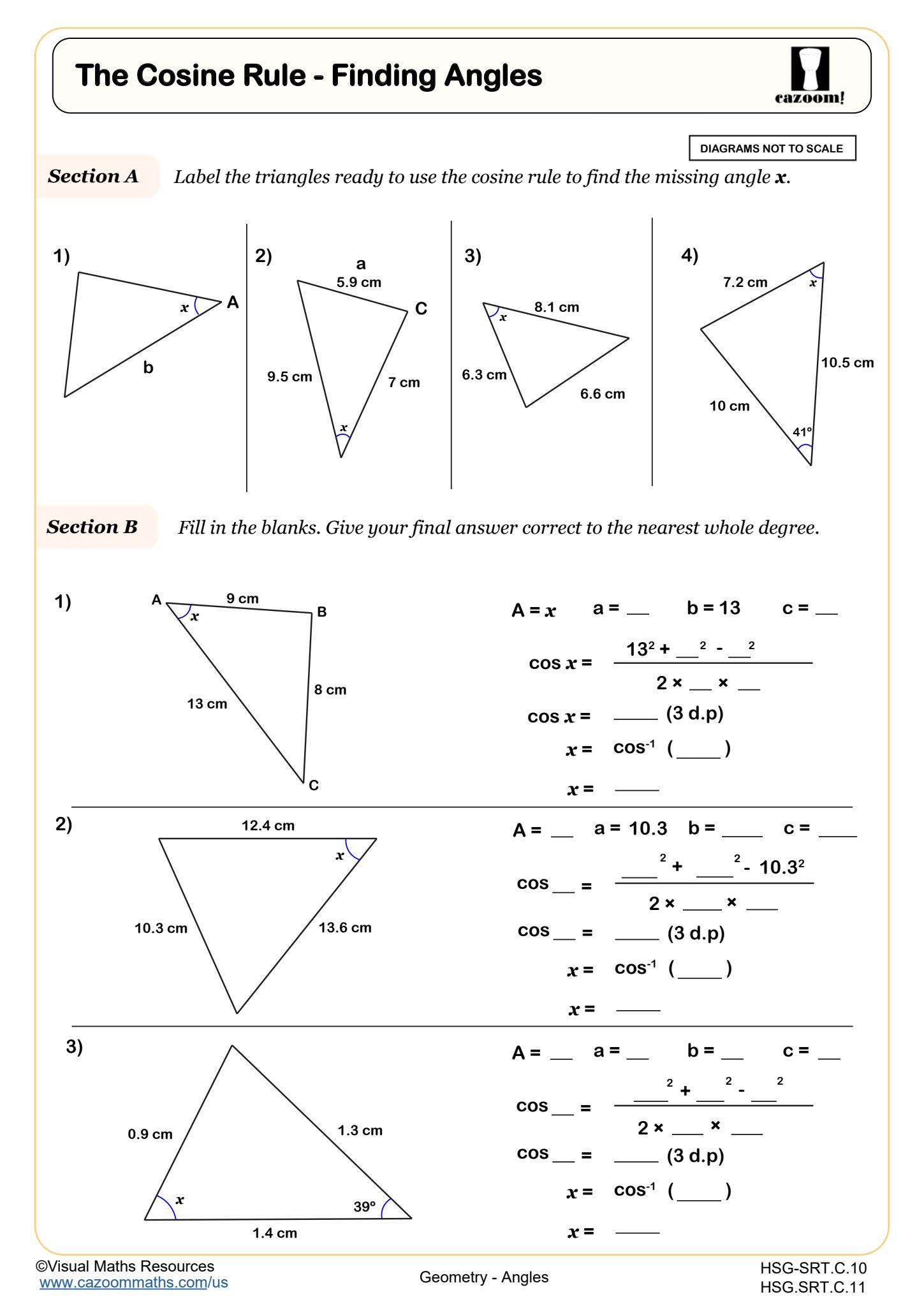
The Cosine Rule - Finding Angles
Grades: Geometry, IM 3
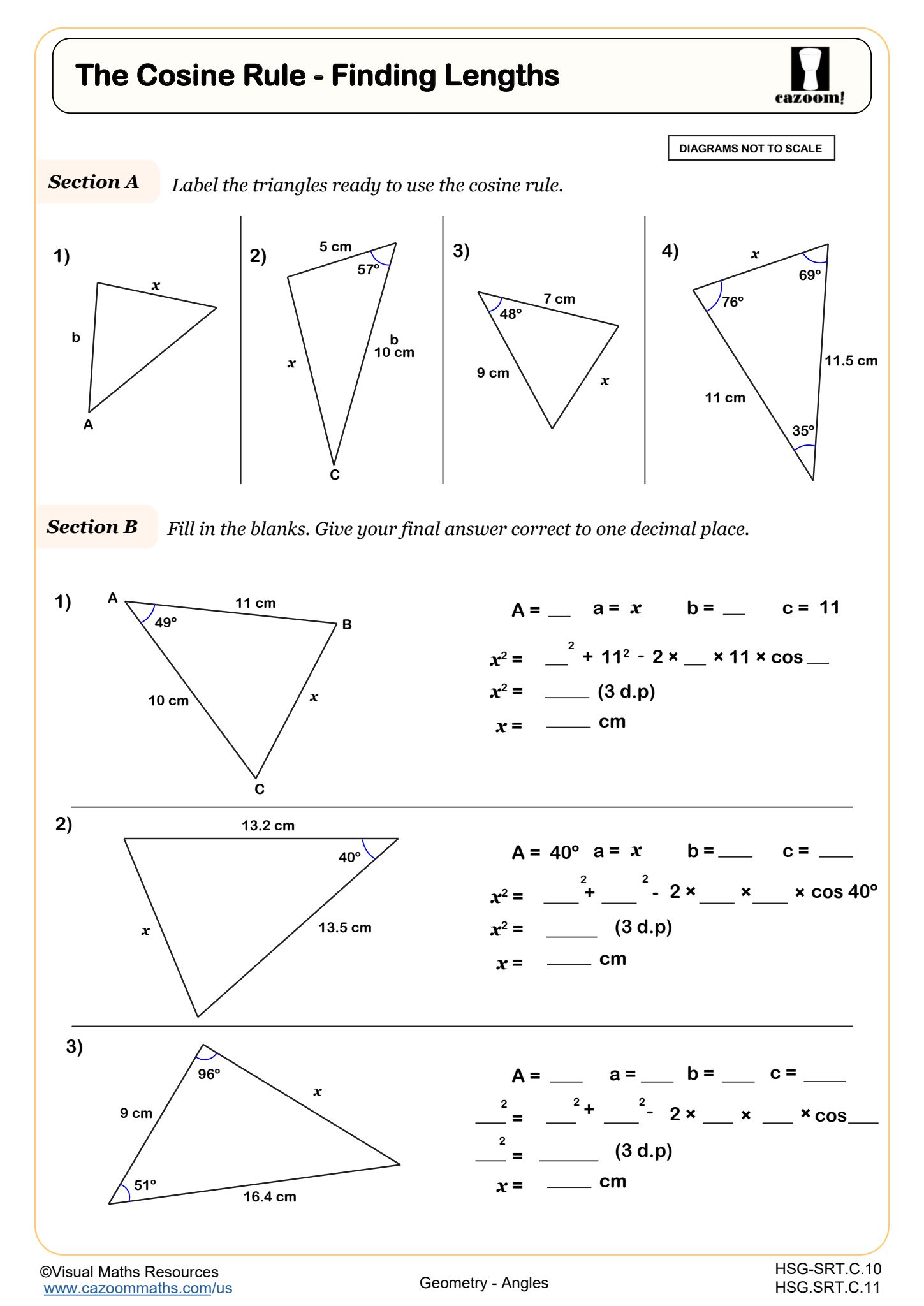
The Cosine Rule - Finding Lengths
Grades: Geometry, IM 3
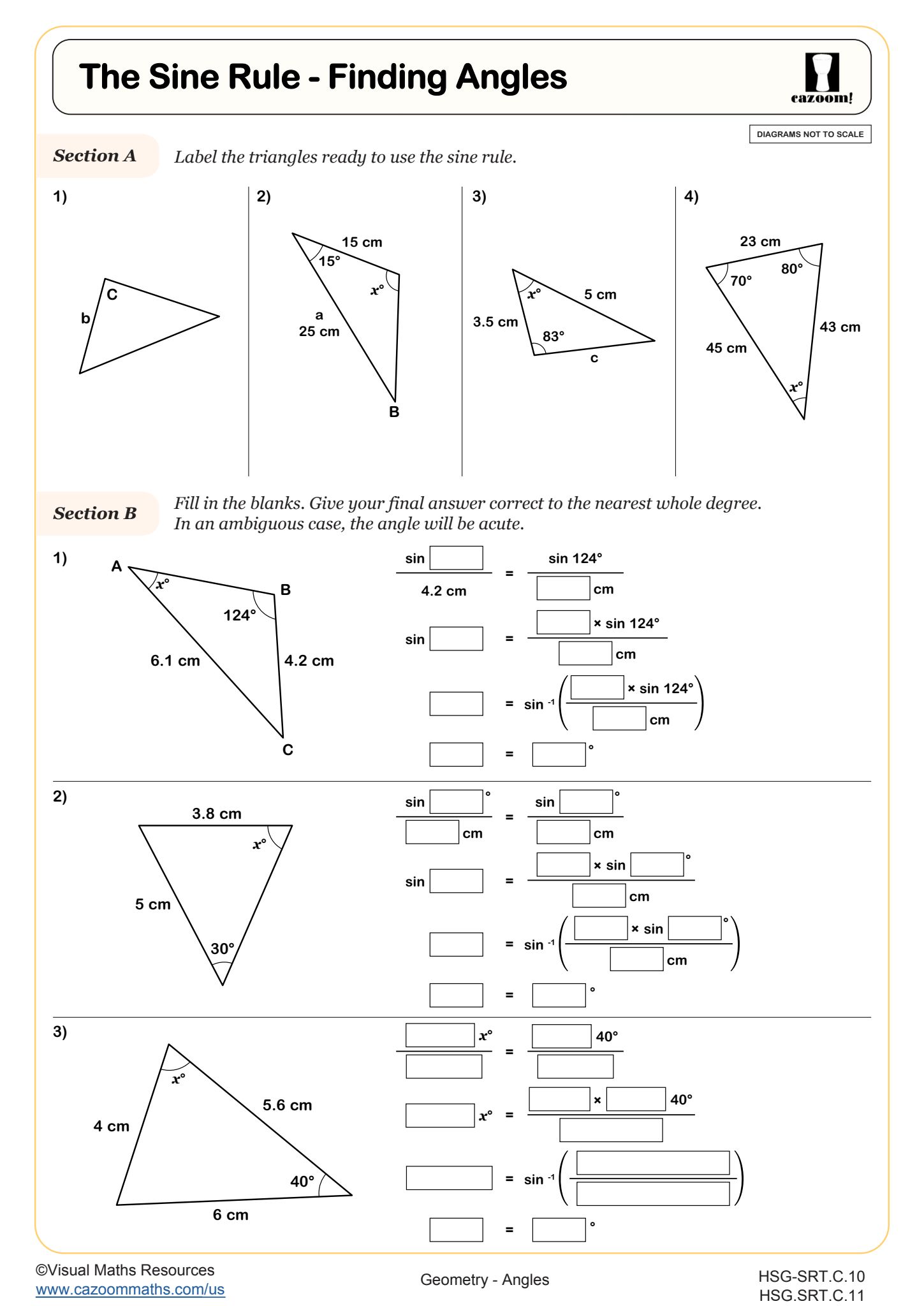
The Sine Rule - Finding Angles
Grades: Geometry, IM 3
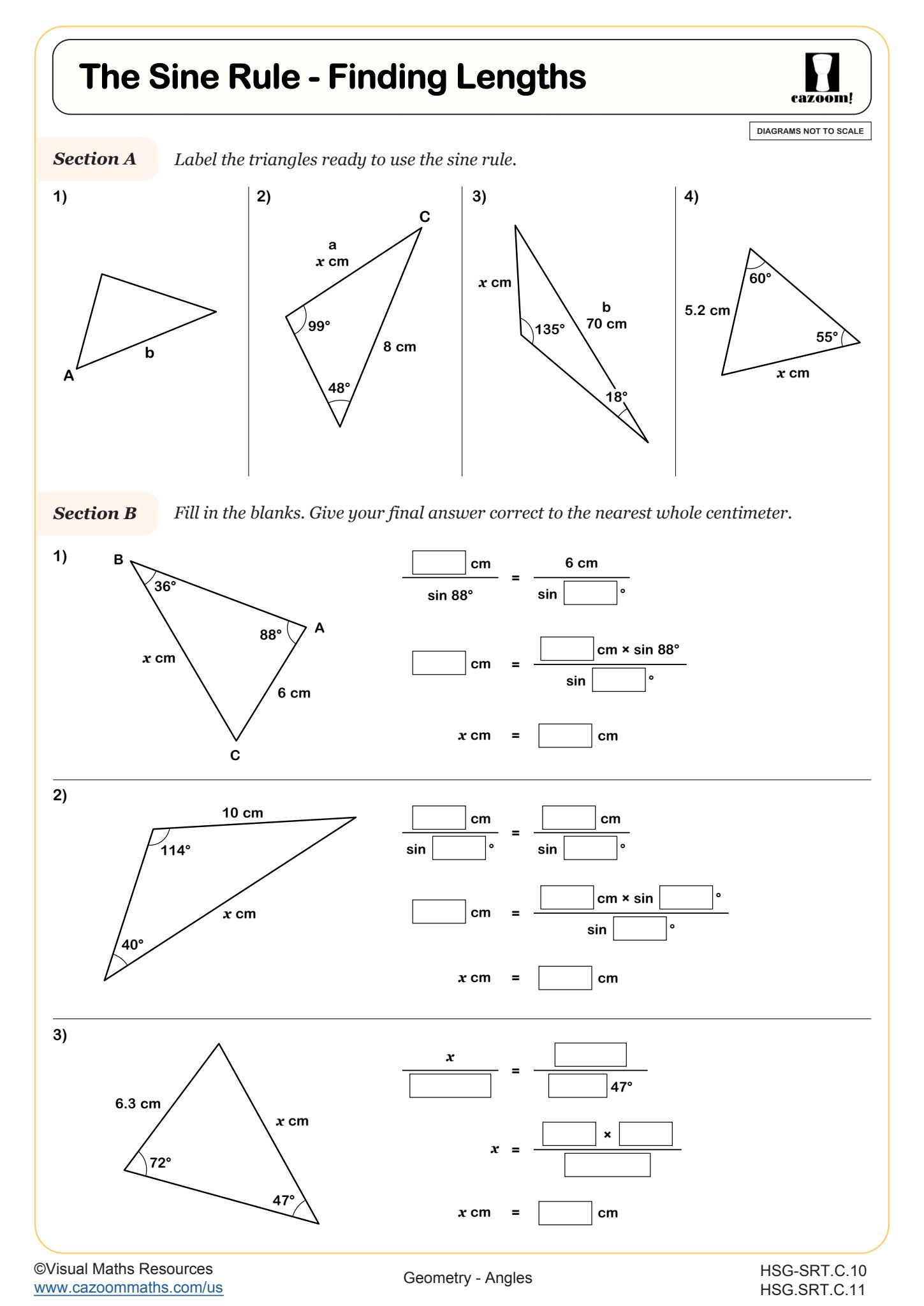
The Sine Rule - Finding Lengths
Grades: Geometry, IM 3
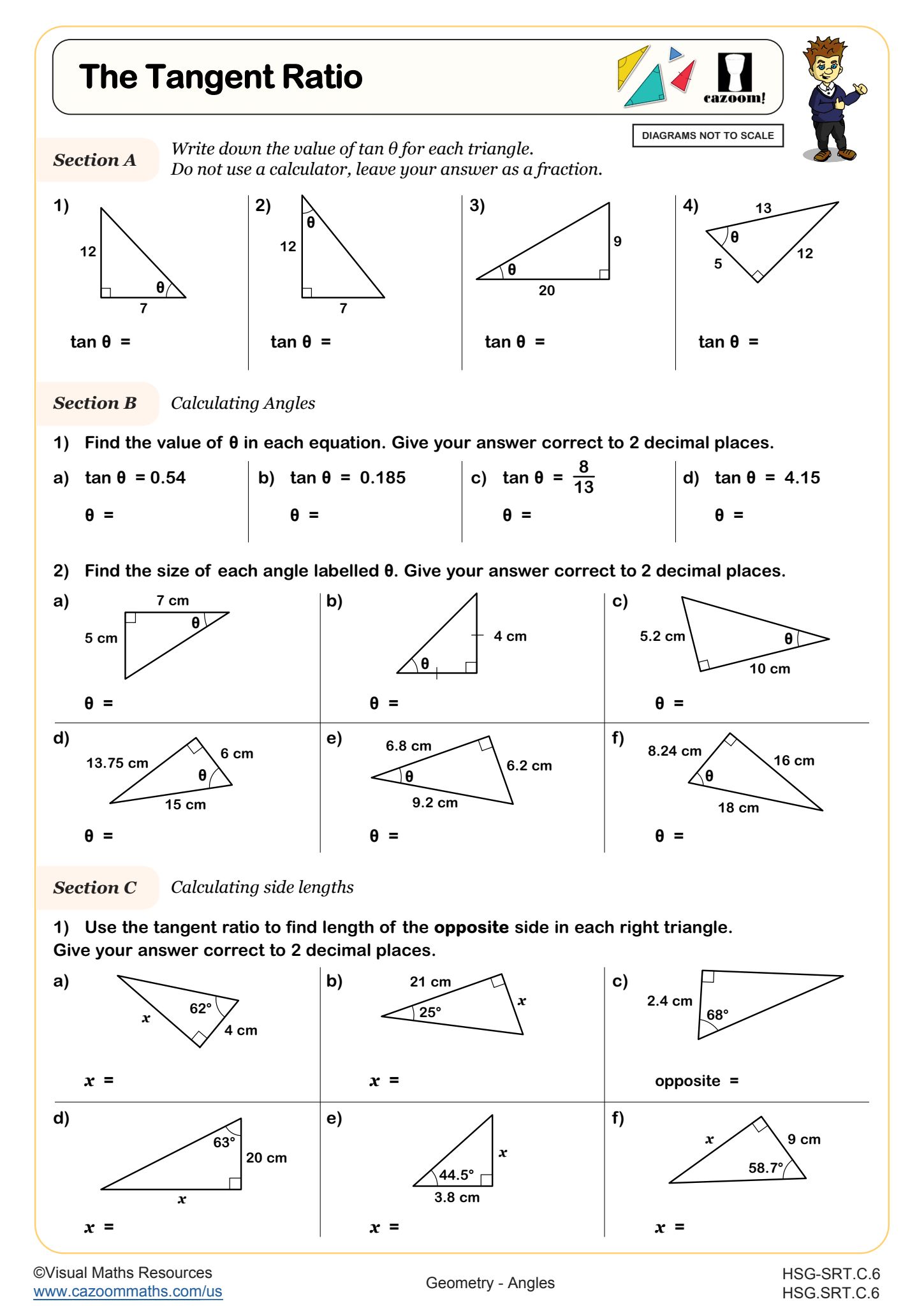
The Tangent Ratio
Grades: Geometry, IM 2
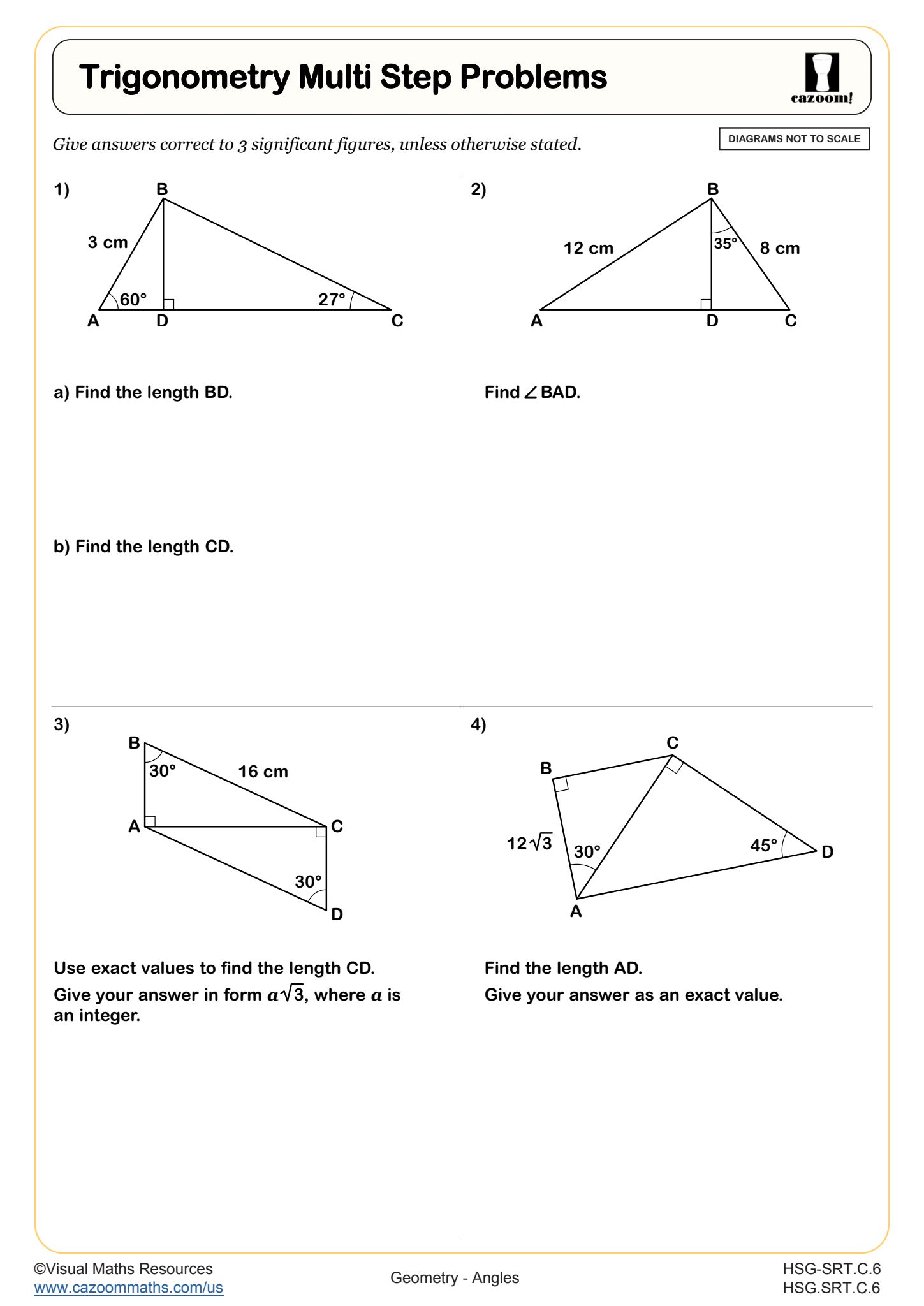
Trigonometry Multi Step Problems
Grades: Geometry, IM 2
All worksheets are created by the team of experienced teachers at Cazoom Math.
Where can Teachers find calculating angles on parallel lines with transversals (c) answers?
All worksheets in this collection include complete answer keys with step-by-step solutions, including calculating angles on parallel lines with transversals c answers for the most challenging problems. These detailed solutions align with Common Core geometry standards for middle and high school students, showing the logical progression from identifying angle relationships to solving for unknown measures.
Teachers frequently observe that students make errors when they correctly identify angle relationships but struggle with the algebraic steps needed to solve for variables. The answer keys demonstrate proper equation setup and solution methods, helping students understand both the geometric concepts and the computational skills required for success on assessments.
What grade levels use these lines and angles worksheets?
Lines and angles worksheets serve students from 4th grade through high school, with content complexity increasing across grade levels. Elementary students work with basic angle identification and measurement, while middle school students tackle parallel lines with transversals and angle relationships. High school geometry courses use these materials for formal proof preparation and advanced problem-solving.
The progression follows Common Core standards carefully, introducing concepts like calculating angles on parallel lines with transversals (a) answers in 8th grade before advancing to more complex scenarios. Teachers appreciate having materials that can differentiate instruction within the same classroom, allowing advanced students to work on calculating angles on parallel lines with transversals (b) answers while others master foundational concepts.
How do students apply interior and exterior angles of polygons worksheet problem 3 concepts?
Interior and exterior angles of polygons connect directly to real-world applications in architecture, engineering, and design fields where professionals calculate structural angles and create precise geometric patterns. Students learn that interior angles of any polygon follow predictable formulas, while exterior angles always sum to 360 degrees regardless of the polygon's shape.
Many teachers notice that students initially struggle with the relationship between interior and exterior angles at the same vertex, often adding them incorrectly instead of recognizing they form linear pairs. The worksheets provide scaffolded practice that builds from simple triangles and quadrilaterals to complex polygons, helping students internalize these fundamental relationships before moving to more advanced geometric proofs.
How should teachers use these angle calculation worksheets most effectively?
Effective implementation starts with diagnostic assessment to identify which students need foundational angle vocabulary versus those ready for complex transversal problems. Teachers report success when they use the worksheets as guided practice after introducing concepts through hands-on activities with protractors and geometric software, then assign independent practice based on individual student needs.
The answer keys serve multiple purposes beyond grading - they provide models for mathematical communication and help teachers identify common misconceptions during formative assessment. Many educators use these materials for exit tickets, homework assignments, and review sessions before state assessments, particularly appreciating the variety of problem types that mirror standardized test formats while building conceptual understanding.
Introducing Lines, Line Segments, and Rays
A line is a straight path of points that has no beginning or ending. Line segment is a part of a line that has two endpoints. A ray on the other hand is a portion of a line that has one end point and extends forever in the other direction.
What are Intersecting Lines?
When two or more lines cross each other in a plane they are called intersecting lines. They share a common point which is called a point of intersection. They can cross one another at any angle.