Pythagorean Theorem Worksheets with Answers
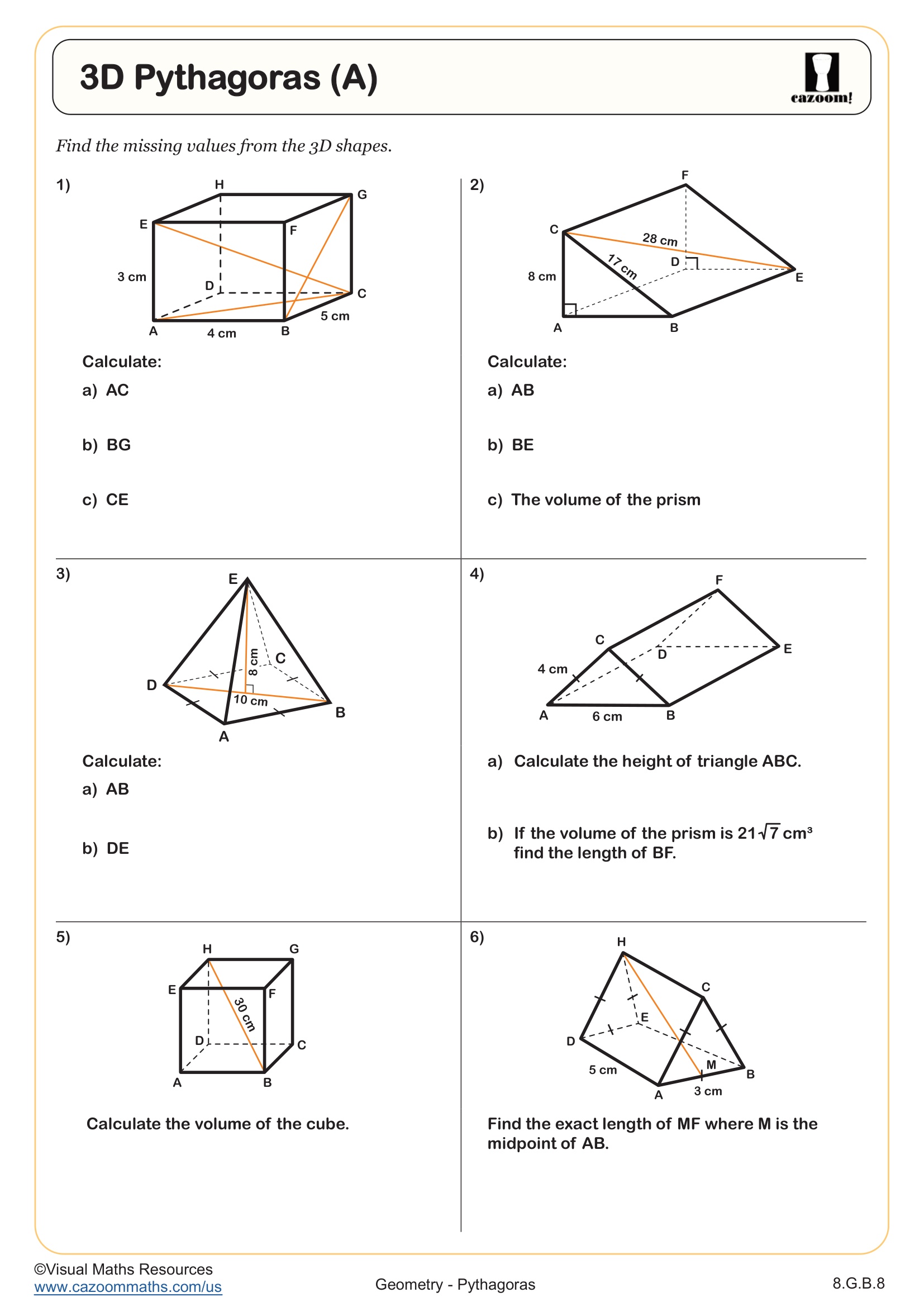
3D Pythagoras (A)
Grades: 8th Grade, Geometry, IM 1
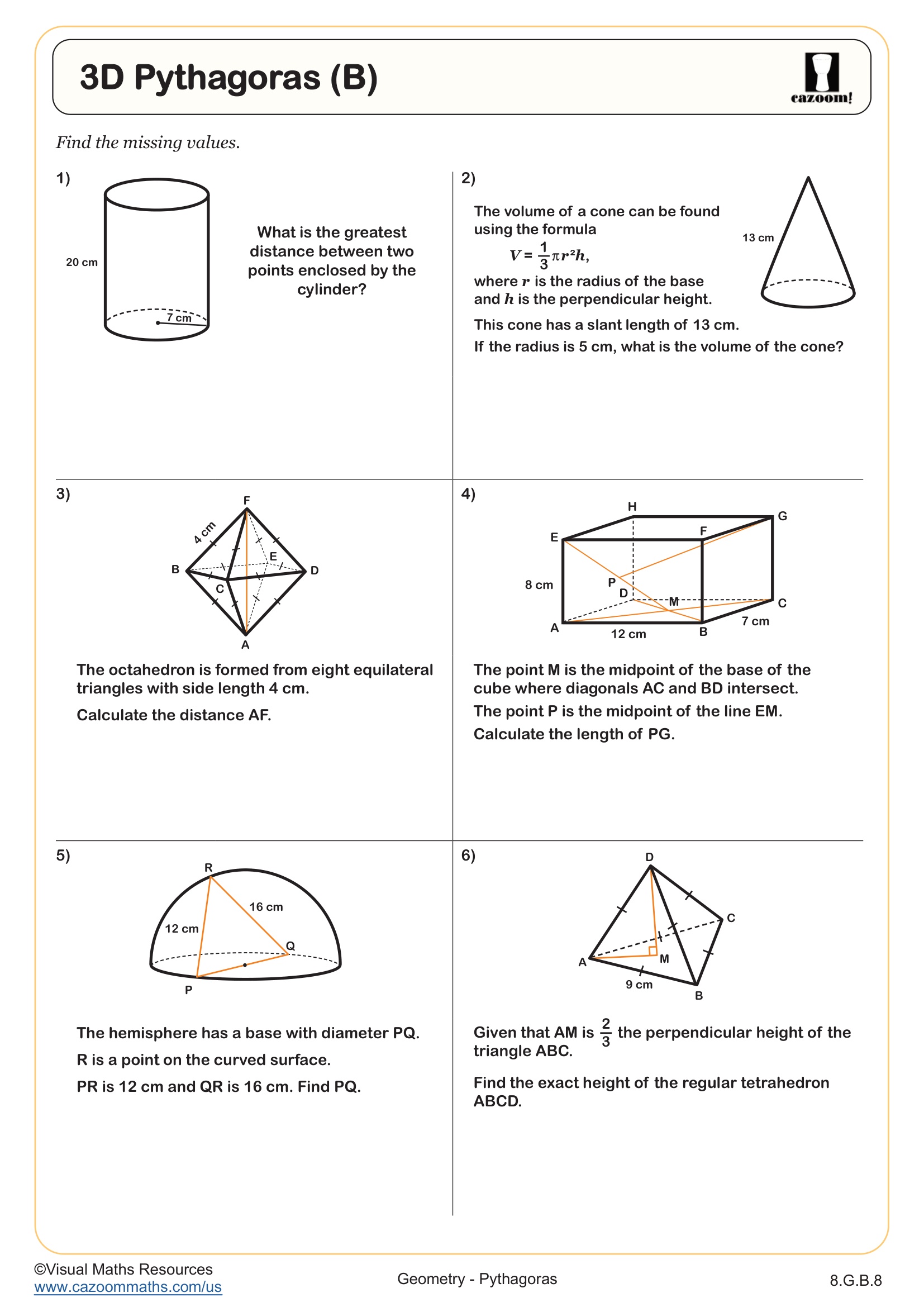
3D Pythagoras (B)
Grades: 8th Grade, Geometry, IM 1
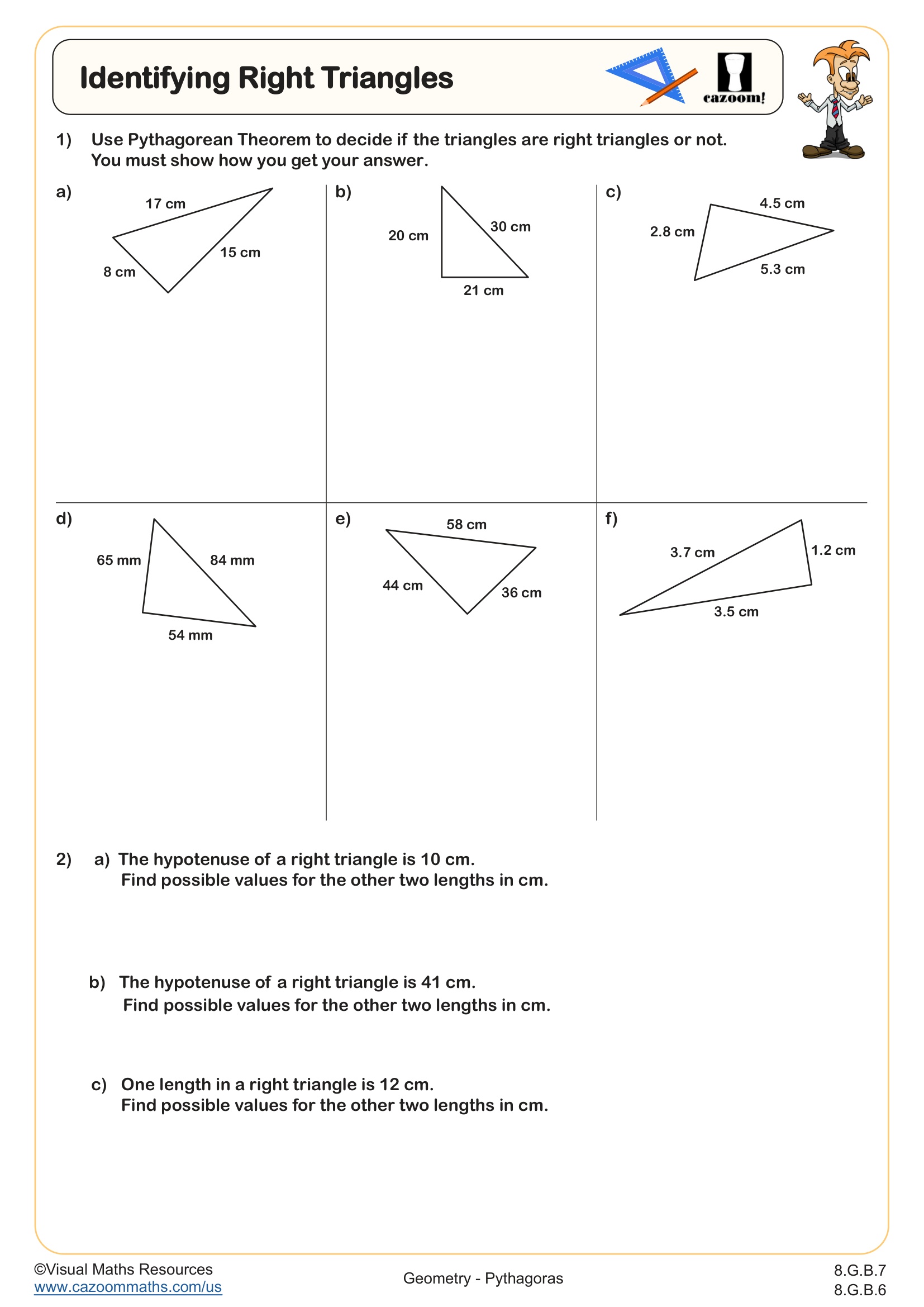
Identifying Right Triangles
Grades: 8th Grade
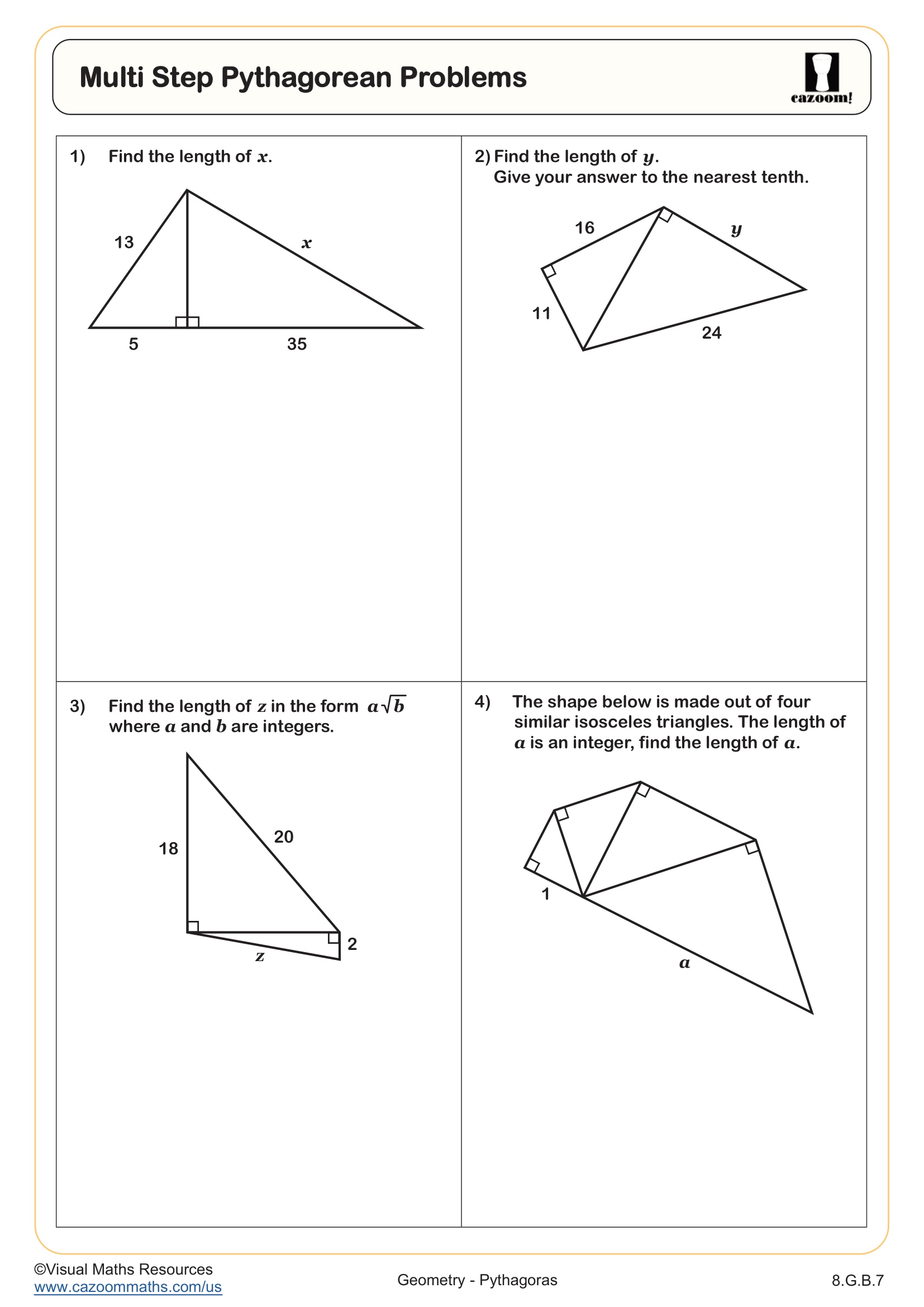
Multi Step Pythagorean Problems
Grades: 8th Grade, Geometry, IM 1
Pythagorean Theorem and coordinates
Grades: 8th Grade, Geometry, IM 1
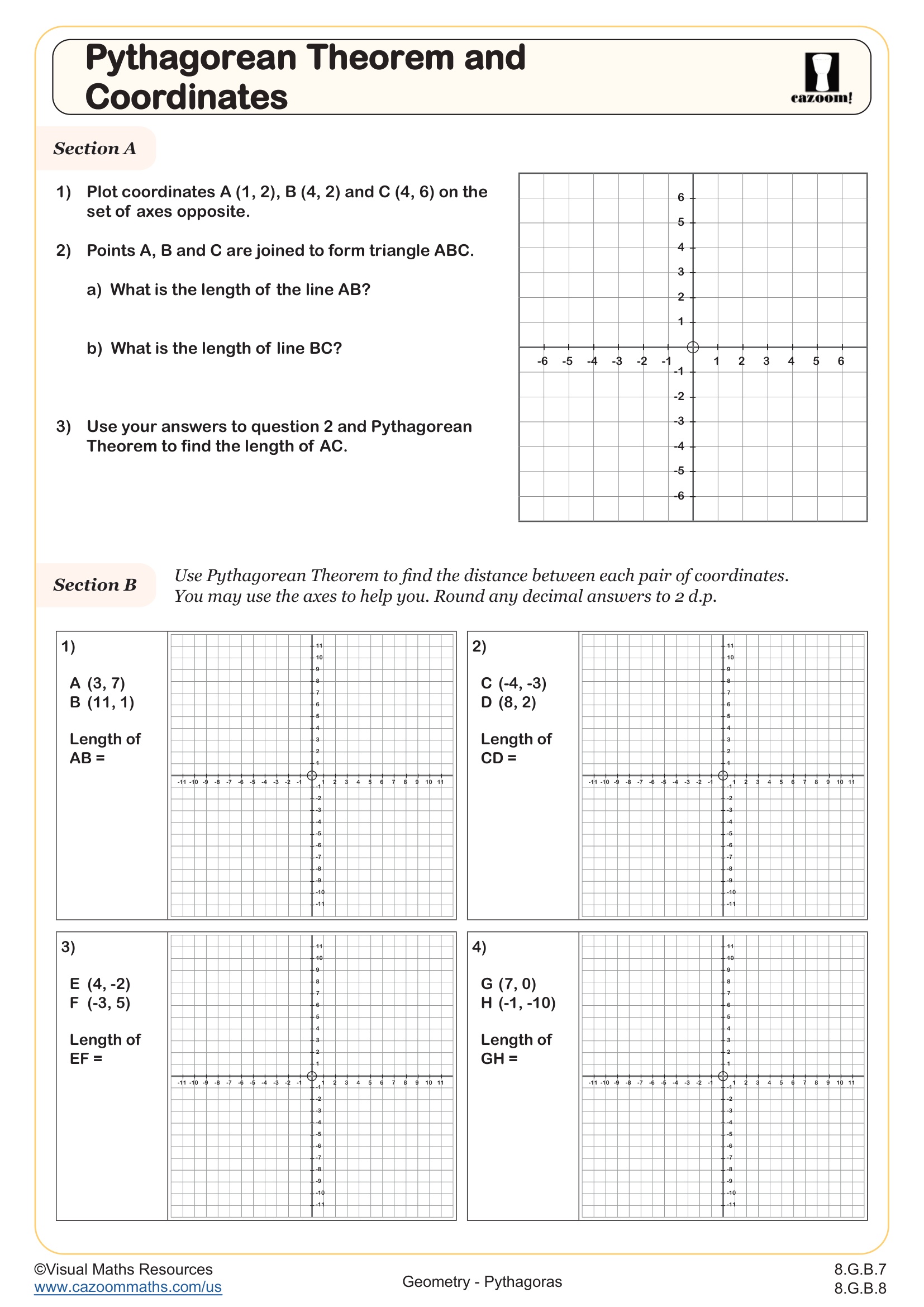
Pythagorean Theorem Word Problems
Grades: 8th Grade
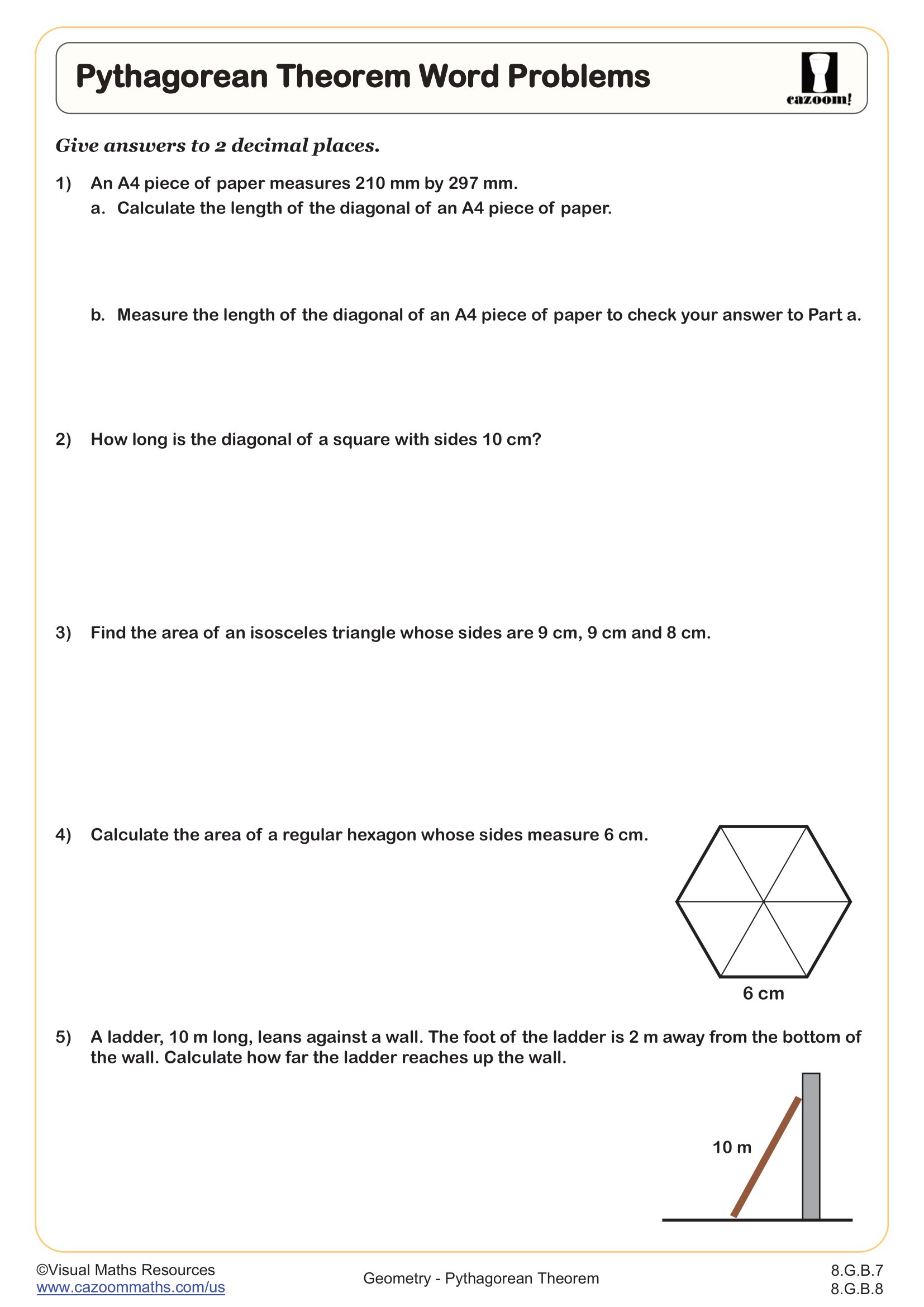
Pythagorean Theorem Word Problems (with clues)
Grades: 8th Grade
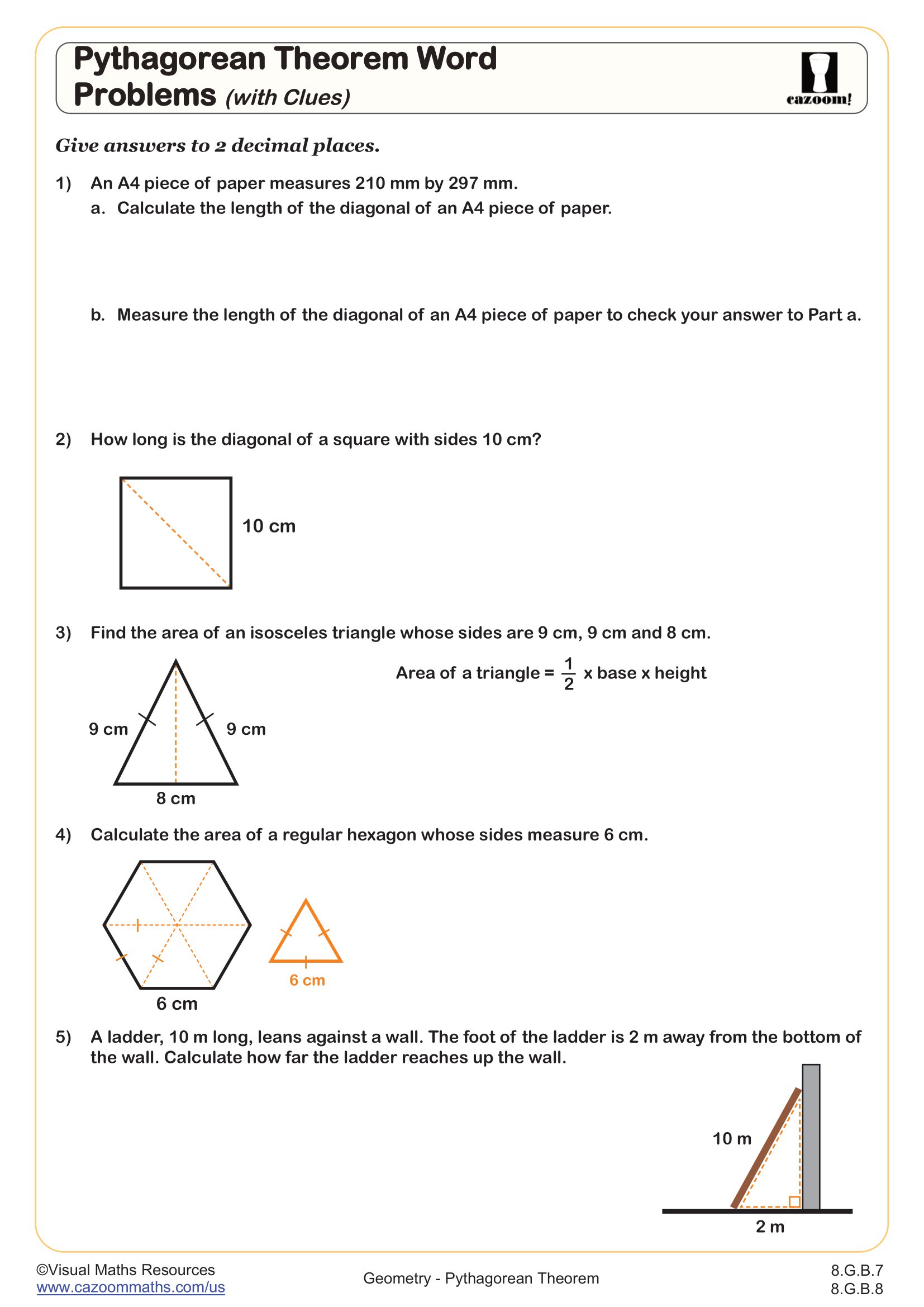
Pythagorean Theorem: Calculating Missing Side Lengths
Grades: 8th Grade
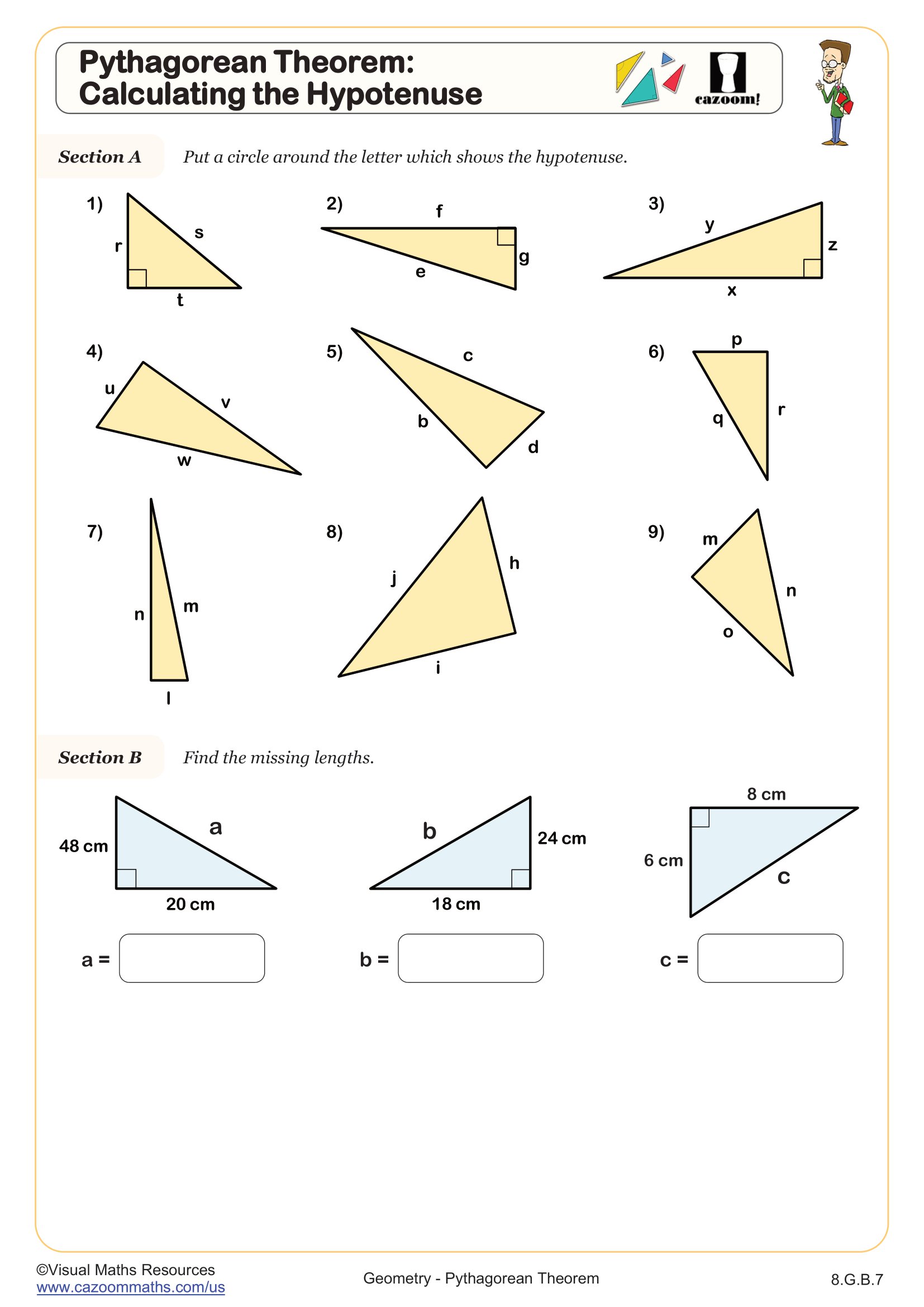
Pythagorean Theorem: Calculating the Hypotenuse
Grades: 8th Grade
All worksheets are created by the team of experienced teachers at Cazoom Math.
What types of problems are included in a pythagorean theorem worksheet?
A quality pythagorean theorem worksheet typically includes finding missing side lengths in right triangles, determining whether three given lengths can form a right triangle, and applying the theorem to real-world scenarios. These worksheets align with Common Core standards 8.G.B.7 and 8.G.B.8, which require students to apply the pythagorean theorem to solve mathematical and real-world problems.
Teachers report that students often get confused when asked to find a leg rather than the hypotenuse, leading to incorrect setups like a² + c² = b² instead of a² + b² = c². Many worksheets include visual cues and consistent labeling to help students identify the correct formula arrangement for each problem type.
Which grade levels should use pythagorean theorem worksheets?
The pythagorean theorem is formally introduced in 8th grade mathematics according to Common Core standards, making 8th grade pythagorean theorem worksheet resources particularly valuable. However, many teachers find success introducing the concept conceptually in 7th grade through hands-on activities before moving to computational practice. High school geometry and Algebra II courses revisit the theorem in more complex contexts.
Advanced middle school students often benefit from pythagoras theorem applications in coordinate geometry and three-dimensional problems, while struggling students may need additional practice with basic right triangle identification and perfect square recognition before attempting more complex calculations involving irrational numbers.
How do pythagorean shapes help students understand the theorem?
Pythagorean shapes refer to right triangles with integer side lengths, also known as Pythagorean triples like 3-4-5, 5-12-13, and 8-15-17. These special triangles help students verify their understanding without getting bogged down in decimal approximations or complex square root calculations. Teachers use these shapes to build confidence before introducing problems with irrational solutions.
Many students initially memorize common Pythagorean triples without understanding the underlying relationship, which becomes problematic when they encounter scaled versions like 6-8-10 or 9-12-15. Effective worksheets include both basic triples and their multiples to help students recognize patterns and develop number sense around pythagorean mathematics concepts.
What makes pythagorean theorem worksheets effective for homework and practice?
Effective pythagorean theorem worksheets provide clear diagrams, consistent notation, and a logical progression from simple to complex problems. Teachers find that students need multiple exposure points to master the concept, making structured homework practice targeted. Worksheets that include both computational problems and word problems help students see connections to real-world applications in construction, navigation, and engineering.
Many teachers supplement traditional math homework help with digital resources, though some search for alternatives to sites like math homework help.pythagorasweb.com.ar when they need more targeted practice materials. The most successful approach combines visual learning with computational practice, ensuring students can both apply the formula mechanically and understand when to use it in authentic problem-solving contexts.