Geometry Transformations Worksheets
Reflection Symmetry
Grades: 4th Grade, 8th Grade
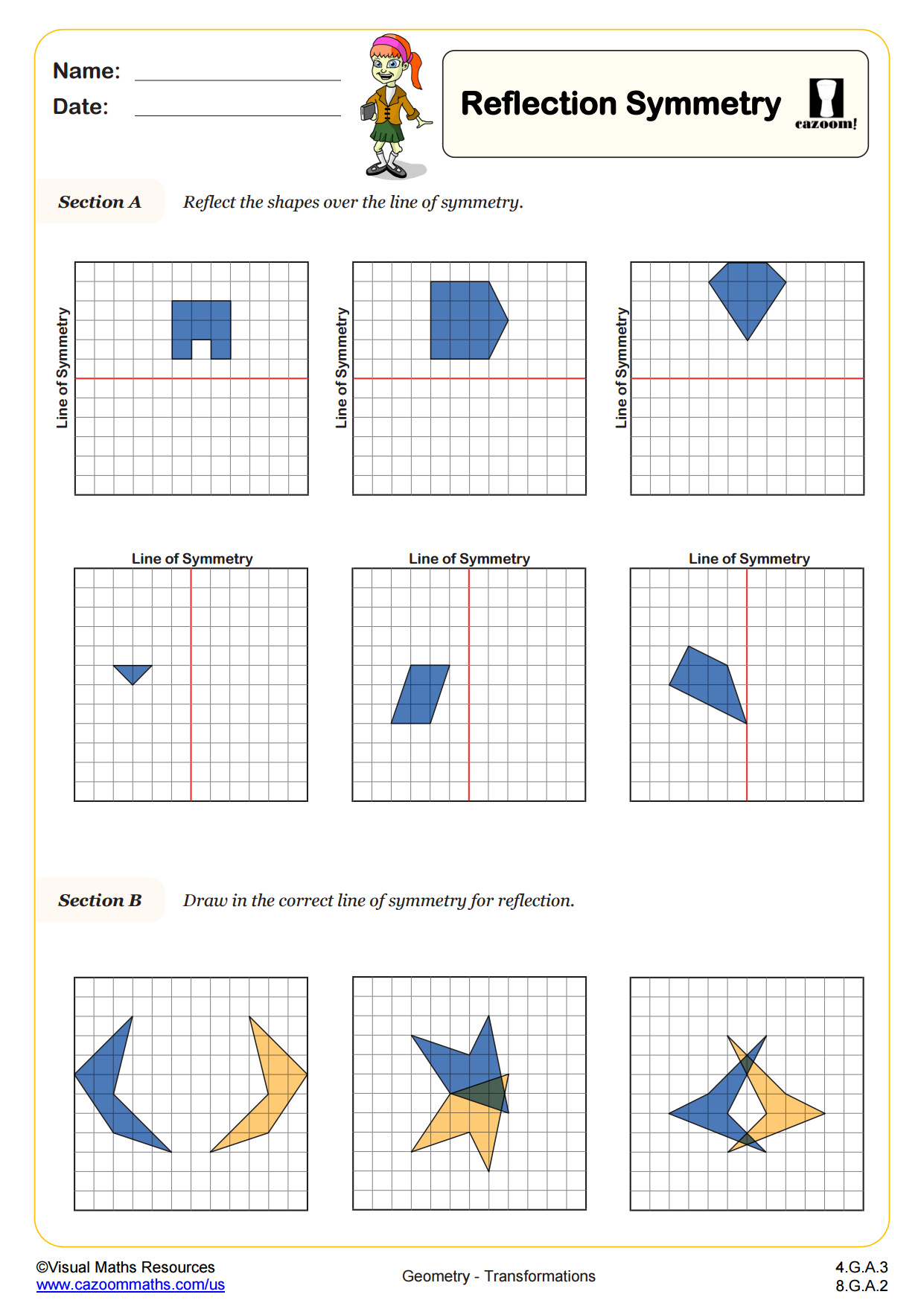
Reflection Symmetry
Grades: 4th Grade, 8th Grade
Translations - In Words
Grades: 4th Grade, 8th Grade
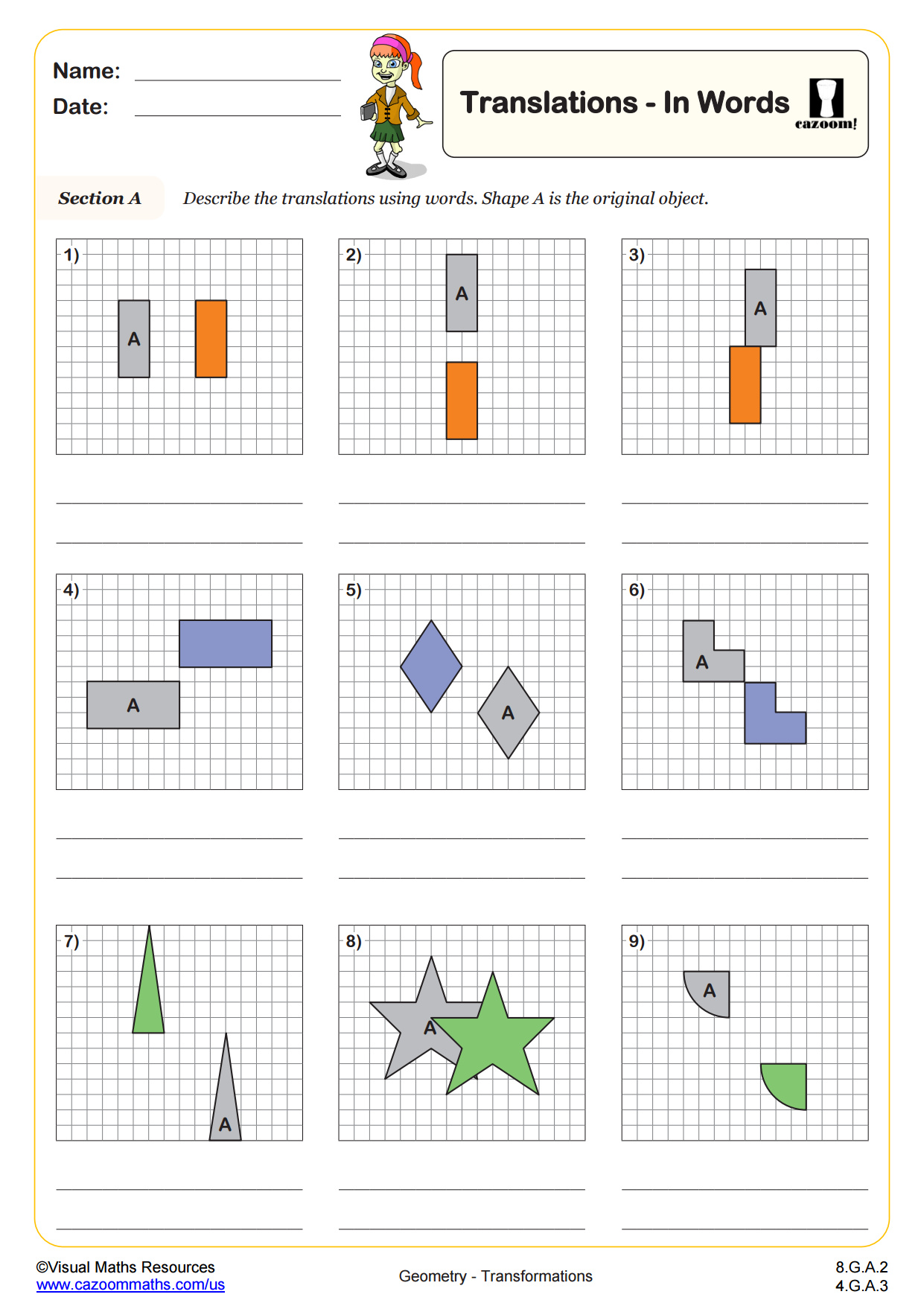
Reflection in X and Y Axes
Grades: 5th Grade, 8th Grade
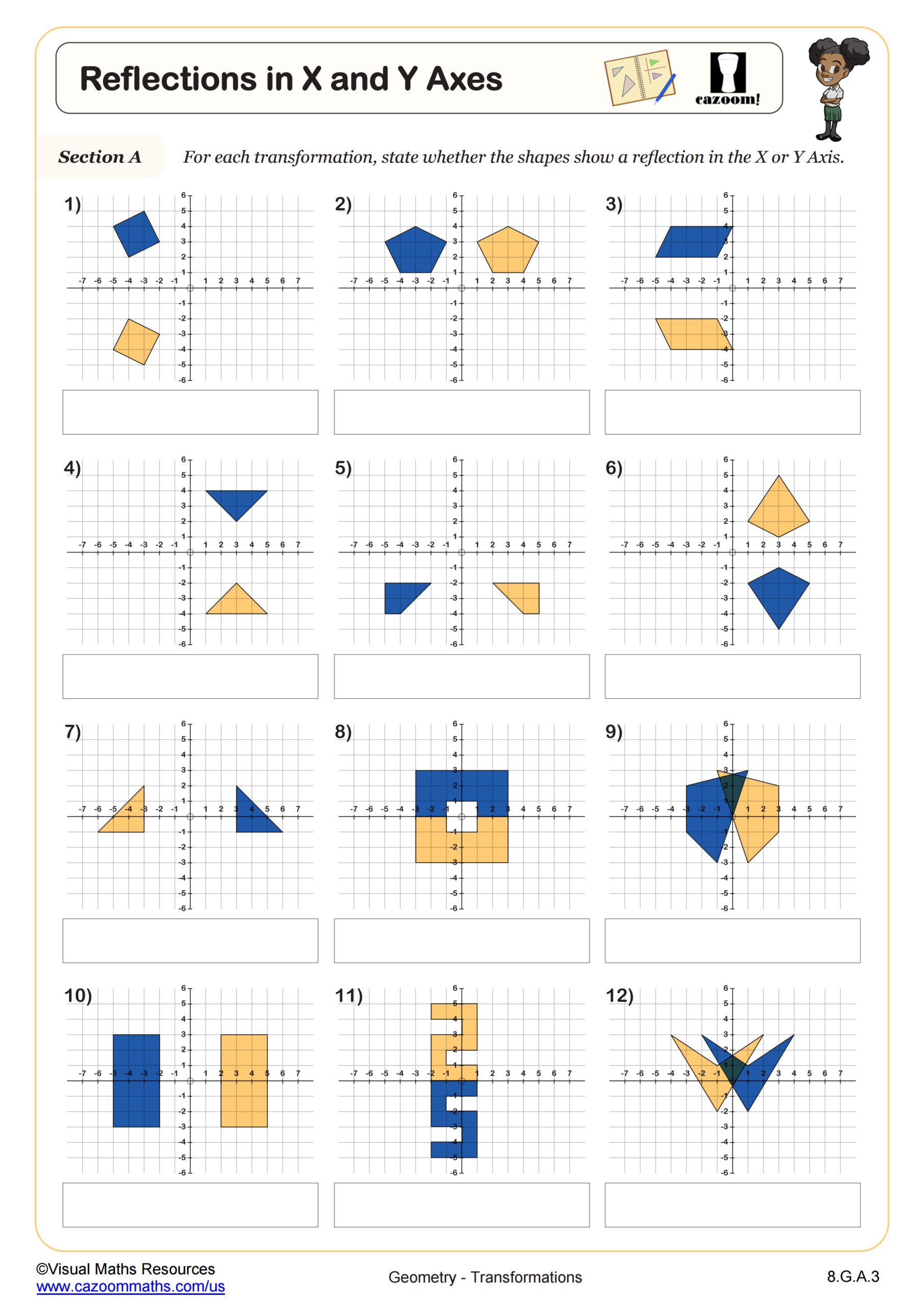
Describing Translations of Figures
Grades: 8th Grade
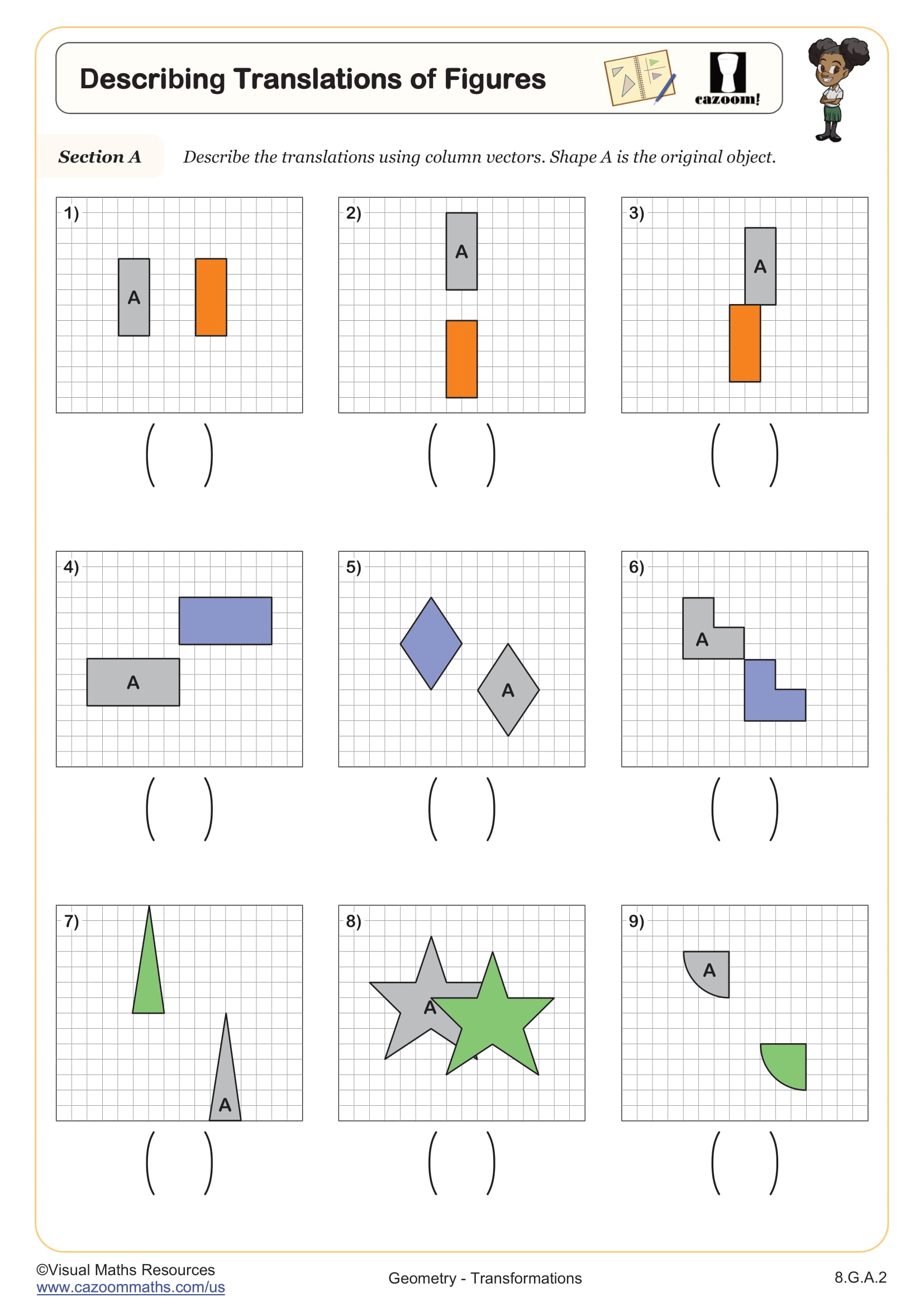
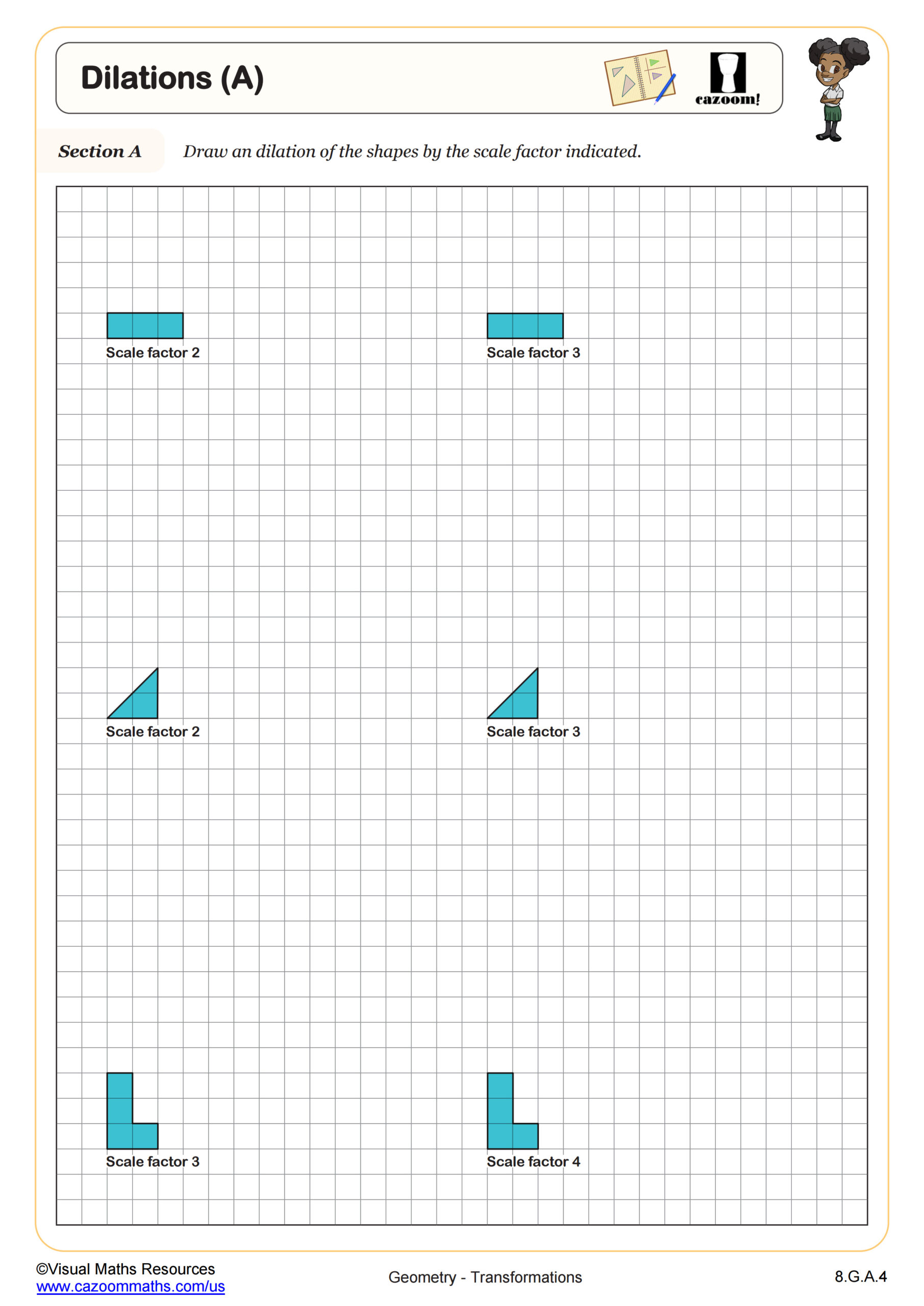
Dilations (A)
Grades: 8th Grade
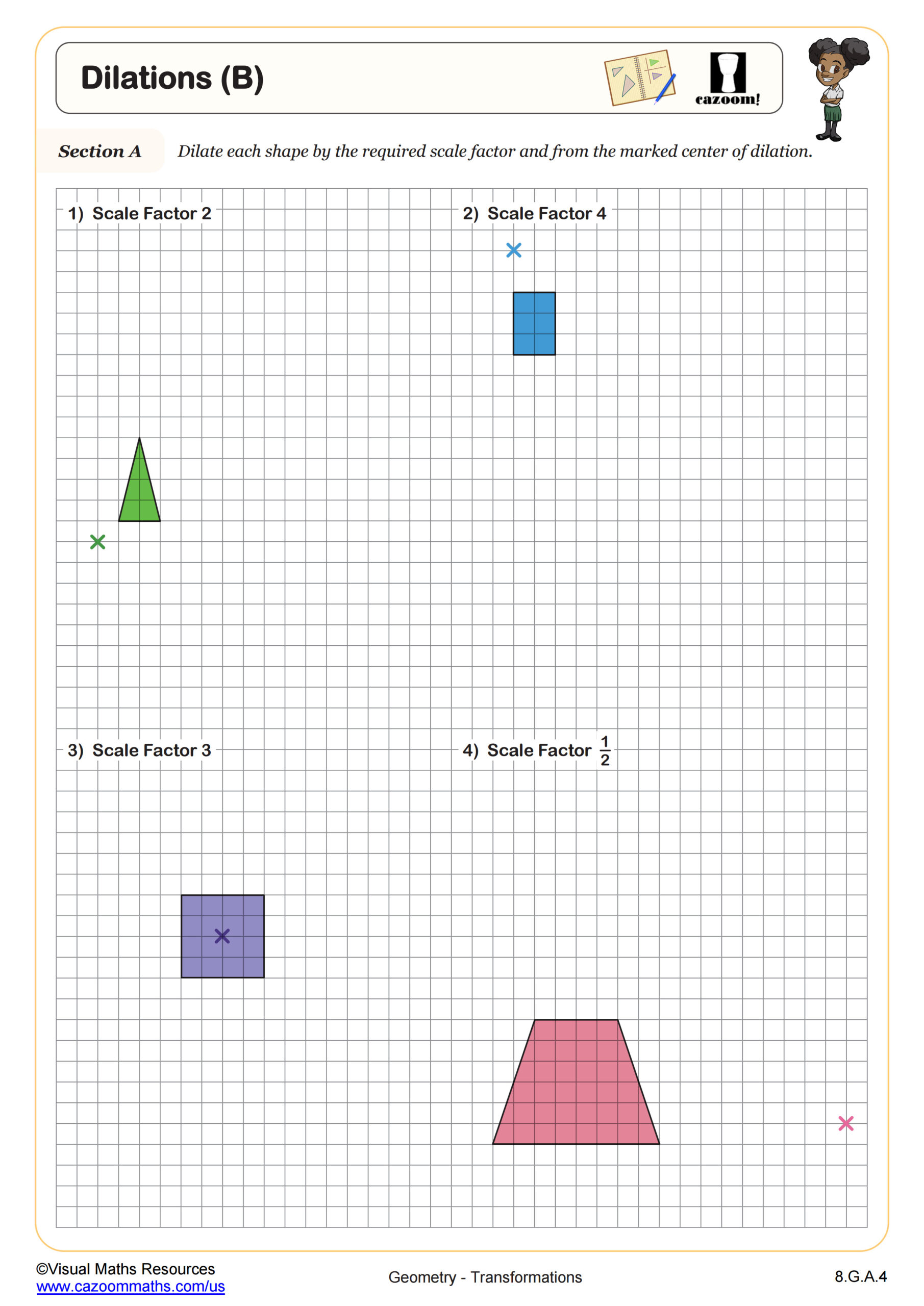
Dilations (B)
Grades: 8th Grade
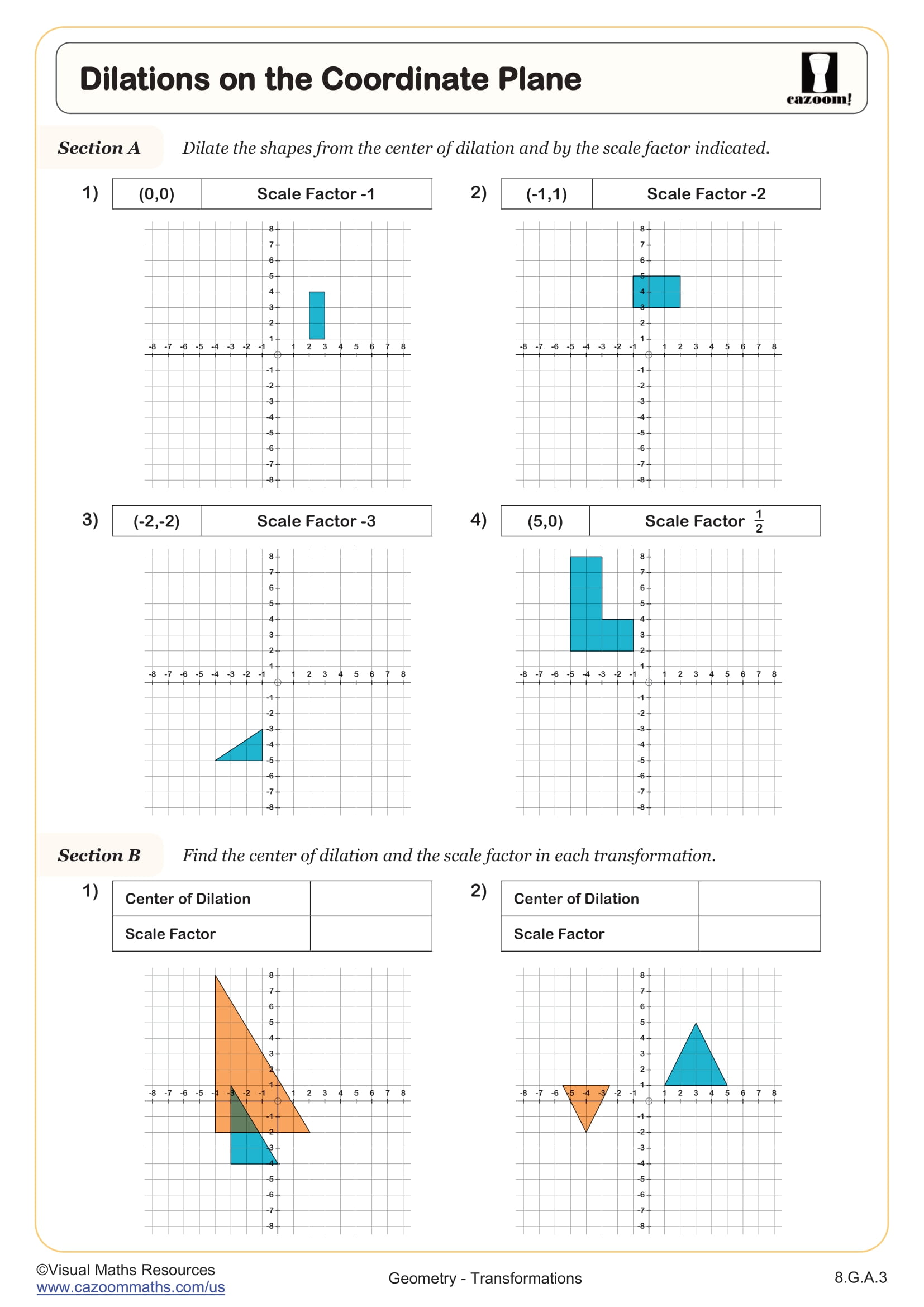
Dilations on the Coordinate Plane
Grades: 8th Grade
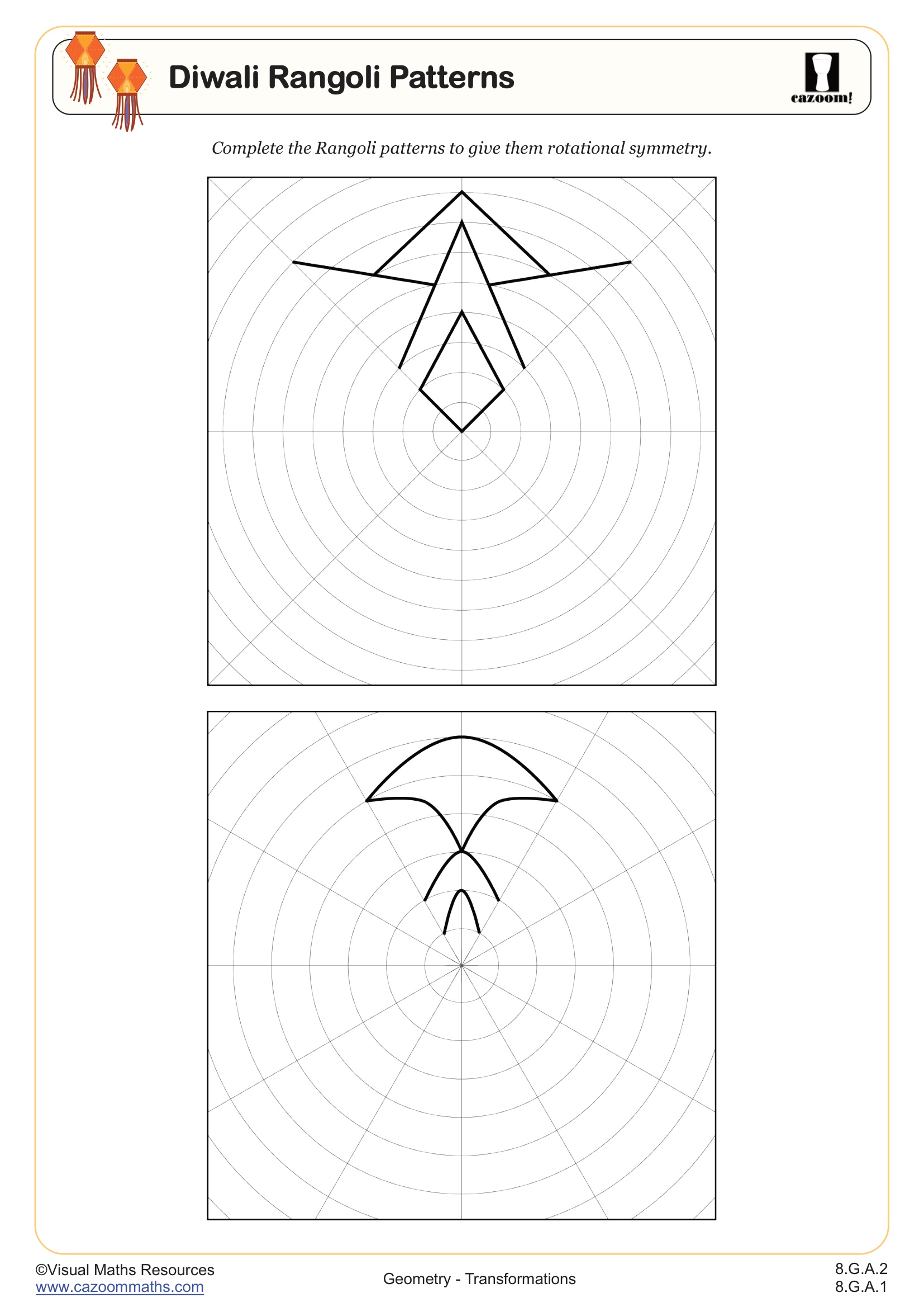
Diwali Rangoli Patterns
Grades: 8th Grade, Geometry, IM 2
Reflections in the 1st Quadrant (A)
Grades: 8th Grade
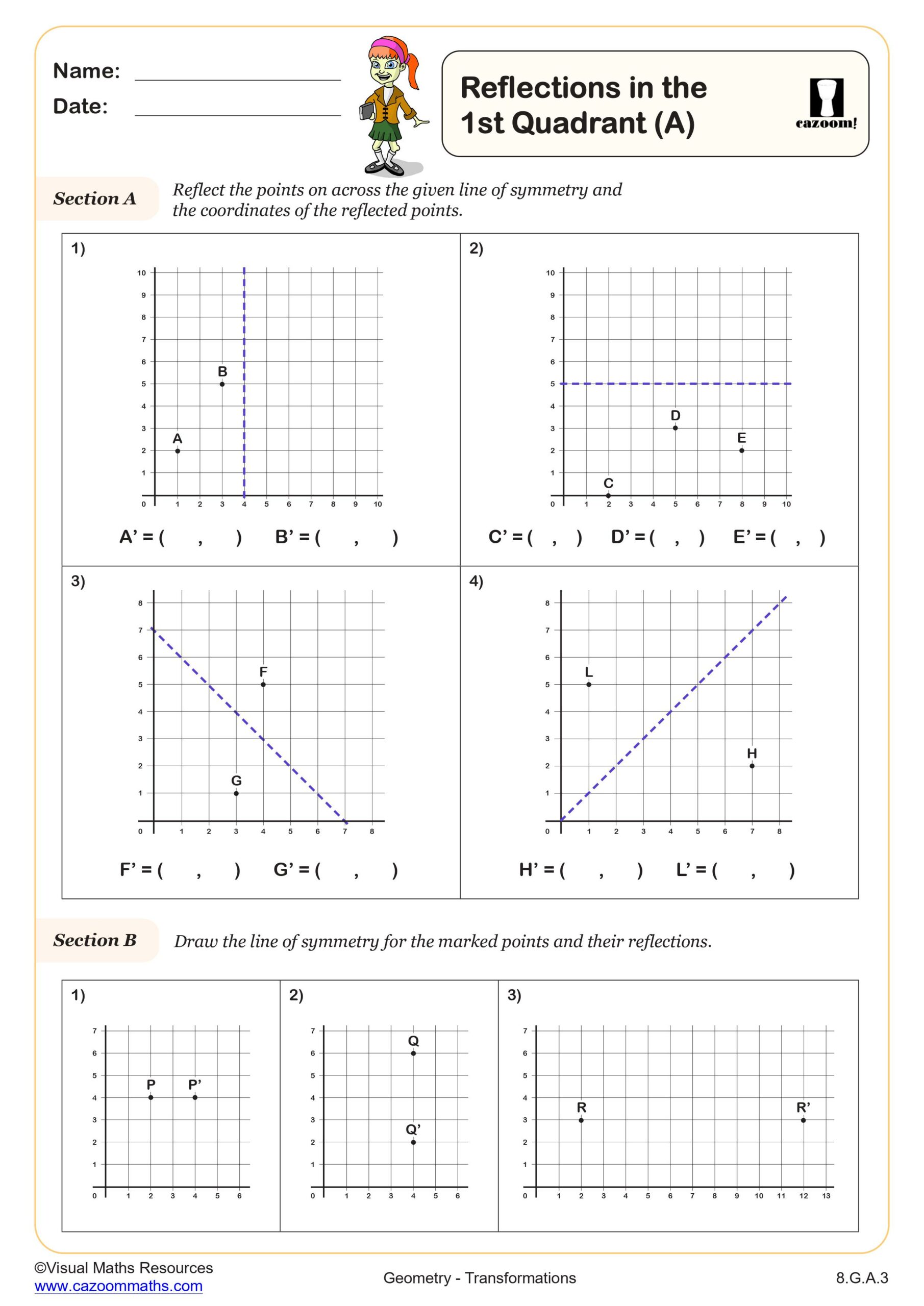
Reflections in the 1st Quadrant (B)
Grades: 8th Grade
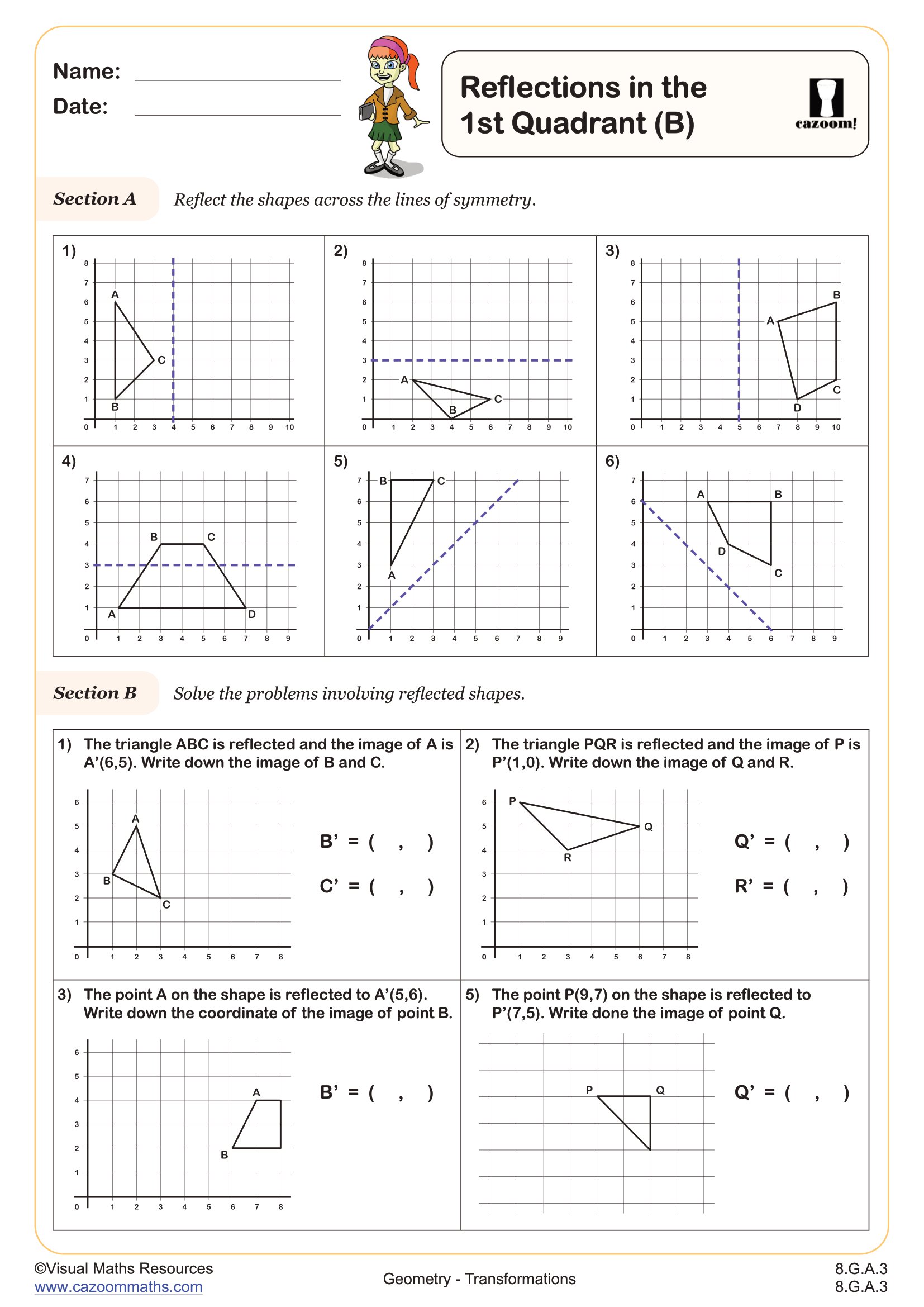
Rotating Shapes
Grades: 8th Grade
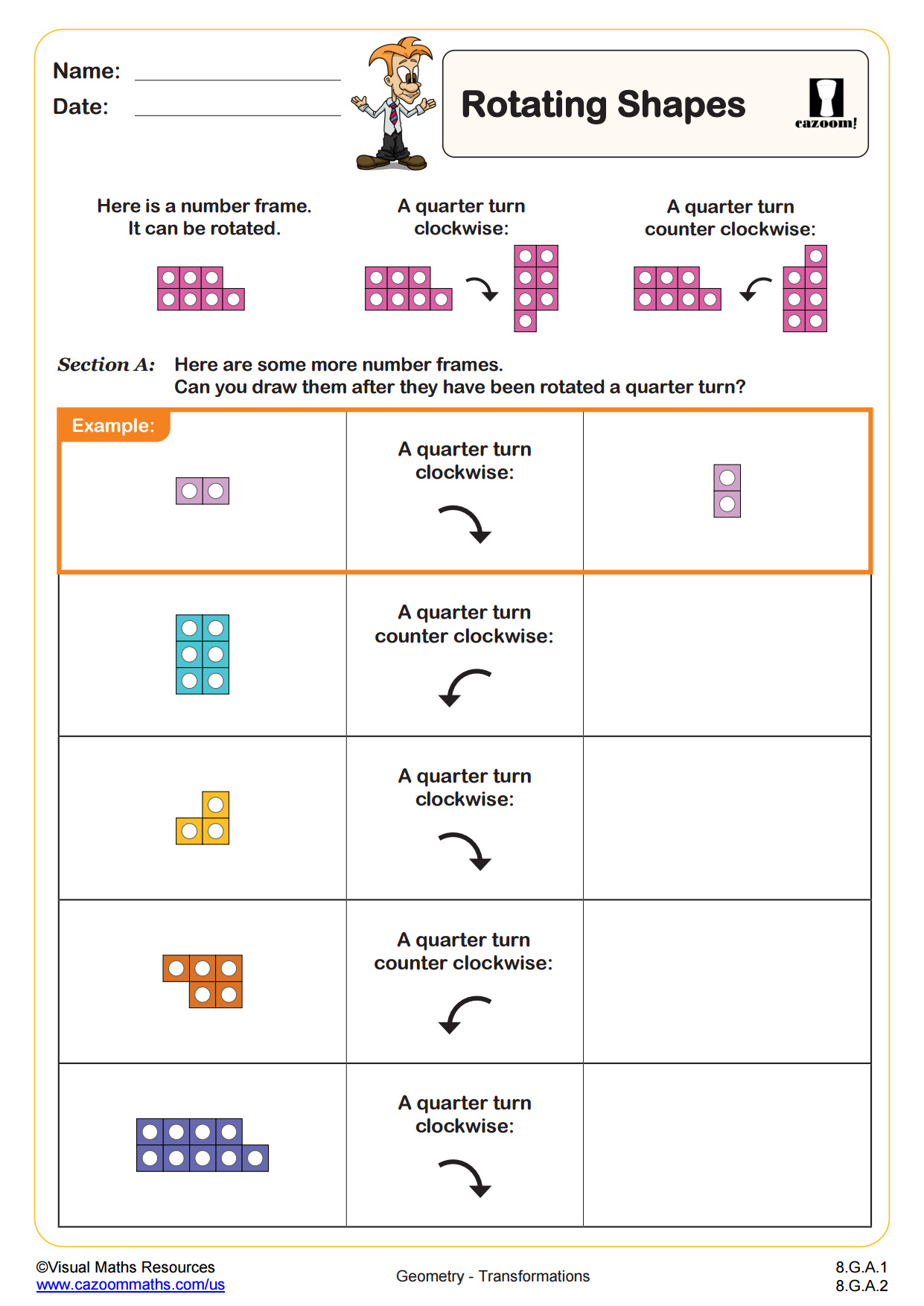
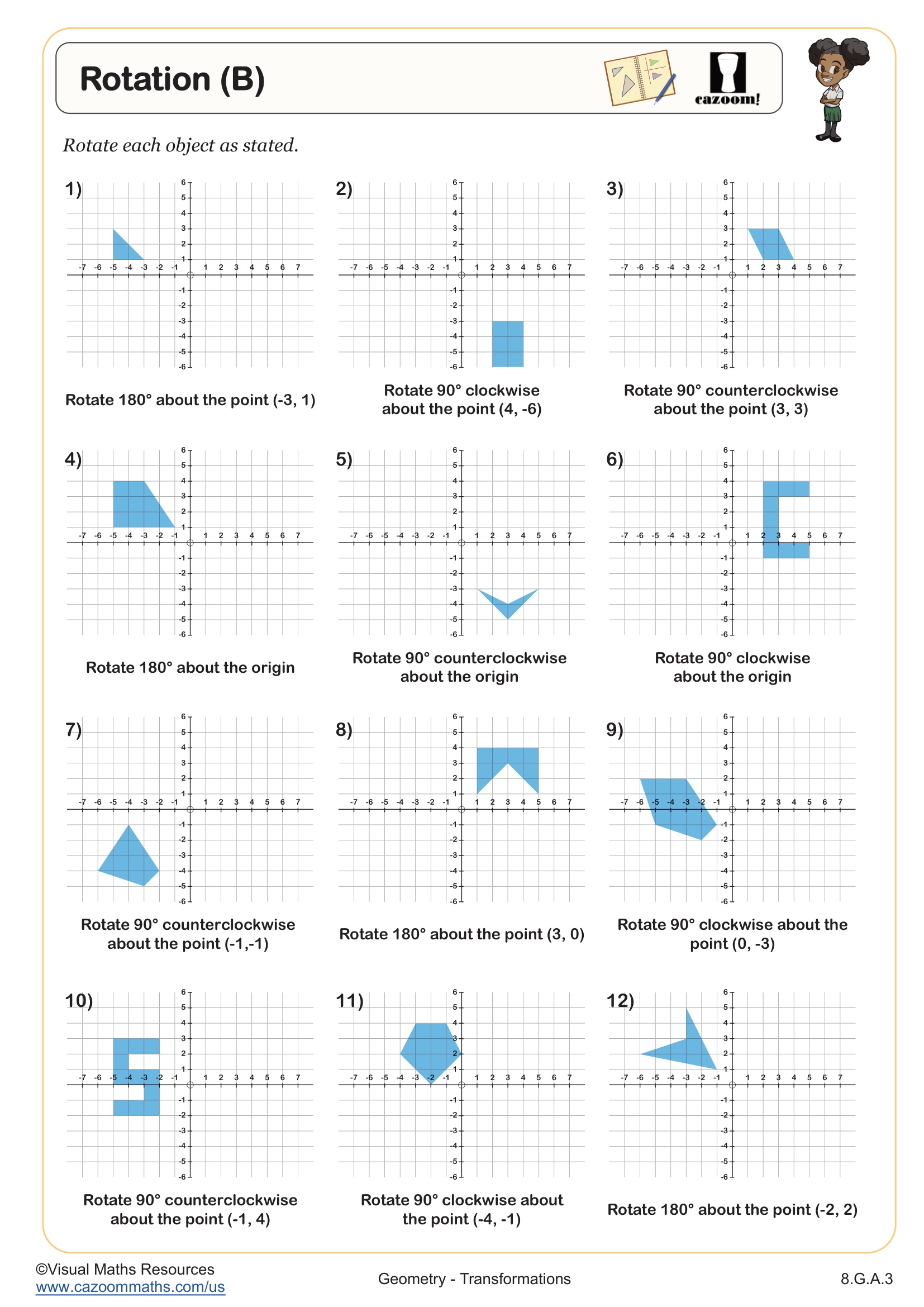
Rotation (B)
Grades: 8th Grade, Geometry, IM 1
Rotation (C)
Grades: 8th Grade, Geometry, IM 1
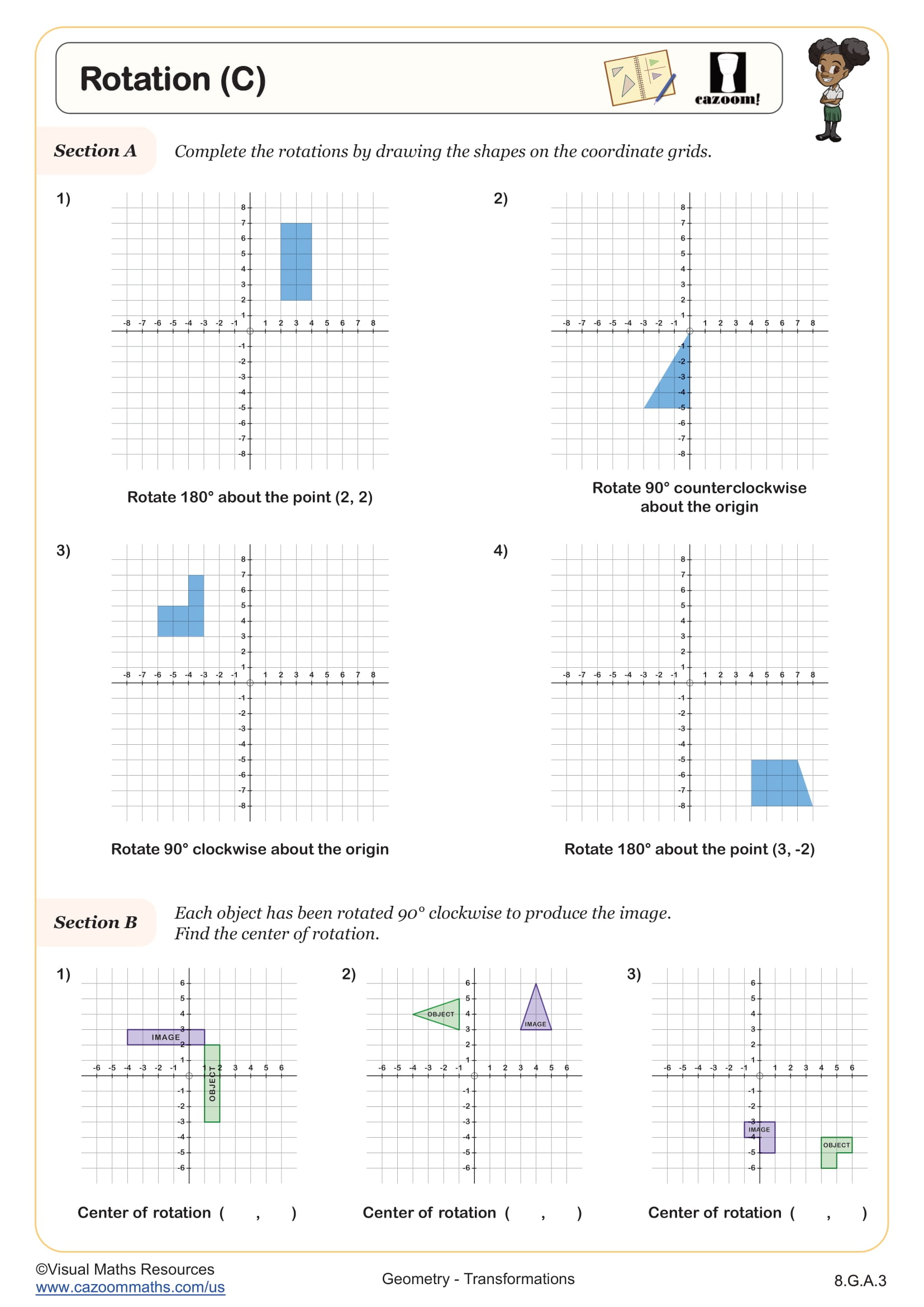
Rotations (A)
Grades: 8th Grade
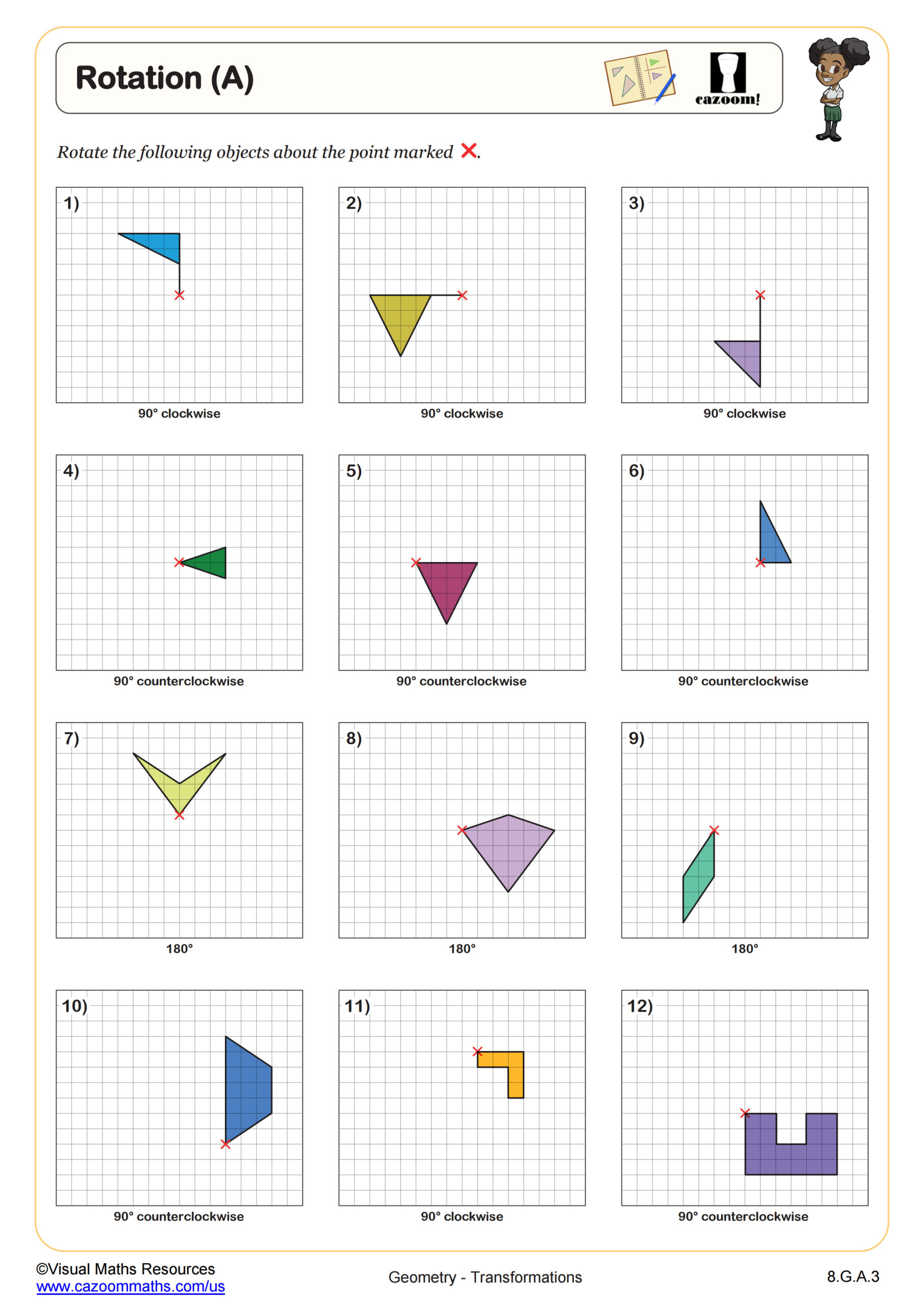
Rotations and Reflections of Polygons
Grades: 8th Grade
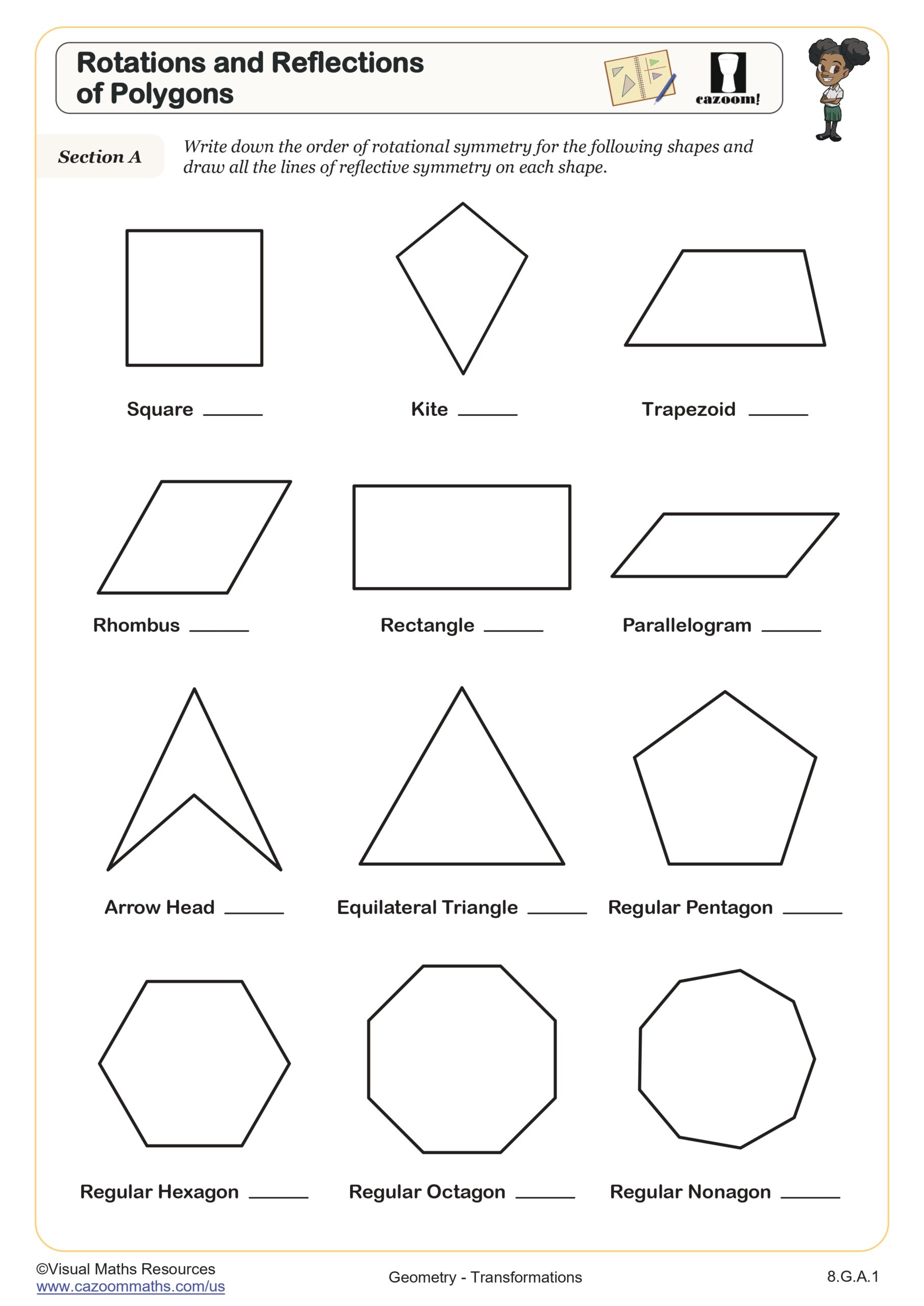
Rotations and Reflections on the Coordinate Plane
Grades: 8th Grade
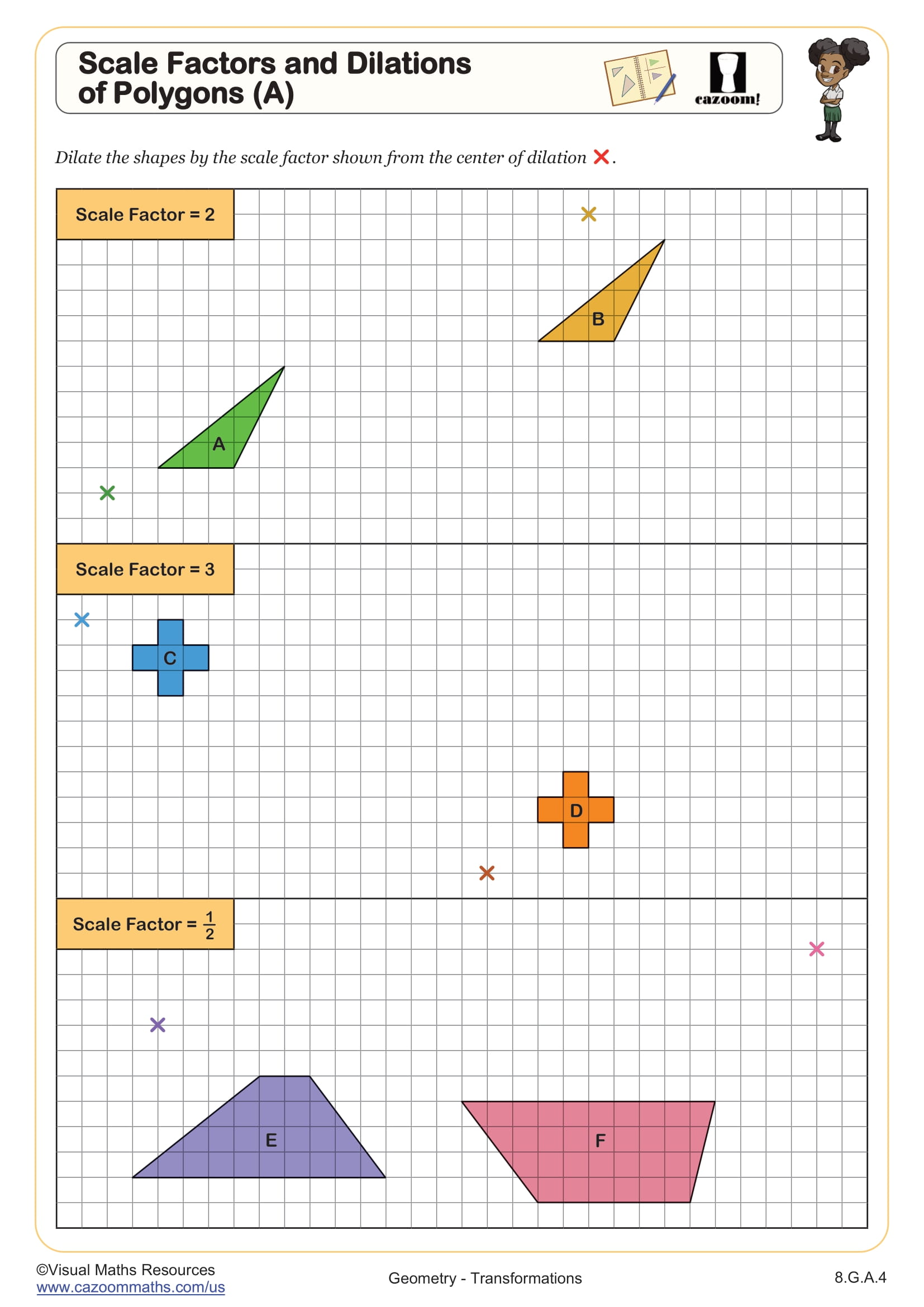
Scale Factors and Dilations of Polygons (A)
Grades: 8th Grade
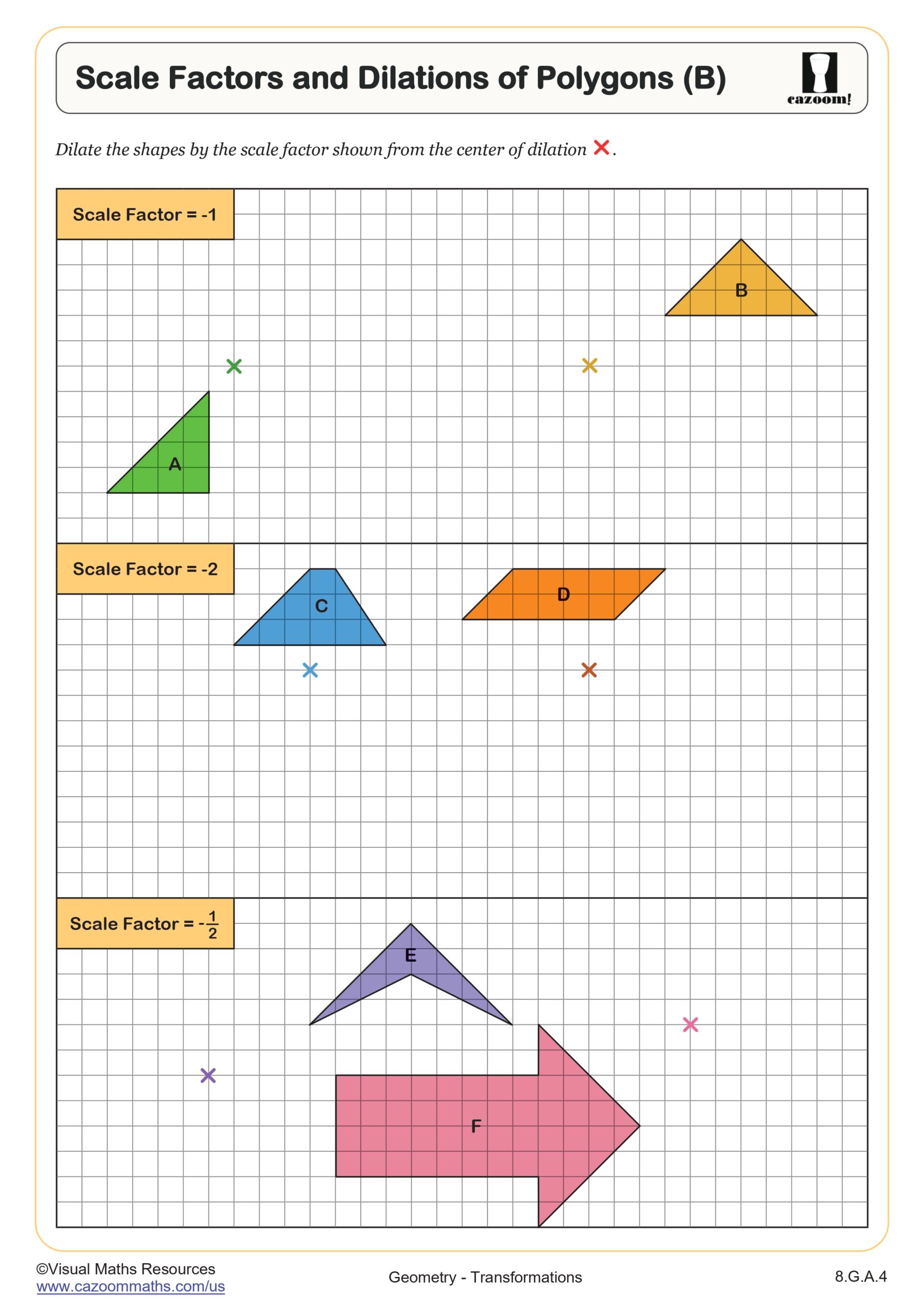
Scale Factors and Dilations of Polygons (B)
Grades: 8th Grade
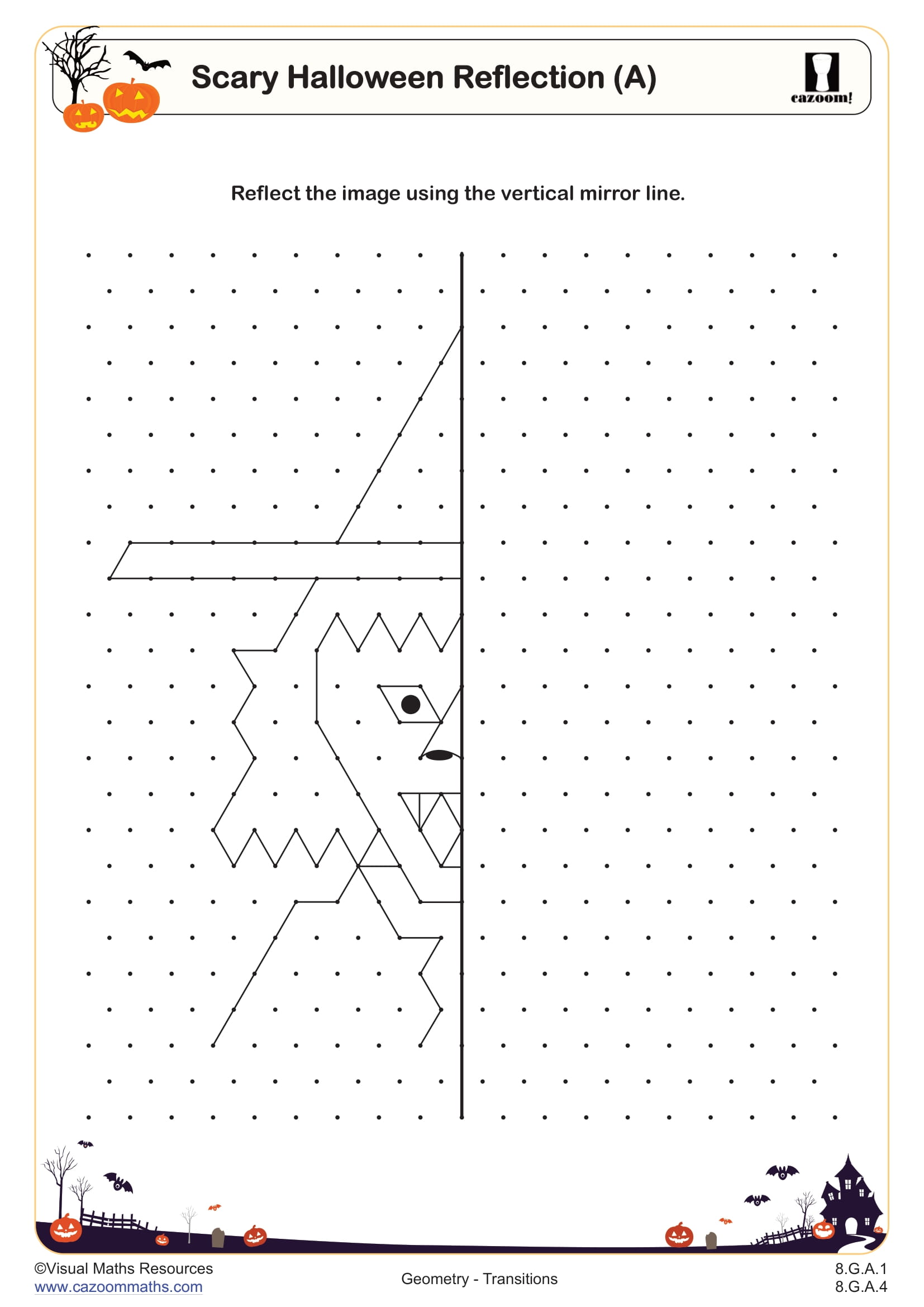
Scary Halloween Reflection (A)
Grades: 8th Grade
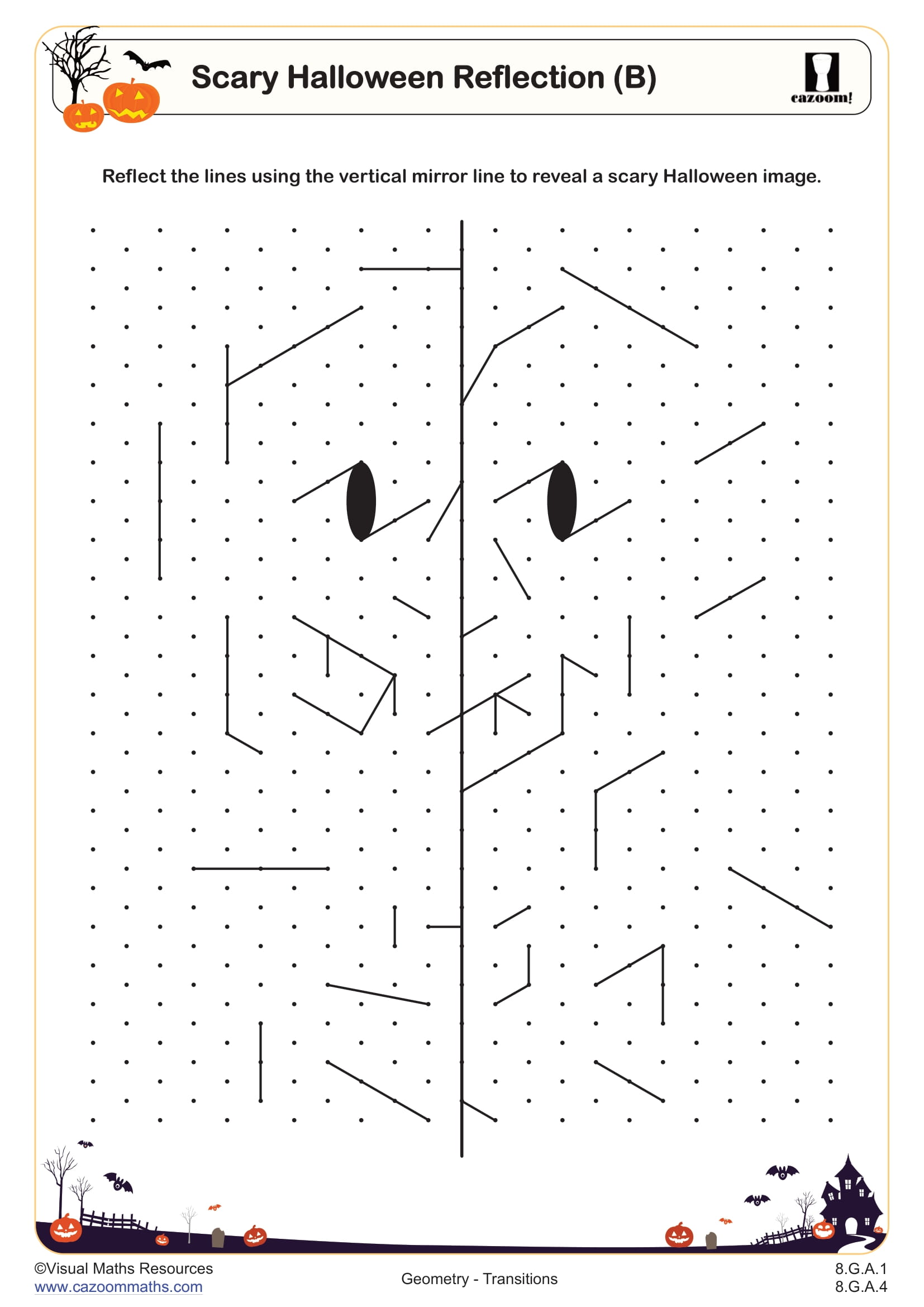
Scary Halloween Reflection (B)
Grades: 8th Grade
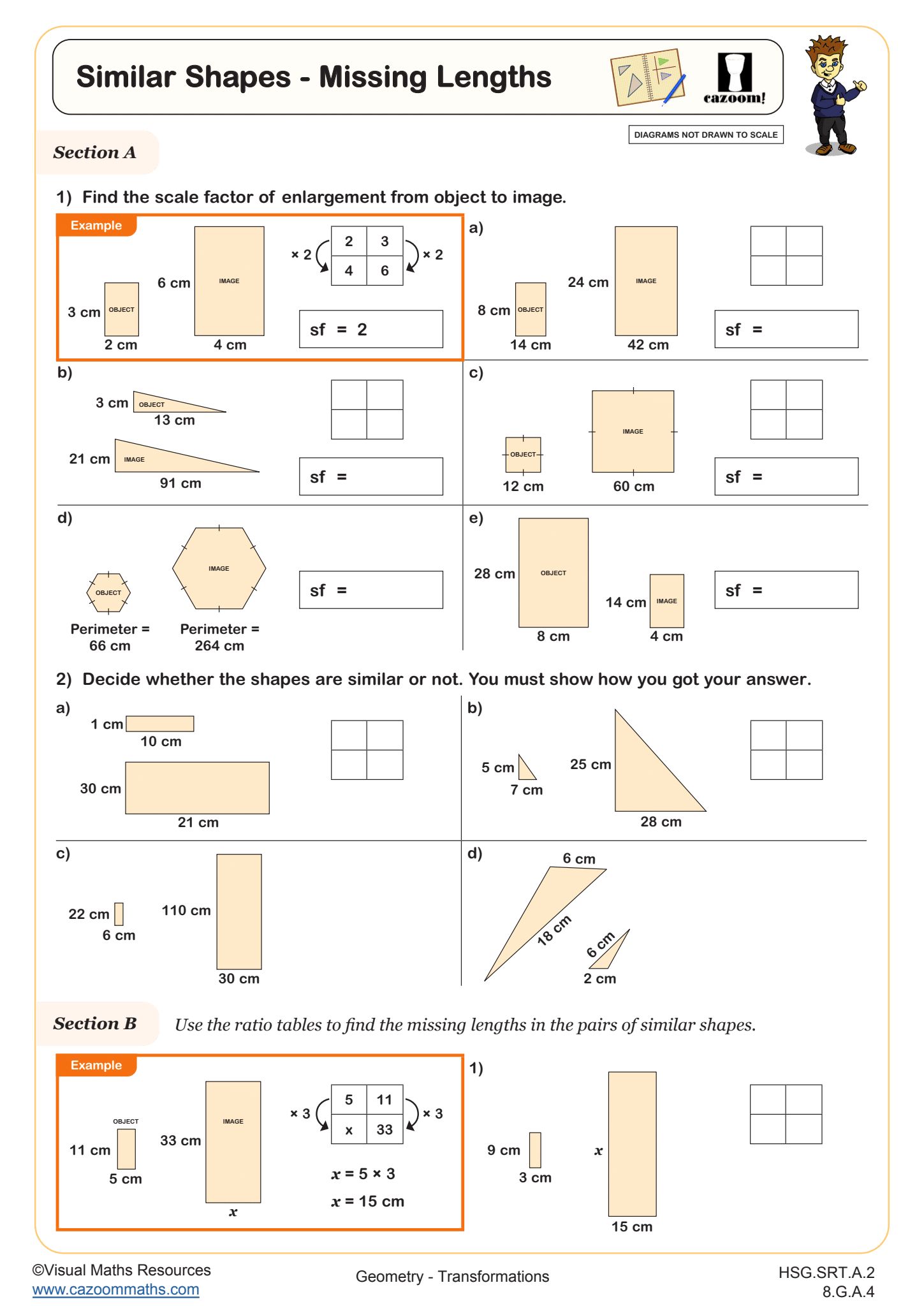
Similar Shapes - Missing Lengths
Grades: 8th Grade, Geometry, IM 2
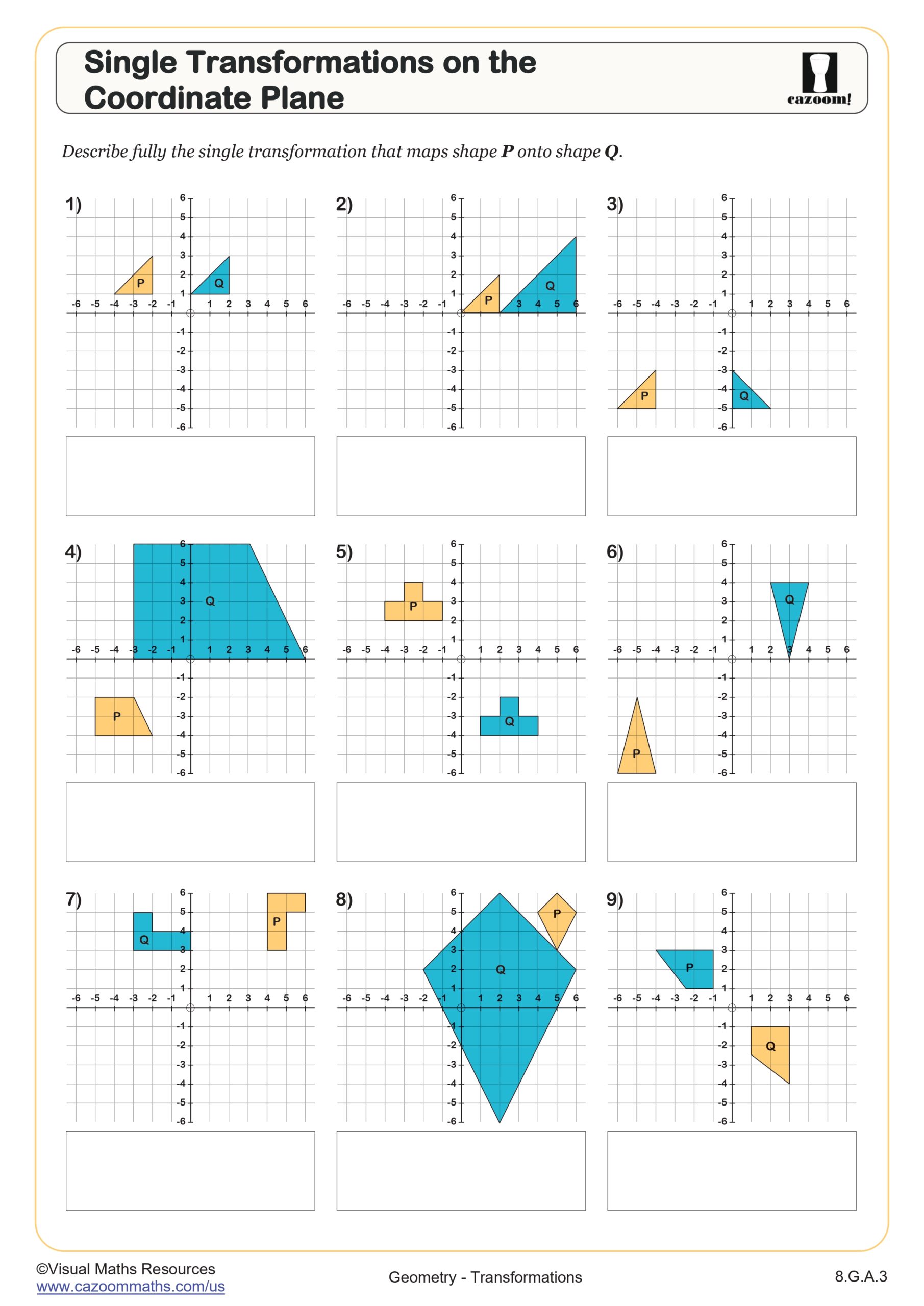
Single Transformations on the Coordinate Plane
Grades: 8th Grade
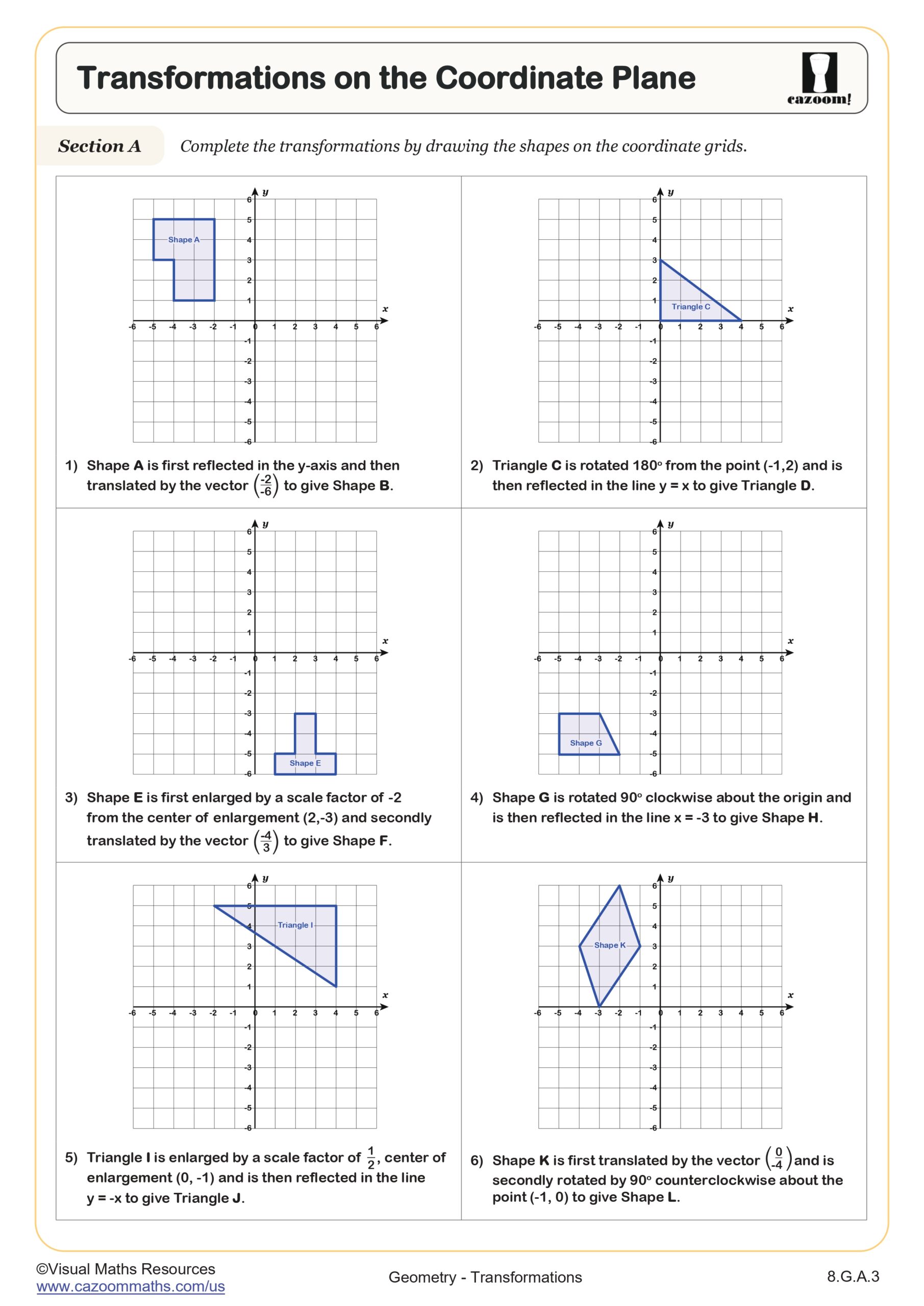
Transformations on the Coordinate Plane
Grades: 8th Grade
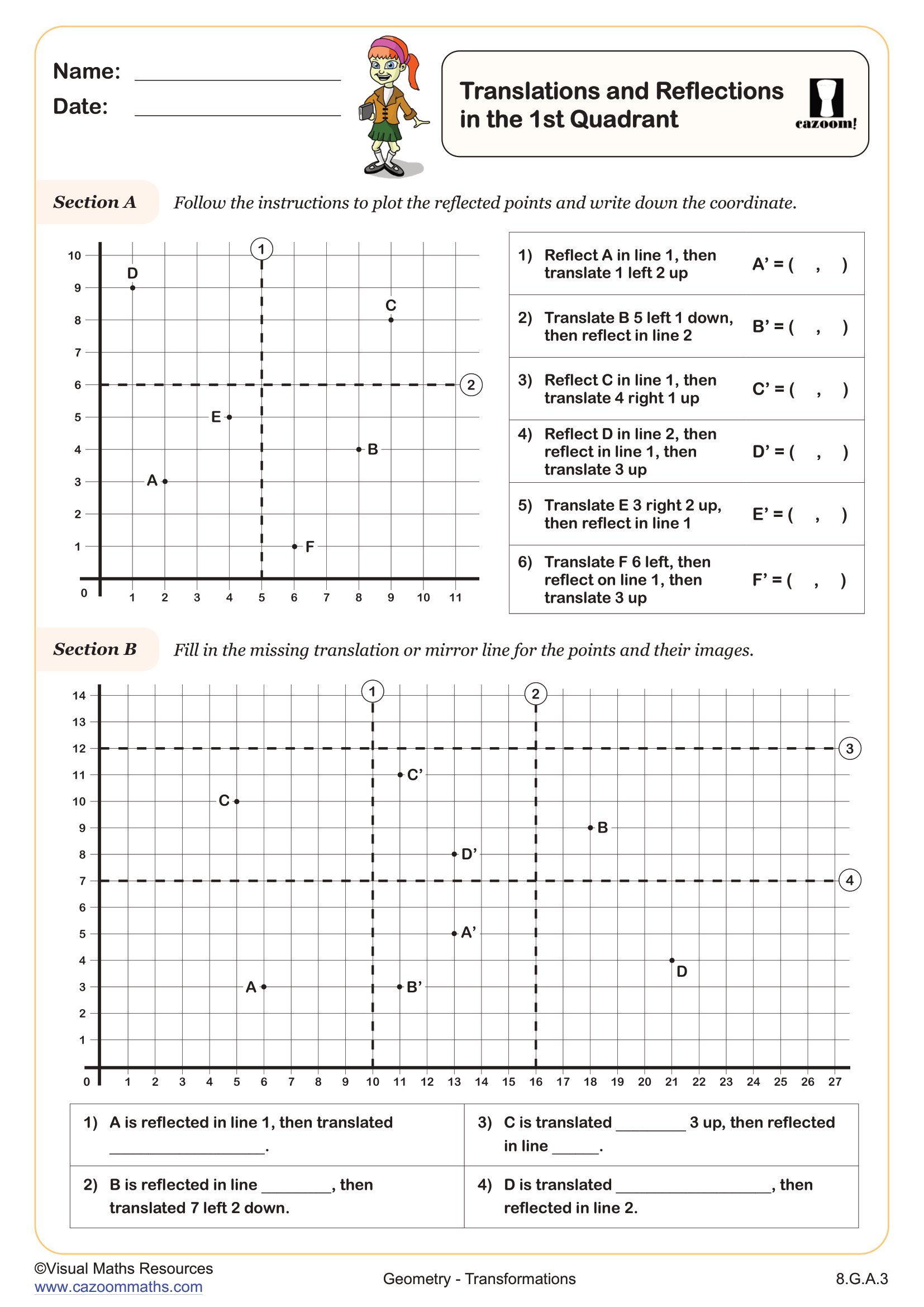
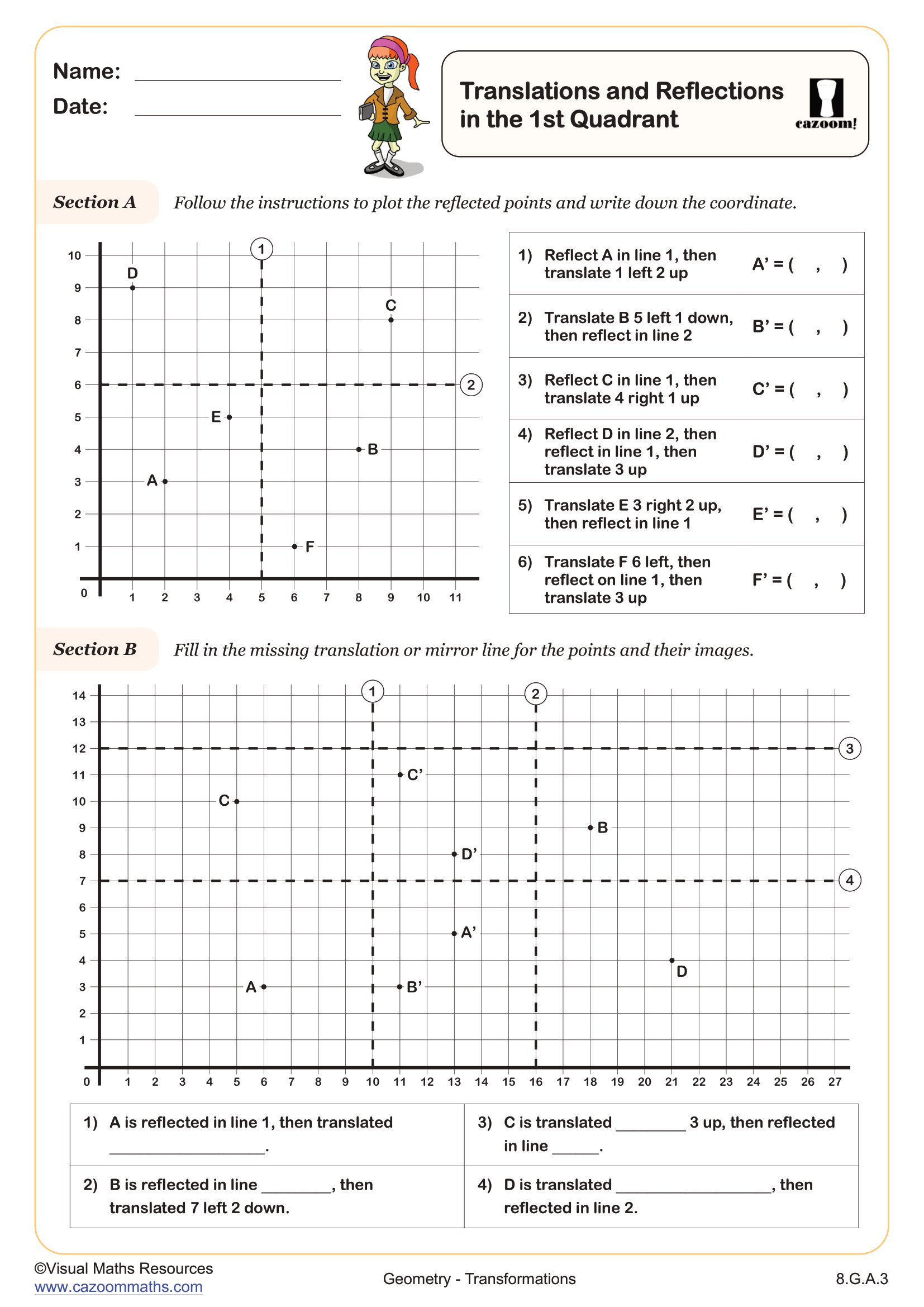
Translations and Reflections in the 1st Quadrant
Grades: 8th Grade
Translations in the 1st Quadrant (A)
Grades: 8th Grade
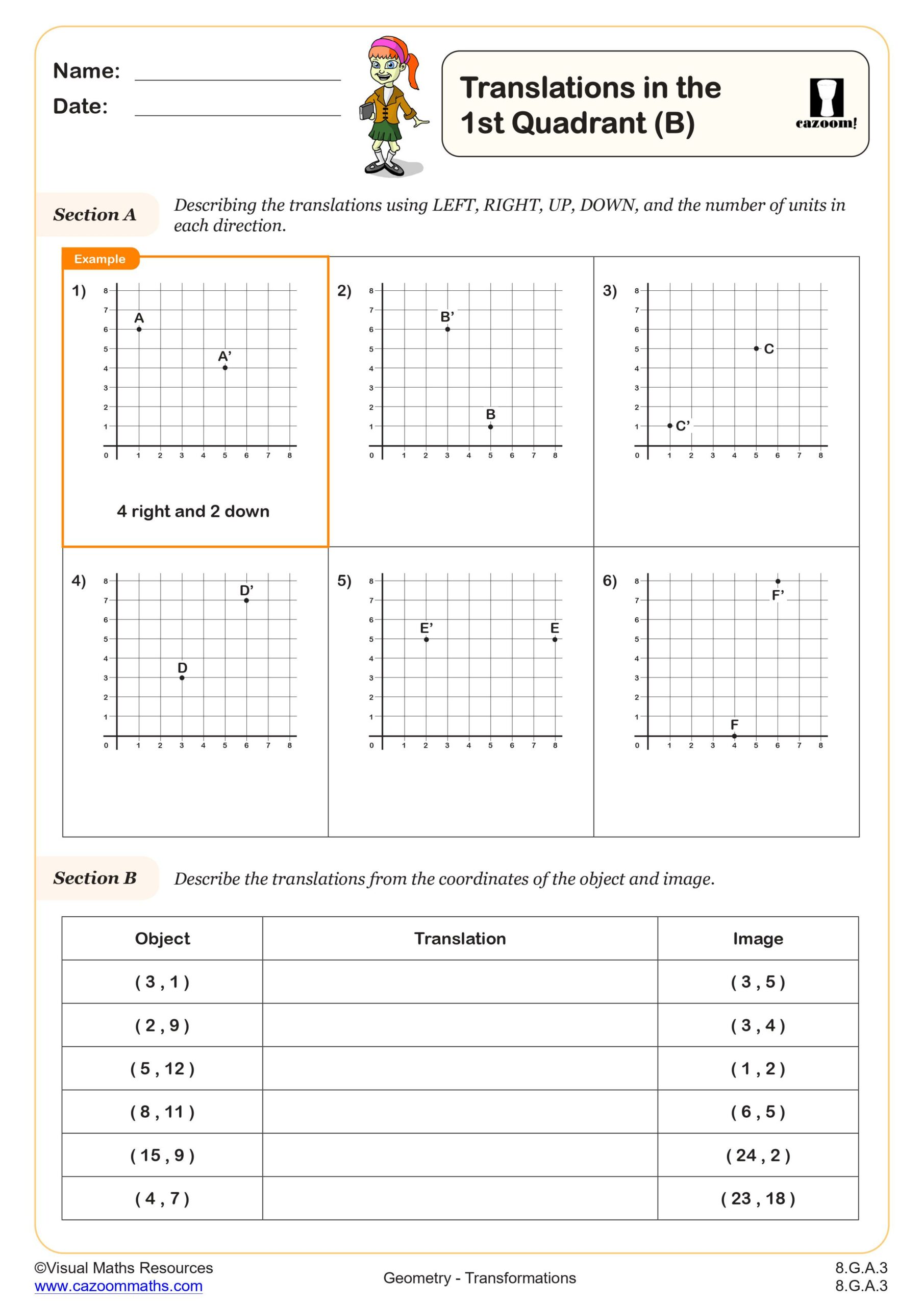
Translations in the 1st Quadrant (B)
Grades: 8th Grade
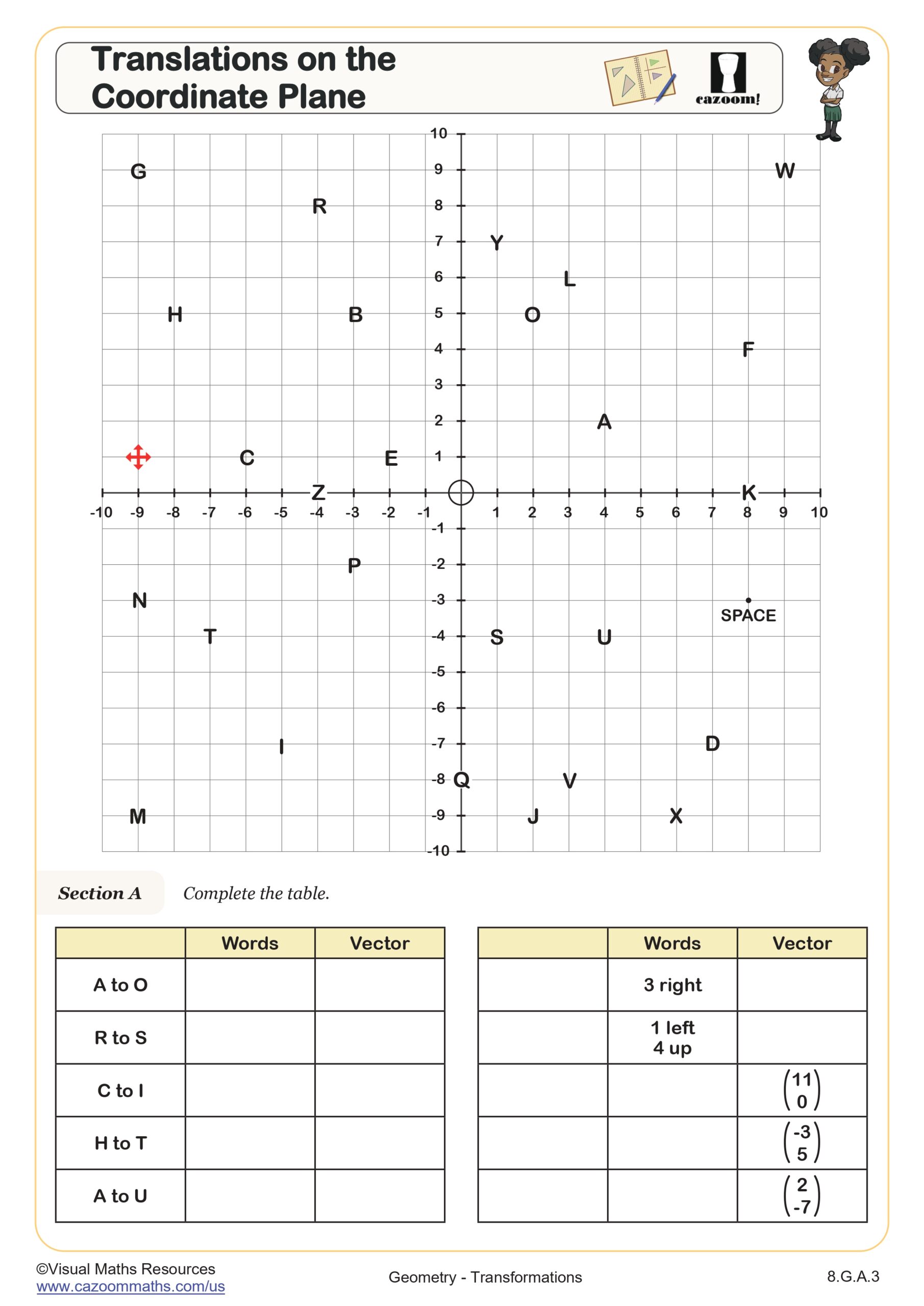
Translations on the Coordinate Plane
Grades: 8th Grade
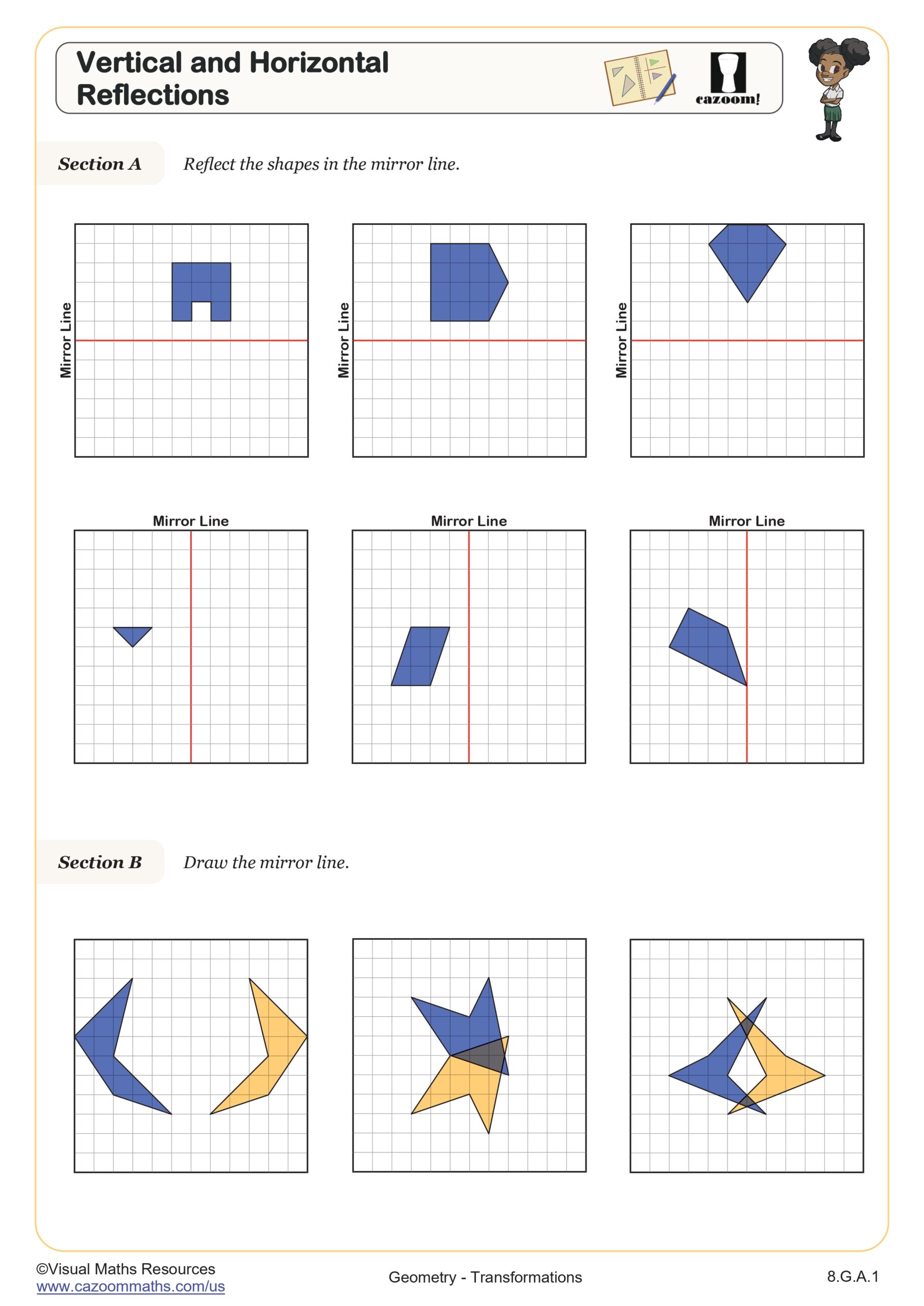
Vertical and Horizontal Reflections
Grades: 8th Grade
All worksheets are created by the team of experienced teachers at Cazoom Math.
How do students identify lines of reflection when δa'b'c' is a reflection of δabc?
When students encounter problems where "δa'b'c' is a reflection of δabc. which best describes the reflection? a coordinate plane showing triangles a b c and a prime b prime c prime. the coordinates of the first figure are a negative 2 comma 2, b zero comma 4, and c 2 comma 2. the coordinates of the second figure are a prime 8 comma 2, b prime 6 comma 4, and c prime 4 comma 2. a reflection over the line x = 2 a reflection over the line y = 3 a reflection over the line x = 3 a reflection over the y-axis," they need to find the perpendicular bisector of corresponding points. This aligns with Common Core standards 8.G.A.3 and builds toward high school geometry concepts.
Teachers observe that students often choose vertical or horizontal lines without calculating the midpoint between corresponding vertices. The correct approach involves finding that points A(-2,2) and A'(8,2) have midpoint (3,2), indicating reflection over the vertical line x = 3. Students frequently miss this systematic approach and guess based on visual approximation.
Which grade levels should use transformations geometry worksheets?
Geometry worksheets transformations typically begin in 6th grade with basic translations on coordinate grids, progressing to 8th grade where students master all three transformations including complex reflections. Middle school focuses on single transformations, while high school geometry courses combine multiple transformations in sequences. The Common Core introduces transformations in 8.G.A.1 through 8.G.A.3, emphasizing congruence and similarity.
Teachers find that 6th graders handle translations well but struggle with rotations around points other than the origin. By 8th grade, students can work with translation and reflection worksheet problems simultaneously, though teachers notice persistent confusion between clockwise and counterclockwise rotations. High school students apply transformations to prove geometric theorems and analyze symmetry in functions.
What makes translation rotation reflection worksheets effective for practice?
Translation rotation reflection worksheet problems work best when they progress from single transformations to combinations, allowing students to build confidence systematically. Effective worksheets include coordinate plane grids with clearly marked axes and provide both algebraic and geometric representations of transformations. Teachers notice students benefit from worksheets that show both pre-image and image on the same coordinate system.
The most successful translations reflections and rotations worksheet formats include step-by-step solution processes rather than just final answers. Teachers observe that students who use translations, reflections and rotations worksheet pdf with answers develop better problem-solving strategies because they can check their work at each transformation step. This immediate feedback prevents compound errors when combining multiple transformations.
How should teachers use transformation geometry worksheets with answer keys?
Teachers find that all transformations worksheet answer key materials work best when students attempt problems independently before checking solutions. The answer keys should show coordinate calculations and transformation rules, not just final positions. This approach helps students identify whether errors occurred in setup, calculation, or graphing phases of the problem-solving process.
Experienced teachers recommend using transformation worksheets with answers as both practice and assessment tools. Students can self-check basic transformation worksheet problems during independent work, while teachers use the detailed solutions to identify common misconceptions during whole-group instruction. The answer keys also help teachers quickly spot students who may be memorizing patterns rather than understanding the underlying mathematical relationships.
Learning Rotations
Rotations are the fourth main type of transformation that students will need to master in their middle and high school years.
Rotations work by having the polygon that has been created within the coordinate grid rotate a certain number of degrees around a given point. The rotations can either turn clockwise or counterclockwise depending on the directions that are given. When a polygon is rotated, the new figure is called the image, and the image is always going to be congruent to the original figure. When students are practicing this skill with one of the transformation worksheets available at cazoommaths.com, they will notice that the rotations are typically a common angle like 45 degrees, 90 degrees or 180 degrees. While rotations can happen at any angle, they usually follow this pattern. When the number of degrees to rotate is positive, then the rotation will be counterclockwise. If the number of degrees is negative, then students will perform a clockwise rotation.
Using the Cazoom Math worksheets to practice translations, rotations and reflections is a great way for students to build confidence in their work. Learning rotations is a challenging process because it requires a lot of visualization of what the image should look like. Rotating figures both clockwise and counterclockwise also adds to the challenge. When students can break down the process by rotating points and then rotating entire figures, it can start to make more sense. Practicing this skill using worksheets is an effective method because the feedback loop for students is immediate. With Cazoom Maths, the answer keys are provided so students can check their work right away to see their progress. The large variety of worksheets also allows for a great deal of practice on any given skill. This means that students will not run out of worksheets even if they struggle with the skill, and they will soon master slides, flips and turns!
An example of a real-world connection is any type of crank arm that would make gears or some other device move. This type of rotation again depends upon a uniform movement each time the arm is turned, and on everything else connected to that arm operating smoothly. Students can look at a bicycle or a clock to visualize what this looks like. Most rotations in real life must have what is called rotational symmetry. This means that no matter how I rotate a figure, it always looks the same. When students master the skill of rotations, they will be able to design and create figures that will have rotational symmetry. This can lead to a whole new skill or hobby of creating gadgets and devices that could help people in their day to day lives.
Using a Transformations Worksheet to master Geometry!
Geometry is a challenging branch of mathematics that students will have to attempt to master in middle and high school.
The work within the field of geometry is a bit more visual, creative and requires students to use their spatial thinking more.
One of the most effective ways to practice the skills that are being learned is to use transformations worksheets from Cazoom Maths. The worksheets are visually appealing to engage students in the work. For a small monthly fee, the worksheets also come with answer keys so that students and parents can check the work as soon as it is completed.
Having a timely feedback loop is important when trying to master concepts in maths. Transformations are a branch of geometry that involves learning about translations, reflections, dilations and rotations. All of these skills have applications in the real world that students can connect to. Making these real-world connections make the skills much more relevant, and that is a huge factor in motivating students to learn the skills.
Any student can master the various transformations if they have the proper instruction, practice, feedback, and motivation. Using Cazoom Maths as part of that process is a great way to help students from 6th Grade onwards increase their achievement levels and soar to success.