Vectors Maths Worksheets
Column Vector Addition
Grades: Pre-Calculus
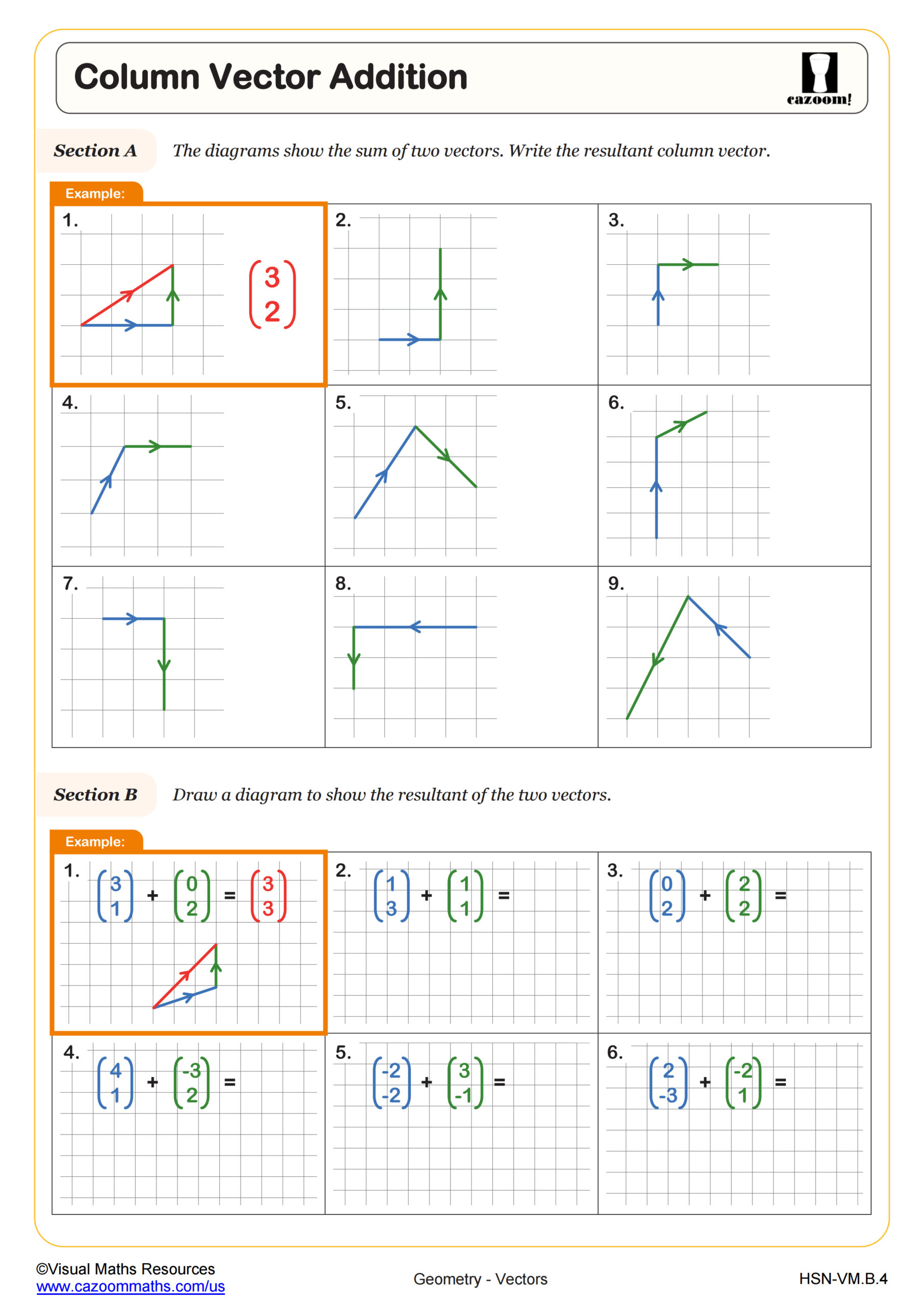
Column Vectors (A)
Grades: Pre-Calculus
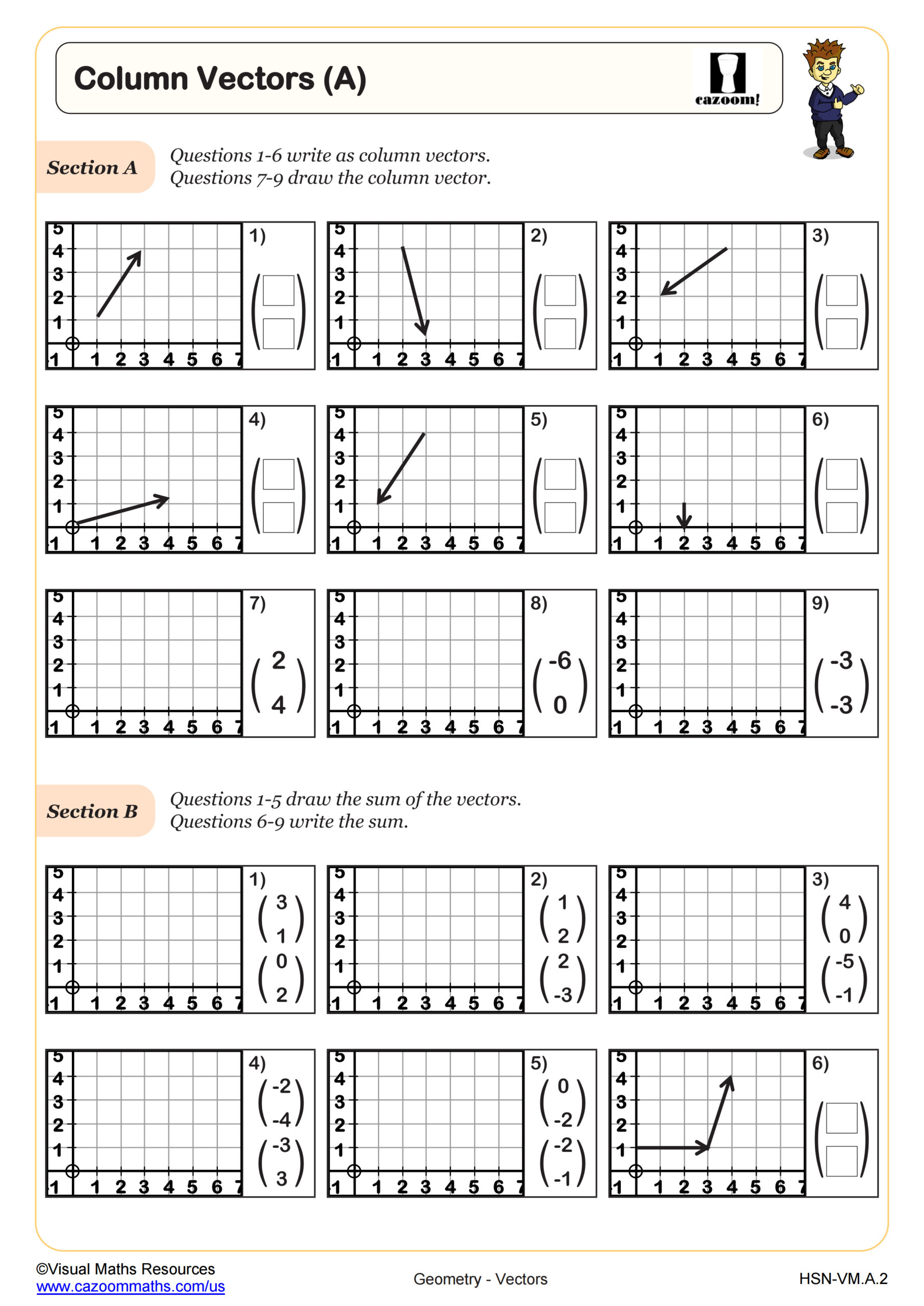
Magnitude of a Vector
Grades: Pre-Calculus
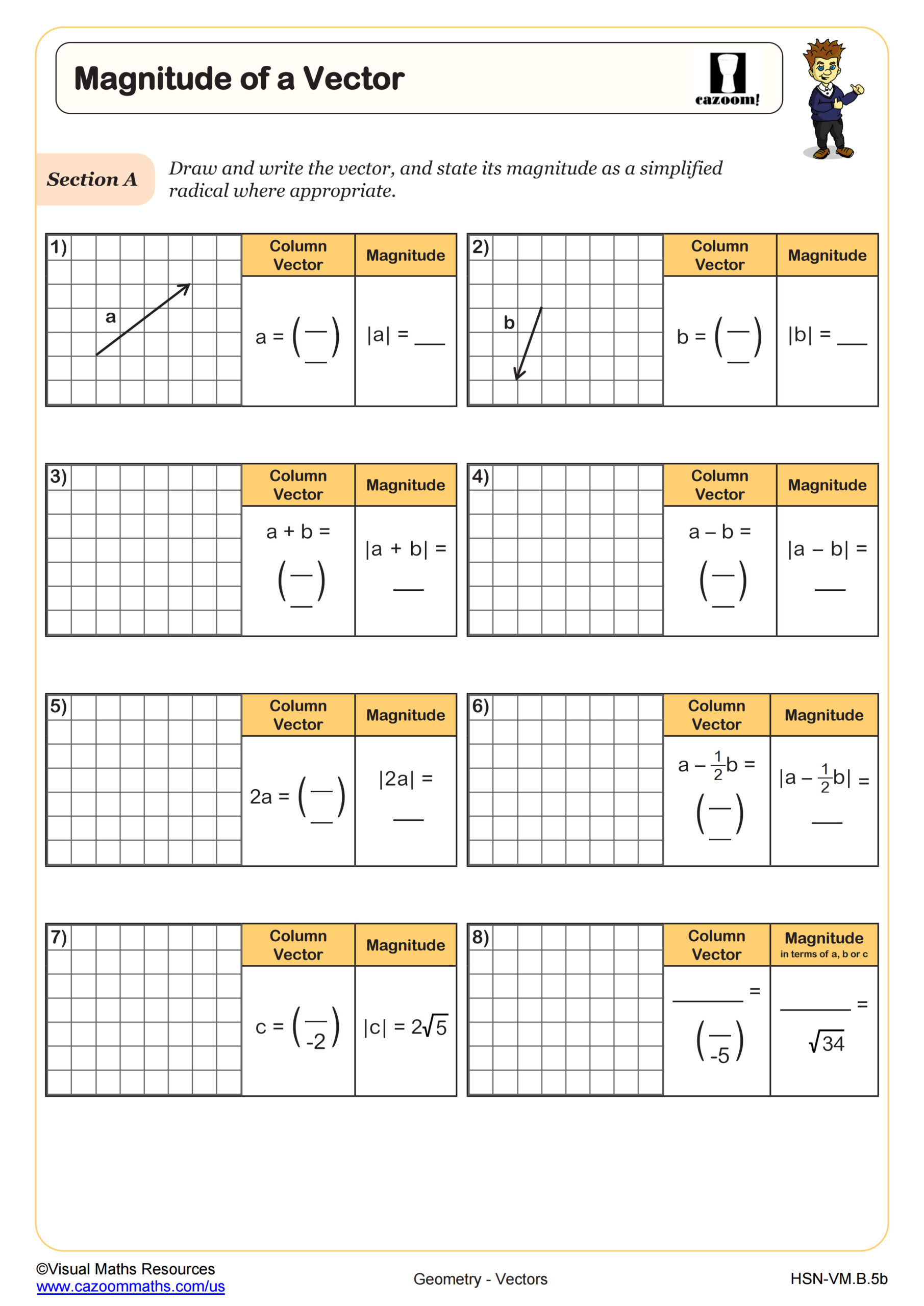
Matching Parallel and Perpendicular Vectors Search
Grades: Pre-Calculus
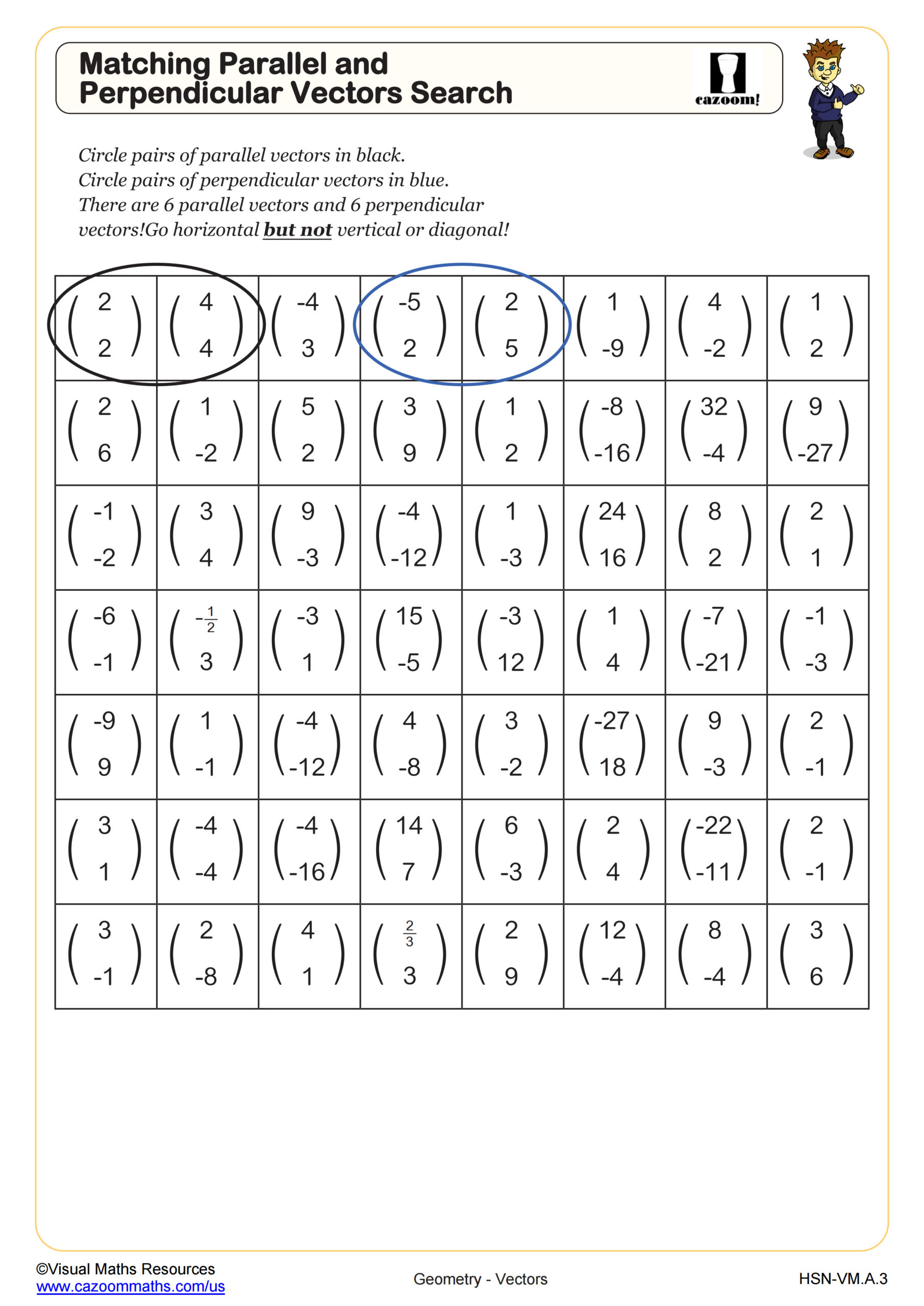
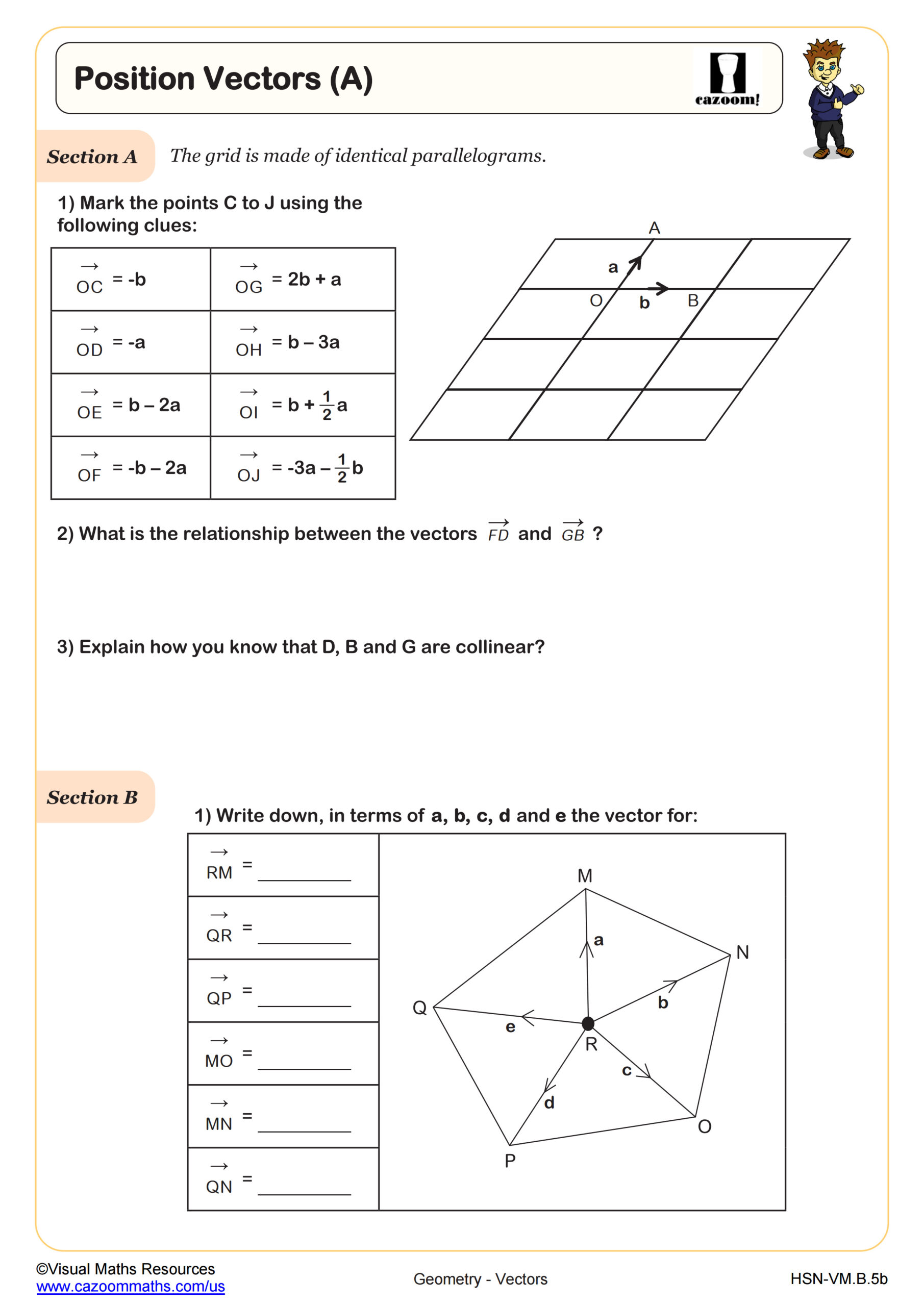
Position Vectors (A)
Grades: Pre-Calculus
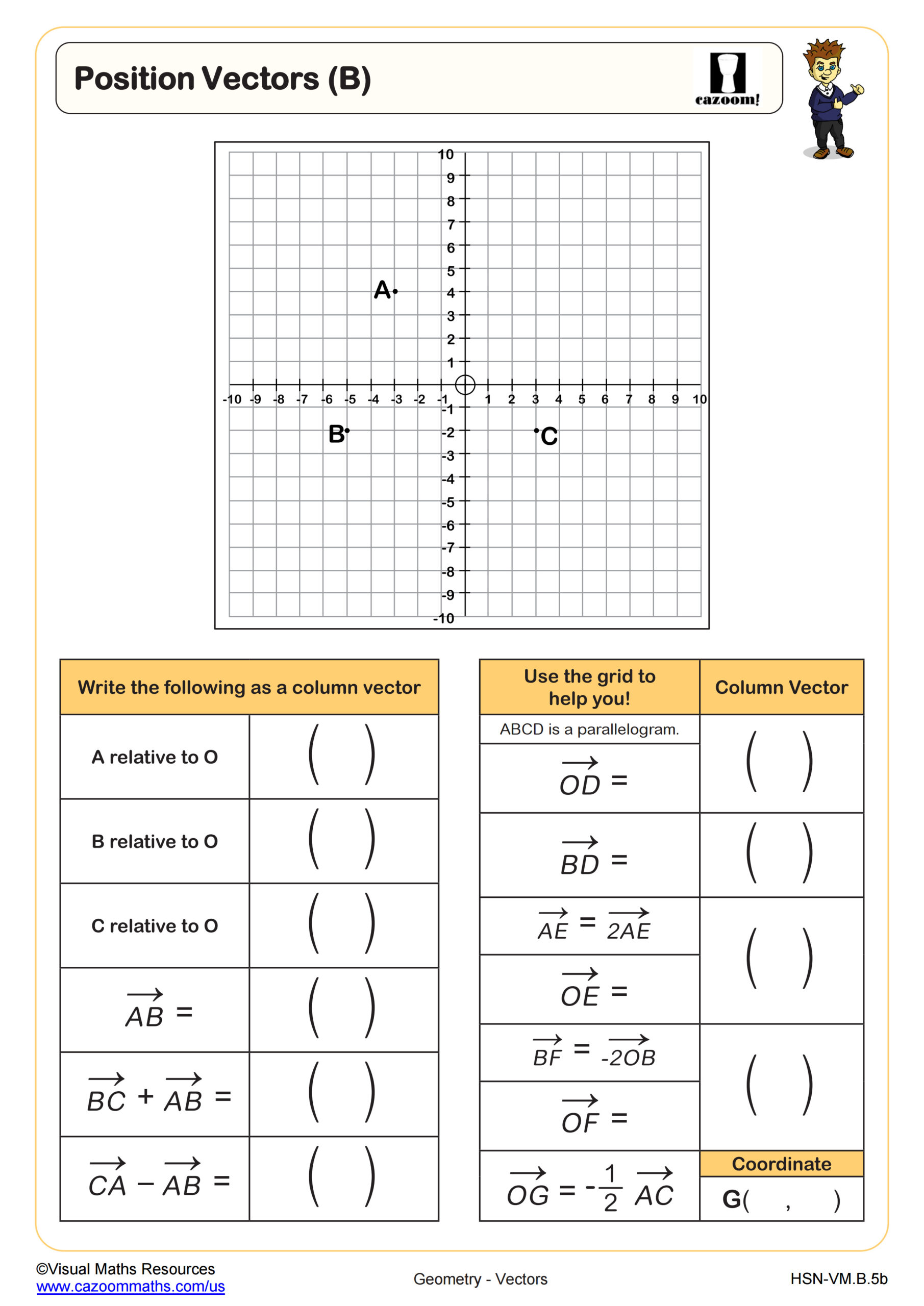
Position Vectors (B)
Grades: Pre-Calculus
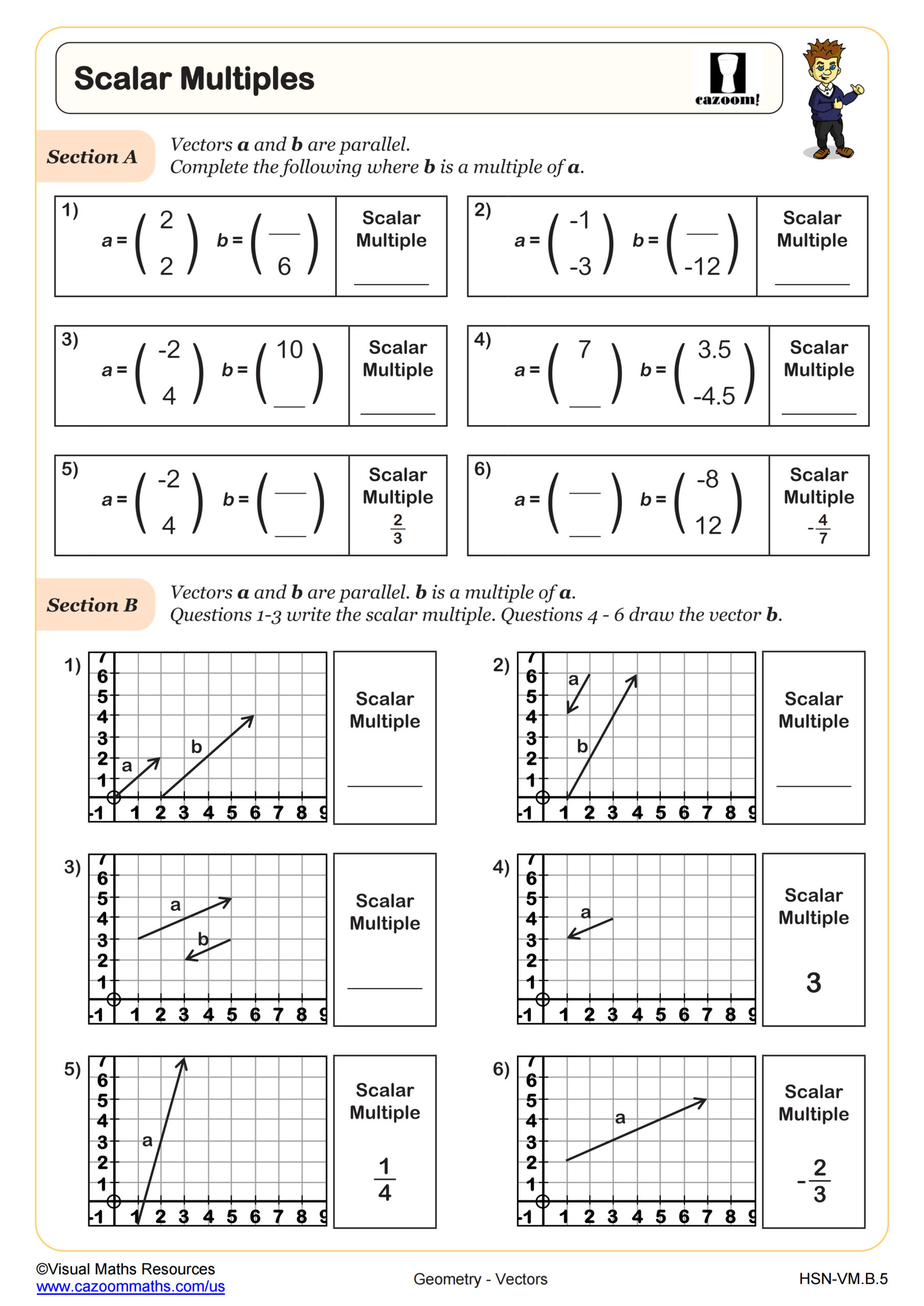
Scalar Multiples
Grades: Pre-Calculus
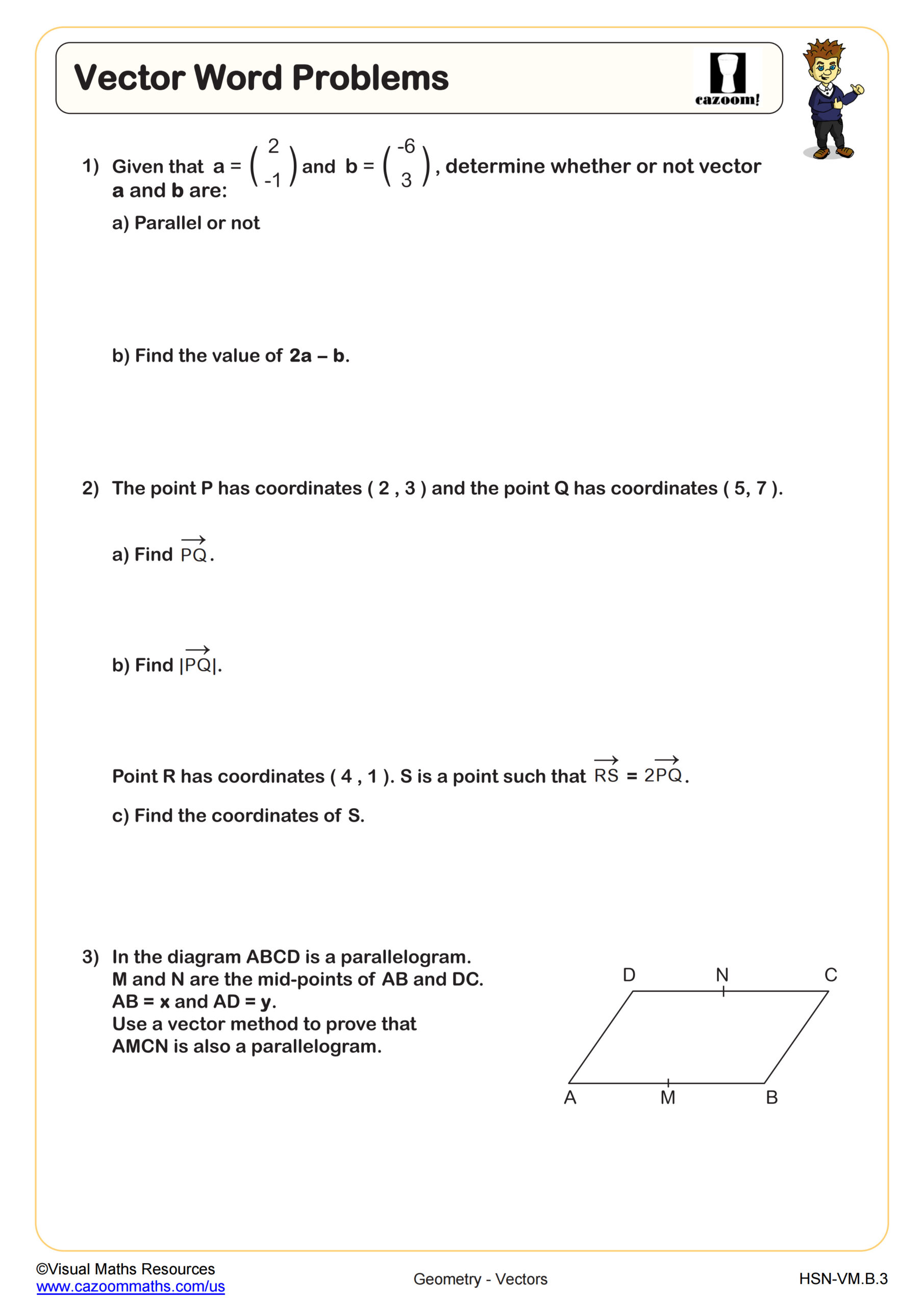
Vector Word Problems
Grades: Pre-Calculus
All worksheets are created by the team of experienced teachers at Cazoom Math.
What makes a quality vectors worksheet with answers PDF?
A quality vectors worksheet with answers PDF includes problems that progress logically from basic vector notation and graphing to more complex operations like finding resultant vectors and calculating dot products. The answer key should show complete solutions with clear step-by-step work, not just final answers, helping teachers identify where students make errors.
Teachers often observe that students need to see the geometric and algebraic approaches side by side to truly understand vector operations. The most effective vector worksheets include problems that require students to convert between component form and magnitude-direction form, as this translation frequently appears on standardized assessments and builds conceptual understanding that transfers to physics applications.
Which grade levels typically use vector worksheets?
Vector worksheets typically appear in high school curricula, most commonly in Algebra 2, Precalculus, and Physics courses for grades 10-12. Some advanced middle school programs introduce basic vector concepts in 8th grade when covering coordinate geometry and transformations in the coordinate plane.
The progression usually starts with graphing vectors and finding components, then moves to vector addition and subtraction using both graphical and algebraic methods. Teachers notice that students who struggle with trigonometry often find vector operations challenging since many problems require using sine and cosine to resolve components. Advanced courses may include dot products, cross products, and applications to projectile motion problems.
How do students typically approach vector addition problems?
Students typically learn vector addition through two primary methods: the tip-to-tail graphical method and component addition using algebraic techniques. Many teachers observe that students initially prefer the graphical approach because it feels more concrete, but they need to develop fluency with component addition for efficiency.
A common error occurs when students add vectors by simply adding their magnitudes, forgetting to account for direction. Teachers find that worksheet vector problems requiring students to use both methods for the same problem help reinforce that vectors are fundamentally different from scalar quantities. This dual approach also prepares students for physics applications where they'll analyze forces, velocities, and other vector quantities.
How can teachers use these worksheets most effectively in class?
Teachers find vector worksheets work best when students first practice with concrete examples using graph paper or coordinate grids before moving to purely algebraic approaches. Starting each lesson with a real-world context, like analyzing airplane navigation or force diagrams, helps students understand why vector operations matter beyond mathematics.
Many teachers structure lessons by having students work through worksheet on vectors problems in pairs, then discussing common errors as a class. The answer keys allow students to check their work immediately, but teachers should emphasize checking both the magnitude and direction of results. This immediate feedback helps students recognize mistakes in angle calculations or sign errors in component form before these misconceptions become ingrained.